






Cyber Insurance Requirements Are Reshaping Business Security
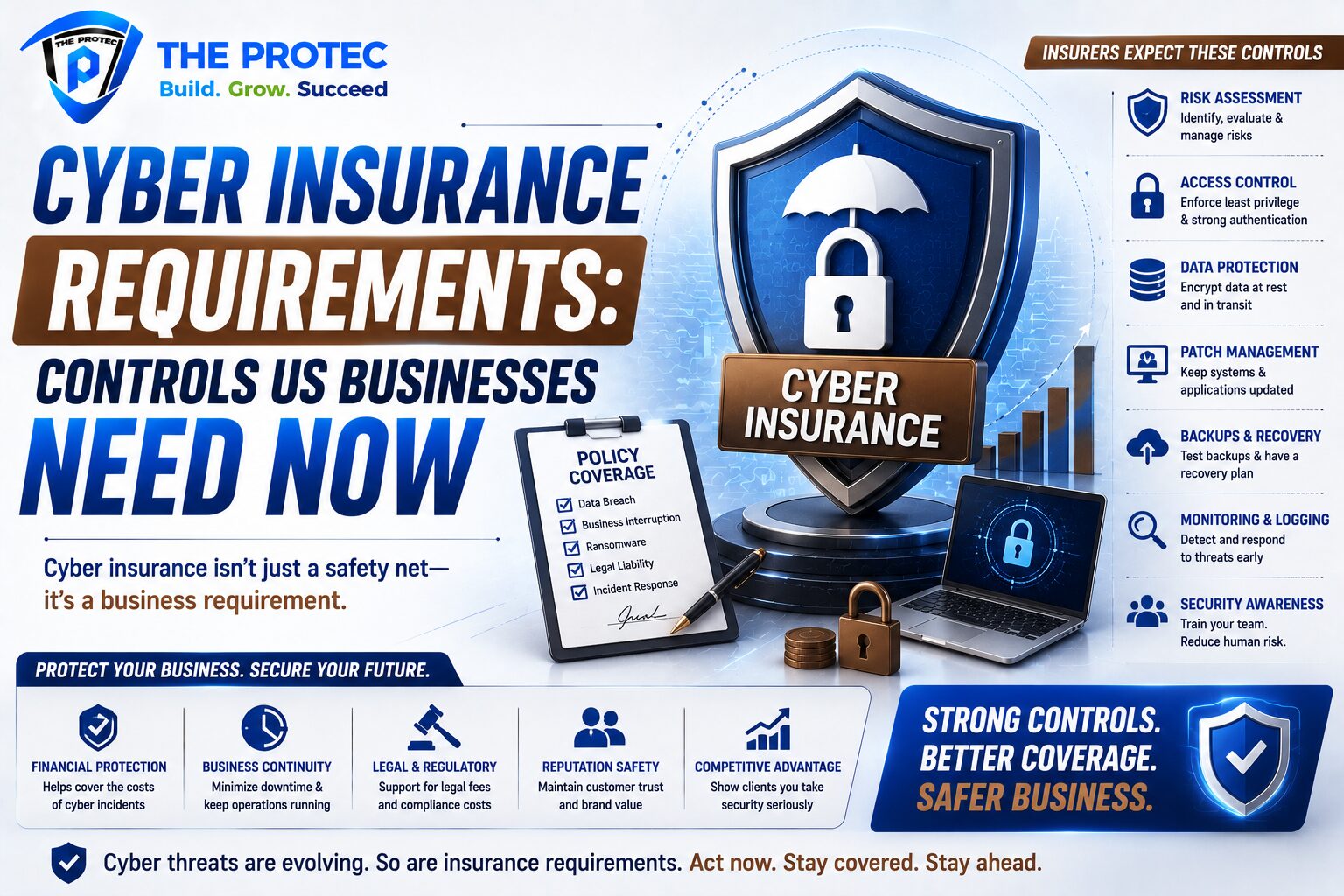
Cyber insurance has become one of the most important financial safeguards for US businesses, but the market has changed dramatically. Insurers are no longer writing policies based only on revenue, industry, or prior claims history. They are scrutinizing business cybersecurity controls in detail and using those findings to decide whether to offer coverage, how much to charge, and what exclusions to apply.
That shift is happening because cyberattacks have become more frequent, more expensive, and more operationally disruptive. Ransomware operators, credential theft campaigns, business email compromise, and supply chain attacks are hitting organizations of every size. At the same time, insurers have learned that basic controls can dramatically reduce losses. The result is a much stricter underwriting environment for cyber insurance USA buyers.
If your organization wants to obtain affordable coverage, avoid frustrating application delays, and reduce the chance of a denied claim, you need to understand the cyber insurance requirements insurers now expect. In practice, that means more than buying a policy. It means proving that your company has implemented the security controls that make a loss less likely and recovery more realistic.
This article breaks down the cybersecurity measures most commonly required by insurers today, why they matter, and how US businesses can build a stronger posture without turning security into a bottleneck.
Why Cyber Insurance Requirements Are Getting Stricter
Insurers are responding to a tougher loss environment. Claims involving ransomware, data theft, legal liability, and business interruption have pushed carriers to rework underwriting models. Instead of assuming that every insured organization has a similar risk profile, carriers now ask whether a business has the controls that meaningfully lower incident probability and impact.
That change reflects a broader reality: insurance is not a substitute for security. A policy can help cover response costs, forensics, legal fees, notification expenses, and some interruption losses, but it cannot prevent attackers from exploiting weak credentials or unpatched systems. Because of that, underwriting now starts with the question: does this business have the fundamentals in place?
For many applicants, the answer determines whether they can get coverage at all. For others, it determines whether the policy includes sublimits, higher deductibles, ransomware exclusions, or additional conditions. In other words, cyber insurance requirements are now a practical extension of business cybersecurity strategy.
The Core Security Controls Insurers Expect
While every carrier and policy form is different, most cyber insurance USA underwriters focus on a set of baseline controls. These controls have emerged because they address the most common attack paths and the most expensive claims.
1. Multi-Factor Authentication Everywhere It Matters
Multi-factor authentication, or MFA, is one of the most common underwriting requirements. Insurers often expect MFA on email, remote access, cloud admin accounts, finance systems, and privileged user accounts. Some carriers also require MFA for all users, especially in organizations with large remote workforces or highly sensitive data.
The reason is simple. Stolen passwords remain one of the most frequent entry points for attackers. MFA makes credential theft much less useful to criminals, especially in phishing and password-spraying attacks. Insurers know that accounts protected by MFA are far less likely to be compromised through simple login abuse.
Businesses should pay attention to the type of MFA they deploy. App-based authenticators and phishing-resistant methods are now preferred over SMS-only authentication. As adversaries adopt more sophisticated phishing kits and session hijacking techniques, insurers increasingly favor stronger authentication methods that reduce the chance of token theft or push fatigue attacks.
2. Endpoint Detection and Response
EDR is another common requirement because it gives businesses visibility into endpoints and helps detect malicious activity early. Insurers want to see that laptops, desktops, and servers are monitored for suspicious behavior such as privilege escalation, malware execution, lateral movement, and unauthorized encryption activity.
EDR matters because many modern attacks do not look like traditional malware outbreaks. Threat actors often use legitimate tools, living-off-the-land tactics, and remote administration utilities to blend in with normal activity. Without endpoint visibility, these behaviors can go unnoticed until systems are encrypted or data is exfiltrated.
From an underwriting perspective, EDR is valuable because it reduces dwell time and improves incident containment. If a company can identify suspicious behavior quickly, it can isolate machines before a small incident becomes a full-scale claim. That is why insurers often ask whether EDR is deployed across all endpoints, whether alerts are monitored, and whether response processes are documented.
3. Offline and Immutable Backups
Backups are one of the most important cyber insurance requirements for ransomware resilience. Insurers typically want to know whether backups are regular, tested, segmented from production systems, and protected from tampering. Increasingly, carriers prefer immutable backups or other mechanisms that prevent adversaries from deleting or encrypting recovery copies.
Backups are not just about data retention. They are about business continuity. A business that can restore critical systems and data quickly is less likely to incur a catastrophic interruption claim. That is especially important as attackers increasingly target backups first, attempting to eliminate the victim’s ability to recover without paying ransom.
Best practice now includes multiple copies, one of which is offline or isolated, with clearly defined restoration objectives. Insurers may also ask how often backups are tested. A backup that exists but cannot be restored is a liability, not a safeguard. Regular restore testing is a strong signal that the business can recover under pressure.
4. Employee Security Awareness Training
Human error remains one of the biggest drivers of cyber incidents, which is why employee training has become a standard expectation. Insurers want to see ongoing security awareness training, phishing education, and clear procedures for reporting suspicious messages or activity.
This is not a checkbox exercise. As email compromise, invoice fraud, and social engineering campaigns become more convincing, employees are often the first line of defense. Training helps reduce the likelihood that a worker will click a malicious link, approve a fraudulent login prompt, or share sensitive information with an attacker posing as a vendor or executive.
Many insurers now expect training to be recurring rather than one-time. They may also want evidence of simulated phishing exercises, role-based training for finance and HR teams, and incident reporting processes that encourage fast escalation. Businesses that can show a mature awareness program often look more insurable because they reduce the probability of a preventable mistake.
5. Patch Management and Vulnerability Remediation
Unpatched systems remain a major source of compromise. Carriers increasingly ask how quickly critical vulnerabilities are remediated, whether patching is centralized, and whether internet-facing systems are reviewed on a regular schedule.
For insurers, patch discipline demonstrates operational maturity. If a business can prove that it prioritizes high-risk vulnerabilities, especially those affecting remote access, email, VPNs, and exposed applications, it is less likely to become an easy target. Many claims begin with a known vulnerability that was left open too long.
Security teams should be prepared to explain patch timelines, exception handling, and how they deal with legacy systems that cannot be updated quickly. The more structured the process, the more confidence an insurer will have in the organization’s cyber hygiene.
6. Privileged Access Controls
Insurers are also focused on how businesses manage administrative access. Privileged accounts can do more damage than ordinary user accounts, so carriers often expect strict controls around least privilege, credential vaulting, session monitoring, and separation of duties.
In practical terms, that means limiting the number of admins, using unique accounts for administrative tasks, and preventing everyday browsing or email on privileged credentials. Many policies now assume that if an attacker compromises an administrator account, the business could face a severe incident. Strong privileged access management reduces that risk.
Some carriers also ask about just-in-time access, password rotation, and whether admin actions are logged. Those details can influence both underwriting and claims handling, especially in environments where critical systems are managed by a small internal team or third-party provider.
7. Email Security and Domain Protection
Email remains one of the most abused channels in cybercrime, so insurers look closely at email security controls. They may ask whether the organization uses advanced filtering, anti-phishing tools, domain-based authentication, and protections against spoofing.
Strong domain controls can significantly reduce the risk of business email compromise. Implementing SPF, DKIM, and DMARC helps prevent attackers from impersonating a company’s domain in outbound fraud campaigns. For many businesses, especially those handling invoices, payroll, or sensitive customer communications, these measures are no longer optional.
Insurers may also want to know how the business handles lookalike domains, executive impersonation, and external message warnings. Since so many claims start with a deceptive email, strong email security can directly improve insurability.
How Insurers Evaluate Business Cybersecurity Maturity
Meeting the minimum requirements is only part of the picture. Underwriters also look at how well controls are implemented, documented, and monitored. A business may technically have MFA or EDR, but if those tools are not enforced consistently, the insurer may still view the organization as high risk.
That is why many applications ask detailed questions about coverage scope, monitoring, incident response, testing, and governance. Carriers want to see whether controls are centralized across the environment, whether exceptions are rare, and whether leadership supports the security program.
Businesses with stronger maturity often benefit in several ways:
- Better odds of qualifying for coverage
- Lower premiums or deductibles
- Fewer exclusions and sublimits
- More favorable terms during renewal
- Faster underwriting decisions
In short, cyber insurance requirements are not just about passing a questionnaire. They are a proxy for how seriously the company manages operational risk.
What US Businesses Should Do Before Applying
If you are shopping for cyber insurance USA coverage or preparing for renewal, the best approach is to close the most common gaps before the application process begins. That can make the difference between a smooth approval and a stressful back-and-forth with underwriting.
Build a control inventory
Document where MFA is enabled, how EDR is deployed, how backups are stored, and who has privileged access. Underwriters often ask for specifics, so it helps to have a clear inventory rather than scattered answers from different teams.
Test your recovery process
Run restore tests for critical systems and document the results. If your backups are not usable under pressure, you may struggle to satisfy insurer expectations after an incident.
Train employees and track participation
Keep records of training completion, phishing results, and remediation steps. Demonstrating a repeatable awareness program helps show that security is embedded in daily operations.
Review third-party risk
Many incidents begin with vendors, MSPs, or cloud service misconfigurations. Make sure you understand how your providers protect access, how they notify you of incidents, and whether they maintain appropriate controls of their own.
Close obvious gaps before renewal
Common issues include missing MFA on admin accounts, backup systems connected to production networks, weak password policies, and unmonitored endpoints. These are exactly the kinds of weaknesses that raise premiums or trigger declinations.
Emerging Trends Affecting Cyber Insurance Requirements
The cyber insurance market continues to evolve as attack methods change. Several trends are shaping underwriting expectations right now and will likely matter even more as coverage terms tighten.
One trend is stronger scrutiny of identity security. As attackers rely more on stolen credentials, session theft, and authentication bypass techniques, insurers are paying closer attention to identity governance, phishing-resistant MFA, and privileged access controls.
Another trend is increased concern around cloud environments and SaaS platforms. Businesses often assume cloud providers handle all security needs, but insurers want to know how the customer manages access, configurations, and data protection inside those environments.
Insurers are also more interested in operational resilience. They want evidence that businesses can continue core functions during an outage, not just recover data afterward. That makes incident response planning, segmentation, and tested backups even more important.
Finally, underwriters are using more detailed questionnaires and sometimes supplemental scans or external signal checks. Public exposure, misconfigured services, and poor security hygiene can influence pricing and terms even before a human reviewer sees the file. Businesses should assume their security posture is being evaluated from multiple angles.
How Strong Security Helps With Coverage and Claims
The most immediate benefit of meeting cyber insurance requirements is eligibility, but the long-term benefit is resilience. A business that has MFA, EDR, backups, training, patch management, and access controls is not only easier to insure, it is also harder to disrupt.
That matters when a real incident happens. Faster detection can reduce the spread of malware. Better backups can shorten downtime. Better training can stop a phishing attack before it becomes a breach. And clearer documentation can streamline the claims process if an event does occur.
In that sense, cyber insurance and business cybersecurity should work together. Insurance transfers part of the financial risk, while security controls reduce the likelihood and severity of the loss. Businesses that treat them as complementary tools usually get the strongest outcome.
Conclusion: Prepare Now, Not at Renewal Time
Cyber insurance requirements are no longer an afterthought. For US businesses, they have become a practical blueprint for the controls insurers expect to see before they are willing to offer meaningful coverage. MFA, EDR, backups, employee training, patch management, privileged access controls, and email protection are now central to the underwriting conversation.
If your organization wants better access to cyber insurance USA markets, the smartest move is to tighten your controls before you apply or renew. That not only improves your odds with insurers, it also strengthens your overall security posture against the threats most likely to affect your operations.
The businesses that succeed in this environment are the ones that treat cyber insurance as part of a broader risk strategy, not a last-minute purchase. The controls you build today can influence cost, coverage, and recoverability tomorrow.
FAQ
What are the most common cyber insurance requirements?
The most common requirements include multi-factor authentication, endpoint detection and response, tested backups, employee security awareness training, patch management, and strong privileged access controls. Many insurers also expect email security protections and documented incident response procedures.
Does every insurer require MFA?
Most do, especially for email, remote access, and administrator accounts. Many carriers now require MFA across all users or at least for any account that can access sensitive data or critical systems. Phishing-resistant MFA is increasingly preferred.
Why do backups matter so much to cyber insurers?
Backups help a business recover from ransomware, data loss, or destructive attacks without paying criminals or suffering prolonged downtime. Insurers want to see that backups are isolated, immutable when possible, and regularly tested for restoration.
Can weak cybersecurity controls affect a claim?
Yes. If a policyholder misrepresented its controls during underwriting or failed to maintain required safeguards, the insurer may limit coverage or dispute the claim. Keeping security controls accurate, documented, and up to date is essential.
How can a business improve its chances of getting cyber insurance?
Start by closing the biggest gaps: enforce MFA, deploy EDR, test backups, train employees, patch critical vulnerabilities quickly, and restrict privileged access. Having clear documentation and a repeatable security process also helps during underwriting.
External references: CISA Cybersecurity Resources and NIST Cybersecurity Framework