









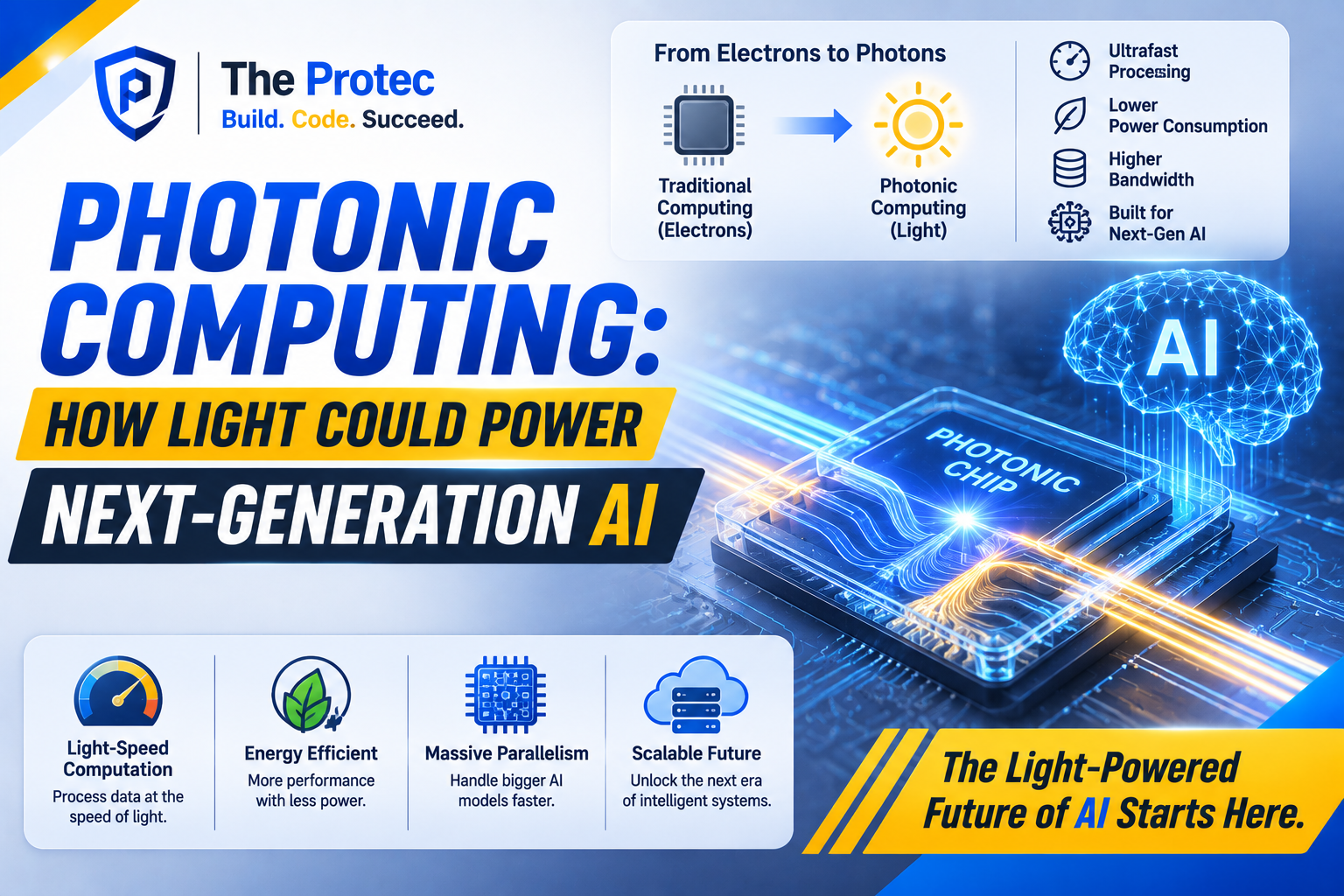
Artificial intelligence is running into a physical problem. Larger models demand more matrix calculations, memory capacity, and communication between accelerators, yet moving electrical signals through a computer consumes increasing amounts of energy. Even when transistors become more efficient, the wires connecting processors, memory, and data center racks remain costly bottlenecks.
Photonic computing offers a radically different approach: use particles of light, called photons, to transport data and perform selected calculations. Because light can carry enormous amounts of information with low latency and comparatively little energy over distance, it could reshape the architecture of AI computers. The most likely outcome is not an entirely optical computer, however. It is a hybrid machine in which photonic AI chips handle communication and computation-intensive operations while electronics retain control, memory, and logic.
What Is Photonic Computing?
Photonic computing, also known as optical computing, represents information with properties of light rather than electrical charge alone. Data can be encoded in a photon’s intensity, phase, polarization, or wavelength. Optical components then route or transform those signals to produce a computational result.
Conventional processors use transistors to switch electrical currents. Photonic systems instead rely on components such as lasers, waveguides, modulators, resonators, beam splitters, and photodetectors. Waveguides act like microscopic channels that direct light across a chip. Modulators place data onto optical carriers, while photodetectors convert the resulting light back into electrical signals when necessary.
One important distinction is that photonics can serve two related purposes:
Optical data movement: Light transports information between chips, memory systems, servers, or data center switches.
Optical computation: A photonic circuit manipulates light to execute mathematical operations, often the linear algebra used in neural networks.
The first application is closer to widespread deployment. The second is more ambitious, but rapid progress in integrated photonics, packaging, and software is bringing specialized optical processors closer to commercial AI infrastructure.
How Photons Can Perform Computation
Neural networks spend much of their time multiplying matrices and vectors. These operations determine how activations move through layers and how model parameters influence an output. Photonic circuits are naturally suited to this type of linear algebra because optical waves can interfere, split, and combine according to predictable physical rules.
A common design uses a network of Mach–Zehnder interferometers. Each interferometer divides a beam into two paths, changes the phase of one or both signals, and recombines them. Depending on their relative phases, the waves reinforce or cancel one another. By programming many interferometers, a chip can represent a matrix and transform an incoming optical vector as light passes through the circuit.
Other architectures use microring resonators, diffraction, or arrays of optical elements. Wavelength-division multiplexing adds another advantage: multiple colors of light can travel through the same waveguide simultaneously. Each wavelength can represent a separate data stream or computational channel, allowing substantial parallelism without requiring a separate physical wire for every signal.
In principle, the matrix operation occurs at the speed at which light travels through the device. It does not require the long sequence of transistor switching events found in a digital multiply-accumulate unit. The practical system still needs electronic circuits to load data, tune optical components, apply nonlinear activation functions, store results, and coordinate execution. Consequently, most photonic AI chips are accelerators rather than standalone computers.
Why Optical Data Movement May Arrive First
AI performance is no longer determined by arithmetic alone. Accelerators must constantly exchange model weights, activations, gradients, and cache data. Electrical connections become harder to scale as signaling rates rise: they lose signal quality, generate heat, and require energy-hungry circuitry to push bits across longer distances.
Optical links are attractive because a single fiber or waveguide can carry many high-speed channels on different wavelengths. Their energy cost also scales more favorably with distance. This makes silicon photonics useful for connecting accelerator packages, switches, servers, and potentially memory.
The industry is therefore moving optics closer to compute. Traditional pluggable optical transceivers sit at the edge of a network switch. Co-packaged optics places optical engines beside the switching silicon, reducing the length of high-speed electrical traces. Optical I/O chiplets could eventually sit inside AI accelerator packages, delivering much more aggregate bandwidth than package pins and copper traces can provide economically.
Why Photonic Computing Is Attractive for AI
Modern AI creates conditions that play to the strengths of photonics. Models contain huge, regular mathematical workloads, and their performance depends heavily on moving data in parallel. Several potential benefits stand out:
High parallelism: Multiple wavelengths and spatial paths can process many values concurrently.
Low-latency linear algebra: Light propagates through a configured circuit without executing every multiplication as a separate digital instruction.
Greater communication bandwidth: Optical links can connect large clusters of accelerators without relying exclusively on increasingly difficult electrical signaling.
Lower energy for selected operations: Passive optical interference can perform transformations with little incremental switching energy, although lasers and conversion circuits still consume power.
Reduced data movement pressure: Photonic interconnects can help feed accelerators and keep distributed AI workloads synchronized.
These characteristics could benefit transformer inference, recommendation systems, scientific machine learning, computer vision, and other workloads dominated by matrix operations. Photonic accelerators may also be useful where extremely low latency matters, such as communications, robotics, and real-time signal processing.
Silicon Photonics and the Latest Industry Direction
Silicon photonics integrates optical components using semiconductor manufacturing methods related to those used for electronic chips. It does not mean every optical function is made from silicon. Lasers may use indium phosphide or other materials, while modulators and detectors can rely on specialized material layers. The value lies in combining these components through scalable fabrication and advanced packaging.
As of August 2026, the clearest trend is heterogeneous integration. Developers are combining electronic compute dies, optical I/O chiplets, laser sources, and high-bandwidth memory within tightly connected packages. This approach avoids waiting for a single material platform to perform every task well. Foundry design kits and chiplet interfaces are also making photonic devices more accessible to system designers.
AI networking is becoming a major commercial entry point. Co-packaged optics and silicon photonics are being developed for switches that must connect thousands of accelerators at very high data rates. At the same time, photonic computing companies are advancing optical matrix engines for inference and, in selected cases, training. Many of these products remain hybrid systems or limited deployments rather than replacements for mainstream GPUs.
Research is also expanding beyond analog optical matrix multiplication. Teams are exploring programmable photonic circuits, optical memory concepts, frequency-comb sources, photonic tensor processors, and methods for improving precision. Readers can follow peer-reviewed developments through Nature’s optical computing research collection, while the National Institute of Standards and Technology provides broader context on photonics measurement and technology.
The Hard Problems Photonic AI Chips Must Solve
The energy and speed claims surrounding optical computing require careful interpretation. A photonic core may execute a matrix transformation efficiently, but a complete system must generate light, encode inputs, read outputs, correct errors, and store data. These surrounding operations can dominate total power consumption.
Electrical-to-Optical Conversion
Digital AI data usually begins in electronic memory. Digital-to-analog converters, modulators, photodetectors, and analog-to-digital converters bridge the electronic and optical domains. High-speed converters can consume substantial power and chip area. A design that repeatedly converts data may lose much of the efficiency gained inside its optical core.
Precision, Noise, and Drift
Optical calculations are often analog. Manufacturing variation, detector noise, laser fluctuations, and temperature changes can affect accuracy. Thermal tuning can correct a circuit, but it also consumes energy. AI inference may tolerate reduced precision, especially with quantized models, while training generally demands tighter numerical control and a larger dynamic range.
Memory and Nonlinear Operations
Light is excellent for moving and transforming data, but practical optical memory remains difficult. Neural networks also require nonlinear activation functions, normalization, data-dependent routing, and control logic. Electronics perform these tasks efficiently, which is another reason hybrid architectures are more realistic than all-optical computers.
Programming and Utilization
An accelerator is valuable only when software can keep it busy. Photonic hardware needs compilers, runtime systems, numerical tools, and integration with established AI frameworks. It must also handle changing model shapes without wasting capacity. A specialized optical matrix engine can look impressive in a laboratory benchmark but deliver less benefit when real workloads include unsupported operations and idle time.
Manufacturing and Packaging
Aligning lasers, fibers, chiplets, and waveguides with low loss is demanding. Packaging costs can outweigh the photonic die itself, and testing optical devices requires different infrastructure from conventional semiconductor testing. Commercial success will depend as much on yield, reliability, and supply chains as on raw computational performance.
Could Optical Processors Break the Power and Bandwidth Wall?
Photonics is likely to relieve these constraints rather than eliminate them. Optical links offer a credible path to higher bandwidth between processors and across data centers. Moving optics into packages can reduce the energy spent driving electrical signals, allowing AI systems to scale without communication power rising as quickly.
For computation, the outcome will be workload-dependent. Photonic AI chips may outperform digital accelerators on large, dense, well-utilized matrix operations, particularly when data can remain in the optical pipeline. Their advantage shrinks when conversions are frequent, models are sparse or irregular, or high precision is essential.
The strongest architecture is therefore a division of labor: electronics provide flexible logic, digital accuracy, memory, and control; photonics supplies high-bandwidth communication and efficient linear transformations. Rather than replacing GPUs overnight, optical computing is poised to become another layer in increasingly heterogeneous AI systems.
Frequently Asked Questions
Is photonic computing the same as quantum computing?
No. Photonic computing generally uses classical light to transport data or perform operations such as matrix multiplication. Quantum photonic computers manipulate quantum states of light to run quantum algorithms. They can share optical components, but their goals and operating principles are different.
Will photonic AI chips replace GPUs?
Not in the near term. GPUs are programmable, supported by mature software, and effective across many workloads. Photonic accelerators are more likely to complement GPUs by handling optical I/O or specialized linear algebra while electronic processors manage memory, control flow, and unsupported operations.
Does optical computing use no electricity?
No. Lasers, modulators, detectors, converters, tuning circuits, memory, and control processors all require electrical power. The benefit is that selected optical operations and long-distance data transfers may use less energy than their electronic equivalents when the overall system is designed carefully.
What is the role of silicon photonics in AI?
Silicon photonics enables compact optical links and processing components to be manufactured and packaged alongside advanced electronics. Its most immediate AI role is improving communication among accelerators, switches, and memory systems. It also provides a practical platform for building programmable photonic computing engines.
When will photonic computing become mainstream?
Optical networking is already fundamental to data centers, and silicon photonics is moving progressively closer to processors. Broader adoption of optical compute will depend on system-level energy savings, manufacturing cost, reliability, and software support. Deployment is likely to occur gradually through hybrid accelerators rather than through a sudden shift to all-optical machines.