








An AI agent can write an email, analyze a document, or call a software tool without remembering anything beyond the current request. The difference between that one-shot assistant and an agent that can manage an ongoing project is memory.
AI agent memory allows a system to retain useful context across steps, conversations, and sessions. It can remember what the user asked five minutes ago, retrieve a preference saved last month, or preserve the outcome of a task so another agent can continue the work. Memory makes agents more coherent and personalized, but it also creates difficult questions about relevance, privacy, accuracy, and control.
Modern AI memory systems rarely rely on one database or an endlessly expanding prompt. They combine conversation state, compact summaries, structured records, semantic retrieval, and policies that decide what should be stored or forgotten. Understanding those layers is essential for building agents that are helpful without becoming unpredictable.
What Is AI Agent Memory?
AI agent memory is the collection of mechanisms an agent uses to preserve and recover information that may influence future reasoning or actions. It is not the same as knowledge encoded in a model’s training parameters. Training gives a model broad capabilities, while memory supplies task-specific context at runtime.
Memory also differs from the model’s context window. A context window is the temporary workspace containing the instructions, messages, tool results, and documents available during a model call. An agent memory system determines which information enters that workspace, which information leaves it, and what remains available later.
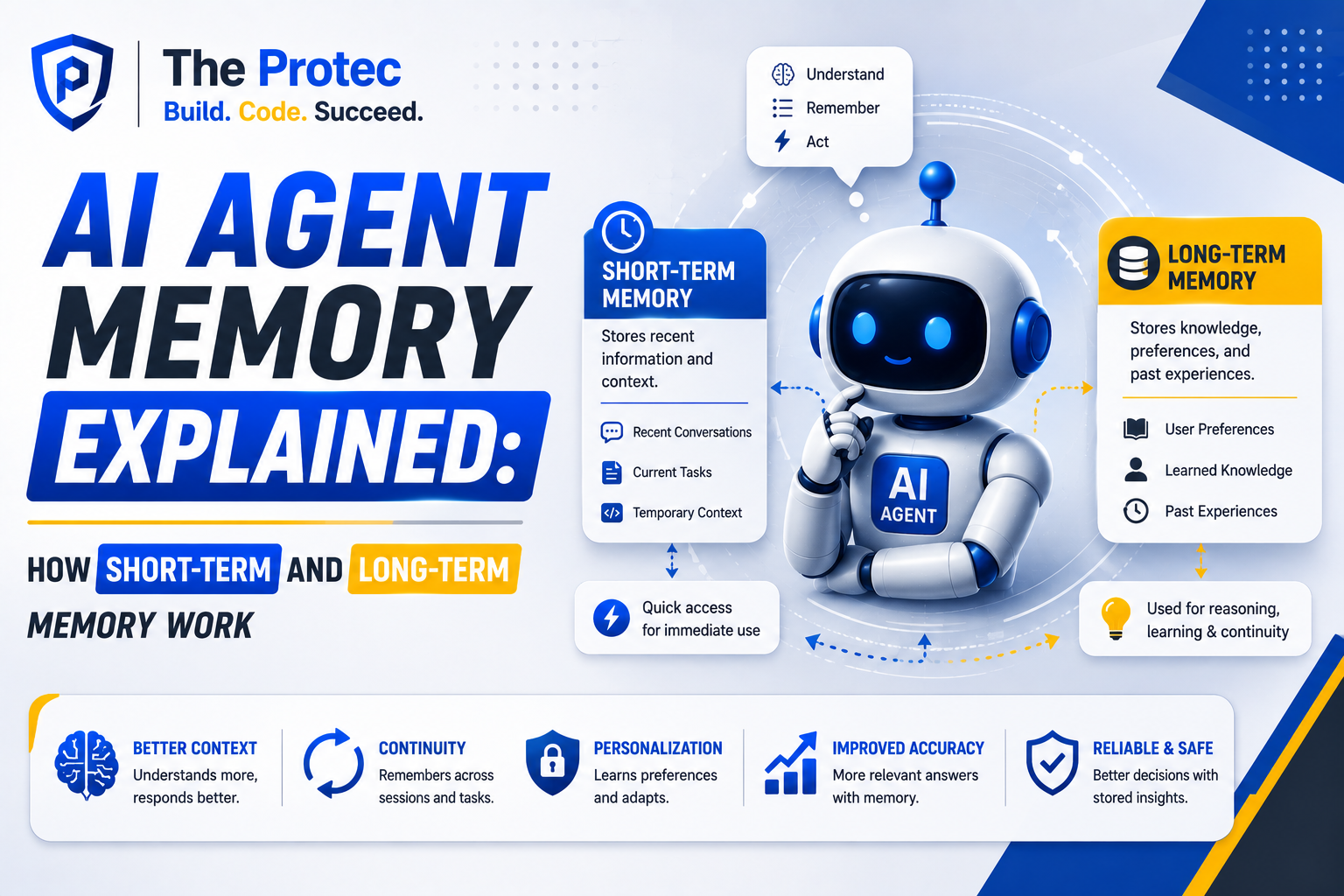
Most production designs divide agent memory into two broad categories: short-term memory for an active task and long-term memory that persists across sessions.
Short-Term Memory: Maintaining Conversation and Task State
Short-term memory tracks what is happening now. It may include recent messages, the current objective, completed steps, pending tool calls, intermediate calculations, and temporary files. This layer gives an agent continuity while it works through a multi-step process.
The simplest approach is conversation state: sending the relevant message history with every model request. Some model platforms manage this state through conversation objects, while agent frameworks may represent it as a checkpointed state graph. Developers can review OpenAI’s conversation state guidance for an example of how state can be preserved between responses.
Raw history works for short exchanges, but it becomes inefficient as conversations grow. Older messages consume tokens, increase latency, and can distract the model from current instructions. Effective short-term memory therefore uses a selection strategy. The agent might retain the latest messages verbatim, preserve critical system rules, and replace older dialogue with a summary.
Task state is often more reliable when stored in structured fields rather than prose. A customer-support agent, for example, might maintain fields for account status, reported problem, attempted fixes, and escalation state. Structured state reduces ambiguity and makes it easier to validate information before an action occurs.
Long-Term Memory: What Agents Retain Across Sessions
Long-term agent memory stores information that may remain useful after the current conversation ends. Depending on the application, this can include user preferences, past decisions, project facts, successful procedures, or records of previous events.
Several memory types commonly appear in long-term designs:
- Semantic memory: Stable facts and concepts, such as a user’s preferred reporting format or an organization’s product terminology.
- Episodic memory: Records of events and experiences, such as a meeting outcome, a resolved support case, or the steps taken during a previous task.
- Procedural memory: Instructions about how to perform work, including approved workflows, tool-use patterns, and reusable plans.
- Profile memory: A curated representation of preferences, permissions, roles, and other user-specific attributes.
These categories should not automatically share the same storage model. Stable profile fields fit a relational or document database, while unstructured event descriptions may be better suited to semantic search. Procedures often need versioning and explicit approval because an incorrect workflow can affect every future task.
Long-term memory should also be selective. Saving every interaction creates noise and raises privacy risks. A robust system evaluates whether information is durable, relevant, trustworthy, and permitted before committing it to persistent storage.
Retrieval: Bringing the Right Memory Back at the Right Time
Stored information has little value unless the agent can recover it when needed. Retrieval is the bridge between persistent memory and the model’s limited working context.
Semantic retrieval converts text into embeddings and finds memories with similar meaning. It is useful when the agent cannot predict the exact wording of a future query. Keyword search remains valuable for names, codes, dates, and exact phrases. Structured filters can narrow results by user, project, permission, source, or recency. Many effective AI memory systems use all three.
A typical retrieval pipeline first identifies the agent’s current intent. It then searches only authorized memory scopes, applies metadata filters, ranks candidates, and places a small number of high-value results into the context. More advanced systems rerank results using relevance, importance, freshness, and confidence rather than relying only on vector similarity.
Hybrid retrieval is increasingly common because similarity alone can return plausible but irrelevant material. A memory about an old project may resemble the current request while no longer being valid. Time decay, version status, source quality, and explicit user corrections help the system choose better evidence.
Some architectures also connect memories through knowledge graphs. Graph relationships can represent people, projects, documents, and decisions more precisely than isolated text chunks. This is particularly useful when an agent must follow dependencies or explain how two facts are related.
Why Summaries Are a Core Memory Mechanism
Summaries compress lengthy activity into a smaller representation. They help an agent preserve the important parts of a conversation without repeatedly loading the complete transcript.
A rolling summary can capture the user’s goal, decisions already made, unresolved questions, and constraints that must remain active. Hierarchical summaries go further by producing summaries of individual exchanges, sessions, and entire projects. This creates multiple levels of detail that can be retrieved according to the task.
Compression carries a cost: details can disappear or become distorted. High-stakes systems should retain links to source messages and treat summaries as derived records rather than unquestionable truth. Critical values, approvals, and obligations are safer in structured fields with provenance.
How an Agent Memory Lifecycle Works
Memory management is a continuous lifecycle rather than a single save-and-search feature. A mature implementation usually performs several operations:
- Capture: Detect potentially useful facts, events, preferences, and outcomes.
- Validate: Check source reliability, permissions, and whether the information contradicts an existing record.
- Transform: Summarize content, extract structured fields, generate embeddings, and attach metadata.
- Store: Place each memory in the appropriate conversation, document, vector, graph, or relational store.
- Retrieve: Select relevant memories based on intent, scope, freshness, and importance.
- Update: Merge duplicates, supersede outdated facts, and preserve an audit trail where required.
- Forget: Delete expired, low-value, or user-requested data according to retention policies.
This lifecycle separates memory creation from memory use. An agent should not write every model-generated assumption directly into a durable profile. Memory candidates may need confirmation from the user, verification against an authoritative system, or approval from a deterministic policy.
The Hardest AI Memory System Challenges
Relevance and Context Overload
Retrieving too little information leaves the agent uninformed; retrieving too much can reduce accuracy. Extra context competes for attention and may include conflicting instructions. Teams need evaluation sets that measure whether the correct memory was retrieved and whether it actually improved the final response.
Stale, Conflicting, and False Memories
Preferences change, projects end, and model-generated summaries can contain errors. Memory records need timestamps, sources, confidence levels, and update rules. When two records conflict, authoritative sources and recent user corrections should take priority rather than allowing the model to improvise.
Privacy, Consent, and Data Isolation
Persistent memory can contain personal or commercially sensitive information. Systems need clear consent, purpose limitations, tenant isolation, access controls, retention periods, encryption, and deletion workflows. Users should be able to inspect and correct important profile memories instead of being silently defined by them.
Security and Memory Poisoning
Malicious content can attempt to plant instructions that activate later. If an agent stores those instructions as trusted memory, the attack can persist across sessions. Retrieved content should be treated as data, not automatically as authority. Source allowlists, trust labels, sanitization, and action-level authorization help reduce this risk. The OWASP guidance on prompt injection provides additional defensive considerations.
Cost and Latency
Embedding every event, running multiple searches, reranking results, and loading long histories can make an agent slow and expensive. Tiered memory helps: recent state stays readily available, durable facts enter persistent stores, and low-value records move to cheaper archives or expire.
Current Trends Shaping Agent Memory
As of August 2026, agent development increasingly treats memory as part of context engineering: the deliberate construction of the model’s runtime information environment. The focus has shifted from simply expanding context windows to selecting smaller, better-governed sets of evidence.
Hybrid memory is becoming the practical default. Structured profiles, vector retrieval, knowledge graphs, event logs, and summaries each solve different problems. Multimodal agents are also creating memories from images, audio, interface activity, and documents, which makes provenance and access control even more important.
Another major direction is memory observability. Teams want to see what was stored, why it was retrieved, how it affected an action, and whether it should be deleted. Memory evaluations now examine retrieval precision, stale-memory rates, personalization quality, security boundaries, and the agent’s ability to honor corrections.
Best Practices for Building Reliable Agent Memory
- Define the purpose and retention period of every memory category.
- Keep active task state separate from durable user or organizational records.
- Use structured storage for critical facts and semantic retrieval for unstructured experiences.
- Attach provenance, timestamps, ownership, and confidence metadata.
- Require confirmation before saving sensitive preferences or consequential conclusions.
- Retrieve the minimum context needed for the current decision.
- Test memory with conflicts, corrections, deleted records, and adversarial content.
- Give users practical controls to view, edit, export, and remove stored information.
Frequently Asked Questions About AI Agent Memory
Is AI agent memory the same as a large context window?
No. A context window is the information available during a particular model call. Agent memory is the broader system that decides what information to retain, summarize, retrieve, update, or delete. A larger context window may support more working material, but it does not replace persistent storage or relevance filtering.
What is the difference between short-term and long-term agent memory?
Short-term memory maintains the state of an active conversation or task, including recent messages and intermediate results. Long-term memory persists across sessions and may store preferences, facts, events, and reusable procedures. The two layers often work together: long-term records are retrieved into short-term context when relevant.
Do all AI agents need persistent memory?
No. A stateless agent may be safer and simpler for one-time tasks such as formatting text or answering an isolated question. Persistent memory is most useful when continuity, personalization, historical reasoning, or ongoing project work creates measurable value.
Can an AI agent learn from memory without retraining?
Yes. Retrieval can place saved information into the model’s context at runtime, allowing behavior to adapt without changing model weights. This is faster and easier to reverse than retraining, although it depends on accurate storage and retrieval.
How should an agent decide what to forget?
Forgetting policies can consider age, usefulness, sensitivity, duplication, legal requirements, and user requests. Temporary task details may expire quickly, while verified project decisions may remain longer. Deletion should also cover derived summaries, embeddings, and cached copies where applicable.
Smarter Agents Need Disciplined Memory
AI agent memory is not merely a feature that makes conversations feel continuous. It is an architecture for controlling what an agent knows at a given moment. Conversation state supports immediate work, persistent stores preserve durable information, retrieval restores relevant evidence, and summaries keep context manageable.
The smartest design is not the one that remembers everything. It is the one that preserves the right information, retrieves it at the right time, and makes every stored memory secure, traceable, correctable, and possible to forget.