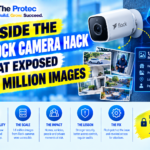





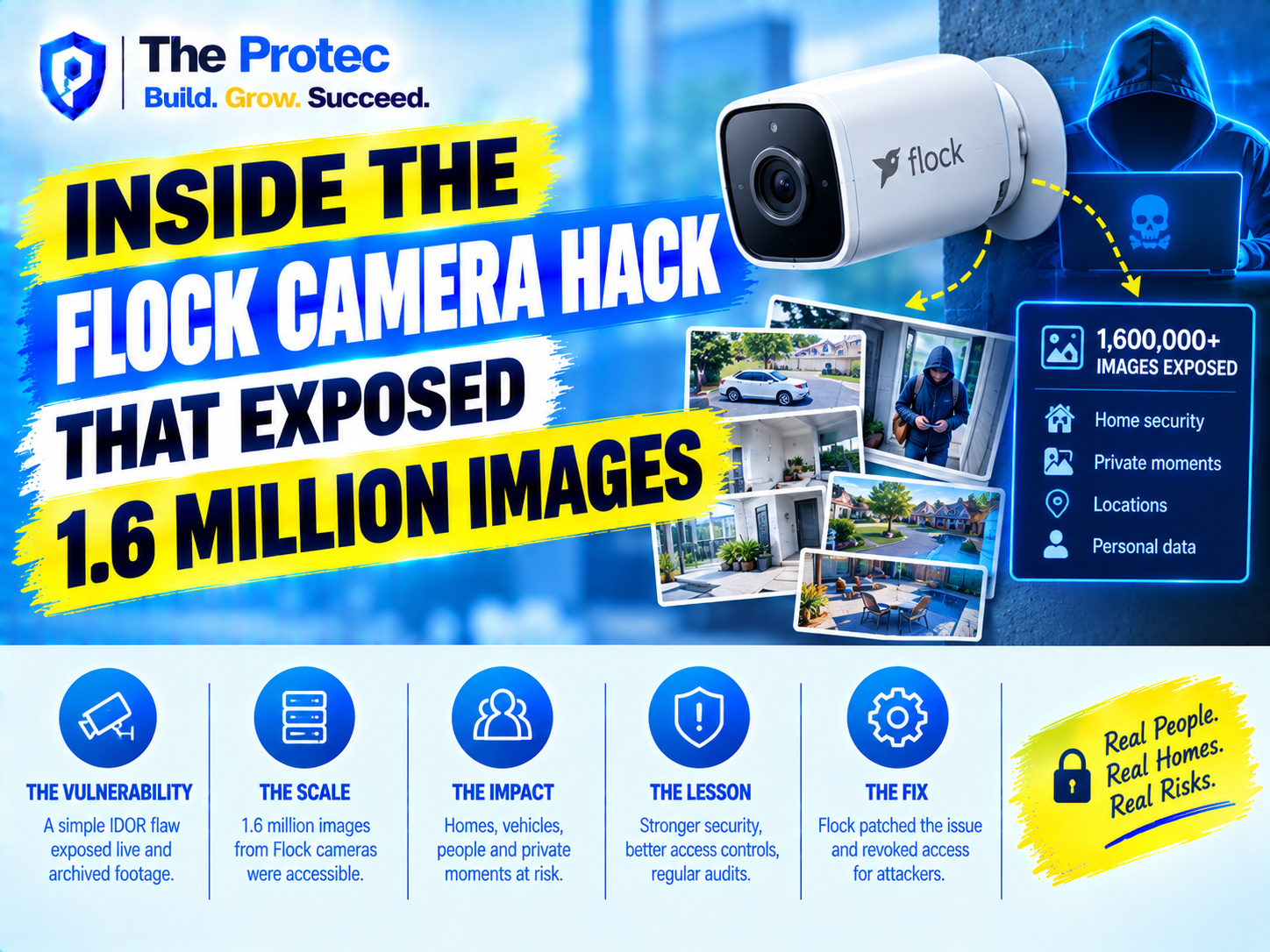
A camera mounted beside a road may look like a self-contained device that photographs passing license plates. The reported Flock camera hack tells a more complicated story. After gaining access to a Flock Safety camera, attackers reportedly reached a collection of roughly 1.6 million images—an incident that offers a rare view into the infrastructure behind one of the fastest-growing vehicle surveillance networks.
The significance extends beyond the number of files. Flock Safety cameras are automated license plate reader systems, commonly called ALPRs. They do not merely capture photographs. They turn road traffic into searchable records by combining images with timestamps, locations, plate text, and descriptions of vehicles. Those records can then be searched, compared with watchlists, and shared among authorized organizations.
The available reporting raises urgent questions about device security, credential management, data isolation, and the consequences of compromising a single point in a large camera network. At the same time, several technical and investigative details remain unsettled. The existence of approximately 1.6 million accessible images does not automatically prove that every file was downloaded, publicly released, or tied to 1.6 million different drivers.
Here is what the reported Flock Safety hack appears to reveal, how the technology normally works, and why the incident matters for both cybersecurity and privacy.
What Happened in the Reported Flock Camera Breach?
According to reports about the incident, hackers obtained access to a Flock camera and were able to examine a much larger image collection associated with the system. Roughly 1.6 million images were reportedly exposed or accessible through that access.
That distinction—accessible rather than necessarily stolen—is important. In cybersecurity reporting, an exposed record is not always an exfiltrated record. Attackers may demonstrate that they can enumerate, retrieve, or view files without copying the entire collection. A complete forensic investigation would need logs, network telemetry, authentication records, and storage data to determine precisely how many images left the environment.
The incident nevertheless suggests that access to the camera was not limited to viewing its live feed or changing a local setting. The reported image corpus points to connections between the physical device, application services, cloud storage, and administrative systems. If camera-level credentials or interfaces can provide broader access, a compromised roadside device can become a doorway into infrastructure containing data from many locations or collection periods.
Important questions remain unanswered publicly, including the initial entry point, the privileges attached to the compromised credentials, the number of cameras or customer environments involved, and whether the weakness has been fully remediated. Those details are essential for measuring the actual blast radius of the Flock camera breach.
What Attackers Were Reportedly Able to Access
The central claim is that attackers reached approximately 1.6 million Flock camera images. Depending on system configuration, an ALPR image may contain far more than a close-up of a plate. A typical capture can include the vehicle, nearby lanes, the road environment, passengers visible through windows, pedestrians, homes, businesses, and other vehicles.
The image may also be connected to structured metadata such as:
- The recognized license plate number and issuing jurisdiction
- The date and exact time of the observation
- The camera’s fixed or approximate location
- Vehicle color, type, make, model, or other visual characteristics
- Direction of travel and lane information
- A customer, agency, camera, or account identifier
- Search, alert, or watchlist information associated with the record
Not every accessible file necessarily contained all of these fields, and the reported total should not be interpreted as 1.6 million unique plates. One car may be photographed repeatedly, a single event may produce multiple image versions, and some files may be thumbnails, cropped plates, or related system assets.
Even with those limitations, the volume matters. A large collection of time-stamped vehicle images can be used to reconstruct patterns: where a vehicle regularly appears, when a person likely leaves home, which medical office they visit, where they worship, or whether two vehicles frequently appear together. The privacy risk comes from aggregation, not simply from any individual roadside photograph.
How Flock Safety Cameras Actually Work
Flock license plate cameras belong to a category of connected edge devices designed to perform continuous, automated observation. Although specific models and deployments differ, the basic data flow has several stages.
1. The Camera Captures Passing Vehicles
A Flock camera is generally positioned to observe traffic entering a neighborhood, crossing an intersection, using a parking area, or traveling along a public road. Many units use cellular connectivity and solar power, allowing deployment without the wired infrastructure required by traditional surveillance systems.
The camera captures images when vehicles pass through its field of view. This collection can occur regardless of whether the vehicle is connected to a crime or active investigation.
2. Software Extracts Vehicle Information
Computer-vision software analyzes the captured material. Optical character recognition attempts to convert the visible plate into searchable text. Additional processing may describe the vehicle’s color, body type, make, model, distinguishing features, or damage.
This is what separates an automatic license plate reader from an ordinary security camera. Instead of requiring a person to watch hours of video, the platform creates an index of vehicle observations that can be searched within seconds.
3. Images and Metadata Are Sent to Backend Services
The camera communicates with remote infrastructure, typically over a cellular or other internet connection. Images, plate reads, timestamps, location data, and device information are transmitted for processing, storage, management, or retrieval.
Data retention is governed by the platform’s policies, customer settings, contracts, and legal requirements. Flock has commonly described a rolling retention period for ALPR data, but preservation requests, exported evidence, integrations, or customer-specific arrangements may affect how long particular records remain available. Readers can review the company’s current statements on its privacy and data practices.
Police departments, neighborhood associations, businesses, schools, and other customers may use Flock Safety cameras. Permissions depend on the deployment. Authorized users can search for a plate or vehicle description, review matching observations, and receive alerts when the system detects a plate placed on a hotlist.
Agencies may also share access with other organizations. This turns individual deployments into a broader network. Sharing can help investigators follow a vehicle across jurisdictional boundaries, but it also increases the number of accounts, integrations, and trust relationships that must be secured.
Security Weaknesses the Incident Puts Under the Microscope
Until technical findings and forensic evidence are released, it would be premature to attribute the Flock Safety security incident to one confirmed flaw. However, the reported access highlights several risks inherent in large ALPR networks.
Physical Devices Operate in Uncontrolled Locations
Roadside cameras are exposed to weather, theft, tampering, and close physical inspection. Unlike servers inside a locked data center, they may be reachable from sidewalks, roadsides, or parking lots. Manufacturers must assume that determined researchers or attackers can eventually handle a device directly.
Secure boot, encrypted storage, tamper resistance, signed firmware, disabled debugging interfaces, and protected hardware keys are therefore critical. A secret extracted from one camera should not unlock unrelated devices or central data.
Device Credentials Can Create an Excessive Blast Radius
Connected cameras need credentials to authenticate with backend services. The key question is how narrowly those credentials are scoped. Ideally, one camera can perform only the limited actions required for its own operation. It should not be able to browse a broad image repository, impersonate another device, or access another customer’s data.
If the reported 1.6 million images became reachable through credentials or tokens obtained from one unit, that would raise concerns about least-privilege design and tenant isolation. It would also show why every deployed camera must be treated as a potentially hostile endpoint.
APIs and Cloud Storage Need Independent Controls
Modern surveillance platforms rely heavily on application programming interfaces. Even when image storage itself is not public, a weak API can expose records through predictable identifiers, inadequate authorization checks, reusable tokens, or excessive query permissions.
Strong authentication is only one layer. Each request should be authorized based on the user, device, customer, purpose, and requested object. Rate limiting and anomaly detection should flag unusual behavior, such as a camera account attempting to enumerate millions of files.
A Large Sharing Network Expands the Attack Surface
Every administrator, agency, contractor, integration, support tool, and connected device can become an entry point. A network’s security is therefore affected by more than the camera manufacturer. Phished police credentials, poorly managed accounts, excessive sharing, and unmonitored exports can also expose sensitive records.
Multi-factor authentication, short-lived credentials, detailed access logs, role-based permissions, and regular reviews of sharing relationships are baseline safeguards. Organizations should also be able to identify who searched for a vehicle, why the search occurred, and what data was exported.
Why 1.6 Million Images Create a Serious Privacy Risk
License plates are publicly visible, but that does not make mass collection harmless. A driver seen once on a public road is different from a searchable history of that driver’s movements. Scale, persistence, and automated analysis transform an ordinary observation into surveillance.
Flock camera images may affect anyone whose vehicle passed a participating camera, not just criminal suspects. That can include residents, delivery drivers, employees, customers, protesters, journalists, attorneys, patients, and people visiting sensitive locations.
The images can also capture individuals who are not represented by the recognized plate. Passengers, pedestrians, cyclists, nearby homeowners, and drivers in adjacent lanes may appear incidentally. Errors create another concern: an automatic license plate reader can misread characters or incorrectly classify a vehicle, potentially connecting an innocent driver to an alert.
The Electronic Frontier Foundation’s overview of automatic license plate readers explains how location records can reveal intimate details when collected over time. A breach magnifies that concern because information gathered for one stated purpose may become available to unauthorized parties with entirely different motives.
Confirmed Details, Reported Claims, and Open Questions
Responsible analysis requires separating what the incident demonstrates from what has not yet been established.
What Has Been Reported
- Attackers or security researchers obtained access inside a Flock camera environment.
- The access reportedly exposed or made reachable roughly 1.6 million images.
- The material provided insight into how camera captures and backend services interact.
What the Number Does Not Prove by Itself
- That 1.6 million unique people or vehicles were affected
- That every accessible image was downloaded or published
- That every Flock Safety customer or camera was compromised
- That all images contained readable plates or complete metadata
- That the initial security weakness remains exploitable
What Still Needs Clarification
- How the camera was initially compromised
- Whether physical access was required
- Which credentials, APIs, or storage systems were reached
- How many customer environments were represented in the images
- Whether personal data was misused after access occurred
- What patches, credential rotations, or architectural changes followed
Answers should ultimately come from technical documentation, independent verification, customer notifications, and a transparent post-incident report. Marketing assurances alone are not a substitute for evidence.
What Large Camera Networks Should Learn From the Flock Safety Hack
The broader lesson is that surveillance camera cybersecurity must be designed around breach containment. It is unrealistic to assume that thousands of unattended internet-connected devices will remain unreachable forever.
Camera operators and vendors should use unique per-device identities, hardware-backed keys, encrypted storage, signed updates, and rapid credential revocation. Backend services should enforce strict tenant boundaries so that compromise of one camera or customer cannot expose a shared repository.
Networks also need real-time monitoring. A device that suddenly requests thousands of historical images is behaving unlike a normal roadside camera. Such activity should trigger automatic blocking and investigation rather than remain unnoticed until an outside researcher reports it.
Finally, data minimization is a security control. Collecting fewer images, retaining them for less time, limiting metadata, and reducing unnecessary sharing means there is less information available to steal. Privacy and cybersecurity are not separate problems here; they reinforce each other.
Frequently Asked Questions
Was Flock Safety hacked?
A reported compromise involved access to a Flock camera and approximately 1.6 million images associated with the system. Publicly available details do not yet establish that every part of Flock Safety’s network or every customer was breached. The precise scope depends on the affected credentials, services, and customer environments.
Were 1.6 million license plates leaked?
Not necessarily. The figure refers to roughly 1.6 million images reported as exposed or accessible. Some may show duplicate vehicles, multiple versions of a capture, unreadable plates, or contextual road scenes. Accessibility also does not automatically mean every image was downloaded or publicly distributed.
What information do Flock Safety cameras collect?
Flock surveillance cameras can collect vehicle images, plate text, timestamps, location information, and visual vehicle characteristics. Depending on configuration, the resulting records may be searchable, compared against hotlists, shared with partner organizations, or exported as evidence.
Can one ALPR camera reveal where a person has traveled?
One camera provides observations at one location. A network of cameras can create a broader movement history when records are searchable across locations or shared among agencies. Repeated observations may reveal routines, associations, and visits to sensitive destinations.
How can organizations reduce the risk of another ALPR camera hack?
They should isolate each device, use unique short-lived credentials, require multi-factor authentication for users, encrypt data, patch firmware, monitor unusual API activity, audit searches, restrict data sharing, and minimize retention. Independent penetration testing should cover both physical cameras and cloud services.
The Bottom Line
The Flock camera hack matters because it exposes the hidden complexity behind a familiar roadside device. A Flock camera is not merely a camera; it is an endpoint in a data system that captures, classifies, stores, searches, and potentially shares vehicle observations at enormous scale.
Roughly 1.6 million accessible images demonstrate the stakes, even while the exact number downloaded, the customers affected, and the technical entry point remain under investigation. The incident should prompt more than a patch for one vulnerability. It calls for stronger device isolation, narrower credentials, transparent auditing, reduced retention, and clear limits on who can search or share vehicle data.
When surveillance networks become this large, a weakness in one component can threaten information collected far beyond one street. Securing those systems—and proving that the safeguards work—is essential for everyone whose daily movements pass in front of a connected camera.