







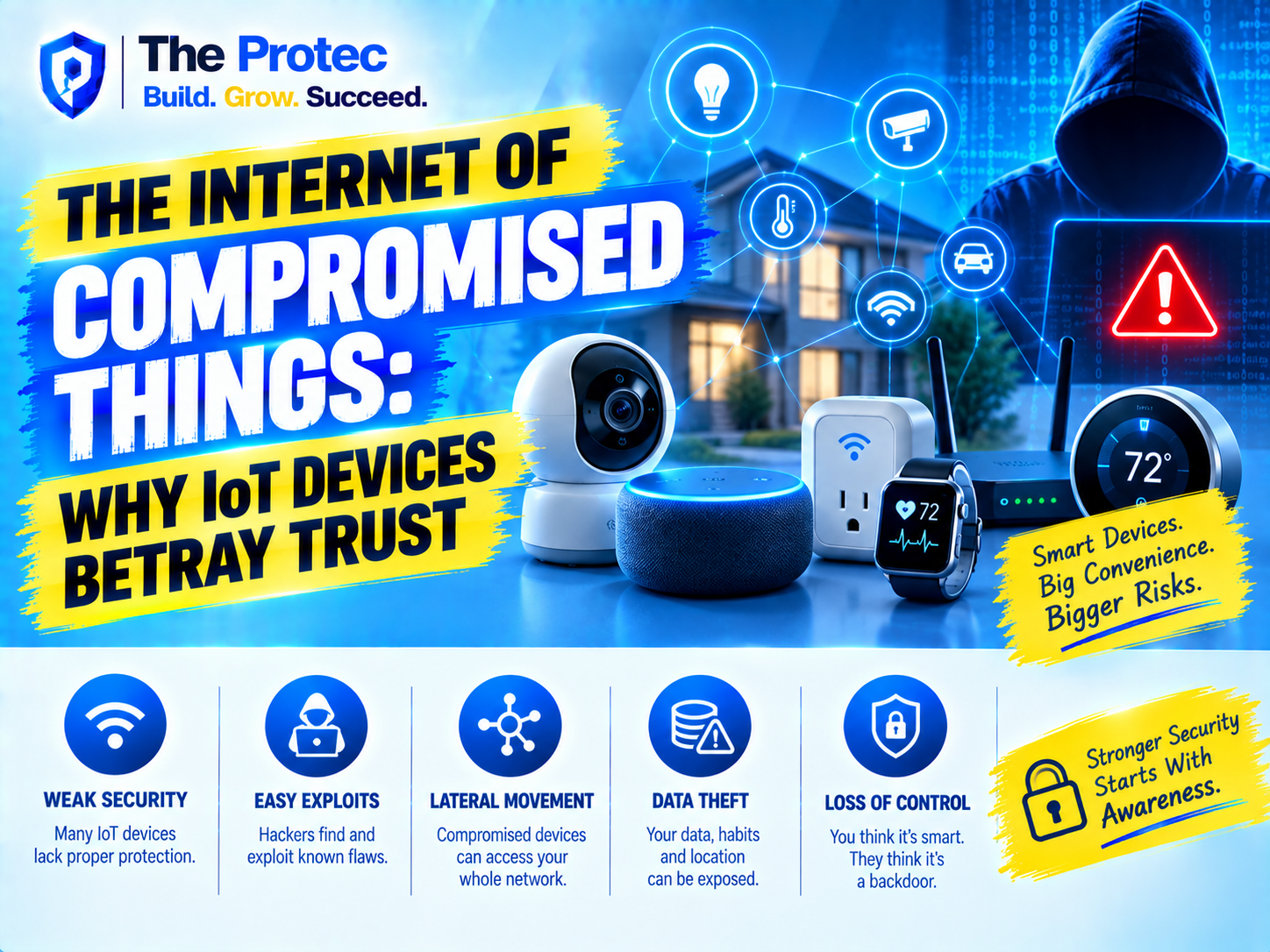
The smart camera watching the driveway, the router connecting a home office, and the sensor monitoring factory equipment appear to serve very different purposes. From a cybersecurity perspective, however, they share a dangerous characteristic: each is a computer that may be poorly secured, rarely monitored, and permanently connected.
The Internet of Things was built around convenience, automation, and inexpensive connectivity. Security was often secondary. That trade-off has created an Internet of compromised things in which legitimate products can quietly become surveillance tools, network entry points, malicious proxy servers, or nodes in an IoT botnet.
The problem is no longer limited to cheap gadgets with obvious flaws. Modern IoT cybersecurity threats affect smart cameras, routers, televisions, voice assistants, medical equipment, building controls, industrial sensors, and edge devices running artificial intelligence workloads. Treating any of them as inherently trustworthy is now a security failure. Connected devices must be authenticated, isolated, monitored, and replaced when their manufacturers stop supporting them.
Why the Internet of Things Has Become a Trust Problem
Traditional security models often assume that a device inside a home or enterprise network is safe. An IoT product may receive broad network access simply because it was purchased from a recognizable vendor, installed by an employee, or connected from a trusted location. None of those conditions proves that the device remains secure.
Unlike laptops and smartphones, many connected products provide little visibility into their software, active services, data collection, or update status. Owners may not know which operating system a device uses, where it sends information, or whether it contains components affected by known IoT vulnerabilities. Some products remain in service for a decade even though their security support ends after two or three years.
Trust also changes over time. A secure device can become vulnerable after researchers discover a flaw, a cloud account is breached, a certificate expires, or a vendor abandons the product. Effective IoT device security therefore depends on continuous verification rather than confidence established on installation day.
How Legitimate Devices Become Compromised IoT Devices
IoT hacking rarely requires a single sophisticated breakthrough. Attackers typically combine ordinary weaknesses that manufacturers, installers, or owners failed to address.
Weak and Reused Credentials
Default passwords, short PINs, shared administrator accounts, and credentials reused across services remain leading IoT security risks. Automated scanners can locate exposed devices and test leaked username-password combinations at enormous scale. Even when a product forces a password change, an associated mobile app or cloud portal may lack multifactor authentication or effective protection against repeated login attempts.
Outdated Firmware and Poor Update Support
Firmware updates repair exploitable code, but many devices do not update automatically. Others require obscure mobile apps, local files, or disruptive manual procedures. Owners may never receive an alert when a patch becomes available. More seriously, unsupported hardware continues functioning after its manufacturer stops publishing fixes, leaving permanent IoT device vulnerabilities on the network.
Exposed Services and Unnecessary Ports
Remote administration interfaces, Telnet, SSH, web dashboards, media servers, and device-discovery protocols can expose more functionality than a product needs. Internet-facing services are especially dangerous, but local services also matter. Malware that compromises one computer can scan the internal network and attack insecure IoT devices that were never directly accessible from the internet.
Insecure APIs and Cloud Dependencies
Many smart products rely on mobile applications and vendor clouds for authentication, storage, automation, and remote access. Weak API authorization can allow attackers to access another customer’s device, video feed, location data, or account records. A flaw in a centralized cloud platform may affect thousands or millions of products simultaneously, turning a vendor compromise into a connected device security crisis.
Supply-Chain Flaws
Manufacturers frequently assemble products from third-party chipsets, software development kits, open-source libraries, cloud services, and white-label firmware. A vulnerable component can appear across many brands that owners assume are unrelated. Hardcoded credentials, undocumented diagnostic accounts, insecure boot processes, and compromised build systems can make weaknesses difficult to identify or remove.
Unsafe Defaults and Misconfiguration
Universal Plug and Play, remote access, peer-to-peer connectivity, microphone recording, and cloud sharing may be enabled by default. Installers can also expose industrial controllers or building systems while troubleshooting and forget to remove access later. Convenience-focused defaults expand the attack surface before an owner has made a single security decision.
What an IoT Attack Looks Like
A typical attack begins with discovery. Criminals continuously scan internet addresses, search device-indexing services, probe cloud APIs, and purchase stolen credentials. Artificial intelligence is making reconnaissance and vulnerability analysis faster, but most successful IoT attacks still exploit familiar failures: an unchanged password, an unpatched service, or an exposed management panel.
After gaining access, an attacker may install IoT malware, change domain name system settings, steal stored credentials, disable security controls, or use the device as a foothold. Because cameras, routers, and sensors are seldom monitored like computers, the intrusion can remain invisible. The product may continue performing its normal function while communicating with command-and-control infrastructure.
Compromised devices are commonly recruited into botnets for distributed denial-of-service attacks, credential testing, spam, click fraud, cryptocurrency mining, or residential proxy services. Modern IoT botnet attacks are not limited to generating traffic. They can conceal other crimes behind trusted household or business IP addresses, making malicious activity harder to trace.
The Consequences Reach Beyond the Device
Privacy and Smart Home Security
IoT privacy risks become physical when a device can see, hear, or infer human behavior. A compromised camera exposes video. A smart lock reveals access events. Lighting, thermostat, and energy data can indicate whether a building is occupied. Children’s devices, health monitors, and voice assistants may collect particularly sensitive information.
Attackers can also use router or hub access to manipulate traffic, redirect users to fraudulent websites, or discover other systems. Smart home security is therefore not achieved by protecting each gadget in isolation; the network connecting those products must also be defended.
Enterprise Networks and Operational Disruption
Businesses may have thousands of devices spread across offices, warehouses, hospitals, stores, and factories. Printers, cameras, badge readers, environmental sensors, conferencing equipment, and building controls often receive less scrutiny than managed endpoints. A compromised device can provide persistent access, reveal operational data, or help an intruder move toward more valuable systems.
Industrial connected systems raise the stakes further. An attack on sensors or controllers can distort measurements, interrupt production, damage equipment, or affect worker safety. The convergence of information technology and operational technology means an apparently minor IoT weakness may create consequences in the physical world.
Critical Infrastructure and Large-Scale Attacks
Energy, transportation, communications, water, and healthcare providers increasingly depend on connected sensors and remotely managed equipment. A large population of similar devices creates systemic risk: one reusable exploit may affect many organizations at once. Botnets assembled from routers and cameras can also generate enough traffic to disrupt online services far beyond the original device owners.
Securing IoT Devices at Home
Consumers cannot repair insecure product architecture, but they can sharply reduce exposure through practical smart device security measures:
- Change default credentials immediately and use a unique, long password for every device account.
- Enable multifactor authentication on vendor cloud accounts whenever it is available.
- Turn on automatic firmware updates and periodically verify that updates are still being delivered.
- Place smart devices on a separate guest or IoT network rather than the network used by work computers, phones, and storage systems.
- Disable remote administration, port forwarding, Universal Plug and Play, microphones, cameras, and cloud features that are not required.
- Review router device lists for unknown products and investigate unusual connections, bandwidth use, or repeated restarts.
- Buy products from vendors that publish support periods, vulnerability disclosure policies, and clear security update instructions.
- Factory-reset devices before disposal and remove them from associated cloud accounts.
Network segmentation does not make a vulnerable device safe, but it limits what that device can reach after a compromise. It is one of the most effective defenses available to households, particularly when paired with a modern router that supports isolated networks and automatic security updates.
Enterprise IoT Security Requires Inventory and Zero Trust
An organization cannot secure devices it cannot identify. Enterprise IoT security should begin with an inventory covering the device owner, model, serial number, firmware version, network location, data handled, business purpose, support deadline, and approved communication paths. Passive discovery tools are often preferable in operational environments where aggressive scanning could disrupt sensitive equipment.
IoT zero trust means a device receives only the access required for its current function. Network location alone should grant no confidence. Organizations should authenticate devices with unique certificates or hardware-backed identities, place them in tightly controlled segments, and deny unnecessary east-west and internet traffic. A lobby camera, for example, should not be able to contact finance servers simply because both are inside the same building.
IoT threat detection should establish a behavioral baseline for each device type. Security teams can then investigate new destinations, unexpected protocols, abnormal upload volumes, repeated authentication failures, or communication outside approved hours. Logs from firewalls, network access controls, domain name services, cloud platforms, and device-management systems should feed centralized monitoring.
Procurement is equally important. Contracts should define patch timelines, support periods, incident notification, secure deletion, component transparency, and vulnerability disclosure obligations. Guidance from the CISA Secure by Design initiative emphasizes shifting responsibility toward technology manufacturers instead of expecting customers to compensate indefinitely for unsafe defaults.
Unsupported Hardware Is a Security Decision
If a vendor no longer fixes critical vulnerabilities, compensating controls may reduce risk temporarily, but they do not restore trust. Organizations should isolate the product, block unnecessary internet access, document the exception, and schedule replacement. Consumers should replace unsupported routers, cameras, hubs, and other devices with network privileges or access to sensitive data.
Before buying, examine the promised support lifetime rather than only the purchase price. Security labels and baseline standards can help, but buyers should still confirm whether the manufacturer provides automatic signed updates, unique credentials, encrypted communications, a vulnerability reporting process, and a defined end-of-support date.
Security Rules Are Catching Up With IoT Risk
By September 2026, regulation and purchasing standards are placing greater emphasis on secure defaults, vulnerability reporting, software component awareness, and long-term update support. The European Union’s Cyber Resilience Act has begun phasing in obligations, while consumer labeling programs are making connected-product security more visible at purchase time.
Standards do not eliminate IoT cyber attacks, but they can make basic protection measurable. The NIST Cybersecurity for IoT Program provides guidance for manufacturers and organizations evaluating connected-device capabilities. The broader direction is clear: security must be designed into the product lifecycle, not added after deployment.
The New Rule: Verify Every Connected Thing
The Internet of Things is not disappearing. Edge AI, private wireless networks, smart buildings, connected vehicles, and industrial automation will place even more devices near valuable data and physical processes. The answer is not to reject connectivity, but to abandon automatic trust.
Every connected product should be treated as a potentially compromised computer. Know what it is, authenticate it, restrict its access, monitor its behavior, update it, and remove it when support ends. That approach turns IoT network security from a collection of hopeful assumptions into a manageable, evidence-based discipline.
Frequently Asked Questions
How can I tell whether an IoT device has been compromised?
Warning signs include unusual bandwidth use, unexplained settings changes, unfamiliar administrator accounts, frequent crashes, disabled updates, unexpected outbound connections, or activity when the device should be idle. Many compromises produce no visible symptoms, so router logs, network monitoring, and vendor security alerts are more reliable than appearance alone.
Is changing the default password enough to secure an IoT device?
No. A unique password blocks common credential attacks, but it cannot repair vulnerable firmware, insecure APIs, exposed services, or supply-chain flaws. Strong authentication should be combined with updates, network segmentation, disabled unnecessary features, and ongoing monitoring.
Should IoT devices be placed on a separate network?
Yes. A separate IoT or guest network limits access to computers and sensitive data if a device is compromised. Enterprises should use more granular segmentation and access policies based on device identity, function, risk, and required destinations.
When should an IoT device be replaced?
Replace a device when security support ends, critical flaws remain unpatched, the vendor disappears, required encryption is obsolete, or the product cannot be isolated safely. Continued operation is not evidence that unsupported hardware remains secure.