







Artificial intelligence is moving out of centralized data centers and into aircraft, ground vehicles, unmanned systems, naval platforms, and remote sensor installations. That shift requires more than raw processing speed. Defense edge computing hardware must deliver useful AI performance while operating within strict limits on size, weight, power, cooling, latency, and environmental exposure.
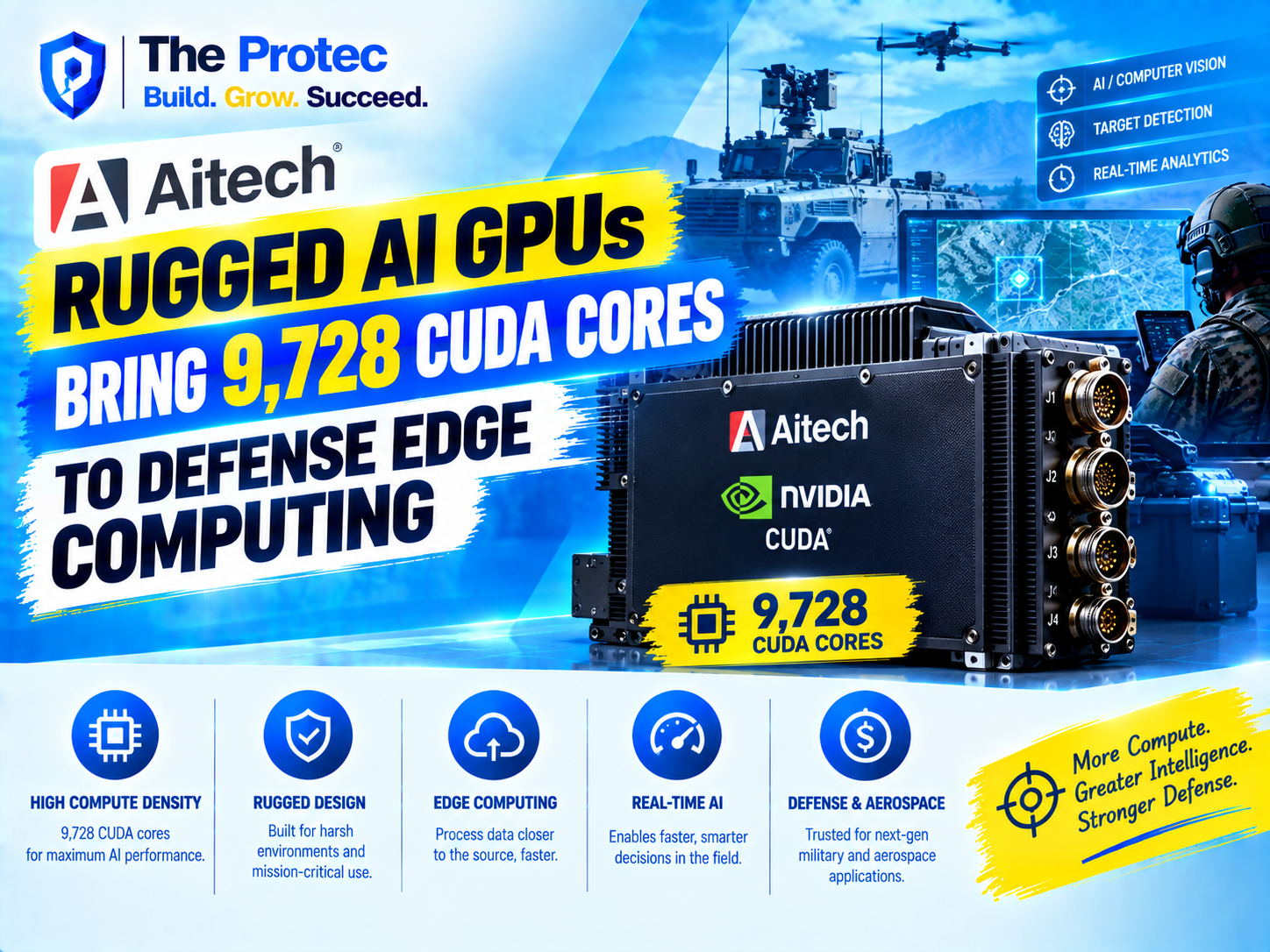
Aitech’s new rugged AI GPGPU boards address that challenge by bringing NVIDIA GPU acceleration directly to demanding edge platforms. With configurations offering up to 9,728 CUDA cores, these boards target applications that previously required workstation- or data-center-class resources. The result is a significant increase in available parallel compute for onboard inference, sensor processing, image analysis, and autonomous decision support.
The headline core count is important, but it is only part of the story. An effective Aitech rugged AI GPU must also maintain predictable performance under vibration, shock, temperature extremes, constrained airflow, and limited electrical power. For defense programs, that combination of performance and durability determines whether advanced AI can move from a laboratory demonstration into an operational system.
Why 9,728 CUDA Cores Matter at the Defense Edge
CUDA cores are programmable processing units within an NVIDIA GPU. Unlike a general-purpose CPU, which is optimized for a smaller number of complex sequential tasks, a GPU can execute thousands of operations concurrently. This parallelism is highly effective for neural-network inference, computer vision, radar processing, signal analysis, and matrix-heavy workloads.
An Aitech AI GPGPU configuration with 9,728 CUDA cores gives system designers a substantial pool of parallel processing resources close to the source of mission data. Instead of transmitting every video frame, radar return, or electronic signal to a remote server, a platform can analyze information locally and forward only results, alerts, or selected data.
CUDA core count should not be treated as a complete benchmark by itself. Memory bandwidth, Tensor Core capability, software optimization, thermal limits, and workload precision all affect application performance. Nevertheless, 9,728 CUDA cores mark a notable level of GPU edge computing capability for a rugged board intended to operate beyond a controlled server room.
NVIDIA GPU Architecture for AI Acceleration
The 9,728-core class is associated with NVIDIA’s high-performance professional Ada-generation GPU technology. In addition to conventional CUDA processing, this architecture includes specialized Tensor Cores for AI operations and hardware designed to accelerate modern graphics and visualization workloads.
Tensor Cores are particularly relevant to defense AI computing because many deployed models rely on mixed-precision arithmetic. Using formats such as FP16, BF16, TF32, and appropriately validated lower-precision techniques can increase inference throughput and reduce energy consumed per result. The correct format depends on model accuracy requirements, software support, and the assurance process for the mission application.
Aitech NVIDIA GPU hardware also benefits from the broader NVIDIA CUDA platform. CUDA gives developers access to mature libraries, compilers, profiling tools, and frameworks used throughout the AI industry. That ecosystem can shorten the path from model development to deployment, although rugged systems still require platform-specific optimization, qualification, and lifecycle planning.
AI Workloads Enabled by Rugged GPGPU Boards
The most compelling use cases for rugged AI GPUs involve large data streams that must be interpreted with minimal delay. Defense platforms increasingly carry multiple electro-optical, infrared, radar, acoustic, navigation, and electronic-warfare sensors. Processing these streams together can reveal patterns that isolated systems may miss.
- Intelligence, surveillance, and reconnaissance: AI models can detect, classify, and track objects across full-motion video while helping operators prioritize significant events.
- Sensor fusion: GPU acceleration can combine data from cameras, radar, lidar, inertial systems, and other sources to create a more coherent operational picture.
- Electronic and signals intelligence: Parallel processing supports spectrum analysis, signal classification, anomaly detection, and emitter recognition.
- Autonomous navigation: Uncrewed platforms can use perception models for terrain understanding, obstacle avoidance, route planning, and localization when connectivity is unreliable.
- Predictive maintenance: Onboard models can examine vibration, temperature, and equipment telemetry to identify emerging faults before they cause mission disruption.
- Multimodal AI: Newer workloads can correlate imagery, text, telemetry, and sensor signals, provided the model is appropriately sized and secured for edge deployment.
AI GPGPU boards also accelerate non-AI algorithms. Image enhancement, compression, synthetic-aperture radar processing, scientific simulation, and cryptographic or signal-processing pipelines may all benefit from general-purpose GPU parallelism.
Ruggedization Is More Than a Protective Enclosure
A commercial GPU installed in a reinforced box does not automatically become defense computing hardware. Genuine rugged edge computing requires engineering at the board, interconnect, mechanical, thermal, and system levels.
Aitech rugged GPGPU products are designed for environments in which persistent vibration, mechanical shock, dust, humidity, altitude, and wide operating temperatures may be routine. Rugged board designs typically use secure connectors, mechanically supported components, controlled material selection, and layouts developed around thermal and signal-integrity requirements. Depending on the program and configuration, conduction-cooled implementations can transfer heat through the card edges into the chassis rather than relying solely on exposed fans.
Environmental qualification remains application-specific. Integrators must match the selected Aitech GPGPU board and chassis to relevant military standards, cooling conditions, power quality, and platform-level requirements. Published rugged credentials are valuable, but they do not replace qualification of the complete deployed system.
This distinction is crucial because intermittent faults can be more dangerous than obvious failures. A defense AI computing system must produce consistent results even after prolonged vibration, repeated thermal cycling, or operation at the limits of its approved envelope.
Managing Power and Heat at High GPU Performance
Nearly ten thousand CUDA cores can generate considerable heat when operating at sustained load. At the edge, cooling capacity may be limited by sealed chassis, high ambient temperatures, altitude, acoustic restrictions, or the absence of conventional airflow. Thermal design therefore becomes a primary performance constraint rather than a secondary mechanical concern.
A rugged AI GPU rarely operates in isolation. The system power budget must include the host processor, memory, storage, network interfaces, sensor ingestion, power conversion, and other accelerator hardware. Peak demand, transient behavior, and startup conditions all matter when sizing the platform’s power supply.
Effective deployments begin with workload profiling. A model that reaches its latency target below the GPU’s maximum power setting may deliver better system-level results by reducing heat, improving reliability, and preserving electrical margin. Techniques such as model pruning, quantization, efficient batching, optimized memory movement, and dynamic workload scheduling can improve performance per watt.
Designers should also evaluate sustained throughput rather than relying on short benchmark bursts. A system may produce impressive initial results and then reduce clock speed if heat cannot be removed quickly enough. Aitech GPGPU boards must be paired with an appropriate chassis, thermal interface, and cooling strategy to make the available NVIDIA GPGPU performance usable throughout the mission.
Why Local AI Beats Cloud-Dependent Processing
Cloud and data-center resources remain valuable for model training, fleet-wide analysis, and long-term storage. They are less suitable when a platform needs an immediate answer and cannot depend on a stable high-bandwidth connection.
Defense edge computing minimizes the distance between sensing and decision-making. Local processing can reduce latency, conserve communications bandwidth, and sustain essential capabilities during network disruption. It can also improve information control by keeping sensitive raw sensor data onboard.
This does not mean every workload should run at the edge. Training a frontier-scale model still requires substantial centralized infrastructure. The more practical pattern is to train and validate models centrally, optimize them for deployment, and run inference on edge AI hardware. Selected observations can then be returned for review, retraining, or intelligence analysis when policy and connectivity permit.
A high-performance Aitech AI GPGPU expands the range of models that can follow this pattern. It gives programs more room for higher-resolution inputs, multiple concurrent sensor pipelines, or larger neural networks without immediately exporting processing to a remote facility.
Integration and Software Considerations
Successful AI computing for defense requires more than selecting an accelerator. Engineers must consider operating-system support, drivers, middleware, cybersecurity controls, model provenance, deterministic behavior, and long-term component availability.
The software pipeline should be developed around the target hardware early. Models often need conversion and optimization before they can use Tensor Cores or lower-precision execution efficiently. Profiling should examine preprocessing, memory copies, sensor ingestion, and post-processing as well as the neural network itself. A fast model can still miss its deadline if the surrounding pipeline creates bottlenecks.
Security is equally important. Deployed systems need authenticated software, controlled update mechanisms, protected model files, and defenses against unauthorized access. Programs should also define how model changes are tested and approved. An AI update may affect mission behavior even when the underlying Aitech rugged GPGPU hardware remains unchanged.
Lifecycle support matters because defense platforms may remain active far longer than commercial GPU product cycles. Working with an established rugged-computing supplier such as Aitech can help programs address configuration control, documentation, environmental options, and long-term sustainment.
Data-Center-Class AI Is Moving Toward the Platform
As of September 2026, edge AI development is increasingly focused on multimodal perception, autonomous teaming, software-defined sensors, and coordinated processing across distributed platforms. These workloads demand more compute, but platform designers cannot simply install a data-center server in an aircraft or tactical vehicle.
Aitech AI GPUs illustrate how the industry is closing that gap. Rugged GPGPU boards adapt powerful NVIDIA architecture to constrained environments where reliability and environmental durability are inseparable from performance. They do not replace the largest training clusters, but they bring a meaningful portion of modern inference and acceleration capability to the point where data is created.
The up-to-9,728-CUDA-core specification is therefore significant not merely as a large number. It reflects a broader transition toward mission systems that can perceive, analyze, and respond locally. For military edge computing, the winning hardware will be the hardware that sustains that performance under real operating conditions.
Frequently Asked Questions
What is an Aitech AI GPGPU?
An Aitech AI GPGPU is a ruggedized general-purpose GPU computing board designed to accelerate AI, computer vision, signal processing, and other highly parallel workloads. It combines NVIDIA GPU technology with board-level engineering intended for defense, aerospace, industrial, and other harsh edge environments.
Are 9,728 CUDA cores enough for defense AI inference?
They can support demanding inference workloads, but suitability depends on model size, precision, memory requirements, input rate, latency target, and power limits. Tensor Core performance and software optimization may matter more than CUDA core count for many neural networks. Programs should benchmark the complete application on the intended configuration.
How is a rugged AI GPU different from a commercial GPU?
A rugged AI GPU is designed around environmental durability, secure mechanical integration, thermal transfer, and long-term platform requirements. Commercial GPUs generally assume controlled airflow, moderate temperatures, and relatively benign vibration. Rugged GPGPU boards are built for systems that may encounter shock, thermal extremes, dust, humidity, or constrained cooling.
Can Aitech GPGPU boards train AI models at the edge?
Smaller-scale training, adaptation, and experimentation may be possible, depending on memory and software resources. However, the primary edge use case is typically inference. Large model training remains better suited to centralized GPU infrastructure, while optimized models are deployed to rugged AI hardware for low-latency local processing.
What should integrators evaluate before choosing a rugged GPU board?
Key considerations include sustained application performance, memory capacity and bandwidth, host interfaces, power consumption, cooling method, environmental qualification, software support, cybersecurity, form factor, and lifecycle availability. The board should be evaluated as part of the complete mission computer rather than as a standalone component.