









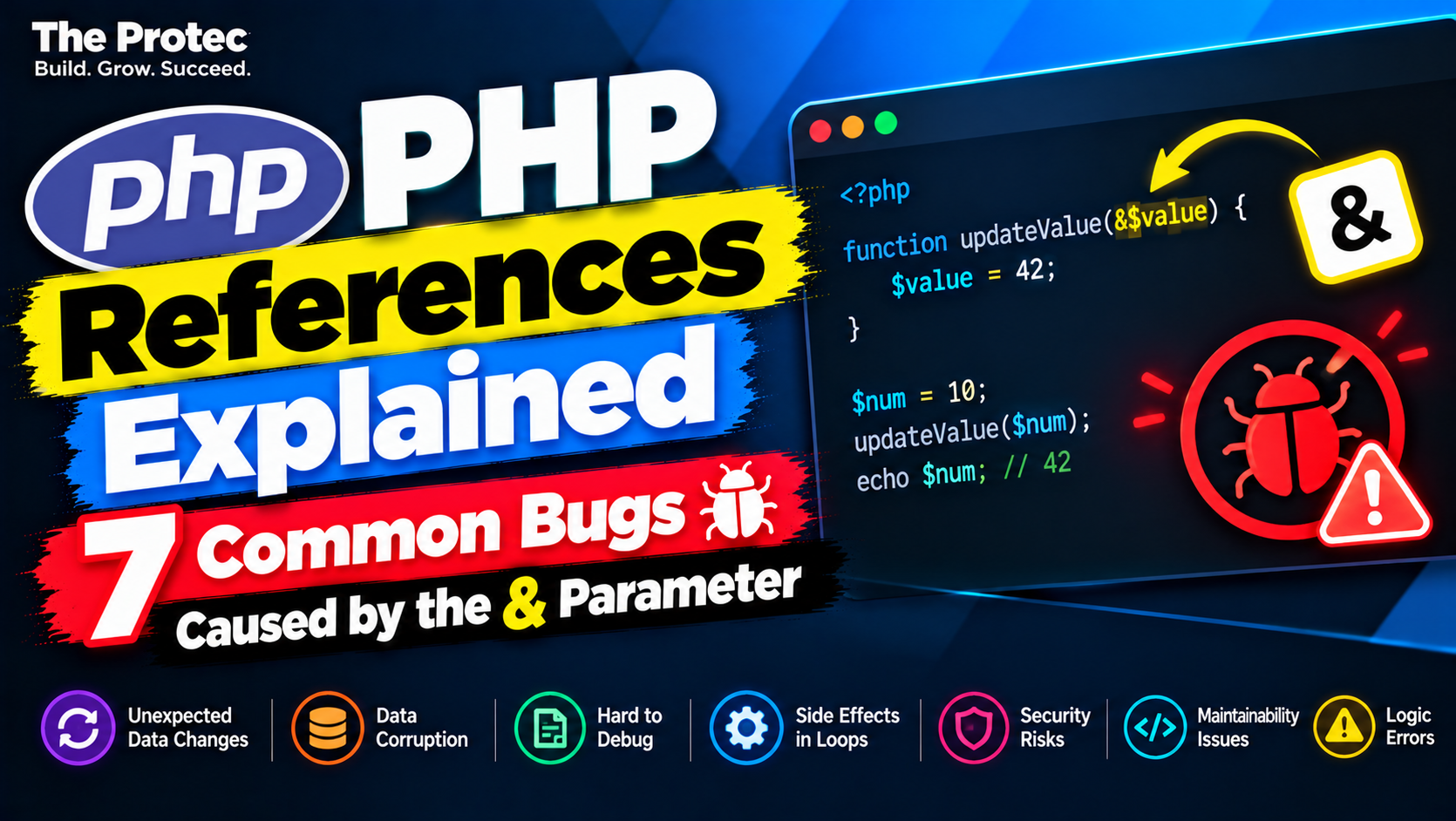
A one-character function signature can create a surprisingly long debugging session. In PHP References Explained, the essential rule is that a reference parameter is declared in the function definition—function updateValue(&$value)—not by adding an ampersand at the call site. The function can then modify the caller’s variable directly, which is useful in limited cases but also creates hidden data flow, unexpected aliases, and state changes far from their source.
This guide examines seven reproducible PHP reference parameter bugs, explains why they happen, and replaces each risky pattern with a clearer alternative. The behavior described here follows documented PHP 8 semantics available as of October 2026.
PHP pass by value vs reference
PHP function arguments are passed by value unless the function signature says otherwise. With an ordinary parameter, assigning a new value inside the function does not replace the caller’s variable:
<?php
function rename(string $name): void
{
    $name = 'Grace';
}

$name = 'Ada';
rename($name);
var_dump($name); // string(3) 'Ada'
A PHP function pass by reference explicitly aliases the parameter to the caller’s variable:
<?php
function rename(string &$name): void
{
    $name = 'Grace';
}

$name = 'Ada';
rename($name);
var_dump($name); // string(5) 'Grace'The call remains rename($name). Call-time reference syntax such as rename(&$name) is not supported in PHP 8. The authoritative rules are documented in the PHP manual sections on function arguments and references.
Passing by value is not necessarily expensive. PHP uses copy-on-write for arrays and strings: an argument can initially share underlying data, with a separate copy made only when one side is changed. Adding a PHP ampersand parameter therefore does not automatically improve performance.
Bug 1: Accidentally modifying the caller’s variable
The most direct reference side effect occurs when a helper appears to inspect or normalize a value but silently changes its input.
<?php
function normalizeName(string &$name): void
{
    $name = trim($name);
}

$customerName = '  Ada  ';
normalizeName($customerName);
var_dump($customerName); // string(3) 'Ada'
The result may be intentional, but the mutation is easy to miss at the call site. In a controller or Laravel service, later validation, logging, or persistence could receive a value different from the one originally submitted.
Prefer returning the transformed value so the assignment is visible:
<?php
function normalizeName(string $name): string
{
    return trim($name);
}

$customerName = normalizeName($customerName);
Bug 2: Passing a literal or expression to a reference parameter
A reference needs a referenceable variable. A literal, arithmetic expression, or most temporary results cannot serve as the caller-side storage location.
<?php
function increment(int &$number): void
{
    $number++;
}

increment(1); // Error: argument cannot be passed by reference
increment($total + 1); // Also invalid
Depending on the expression and API involved, PHP can produce an error or an “Only variables should be passed by reference” diagnostic. The safe correction is to provide an actual variable:
<?php
$total = 1;
increment($total);
var_dump($total); // int(2)
This PHP function argument must be variable rule often surfaces with older helper APIs or callbacks that use output parameters. Do not hide the problem with error suppression; inspect the function signature and store the input in a named variable—or redesign the function to return a value.
Bug 3: Confusing values, references, and object handles
References are not C-style pointers. PHP references are aliases: two names can refer to the same variable container. Ordinary assignment and reference assignment therefore behave differently:
<?php
$a = 10;
$b = $a;
$b = 20;
var_dump($a); // int(10)

$c = 10;
$d =& $c;
$d = 20;
var_dump($c); // int(20)
Objects add another distinction. An object variable holds an object handle, so assigning it to another variable allows both handles to access the same object. No ampersand is required:
<?php
$user = (object) ['active' => false];
$copy = $user;
$copy->active = true;
var_dump($user->active); // bool(true)
Use clone $user when an independent object is required. A reference parameter around an object variable is usually unnecessary unless the function must replace the caller’s handle with a different object. Prefer an explicit return value or an object method whose name communicates the state change.
Bug 4: Leaking a reference from a foreach loop
One of the best-known PHP foreach reference bugs is also one of the easiest to overlook. After iteration by reference, the loop variable remains an alias to the final array element.
<?php
$prices = [10, 20, 30];

foreach ($prices as &$price) {
    $price *= 2;
}

foreach ($prices as $price) {
    // Reusing $price overwrites the referenced final element.
}

var_dump($prices); // array values end with 40, not 60
During the second loop, each assignment to $price also writes into the last element. The PHP manual explicitly warns about this behavior in its foreach documentation.
Always break the alias immediately after a by-reference loop:
<?php
foreach ($prices as &$price) {
    $price *= 2;
}
unset($price);

foreach ($prices as $price) {
    // Safe to reuse the variable.
}
unset($price) removes the local alias; it does not delete the array’s final element.
Bug 5: Retaining aliases after assigning a new value
Developers sometimes expect assigning through a PHP reference variable to detach it. It does not. The new value is written to the shared container.
<?php
$status = 'draft';
$current =& $status;
$current = 'published';

var_dump($status); // string(9) 'published'
The variables remain aliases until one is unset or rebound. A later assignment can therefore change state long after the reference assignment has scrolled out of view.
If a snapshot is wanted, use ordinary assignment:
<?php
$status = 'draft';
$current = $status;
$current = 'published';
var_dump($status); // string(5) 'draft'
When a reference was genuinely required, call unset($current) as soon as its job is complete. A narrow lifetime makes PHP unexpected variable changes easier to diagnose.
Bug 6: Hiding state changes across nested calls
Reference behavior becomes harder to trace when several data-processing functions forward the same mutable argument.
<?php
function sanitize(array &$data): void
{
    $data['email'] = strtolower(trim($data['email']));
}

function prepare(array &$data): void
{
    sanitize($data);
    $data['ready'] = true;
}

$requestData = ['email' => ' [email protected] '];
prepare($requestData);
The controller that calls prepare() may not realize that a nested function changes two fields. In Laravel debugging, this pattern can appear in services, controller helpers, event callbacks, or import pipelines where the original request array is reused.
Make each transition explicit instead:
<?php
function sanitize(array $data): array
{
    $data['email'] = strtolower(trim($data['email']));
    return $data;
}

$cleanData = sanitize($requestData);
$cleanData['ready'] = true;
Returning values provides a visible chain of transformations and makes unit tests simpler. It also reduces the chance that one nested call will unexpectedly affect another consumer.
Array elements can hold references, creating aliases that survive beyond the code that established them.
<?php
$user = ['role' => 'reader'];
$state = [];
$state['user'] =& $user;

$state['user']['role'] = 'admin';
var_dump($user['role']); // string(5) 'admin'
This is particularly risky in shared configuration, long-running workers, static properties, service containers, or closure captures such as use (&$state). A callback can alter data owned by another layer without an obvious assignment.
Use normal array assignment and return changed state:
<?php
function grantAdmin(array $user): array
{
    $user['role'] = 'admin';
    return $user;
}

$user = ['role' => 'reader'];
$admin = grantAdmin($user);
var_dump($user['role']);  // string(6) 'reader'
var_dump($admin['role']); // string(5) 'admin'
Because arrays use copy-on-write, passing the array by value does not automatically create a full eager copy. Optimize only after profiling; references can introduce bookkeeping and semantic complexity rather than a guaranteed speed improvement.
PHP 8 reference behavior and practical debugging tips
PHP 8 continues to require the ampersand in the function signature, supports type declarations on by-reference parameters, and rejects invalid call-time ampersands. Types do not remove mutation risk: a correctly typed reference can still make an unexpected but type-compatible change.
When debugging PHP reference parameter errors, use a systematic process:
- Search function signatures for
&$parameter, reference assignments using=&, closure captures usinguse (&$variable), and by-referenceforeachloops. - Place
var_dump($value)immediately before and after suspicious calls. Dump both the original variable and any alleged copy. - Temporarily store a before-state—such as
$before = $data—and compare it with the result after each nested call. - Use
ReflectionParameter::isPassedByReference()when investigating framework callbacks or unfamiliar third-party APIs. - Enable useful error reporting in development. Do not suppress warnings that reveal non-referenceable arguments.
- Add regression tests that assert both the expected result and whether the input should remain unchanged.
Checklist: Is a reference parameter genuinely necessary?
- Does the function clearly need to update the caller’s existing variable rather than produce a result?
- Would returning one value—or a small result object—make the data flow clearer?
- Is mutation obvious from the function’s name, documentation, and tests?
- Could an object method express the behavior without replacing the caller’s object variable?
- Have you avoided references solely for assumed performance gains?
- Will every
foreachreference and temporary alias be followed byunset()? - Can the mutable state be kept local instead of shared across services, callbacks, or controllers?
Frequently asked questions
Should an ampersand be added when calling a reference function?
No. Declare it in the PHP function signature, as in function updateValue(&$value), and call the function normally with updateValue($value). Call-time pass-by-reference syntax is invalid in PHP 8.
Does passing an array by reference avoid copying it?
It changes the argument’s semantics but is not a general performance optimization. PHP normally uses copy-on-write, so a by-value array is not necessarily duplicated immediately. Profile real workloads before making performance decisions.
Are PHP object variables automatically references?
No. They contain handles that can access the same object, which differs from two variable names being aliases. Object property mutations are shared, but assigning a different object to one ordinary variable does not replace the other variable’s handle.
Why should a foreach reference variable be unset?
The loop variable remains linked to the last array element after iteration ends. Calling unset($value) breaks that alias and prevents later assignments or loops from corrupting the element.
Reference parameters are appropriate when caller mutation is deliberate, limited, and unmistakable. For most application code, returning a value or using an object with explicit behavior produces safer APIs, clearer tests, and far fewer hidden state changes.