









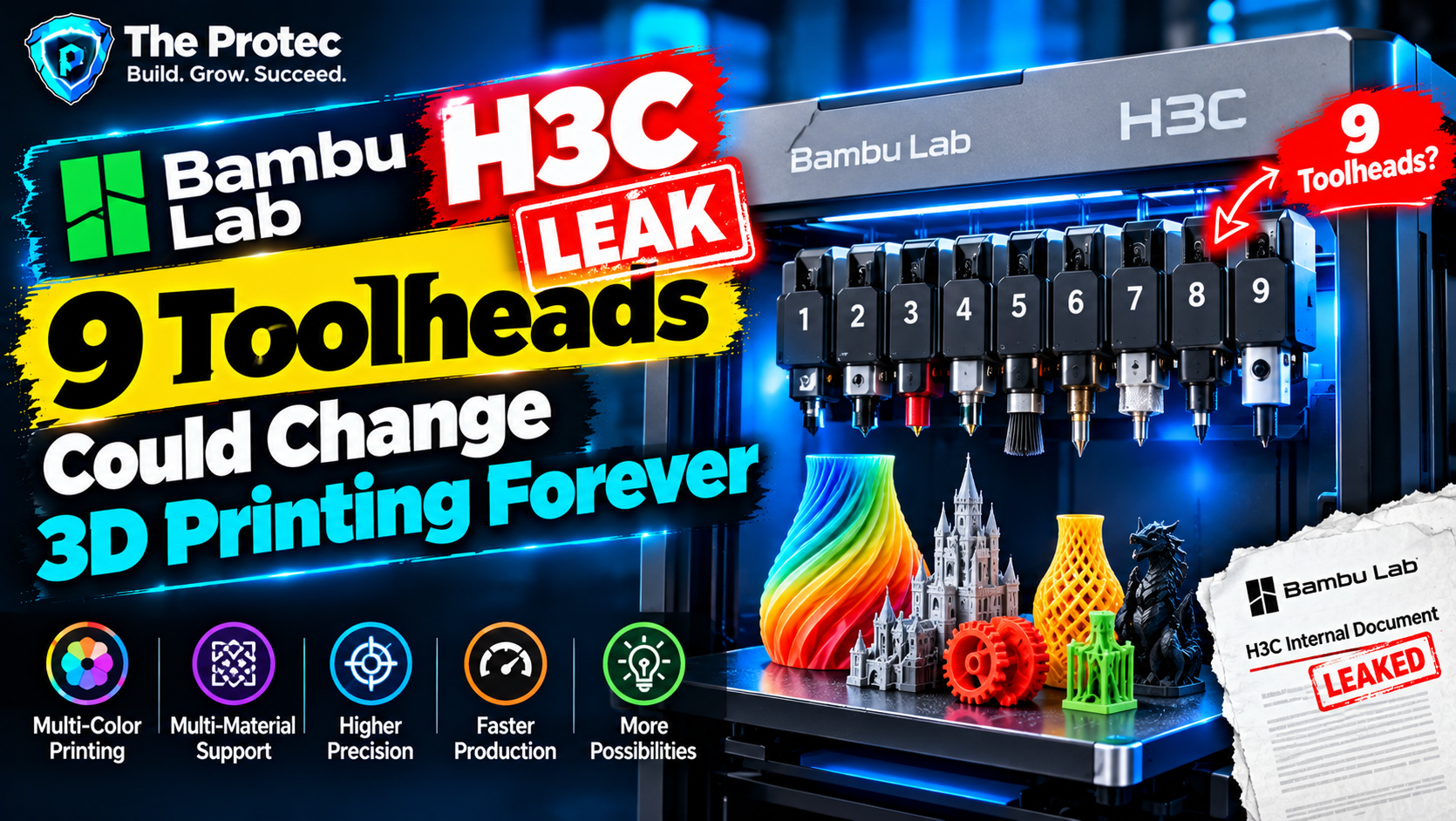
Could a tool-changing architecture finally make multicolor 3D printing significantly less wasteful? That is the central question raised by the reported Bambu Lab H3C leak, which appears to show a large enclosed printer with nine visible tool positions and references to a possible November reveal.
If the image is authentic—and if those positions hold independently usable printing tools—the machine could approach color and material changes differently from printers that repeatedly flush one shared melt path. That could reduce some of the purge filament, transition time, and cross-contamination associated with current multi-material 3D printing workflows.
There are important caveats. As of October 23, 2026, the H3C name, final industrial design, specifications, price, availability, and launch timing should be treated as unconfirmed unless Bambu Lab publishes them through an official channel. The alleged store banner is promotional material of uncertain provenance, not proof of a finished retail product. Its imagery also cannot tell us whether the nine positions hold complete toolheads, removable hotends, nozzle modules, or another mechanism.
What Leaked About the Bambu Lab H3C?
The Bambu Lab H3C leak consists of images circulated online and described as photographs of an alleged in-store promotional banner. The pictured machine has an enclosed frame and a row of nine visible positions across its upper area. Reposts identify it as the Bambu Lab H3C 3D printer and associate the promotion with November 3, 2026.
Only a few details are directly observable: the banner depicts a printer-like product, nine repeated components are visible, and marketing text appears alongside the image. The original installation, photographer, retailer, and complete chain of custody have not been reliably established through the reposted material. The alleged tagline has likewise not been matched conclusively to an official Bambu Lab product page or announcement. It should not be quoted as a confirmed product claim.
Everything about how the machine works remains speculative. Nine visible positions do not necessarily mean nine complete Bambu Lab toolheads, nine materials printing simultaneously, or nine independently heated nozzles. Some positions could be storage docks, hotend slots, cleaning stations, or inactive expansion bays. The image also reveals no dependable Bambu Lab H3C specifications such as build volume, motion system, nozzle temperature, or filament compatibility.
Tool Changer vs. Nozzle Changer
A true tool-changing 3D printer parks complete printing tools and attaches the required one to a moving carriage. Depending on the implementation, each tool may include its own hotend, nozzle, heater, temperature sensor, filament path, and extruder. Keeping materials in separate melt zones can avoid flushing every previous color through a single nozzle.
A nozzle or hotend changer swaps a smaller thermal assembly while retaining more of the printer’s shared carriage and drive hardware. This can still separate melt paths and reduce transitions, but it is mechanically different from exchanging a complete toolhead. The distinction affects weight, calibration, maintenance, cost, material loading, and the time required for every change.
Bambu Lab’s officially documented H2C uses the Vortek hotend-changing approach. Vortek stores compatible hotend modules and exchanges them at a docking area rather than operating like a conventional printer with nine complete, independently driven extruder carriages. Configuration and compatibility should be checked against the latest information on the official Bambu Lab website and its support documentation.
That architecture is relevant because it shows Bambu Lab has already explored automated hotend exchange. It does not prove that the leaked H3C uses Vortek, a larger version of it, or a full Bambu Lab tool changer. Until the attachment mechanism and filament routing are documented, calling the H3C a nine-tool printer is a useful description of the rumor—not a verified technical specification.
Could Nine Tools End Multicolor 3D Printing Waste?
Conventional single-nozzle multicolor systems feed several filaments into one hotend. When the printer changes color, it must remove or retract the previous filament and push the new one through the shared melt zone. The slicer commands an extra purge to clear residue and produce a cleaner transition. That material may become a purge line, purge tower, chute deposit, or internal model infill.
The amount of 3D printer filament purge waste varies substantially. A small object with hundreds of color changes can consume more purge material than a larger model with long, uninterrupted color regions. Light-to-dark and dark-to-light transitions may require different flushing volumes. Material chemistry, nozzle size, temperature, purge settings, layer sequence, and slicer configuration also affect the result.
Dedicated tools could reduce repeated flushing because each color or material could remain loaded in its own melt path. The printer would park one tool, collect another, confirm its position, and continue. This could be especially useful for models with frequent transitions, soluble supports, or materials that contaminate one another when passed through a shared nozzle.
However, a Bambu Lab nine-toolheads layout would not automatically create zero-waste printing. A machine may still need to prime each tool, wipe the nozzle, stabilize pressure, print a tower for alignment, or discard startup material. Brims, support structures, failed prints, calibration objects, and incompatible material combinations remain sources of waste. Idle hotends may also ooze unless temperature and retraction are carefully controlled.
Potential Benefits and Trade-Offs
- Potential benefit: Less flushing between colors that stay assigned to separate melt paths.
- Potential benefit: Shorter transitions when the docking process is faster than unloading, loading, and purging filament.
- Potential benefit: Reduced cross-contamination in carefully matched multi-material workflows.
- Trade-off: More docks, heaters, sensors, connectors, and calibration points can increase complexity.
- Trade-off: Tool pickup, cleaning, heating, and verification may introduce their own delays.
- Trade-off: Multiple equipped tools could increase purchase and replacement costs.
Any waste claim should be tested with equivalent models, materials, nozzle sizes, temperatures, color sequences, and slicer settings. Comparing a nine-color demonstration with a simpler two-color print would not establish an accurate percentage reduction.
Bambu Lab H3C vs. H2C
The Bambu Lab H2C vs. H3C comparison is currently uneven because one side has documented architecture while the other is based on a leaked image.
- Changing mechanism: The H2C is documented around its Vortek hotend-changing system. The H3C mechanism is unconfirmed; its nine visible positions could hold hotends, complete tools, or another module.
- Material workflow: The H2C exchanges supported hotend assemblies according to its documented loading and docking workflow. The H3C’s filament routing and number of usable materials are unknown.
- Waste implications: Separate hotends can avoid some shared-nozzle flushing. Neither the H2C nor a rumored H3C should be assumed to eliminate priming, wiping, towers, or failed-print waste.
- Setup and maintenance: H2C owners can consult published procedures and compatibility guidance. H3C calibration, cleaning, spare-part, and maintenance requirements remain unknown.
- Capacity: Nine visible H3C positions do not confirm nine simultaneously available materials. Some slots may have different functions or require optional hardware.
- Compatibility: H2C users have an official basis for checking supported modules and materials. No verified H3C compatibility list is available.
In short, Bambu Lab H2C Vortek provides a real reference point for automated hotend exchange, but it cannot be used to fill gaps in the leaked product’s specification sheet.
What About Print Quality and Speed?
Dedicated tools could improve certain prints by keeping incompatible colors or materials out of the same melt chamber. A tool can potentially retain its own nozzle diameter and temperature profile, opening useful combinations such as a fine detail nozzle, a high-flow nozzle, and a support-material tool in one job.
Those benefits depend on accurate docking and calibration. Every tool must return to a repeatable position so its X, Y, and Z offsets align with the others. Nozzle wiping, pressure control, thermal stabilization, and inactive-tool ooze can affect seams and surface finish. More moving interfaces also create additional wear points.
Speed is equally uncertain. Avoiding long filament unload and purge cycles could save time, but tool pickup, heating, inspection, and cleaning may offset part of that gain. Actual print quality, throughput, reliability, noise, and material compatibility require verified specifications and independent testing on production hardware.
Expected Bambu Lab H3C Price and Specifications
No confirmed Bambu Lab H3C price has been published, and retailer speculation should not be treated as a quotation from the manufacturer. The leak also provides no trustworthy answer about build volume, maximum nozzle or chamber temperature, supported filaments, motion hardware, software integration, power consumption, or regional availability.
Other important questions include whether tools are included or sold separately, whether users can install different nozzle diameters, and whether existing Bambu filament systems will be compatible. Upgradeability matters too: a modular base machine could have a very different total cost from a package requiring nine proprietary assemblies.
For hobbyists, consumable and replacement-part prices may matter as much as the initial purchase. Print farms will focus on uptime, automated recovery, maintenance intervals, and per-part waste. Professional users may prioritize dimensional repeatability, material validation, service options, network controls, and predictable software support. Without those details, a headline price would not reveal the H3C’s true cost of ownership.
Should You Wait Before Buying an H2C or H2D?
Buyers who need a printer now should compare currently available machines with their actual work rather than postponing a purchase solely because of an unverified Bambu Lab new 3D printer report. Consider the number of colors used per job, required materials, build size, daily output, downtime tolerance, support options, and budget.
If multicolor 3D printing waste is your primary problem, waiting for verified H3C information may be sensible. Look for independent measurements using identical models and transition settings—not a carefully selected demonstration. Confirm pricing, tool capacity, availability, reliability reviews, replacement-hotend costs, and software limitations before deciding between Bambu Lab H2C vs. H3C.
The H2D may remain the more practical choice for users whose workflows benefit from an established dual-nozzle platform but do not require a larger tool bank. The H2C is more relevant to buyers specifically interested in automated hotend exchange. Neither should be dismissed merely because a more ambitious-looking machine may be approaching.
When Will Bambu Lab Reveal the H3C?
The reported Bambu Lab H3C November reveal is November 3, 2026, but the date originates from imagery whose source and authenticity have not been conclusively established. No purchasing or production decision should depend on it. A formal newsroom post, verified social account, product page, or direct media invitation would provide stronger confirmation of the Bambu Lab H3C release date.
If the image is genuine, nine tool positions could represent an important change in tool-changing 3D printer technology. The real breakthrough will not be the number shown in a banner, however. It will depend on measurable waste reduction, usable tool capacity, calibration stability, reliability, material support, and price.
Frequently Asked Questions
Is the Bambu Lab H3C officially confirmed?
The circulated banner and H3C name should be treated as unconfirmed until Bambu Lab publishes an official announcement or product page. A promotional image alone does not establish the final design or feature set.
Does the leak prove the H3C has nine complete toolheads?
No. Nine repeated positions are visible, but the image does not reveal whether they contain full toolheads, hotend modules, nozzles, storage bays, or a combination of components.
Would separate tools eliminate filament purge waste?
They could reduce purging caused by sharing one melt path, particularly during frequent color changes. They would not necessarily eliminate priming, nozzle wiping, purge towers, startup waste, supports, or failed prints.
What is the difference between the H2C Vortek system and the rumored H3C?
The H2C uses Bambu Lab’s documented Vortek hotend-changing architecture. The H3C’s mechanism has not been verified, so it cannot yet be classified confidently as a complete tool changer or hotend changer.
Is November 3 the confirmed H3C release date?
No. It is a reported reveal date associated with the alleged banner, not a confirmed shipping date. Official details are needed before treating it as either a launch event or retail release.