







Linux administrators are accustomed to vulnerability announcements arriving with a familiar set of details: a CVE identifier, affected packages, fixed versions, and an update from the distribution they trust. Recent reports about Linux kernel security did not follow that orderly sequence.
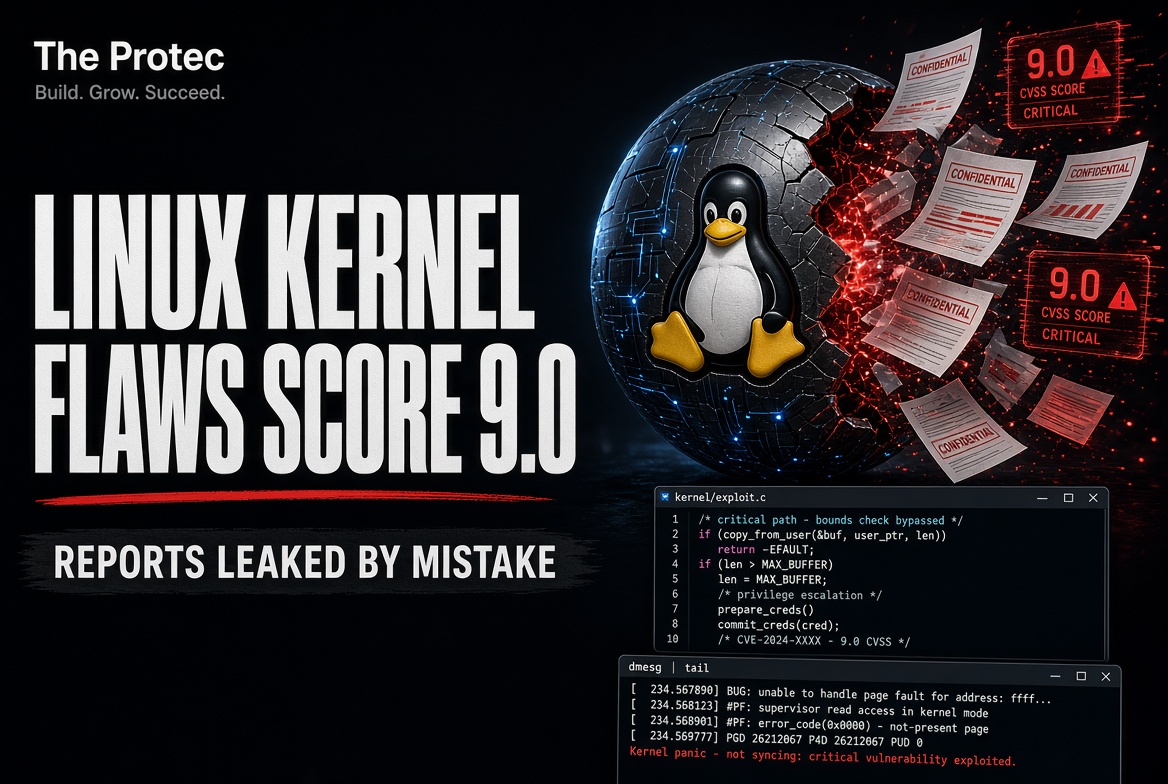
According to reporting highlighted by Phoronix, multiple vulnerability submissions associated with Trend Micro’s Zero Day Initiative, or ZDI, appeared on the public Linux kernel mailing list rather than being handled only through the kernel project’s private security channel. Some reports carried CVSS base scores of 9.0, placing them in the critical range. At least some of the described problems reportedly did not yet have an accepted mainline fix when the messages became public.
That combination sounds alarming, but it requires careful interpretation. Public technical details do not prove that a flaw is exploitable on every Linux system. A CVSS 9.0 score does not demonstrate active attacks. An unpatched mainline kernel does not necessarily mean every distribution kernel lacks a backported fix. Most importantly, there has been no confirmed evidence that the disclosure resulted from a compromise of Linux infrastructure, ZDI systems, or a distribution’s security process.
For security teams, the correct response is neither panic nor inaction. It is disciplined verification: identify the affected component, establish whether that component is present and reachable, follow the relevant vendor advisory, and apply a supported update or mitigation when one becomes available.
What reportedly happened with the Linux vulnerability disclosure
The Linux kernel project maintains public mailing lists for development discussions, patch review, and subsystem coordination. It also documents a private process for vulnerabilities that should receive coordinated handling before technical details are broadly distributed.
The recent disclosure issue reportedly involved ZDI vulnerability reports being delivered to a public Linux kernel mailing list instead of the usual private security contact. The messages exposed technical claims about multiple kernel flaws, including potential impact, triggering conditions, affected functionality, and severity assessments. Some of the reports assigned a CVSS score of 9.0.
This is best described as an apparent premature or misdirected public disclosure. Calling it a confirmed “leak” or security breach would go beyond the evidence. A message can become public because of an addressing error, process misunderstanding, automated routing problem, or intentional disclosure after a coordination deadline. Unless the parties involved publish a definitive explanation, the precise cause should be treated as unconfirmed.
The kernel project’s official process for reporting security issues is described in the Linux kernel security bugs documentation. That process emphasizes private initial reporting, limited distribution, coordinated development of a fix, and disclosure after maintainers have had an opportunity to respond.
What was disclosed, and what remains uncertain
The public material reportedly consisted of individual vulnerability reports rather than one universal Linux flaw. That distinction matters. Each report must be evaluated according to its own subsystem, affected code path, kernel history, configuration requirements, permissions, and proposed remediation.
Public mailing-list messages may contain a ZDI tracking number, a preliminary severity rating, reproduction details, or a proposed affected-version range. Those elements are useful, but they are not automatically equivalent to a finalized Linux kernel security advisory. Likewise, a ZDI case number, mailing-list subject, CVE reservation, and distribution advisory are separate records that may be published at different times.
Administrators should resist combining every message into a single claim that “Linux has several remotely exploitable zero-days.” The reports may involve different exploit prerequisites. A flaw described as remote code execution could require an optional network-facing subsystem, a specific protocol, a vulnerable driver, prior authentication, or a nondefault configuration. A Linux privilege escalation vulnerability may require a local account or the ability to invoke a particular kernel interface.
CVE identifiers also need to be checked individually. Early disclosures do not always include a finalized Linux kernel CVE, and an identifier can be reserved before its public record contains complete information. Conversely, the Linux kernel CVE authority may later assign identifiers, adjust affected-version data, reject a duplicate, or link the problem to a correcting commit. Security teams should correlate each ZDI report with the eventual CVE record, upstream commit, stable-kernel backport, and distribution advisory rather than relying on copied lists from social media.
ZDI’s public advisories can be monitored through the Zero Day Initiative published advisories. If a ZDI entry and a kernel mailing-list post appear to describe the same issue, compare technical details instead of matching solely by title.
Why some flaws may remain unpatched in the mainline kernel
A report can become public before a correction is accepted into the mainline Linux tree. That does not always mean developers ignored it. Kernel patches must be technically correct, avoid regressions, fit the subsystem’s locking and lifetime rules, and survive review. The first proposed patch may need revision, especially for memory-safety, concurrency, or reference-counting defects.
Several patch states can exist at once:
- Reported but not fixed: Maintainers are still validating the issue or designing a correction.
- Patch proposed: Code has appeared on a mailing list but has not been accepted.
- Accepted upstream: A fix is in a maintainer tree or mainline release but may not yet be in stable kernels.
- Backported: Stable-kernel maintainers or a distribution have adapted the fix to an older supported kernel.
- Distributed: Updated packages are available through a vendor repository, but customers still need to install them and reboot.
This is why “fixed in Linux 6.x” is often inadequate operational guidance. Enterprise distributions commonly maintain kernels whose package versions look older while carrying extensive security backports. Meanwhile, a newer kernel from an unofficial repository could contain the vulnerable code, omit a required backport, or introduce unrelated compatibility and security risks.
What a Linux vulnerability CVSS 9.0 score actually means
CVSS is a standardized method for describing vulnerability severity. Under CVSS v3.1, scores from 9.0 through 10.0 are categorized as critical. A score can rise when a flaw is reachable over a network, requires little complexity, needs no user interaction, crosses a security boundary, or can seriously affect confidentiality, integrity, and availability.
However, CVSS is not a prediction that exploitation will occur. It also does not capture every environmental control. A Linux kernel remote code execution issue can receive a very high base score even when the vulnerable subsystem is disabled on most servers. A high-scoring local flaw may still require an authenticated account, container access, a device node, or a capability that hardened systems do not grant.
When reviewing a reported CVSS 9.0 Linux vulnerability, ask:
- Is the attack vector network, adjacent, or local?
- Does exploitation require authentication, privileges, or user interaction?
- Is the vulnerable subsystem compiled, loaded, configured, and reachable?
- Does the workload expose the relevant protocol or device to untrusted users?
- Is the score vendor-assigned, researcher-assigned, or confirmed in an authoritative CVE record?
- Is exploit code public, and is there credible evidence of active exploitation?
No confirmed active exploitation should be inferred merely because technical information became public. Nevertheless, premature disclosure can reduce defenders’ lead time by giving researchers and attackers additional information before Linux kernel security patches are widely available.
Mainline status is not the same as distribution exposure
Linux server security depends heavily on distribution packaging. Red Hat, Ubuntu, Debian, SUSE, Amazon Linux, Oracle Linux, and other vendors assess kernel vulnerabilities against their own source trees, configurations, backports, and support policies. Two servers reporting similar upstream kernel versions may therefore have different exposure.
A distribution may determine that its kernel is not affected because the vulnerable commit was never included. It may classify the issue as lower priority because the feature is unavailable or disabled. It may also release a backported correction without changing to the newest upstream kernel series.
For that reason, administrators should not use the version shown by uname -r as the sole verdict. It identifies the running kernel, but exposure analysis also requires the distribution package release, architecture, configuration, loaded modules, and vendor advisory status.
Practical Linux server vulnerability mitigation checklist
1. Inventory the running kernel and distribution
Record uname -r, the operating-system release, architecture, kernel package version, and cloud or appliance image. Confirm whether the machine is using the distribution kernel, a cloud-optimized build, a real-time kernel, or a third-party package.
2. Monitor official security advisories
Follow the security channel for the exact distribution and supported release. Vendor advisories should be the primary source for affected-package determinations, fixed versions, mitigations, and reboot instructions. Also monitor the relevant CVE records and stable-kernel updates as details evolve.
3. Assess exposure to the affected functionality
Determine whether the implicated subsystem is compiled into the kernel or available as a module. Check whether the module is loaded, whether a related service is listening, and whether untrusted local users, containers, virtual machines, or network clients can reach the vulnerable interface.
4. Apply vendor-recommended mitigations
If no patch is available, a vendor may recommend disabling a service, blocking a protocol, unloading or denying a module, restricting a device, or tightening access controls. Test mitigations before broad deployment and document their operational impact. Do not invent configuration changes based only on an incomplete mailing-list report.
5. Reduce privileges and unnecessary services
Limit shell access, administrative capabilities, container privileges, device passthrough, and exposed network services. These measures do not repair Linux kernel vulnerabilities, but they can remove exploit prerequisites and reduce the impact of successful exploitation.
6. Install supported updates promptly
Use signed packages from the operating-system vendor or another formally approved supplier. Prioritize internet-facing systems, multi-user servers, container hosts, and machines processing untrusted content when their configurations match the affected conditions.
7. Reboot when the updated kernel requires it
Installing a kernel package normally does not replace the kernel currently running in memory. Schedule and verify a reboot, then confirm that the fixed package is active. Live patching may address certain flaws, but only when the vendor explicitly states that the applicable live patch covers the vulnerability.
8. Watch for exploitation evidence without overstating it
Review authentication events, crashes, kernel warnings, module activity, service logs, and unusual privilege changes. Preserve evidence if compromise is suspected. A crash or warning alone is not proof that one of the disclosed flaws was exploited.
Why unofficial patches and blind kernel switching are risky
Public mailing-list discussions often include experimental patches. Administrators should not copy and deploy them to production simply because a vulnerability has a critical score. A proposed change may be incomplete, may not apply cleanly to a vendor kernel, or may introduce a denial of service, data corruption, or a new security weakness.
Switching to another kernel version is not a guaranteed solution either. The alternative version could contain the same vulnerable commit, lack a stable backport, fall outside vendor support, or be incompatible with required modules. The safer approach is to wait for an authenticated, tested update or explicit mitigation from the responsible kernel or distribution security team, unless an organization has the engineering capacity to validate and maintain its own kernel builds.
FAQ about the public Linux kernel security reports
Were all Linux servers affected by the reported vulnerabilities?
No. The reports concern individual kernel components and code paths. Exposure depends on the precise flaw, kernel source history, distribution backports, configuration, architecture, loaded modules, services, and attacker access. Administrators need a distribution-specific assessment for each CVE.
Does a CVSS 9.0 score mean attackers are exploiting the flaw?
No. CVSS describes potential technical severity under defined conditions. It does not establish exploit availability or active exploitation. Those require separate evidence from vendors, incident responders, telemetry providers, or government security agencies.
Was the public disclosure caused by a security breach?
There is no basis to describe it as a confirmed breach without an authoritative investigation or statement. The available reporting indicates that vulnerability material appeared on a public mailing list rather than the expected private channel. The cause remains distinct from the security impact of the disclosed flaws.
Should administrators upgrade directly to the newest upstream kernel?
Not automatically. Most production systems should follow their distribution’s supported update path. Distribution kernels frequently contain security backports, while an arbitrary upstream or third-party build may create support, compatibility, and security problems.
What should teams track as the reports develop?
Track each confirmed Linux kernel CVE, the vulnerable and correcting commits, stable backports, ZDI advisory updates, and the security bulletin for the deployed distribution. Recheck earlier conclusions because affected-version ranges and patch status can change as maintainers complete their analysis.
The priority is verified, distribution-specific action
The accidental or premature appearance of Linux kernel security reports is important because it may expose technical details before coordinated fixes reach users. The reported CVSS 9.0 ratings justify prompt investigation, but they do not support blanket claims that every Linux server is critically vulnerable or under attack.
Security teams should maintain a current kernel inventory, monitor official Linux distribution security channels, correlate ZDI reports with confirmed CVE identifiers, and evaluate whether affected functionality is actually reachable. Apply supported Linux kernel security patches as soon as they are available, use vendor-recommended mitigations when they are not, and reboot where necessary to activate the corrected kernel.
As technical details evolve, authoritative advisories and verified patch records should take precedence over screenshots, reposted mailing-list excerpts, and untested fixes. That measured approach gives administrators the best chance of responding quickly without creating new risks in the process.