






Best AI Voice Generators: ElevenLabs vs PlayHT vs Google AI Studio
Choosing the best AI voice generator is no longer a novelty decision. For creators, marketers, founders, and production teams, it is now a business choice that affects brand quality, localization speed, and content output. The strongest platforms do more than read text aloud. They deliver emotionally convincing speech, support multiple languages, offer voice cloning, and provide commercial usage terms that actually work for real projects.
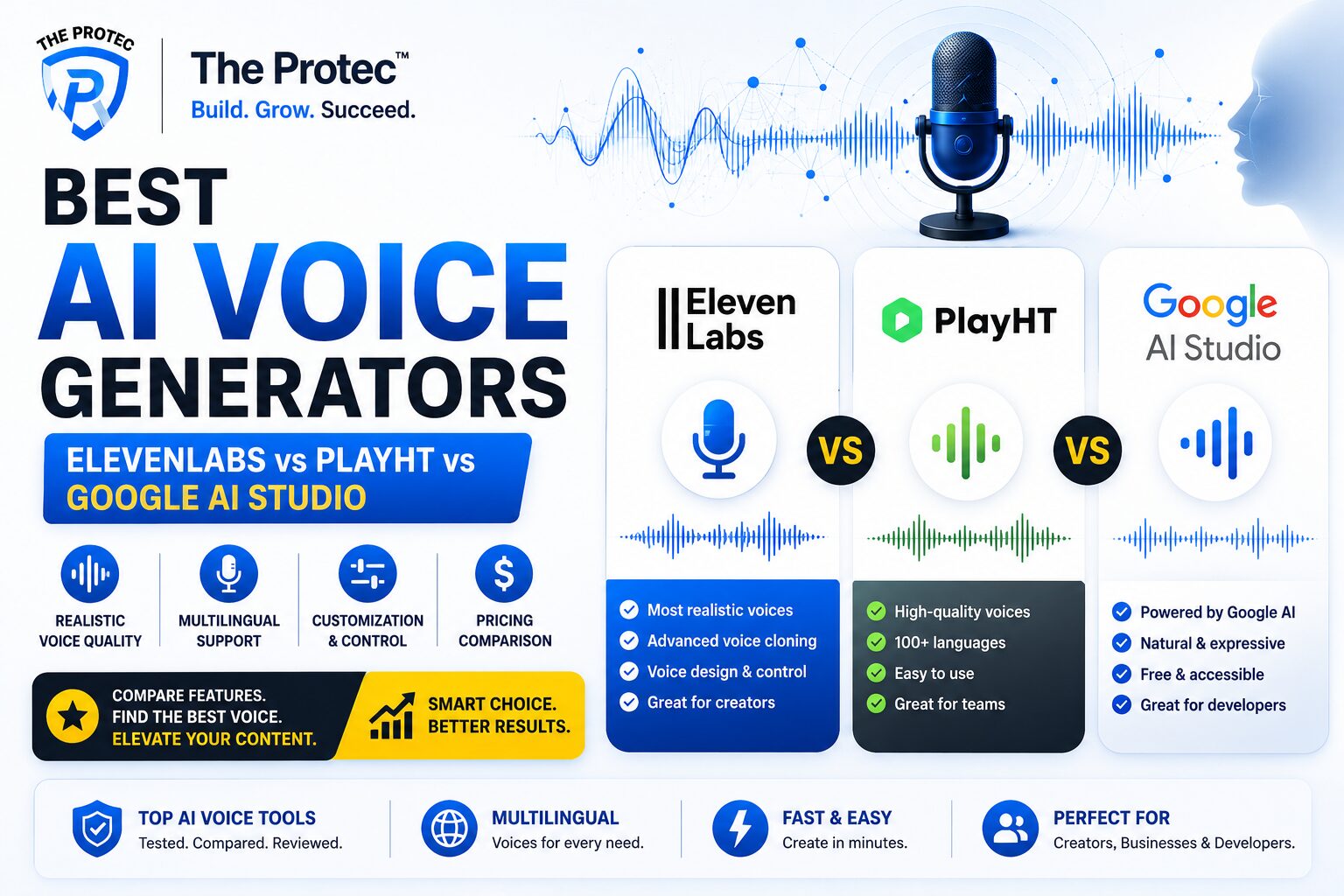
In this AI voice generator comparison, three names stand out in 2026: ElevenLabs, PlayHT, and Google AI Studio. Each one has a different strength. ElevenLabs is widely known for ultra-realistic voice quality and flexible cloning. PlayHT is attractive for teams that want broad voice control and deployment options. Google AI Studio, powered by Google’s broader AI ecosystem, appeals to developers and businesses that want infrastructure, multimodal workflows, and scalable integration.
If you are searching for ElevenLabs alternatives or trying to decide which platform is best for podcasts, ads, training content, videos, or customer-facing applications, this guide breaks down the practical differences that matter most.
What matters in a best AI voice generator
Not every text-to-speech tool belongs in the same conversation. A truly useful best AI voice generator should be judged on a few core criteria:
- Voice realism: Does the speech sound natural, expressive, and emotionally believable?
- Voice cloning: Can you create a custom voice from samples, and how accurate is it?
- Language support: How many languages and accents are available, and how well are they pronounced?
- Commercial rights: Can you use the output in monetized content, ads, apps, or client work?
- Pricing: Is the platform affordable at scale, or does usage get expensive quickly?
- Workflow fit: Is it built for creators, teams, or developers?
In 2026, the biggest trend is not just better voice generation. It is controllable voice generation. Users want styles, pacing, emotional range, instant multilingual delivery, and safe commercial use without confusing licensing restrictions.
ElevenLabs overview: the realism benchmark
ElevenLabs remains the reference point for voice realism. It is often the first platform people test when they want natural-sounding narration that feels close to human performance. What makes it stand out is the combination of clarity, intonation, and emotional nuance. In many use cases, it still sounds less robotic than most competitors, especially for long-form narration, storytelling, and branded content.
The platform’s voice cloning is one of its biggest selling points. For creators and businesses that need a recognizable voice identity, ElevenLabs can produce impressive custom results with relatively little friction. It is especially useful for audiobook-style narration, YouTube videos, e-learning, and multilingual dubbing workflows.
ElevenLabs also offers a strong ecosystem for speech generation, including tools for voice design, sound effects, and API access. That makes it appealing not only to solo creators but also to teams building products that need voice at scale.
Best for: creators who prioritize realism, brands that want premium voice quality, and teams building polished audio experiences.
Main tradeoff: pricing can rise quickly as usage grows, especially for heavy content production or high-volume commercial workflows.
PlayHT overview: flexible and creator-friendly
PlayHT has positioned itself as a practical ElevenLabs alternative for users who want strong voice output with more flexibility in how they deploy and manage content. It is popular with marketers, content teams, course creators, and businesses that need a broad library of voices without spending time on complex setup.
One of PlayHT’s strengths is its balance between quality and usability. The voices are generally polished, and the platform supports a range of accents and styles that can work well for explainers, podcasts, social clips, and product demos. While it may not always match ElevenLabs at the very top end of realism, it often delivers more than enough quality for commercial content where speed and consistency matter.
PlayHT is also known for offering production-friendly features such as API access, team workflows, and export options that fit into modern content pipelines. For businesses that want to standardize voice generation across multiple projects, that matters as much as raw voice quality.
Best for: creators and businesses that want a strong balance of quality, control, and practical pricing.
Main tradeoff: for the most emotionally nuanced voices, some users still prefer ElevenLabs.
Google AI Studio overview: powerful for developers and scale
Google AI Studio is different from the other two in how it is typically used. Rather than being marketed purely as a consumer-first voice platform, it sits inside a broader AI development environment. That makes it attractive to technical teams, product builders, and enterprises looking for integration with modern Google AI workflows.
For voice generation, Google’s ecosystem is strongest when audio is part of a larger AI system: content pipelines, assistants, transcription, summarization, and multimodal product experiences. If your team needs voice generation connected to prompts, structured workflows, or application logic, Google AI Studio can be a compelling choice.
That said, businesses comparing the best AI voice generator options should recognize that Google AI Studio is usually less about a creator-style voice marketplace and more about building with AI. For users who want plug-and-play voice cloning and a deep library of studio-ready voices, ElevenLabs and PlayHT may feel more directly tailored.
Best for: developers, product teams, and businesses building AI-powered audio features into larger workflows.
Main tradeoff: it may require more technical setup and is not always the simplest option for quick content production.
AI voice generator comparison: realism, cloning, and control
Voice realism is the first thing most users notice, and it is still the biggest differentiator in this category. ElevenLabs generally leads in emotional depth and human-like cadence. It tends to sound especially strong in narration, character voices, and long-form spoken content. If realism is your top priority, it remains a top contender for the best AI voice generator title.
PlayHT offers solid realism with enough expressiveness for most business use cases. It is usually a reliable choice when the goal is professional audio that sounds clean, understandable, and brand-safe. For many teams, the difference between “excellent” and “very good” matters less than whether the workflow is fast and affordable.
Google AI Studio’s voice capabilities are more closely tied to its underlying model and developer environment. It is promising for advanced workflows, but the experience is often less about choosing from a polished catalog of voices and more about integrating voice into an AI system. That makes it powerful, but not always the easiest path for creators who want immediate results.
On voice cloning, ElevenLabs is still one of the most recognized names. Its cloning tools are mature and widely used for branded narration, creator voice replication, and localization. PlayHT also offers cloning features that can work well for business applications. Google AI Studio is better understood as a platform for custom AI solutions than a dedicated voice cloning studio, which means it is strongest for technical teams rather than casual users.
Language support and global content creation
Language support is now a major buying factor. More teams are publishing content across regions, and voice quality in non-English languages matters far more than it did a few years ago. In this area, both ElevenLabs and PlayHT have expanded significantly, especially for multilingual narration and localized video content.
ElevenLabs is particularly strong for users who want the same voice identity across different languages. That consistency is valuable for brands, educators, and media companies that want a unified sonic presence.
PlayHT also supports multiple languages and can be effective for international content pipelines. It is a practical option for teams that need multilingual delivery without overcomplicating production.
Google AI Studio benefits from Google’s deep language and AI expertise, which gives it strong potential for multilingual workflows, especially when combined with translation, speech, or assistant features. For businesses building products that must serve global audiences, that ecosystem advantage can be important.
In short, if you are focused on creator-grade multilingual narration, ElevenLabs and PlayHT are easier to evaluate directly. If you are building a product where voice is only one part of a larger language system, Google AI Studio becomes more compelling.
Pricing and value: where each platform makes sense
Pricing is one of the most important parts of any AI voice generator comparison because voice generation costs can scale quickly with volume. The cheapest option is not always the best value if the audio quality forces rework. Likewise, the most expensive option is not always worth it if your content only needs straightforward narration.
ElevenLabs typically offers strong value for premium-quality output, but it can become costly for teams with high usage, especially when cloning, API calls, and larger production workflows are involved. If you need the best quality and are willing to pay for it, it is often justified. If you are producing hundreds of voice minutes every month, costs deserve careful review.
PlayHT is often viewed as a more approachable commercial option for teams that want quality without premium pricing pressure. It can make sense for agencies, startups, and content operations that need consistent output across many pieces of content.
Google AI Studio may offer strong value in the context of broader AI development, especially if your organization is already using Google AI tools. For standalone voice creation, though, the value story depends heavily on your technical setup and how deeply you plan to integrate it into product workflows.
When comparing pricing, think in terms of total cost of production, not just subscription fees. Editing time, localization effort, and the need for retakes can make a more expensive voice generator cheaper in practice if it saves hours of cleanup.
Commercial rights and business use
Commercial rights are essential if you plan to monetize the output. That includes YouTube monetization, client projects, ads, podcast sponsorships, training modules, SaaS products, and in-app voice experiences. Before choosing any platform, review the current plan terms carefully. Licensing can differ by plan level, usage type, and whether you are using generated voices internally or externally.
ElevenLabs has built a strong reputation for commercial-ready use cases, particularly among creators and businesses that need confidence in the output rights. PlayHT also supports commercial workflows and is commonly used by teams producing branded content. Google AI Studio’s commercial suitability depends more on how you are using the broader Google AI environment and what terms apply to the specific tools and services involved.
The practical advice is simple: if your business depends on voice output, do not choose based on audio quality alone. Confirm whether the platform allows client work, resale, distribution, and product integration under your plan. This is especially important for agencies and SaaS companies.
Which tool is best for creators?
For creators, the best AI voice generator usually comes down to three things: realism, speed, and brand identity. ElevenLabs is often the best choice for creators who want premium narration quality and expressive delivery. It is particularly strong for YouTubers, podcasters, course creators, and storytellers.
PlayHT is a smart pick for creators who need dependable output and a slightly more operational workflow. If you produce lots of social content, tutorials, or marketing assets, it can be a very practical ElevenLabs alternative.
Google AI Studio is less of a direct creator-first voice tool and more of a builder’s environment. Creators working with technical partners or embedding voice into an app may find it valuable, but for quick studio-style production, the other two are usually easier.
Which tool is best for businesses?
For businesses, the decision is broader than narration quality. Teams need reliability, licensing clarity, collaboration, and scale. ElevenLabs is the premium choice for brand-forward businesses that want voice quality to reflect their product or media standards. It is especially good for marketing, customer education, and premium content.
PlayHT is often the most balanced option for business teams that need to produce at volume without overspending. It fits agencies, internal learning teams, and content studios that value workflow efficiency.
Google AI Studio is strongest for businesses building AI products, digital assistants, or automated content systems. If voice is part of a larger product architecture, it can be the most strategic choice of the three.
If your business needs a voice layer that customers will hear directly, the experience should feel polished and stable. If you are building the voice layer into a product backend, technical flexibility may matter more than a voice marketplace UI.
Final verdict: the best AI voice generator depends on the job
There is no single winner for every use case, but there is a clear pattern.
- Choose ElevenLabs if you want the most natural, emotionally convincing voice quality and strong voice cloning.
- Choose PlayHT if you want a practical balance of quality, flexibility, and business-friendly workflows.
- Choose Google AI Studio if you are building technical AI products and want voice to be part of a larger Google-powered workflow.
For most creators, ElevenLabs is the best AI voice generator if realism is the top priority. For many businesses, PlayHT can be the better value. For developers and product teams, Google AI Studio may be the most strategic platform even if it is not the most creator-friendly.
The smartest move is to test all three with the same script, same tone, and same use case. That will show you how each platform handles pacing, pronunciation, emotions, and consistency. In 2026, the best AI voice generator is the one that saves time, sounds believable, and fits your commercial workflow without friction.
For a helpful external reference on platform capabilities, you can review the official sites for ElevenLabs and PlayHT.
FAQ
What is the best AI voice generator for realism?
ElevenLabs is usually the strongest option for realism, especially if you want expressive narration, natural pacing, and convincing emotional delivery.
Are ElevenLabs alternatives good enough for commercial use?
Yes. PlayHT is a strong ElevenLabs alternative for many commercial projects, and Google AI Studio can work well for technical business applications when used in the right workflow.
Which AI voice platform is best for voice cloning?
ElevenLabs is one of the most recognized voice cloning tools, while PlayHT also offers useful cloning features. Google AI Studio is better suited to custom AI development than direct creator-style cloning.
Which tool is best for multilingual content?
ElevenLabs and PlayHT are both strong for multilingual narration. Google AI Studio is powerful for language-based AI workflows, especially in technical environments.
How should businesses choose between these tools?
Businesses should compare voice quality, commercial rights, pricing at scale, API access, and workflow fit. The best choice depends on whether the goal is content production, branded narration, or AI product development.