







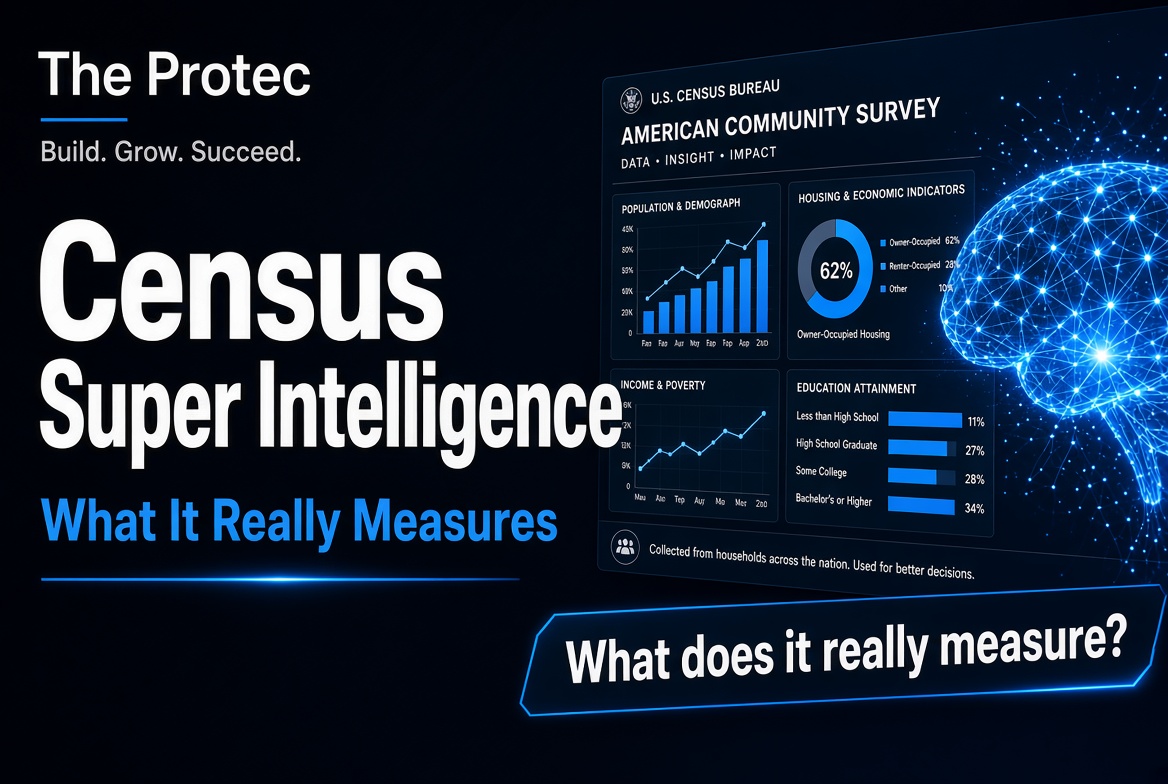
A federal terminology change has created a new challenge for anyone tracking how companies use artificial intelligence. The Census Bureau Super Intelligence survey now uses “Super Intelligence,” abbreviated as “SI,” where it previously referred to “Artificial Intelligence” or “AI.” The change follows Executive Order 14434, but it does not mean the government has discovered, created, or formally redefined a more advanced class of technology. It changes the language used in official federal communications—and potentially how businesses understand and answer the survey question.
That distinction matters because the U.S. Census Bureau’s Business Trends and Outlook Survey, or BTOS, is an important source of timely information about business conditions and technology use. Researchers, journalists, investors, and policymakers may be tempted to place its adoption estimates on a single continuous chart. Doing so without checking the questionnaire version could produce a misleading trend.
What changed in the Census Bureau business survey?
The Census Bureau replaced references to Artificial Intelligence and AI with Super Intelligence and SI in BTOS materials following Executive Order 14434. The order directs federal agencies to adopt the new terminology in official communications. The relevant change is therefore administrative and linguistic: federal documents use a different label for the technology.
The executive order itself should be read through the White House’s official presidential actions collection. Nothing about substituting the term “Super Intelligence” automatically changes the software, models, automation tools, or business activities covered by the survey. It also does not establish that today’s systems possess what computer scientists might independently describe as superintelligence.
In practical terms, a business using a generative writing assistant, machine-learning forecasting system, image-recognition service, or AI-enabled customer support tool does not begin using a different technology merely because a federal questionnaire calls it SI. The label changed; the underlying tools did not necessarily change.
Executive Order 14434 changes terminology, not technology
The phrase “superintelligence” already has meanings in academic, industry, and popular discussions. It is often used hypothetically to describe a system whose capabilities substantially exceed human performance across a wide range of intellectual tasks. That background makes the federal wording potentially confusing.
Executive Order 14434, however, operates as a direction about government language. It should not be interpreted as technical proof that existing AI systems have reached a particular capability threshold. Nor does the order, by itself, show that businesses changed which tools they use.
This is the central point for interpreting Census Bureau AI data: a terminology mandate can alter a survey instrument without altering the real-world behavior the instrument is intended to measure. At the same time, respondents may react differently to the new phrase. Some may treat SI as a direct replacement for AI, while others may assume it refers only to unusually advanced systems. That possibility creates a measurement concern even if Census intended the terms to cover the same underlying category.
The survey’s scope had already changed before AI was renamed
The SI terminology is not the only issue affecting comparisons. As Simon Willison documented in his Weblog chronology and analysis, BTOS had already revised the substance of its technology-use question. An earlier version focused on whether a business used AI in producing goods or services. A later version asked about its use in any business function.
Those formulations measure different scopes:
- Producing goods or services concentrates on technology involved in a company’s output or production process.
- Any business function can also encompass internal activities such as marketing, accounting, human resources, cybersecurity, administration, research, or customer management.
A company might use a generative AI assistant to draft internal communications while never applying AI directly to the goods it sells or the services it delivers. Under a production-focused question, that company might answer no. Under an any-function question, it could appropriately answer yes—even if its technology use had not changed between survey periods.
The broader wording may therefore capture more forms of U.S. business AI adoption. An increase between the two versions cannot automatically be attributed to companies adopting AI at a faster rate. Part or all of the difference could arise from the expanded definition of where use counts.
Why the SI wording may create another break in the series
Survey researchers use the idea of a “break in series” when a change in definitions, questions, methods, or classifications makes newer estimates imperfectly comparable with earlier ones. The BTOS technology questions now present at least two relevant transitions:
- The scope moved from AI use in producing goods or services to AI use in any business function.
- The terminology moved from Artificial Intelligence or AI to Super Intelligence or SI.
The first change clearly broadens the activities respondents may consider. The second is intended as a terminology substitution, but it may still affect interpretation. “AI” is a familiar commercial label found in software menus, product descriptions, and corporate policies. “SI” is less familiar and may suggest a narrower or more capable class of system to some respondents.
That does not prove the new term changed responses. Establishing a measurable wording effect would require evidence, such as randomized question testing, a bridge study, or parallel versions administered to comparable samples. Without that evidence, analysts should recognize the risk without claiming a demonstrated effect.
The safest conclusion is limited but important: estimates collected under different question versions should not be treated as directly interchangeable. A rise or fall near a wording transition may reflect real adoption, the expanded business-function scope, respondents’ interpretation of SI, ordinary sampling variation, or a combination of these factors.
Collection dates and publication dates are not the same
Another source of confusion is the difference between when businesses answer a question and when the resulting estimates become public. BTOS data are associated with a collection period, while Census releases the processed results later. A webpage update or table publication date is not necessarily the date respondents first encountered the wording.
Willison’s chronology is useful because it separates the executive order, the questionnaire changes, collection, and public availability rather than collapsing them into one event. Census materials should remain the source of record for the questionnaire, collection period, release notes, and published estimates. The agency’s Business Trends and Outlook Survey page provides the relevant survey documentation and data resources.
As of November 2, 2026, it would be inaccurate to describe results using the new SI terminology as simply awaiting release. Census Bureau materials include published BTOS results associated with the revised wording. Analysts should still identify the applicable collection period and questionnaire version instead of assigning the wording based only on the date a chart, article, or data file was published.
How to interpret Census Bureau AI data responsibly
Readers do not need to discard BTOS technology data. They do need to use it with appropriate methodological context. Several practices can prevent overstatement.
Check the exact question before comparing estimates
Do not rely only on a chart label such as “AI use” or “SI use.” Read the questionnaire text and determine whether it refers to production or to any business function. A short label can conceal a consequential difference in scope.
Divide the timeline into comparable segments
Analyze production-focused AI estimates separately from any-function estimates. Within the broader series, note when AI renamed Super Intelligence became the official wording. Showing visible annotations or separate lines is more transparent than presenting an apparently seamless trend.
Avoid causal claims based on the wording transition
If reported adoption changes around the transition, do not claim that the executive order caused businesses to adopt or abandon technology. The order affects federal terminology. It is not, on its own, evidence of changed investment, deployment, productivity, or technical capability.
Report both collection and release information
A careful citation should identify the collection period represented by an estimate and, where relevant, its release date. This prevents a later publication date from being mistaken for the moment when the revised question was administered.
Use qualified language
Phrases such as “reported use under the revised question” are more accurate than broad claims that business AI use definitively surged or collapsed. Qualification is especially important until researchers can estimate whether the unfamiliar SI label produced a response effect.
What the change means for U.S. business AI adoption
BTOS remains valuable because it provides frequent, broad-based information about U.S. businesses. The terminology dispute does not make the data useless. Instead, it illustrates why survey estimates cannot be separated from the questions that produced them.
The broader “any business function” formulation may offer a more complete view of how companies encounter AI-enabled tools across daily operations. Yet it measures a wider concept than the earlier production question. The subsequent SI substitution may preserve the government’s intended concept while changing the words respondents see.
For policymakers and business leaders, the lesson is straightforward: data continuity depends on more than keeping the same table name. Definitions, examples, scope, abbreviations, and respondent understanding all matter. Anyone using the Census Bureau Super Intelligence survey as evidence should disclose these transitions and avoid treating every movement as a real-world change in adoption.
Frequently asked questions
Did the Census Bureau replace AI technology with Super Intelligence?
No. The Census Bureau changed the terminology used in the survey following Executive Order 14434. The change does not itself replace, upgrade, or redefine the technologies businesses use. SI functions as the required federal label in this context.
Are AI and SI estimates directly comparable?
Not automatically. The label change may influence how respondents interpret the question, and the survey’s scope had already expanded from production-related use to use in any business function. Comparisons should account for both revisions.
Does a higher estimate prove business adoption increased?
No. A higher estimate could reflect genuine adoption, broader question coverage, a wording effect, sampling variation, or several factors together. The data and questionnaire version must be examined before drawing a conclusion.
Have results using the new SI wording been published?
Yes. As of November 2, 2026, Census materials include released BTOS results associated with the new terminology. Readers should distinguish the collection period from the later publication date when identifying which wording applies.
What is the best way to present the trend?
Mark the question changes clearly, separate noncomparable segments where necessary, quote or summarize the applicable wording, and avoid drawing a continuous line without a methodological note. That approach preserves the usefulness of the data without overstating its comparability.