








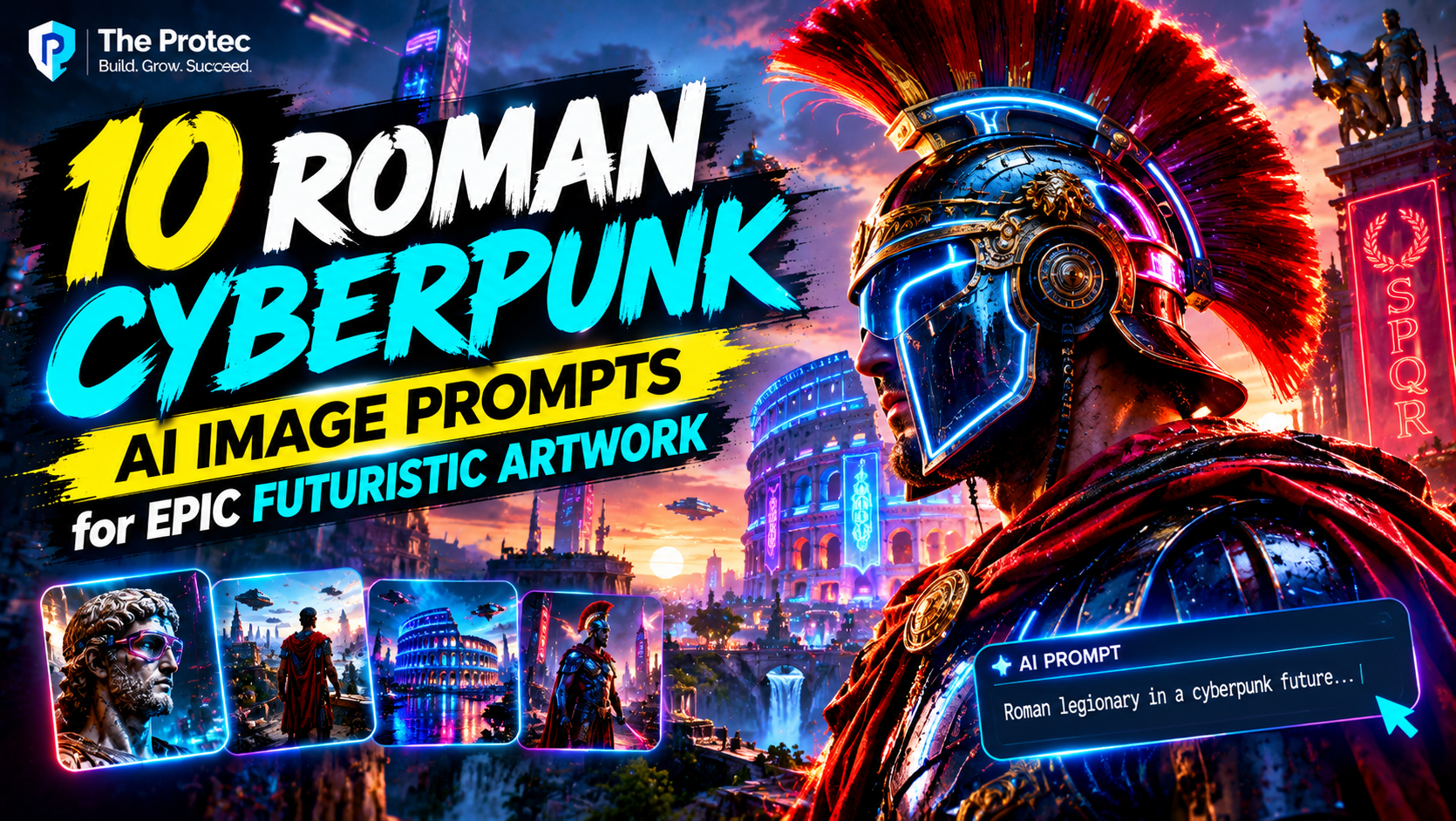
Ancient monuments become far more intriguing when starships cross their skylines and armored legionnaires carry energy shields. These Roman cyberpunk AI image prompts are designed to help you create that contrast deliberately rather than settling for an ordinary cyberpunk city with a few columns added. Each copy-ready prompt combines recognizable Roman forms and cultural motifs with cybernetics, artificial intelligence, dystopian infrastructure, holographic propaganda, advanced transport, and dense futuristic cities.
Roman cyberpunk is an imaginative alternate-future aesthetic, not a claim about Roman history. Its strongest images preserve visual anchors such as arches, aqueducts, forums, marble temples, military insignia, laurel crowns, and monumental sculpture. Futuristic technology should then feel integrated into those forms: circuitry follows engraved borders, transit lines resemble aqueducts, and robotic armor echoes classical silhouettes.
Before generating your Roman cyberpunk art
You can test these prompts with ChatGPT image generation, Midjourney, Adobe Firefly, or Leonardo AI. No generator is universally best: interpretation, detail, text rendering, editing options, and stylistic tendencies vary by model and settings. Access requirements, usage allowances, pricing, and aspect-ratio controls also change frequently. Before choosing a workflow, confirm current details through each provider’s official product pages; useful starting points include OpenAI’s image-generation overview and Adobe Firefly plans. Midjourney and Leonardo AI likewise offer plan-dependent access and generation limits, so check their current interfaces rather than relying on an old tutorial.
The aspect ratios below describe the intended canvas. Enter them through the generator’s dedicated controls when available; otherwise, retain the ratio instruction in the text. Results will still vary, so treat the first output as a draft to diagnose and refine.
10 Roman cyberpunk AI image prompts to copy and customize
1. The Colosseum After Dark
A colossal futuristic Roman Colosseum at night, its ancient stone arches reinforced with dark metal ribs and illuminated from within by amber architectural lights; immense holographic imperial banners drift above the upper tiers while compact flying vehicles circle the structure. Rain-slick travertine plazas reflect controlled cyan and crimson accents, with tiny pedestrians establishing scale. Dramatic wide establishing shot from street level, deep perspective, storm clouds opening behind the arena, cinematic realism, finely textured weathering, 16:9 aspect ratio.
2. Cyberpunk Roman Legionnaires
A disciplined formation of cybernetic Roman legionnaires marching through a smoky battlefield, wearing articulated bronze-and-titanium armor with engraved imperial insignia, segmented mechanical joints, red luminous visor details, and translucent energy shields. Ash moves across broken defensive walls as distant machinery burns behind them. Cinematic low-angle composition near ground level, the lead soldier sharply defined against diffuse firelight, forceful diagonal movement, realistic scratches and soot, tense military atmosphere, 16:9 aspect ratio.
3. Neon Forum Market District
A crowded street inspired by ancient Rome reimagined as a cyberpunk market district, with marble columns supporting improvised balconies, neon Latin-inspired signage, holographic produce stalls, exposed cables, steam vents, delivery robots, and wet cobblestones. Merchants and citizens in layered techno-togas fill the foreground and middle distance. Layered street-level perspective from within the crowd, warm shop interiors contrasting with cool reflections, humid evening atmosphere, dense environmental storytelling, tactile stone and fabric, 16:9 aspect ratio.
4. Robotic Emperor on the Imperial Throne
A commanding Roman emperor wearing intricate robotic imperial armor, seated in a monumental throne room; overlapping engraved metal plates, black enamel inlays, glowing gold circuitry, and a technologically enhanced laurel crown frame a stern human face. The throne combines carved marble eagles with precision machinery, while tall windows reveal an advanced capital. Refined vertical portrait, slightly low viewpoint, centered authority, sculpted overhead illumination and deep burgundy shadows, crisp facial detail, 4:5 aspect ratio.
5. Futuristic Roman Goddess
A fictional futuristic Roman goddess inspired by classical sculpture, standing beneath a marble-and-glass rotunda in elegant flowing metallic robes. Luminous pearl ornaments trace the fabric folds, subtle holographic constellations orbit her hands, and polished silver details contrast with softly weathered stone. Refined vertical composition with a graceful full-length silhouette, ethereal rim lighting from the circular roof, restrained ivory and pale-blue palette, serene expression, delicate material response, dreamlike but sophisticated atmosphere, 4:5 aspect ratio.
6. Cyberpunk Gladiator Arena
A cyberpunk gladiator arena packed with roaring spectators, towering holographic displays suspended over the sand, and two armored combatants colliding at the center with energized weapons. Transparent energy barriers protect the lower stands while mechanical gates open behind them. Wide action composition captured at the instant of impact, dramatic spotlights cutting through airborne dust, strong opposing silhouettes, sparks and displaced sand conveying motion, immense architectural scale, high-contrast cinematic art direction, 16:9 aspect ratio.
7. Flying Chariot Above New Rome
A high-tech Roman chariot flying above a futuristic imperial city, built from aerodynamic bronze panels, carbon-fiber structural elements, and a compact anti-gravity system producing controlled blue energy trails. The pilot banks between towers while elevated aqueduct-like transit routes curve through the skyline below. Cinematic aerial view from behind and above the vehicle, late-afternoon sun breaking through haze, atmospheric perspective, believable velocity, layered city depth, elegant engineering rather than excessive ornament, 16:9 aspect ratio.
8. The AI-Powered Temple
A monumental Roman temple powered by artificial intelligence, with pristine marble columns integrated into luminous geometric mechanisms and fine circuitry embedded like decorative inlay. Floating data projections hover above a central abstract intelligence core, while silent attendants observe from a respectful distance. Perfectly symmetrical frontal architectural composition, cool dawn light entering through open colonnades, measured reflections on black stone flooring, sacred-looking yet clearly fictional technology, calm ceremonial atmosphere, precise repeating forms, 16:9 aspect ratio.
9. Veteran Cyberpunk Centurion
A close-up portrait of a futuristic Roman centurion with a weathered face, focused expression, and subtle facial cybernetics along one temple. His detailed helmet combines brushed bronze, dark steel, worn leather, engraved cheek guards, and a restrained red crest. Dramatic side lighting reveals pores, scars, oxidation, and machining marks; a softly blurred futuristic Roman city provides background separation. Head-and-shoulders framing, eye-level camera, shallow depth of field, natural color grading, 4:5 aspect ratio.
10. Dystopian Imperial Megacity
A dystopian futuristic Roman Empire megacity dominated by monumental government buildings, immense emperor statues, stacked residential districts, surveillance drones, and elevated traffic lanes. Smog hangs between colossal arches as holographic state messaging looms over crowded lower streets. Wide establishing shot from a high public terrace, tiny figures emphasizing oppressive scale, dark overcast sky above selective magenta and acid-green urban light, compressed city layers, severe authoritarian atmosphere, detailed ancient Rome futuristic art, 16:9 aspect ratio.
How to customize Roman cyberpunk prompts effectively
A reliable prompt structure separates seven elements: subject, environment, materials, lighting, composition, style, and output constraints. Keeping these components distinct makes weak results easier to diagnose. If the armor lacks definition, adjust materials rather than rewriting the city, camera position, and atmosphere at the same time.
For photorealistic scenes
Ask for realistic material response, physically plausible lighting, fine surface texture, and natural imperfections. Details such as tarnished bronze, chipped marble, rain residue, skin texture, cloth seams, and scratched coatings provide more credibility than simply adding “photorealistic.” Include lens characteristics when useful—for example, a 35mm environmental view or an 85mm portrait with shallow depth of field—and request restrained color grading to prevent every surface from becoming fluorescent.
For science-fiction concept art
Prioritize a readable silhouette, environmental storytelling, scale, mood, and deliberate art direction. A strong concept-art prompt explains how people use the space and how technology connects to Roman design. Specify a dominant shape language, focal hierarchy, and limited palette. This approach produces more coherent Roman cyberpunk art than combining numerous unrelated style labels.
For wallpapers and portraits
For a Roman cyberpunk wallpaper, request clean negative space for icons, balanced focal placement, and the final screen ratio. Use 16:9 for standard desktop displays, 9:16 for phones, or an ultrawide ratio supported by your target device and generator. For portraits, state head-and-shoulders framing, expression, facial detail, background separation, eye direction, and a vertical ratio such as 4:5. These constraints prevent an intended character portrait from becoming a distant full-body scene.
Adapting AI image prompts across generators
- Change one variable at a time: preserve the subject and seed while testing a different lens, palette, weather condition, or armor material. This reveals which instruction caused the improvement.
- Use prompt weighting selectively: where supported, give additional emphasis to the essential subject or architecture. Syntax differs by tool, so consult its current documentation rather than assuming another platform’s notation will work.
- Reuse seeds when available: a repeated seed can help create related variations, although model updates and changed settings may still alter the composition.
- Avoid contradictory styles: instructions such as minimalist, hyper-detailed, flat illustration, and photorealistic can compete. Choose a clear visual direction.
- Use references responsibly: reference-image and image-to-image controls can stabilize armor, faces, or composition when the selected tool provides them and their use is permitted. Use images you have the right to upload.
Compatible models may benefit from this negative prompt: blurry, low resolution, poorly rendered hands, extra fingers, duplicated limbs, distorted face, unreadable text, watermark, logo, oversaturated glow, flat lighting. Negative prompts are not supported by every generator. Do not paste this list blindly into a system that interprets all text as positive instructions; use its designated negative-prompt field only.
Refine weaknesses instead of restarting
When an image is close, identify the exact failure: an unclear face, crowded skyline, weak shield shape, flat lighting, or inconsistent columns. Regenerate or edit that weakness while preserving successful choices. Constantly rewriting the entire prompt makes it difficult to learn which variables matter.
AI image generators can still struggle with legible inscriptions, historically accurate Latin, hands, intricate armor connections, and repeated architectural patterns. If exact wording matters, generate a blank sign or banner and add typography during editing. Inspect hands, facial symmetry, weapon grips, columns, and background figures at full resolution before publishing the artwork.
Frequently asked questions
What makes cyberpunk ancient Rome recognizable?
Preserve unmistakable Roman forms—arches, forums, aqueducts, temples, legionary silhouettes, laurel imagery, and carved stone—then integrate technology into their construction. The historical motifs should shape the future rather than sit on top of a generic neon city.
Which aspect ratio is best for Roman cyberpunk art?
Use 16:9 for architecture, battles, cityscapes, and desktop wallpapers. Choose 4:5 for emperors, goddesses, centurions, and other character portraits. A 9:16 canvas suits phone wallpapers, while ultrawide formats work well for panoramic megacities when supported.
Why does generated Latin text look incorrect?
Image models often treat letters as visual shapes rather than carefully typeset language. Requesting short, simple inscriptions may help, but exact Latin should be added separately with a design or photo-editing application.
Can I use these AI art prompt ideas commercially?
Commercial permissions depend on the generator, subscription, output terms, source material, and jurisdiction. Review the provider’s current terms before selling or licensing an image, and avoid protected logos, recognizable copyrighted characters, or reference images you are not authorized to use.