







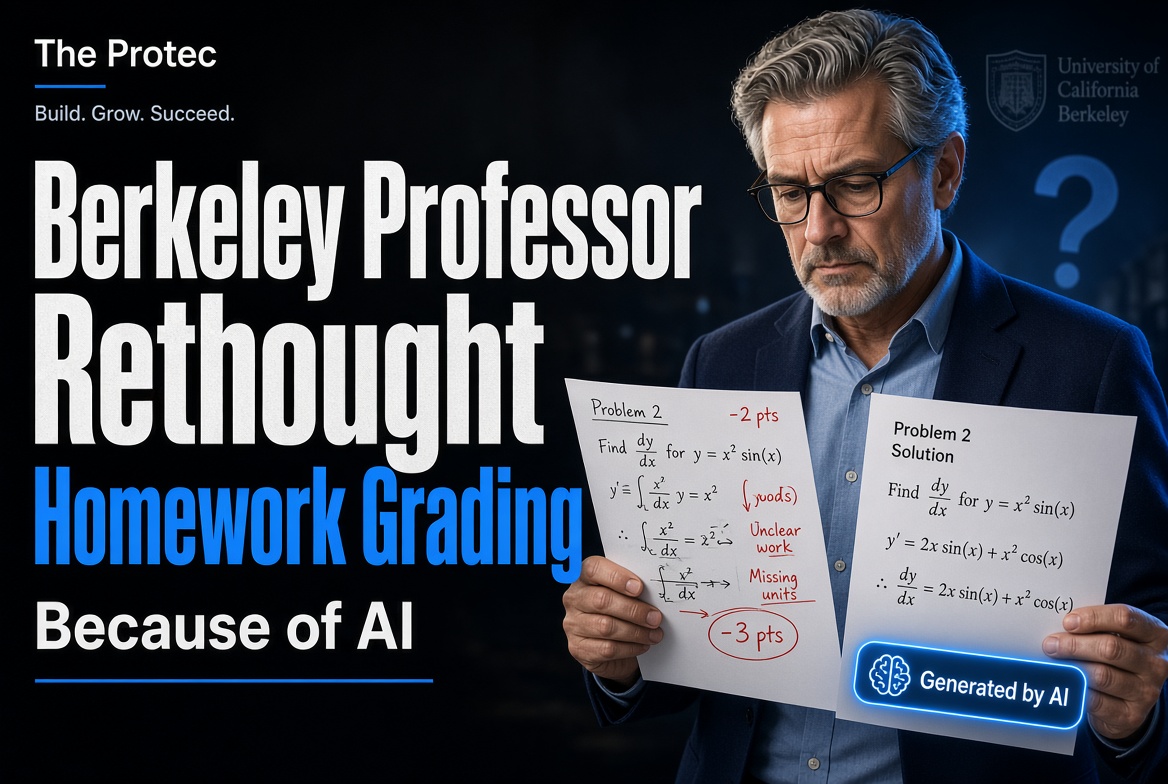
If an AI assistant can solve a student’s math assignment in seconds, a high homework score may no longer prove that the student understands the mathematics. That problem led a UC Berkeley Math Professor, Richard Borcherds, to reconsider what correctness-based homework grades actually measure. His experience offers a revealing case study for universities worldwide—but it does not mean that he abandoned teaching, practice problems, or assessment altogether.
The distinction matters. Headlines suggesting that AI has made all homework pointless go beyond the available evidence. Borcherds’s narrower argument concerns the reliability of unsupervised, take-home solutions as evidence of independent learning when students can obtain polished answers from generative AI.
What Richard Borcherds Actually Changed
Richard Borcherds is a mathematician at the University of California, Berkeley, and the recipient of the 1998 Fields Medal for his work in algebra. That distinction makes his comments especially notable, although his approach remains an individual instructor’s response rather than a UC Berkeley-wide policy.
In public commentary on his educational YouTube channel, Borcherds described seeing students use AI to produce unusually strong homework results. His response was not to declare mathematical practice useless. Instead, he stopped treating the correctness of unsupervised homework as dependable graded evidence of what an individual student could do.
The most defensible summary is that he moved away from awarding meaningful course credit based primarily on whether take-home solutions were correct. Homework could still be assigned or recommended for practice, while more controlled assessments carried the burden of measuring mastery.
Important details are not clearly established in his publicly available remarks, including the specific course, semester, previous homework weight, and exact formula used afterward. It would therefore be misleading to claim that Borcherds eliminated every assignment, stopped giving feedback, or concluded that all homework is worthless.
Why Conventional Homework Grading Is Under Pressure
Traditional homework rests on an assumption: the submitted work broadly reflects the student’s own reasoning. That assumption was never perfect. Students could copy friends, consult solution manuals, hire tutors, or search online. Generative AI changes the scale and convenience of assistance.
Tools such as ChatGPT can answer many standard algebra, calculus, probability, and introductory proof questions. They can also produce step-by-step explanations in seconds. For a student who wants feedback or a hint, that capability can support learning. For someone who submits the output with little scrutiny, it can turn homework into answer acquisition rather than mathematical practice.
This is the central concern behind debates over AI grading homework and AI homework cheating. A correct final answer—or even a polished derivation—may reveal less about independent understanding when the reasoning can be outsourced.
That does not mean AI reliably solves every problem. Mathematical models can make arithmetic errors, invoke theorems under invalid assumptions, skip necessary proof steps, or present circular arguments with impressive confidence. Performance also varies by model, prompt, notation, and problem complexity. Advanced proof construction and unfamiliar problems remain particularly difficult to evaluate through simple answer checking, whether the answer comes from a person or a machine.
A Completed Assignment Is Not the Same as Learning
Homework serves several purposes that are easy to blur together. It gives students practice, encourages regular study, reveals misconceptions, provides feedback, and sometimes contributes points toward a final grade. AI exposes the tension between those roles.
An assignment can be completed without producing much learning. Conversely, a student can struggle, make errors, revise a solution, and learn substantially while earning fewer correctness points. If the goal is practice, making homework a high-stakes measure may create the wrong incentive: students focus on securing the answer rather than confronting confusion.
Potential benefits of reducing correctness-based grades
- Less incentive to outsource solutions: When homework carries fewer high-stakes points, obtaining an AI-generated answer becomes less rewarding.
- More productive mistakes: Students can test ideas and submit imperfect reasoning without every error becoming a grade penalty.
- Greater focus on feedback: Instructors can emphasize where reasoning breaks down instead of merely recording whether the final answer matches.
- Clearer evidence of mastery: Supervised quizzes, discussions, or oral follow-ups can show what students can explain independently.
The risks of removing homework grades
Reducing grades is not automatically an educational improvement. Some students rely on deadlines and points to maintain a practice routine. Optional work may be postponed until an exam, when misconceptions are harder to fix. Students with weaker preparation or demanding schedules may also need more structure, not less.
A thoughtful policy therefore preserves accountability. Instructors might award completion credit, require corrections, conduct low-stakes checks, or connect homework directly to later in-class tasks. The objective is not to make practice disposable; it is to avoid confusing a polished submission with verified understanding.
Better Ways to Assess Mathematics in the AI Era
No assessment is completely AI-proof, and trying to build an impenetrable system can create unnecessary surveillance or accessibility barriers. The better question is which combination of methods provides credible evidence for the intended learning outcomes.
- Short in-class quizzes: These can test fluency and recall under controlled conditions. Their limitations include time pressure and weaker measurement of extended reasoning.
- Oral examinations: Follow-up questions reveal whether students can defend a step, define a concept, or adapt an argument. Oral exams are resource-intensive and require accommodations and consistent rubrics.
- Live problem-solving: Students can think aloud at a board or in a small group. This exposes process but may disadvantage learners who need more reflection time.
- Supervised or handwritten proofs: Such tasks can provide stronger evidence of authorship in appropriate settings. Handwriting alone is not AI-proof because students can use tools while preparing.
- Projects and unfamiliar applications: Open-ended work can assess modeling, judgment, and synthesis. AI can still assist, so checkpoints and individual explanations remain useful.
- Process-based grading: Drafts, annotations, revisions, error analyses, and explanations make the path to an answer visible. This requires more instructor time but rewards genuine engagement.
- Questions about submitted work: A brief conversation asking a student to justify one step or modify an assumption can quickly expose shallow copying.
The strongest approach will often combine low-stakes practice with several forms of verified assessment. That is relevant not only to universities but also to the growing discussion around AI assessment in schools.
How Instructors Can Use AI Instead of Only Fighting It
Banning every AI interaction may be impractical and can eliminate legitimate learning benefits. A better strategy is to design tasks that make evaluation, explanation, and judgment visible.
For example, an instructor could give students an AI-generated proof containing one subtle flaw. Students must identify the invalid step, explain why it fails, and repair the argument. Another assignment might ask students to compare two proposed solutions, state the assumptions behind each, and decide which generalizes to a new case.
A practical assignment framework can require students to:
- Attempt the problem independently and record an initial approach.
- Document permitted AI assistance, including prompts or a concise description of how the tool was used.
- Verify every consequential step using definitions, computation, or established results.
- Explain the reasoning in their own words, including why an alternative approach was rejected.
- Defend or extend the solution through a follow-up question, changed assumption, or unfamiliar example.
This turns ChatGPT math homework from a hidden shortcut into an object of critical analysis. Students learn that an answer is not trustworthy merely because it sounds authoritative.
Clear rules are essential. A course policy should specify whether AI may be used for hints, editing, checking calculations, generating examples, or drafting solutions. It should also state when disclosure is required and which uses count as academic misconduct. Policies must be communicated early and applied consistently rather than enforced through guesswork or unreliable AI-detection claims.
What This Means for AI and College Education
The Borcherds example highlights a larger issue for AI and college education: grading systems must measure the knowledge and capabilities institutions claim to certify. If a substantial part of a grade comes from work that can be completed without understanding, the assessment design—not only student behavior—needs attention.
Generative AI can still provide personalized explanations, additional practice, translation assistance, and rapid feedback. Those uses may be valuable for students who cannot easily access office hours or private tutoring. Yet generated explanations can also contain persuasive errors that an inexperienced learner is poorly equipped to detect.
Equity complicates the picture. Paid systems may offer capabilities or usage limits unavailable to students using free tools. At the same time, overly restrictive rules can disadvantage learners who responsibly use AI for language support, accessibility, brainstorming, or tutoring. Institutions need policies based on learning objectives and actual conduct rather than assumptions about who uses technology.
Foundational skills remain important in the future of math education. Even when software performs calculations, people must formulate the problem, select assumptions, interpret outputs, recognize impossible results, and determine whether a proof is valid. AI changes which skills are easiest to automate; it does not eliminate the need for mathematical judgment.
Is Grading Homework Pointless Now?
No—but some forms of homework grading have become less informative.
Answer-only assignments completed outside supervision are easier to game with generative AI. Treating those answers as strong evidence of individual mastery is increasingly difficult. Borcherds’s decision illustrates why a professor might separate practice from certification and place greater weight on assessments that require students to demonstrate reasoning directly.
Homework remains useful for deliberate practice, feedback, fluency, diagnosing misconceptions, and preparing for deeper work. It can also help instructors see where a class is struggling, especially when students are encouraged to submit honest attempts rather than optimized answers.
The real challenge is distinguishing evidence that learning occurred from evidence that a student obtained a correct solution. The best response to AI in education is therefore not necessarily to abandon homework, but to redesign its role: lower the reward for outsourcing, strengthen feedback, verify understanding through multiple methods, and teach students to evaluate AI critically.
Frequently Asked Questions
Who is Richard Borcherds?
Richard Borcherds is a UC Berkeley mathematician known for major work in algebra and mathematical physics. He received the Fields Medal in 1998.
Why would a UC Berkeley math professor stop grading homework for correctness?
Borcherds said AI use made high homework scores less reliable as evidence of independent understanding. The change concerned correctness-based credit for unsupervised work, not a claim that mathematical practice has no value.
Can ChatGPT solve college-level math homework?
It can solve many standard college problems and generate plausible explanations, but reliability varies. It may make computational errors, omit proof steps, or use invalid reasoning, especially on advanced or unfamiliar tasks.
Is using AI for homework cheating?
That depends on the course policy and how the tool is used. Permitted tutoring or error checking may be acceptable; submitting AI-generated reasoning as one’s own when assistance is prohibited is academic misconduct.
How can teachers assess learning when students have AI?
Teachers can combine in-class quizzes, oral follow-ups, live problem-solving, projects, process documentation, reflective explanations, and questions that require students to defend or adapt their work.
Is homework still useful in the AI era?
Yes. Homework remains valuable for practice and feedback. Its limitations arise when an unsupervised correct answer is treated as conclusive proof that the student independently understands the material.
Assessment Must Measure Understanding, Not Answer Access
The lesson from this UC Berkeley case is not that every school should stop grading homework. It is that educators must be precise about what a grade represents. When AI can supply a convincing solution on demand, correctness alone provides weaker evidence of who performed the reasoning.
Universities can respond by preserving homework as meaningful practice while using varied, fair, and accessible assessments to verify understanding. That approach acknowledges both sides of the technology: AI can undermine weak assessment designs, but it can also help students learn—provided they are still expected to think, verify, explain, and defend the mathematics themselves.