







Artificial intelligence is moving into classrooms faster than many school privacy policies can keep up. Teachers are using generative AI to plan lessons, summarize documents, create assessments, and support students. Administrators are exploring AI for communications and operations, while students increasingly encounter chatbots, writing assistants, tutors, and AI features embedded in familiar software.
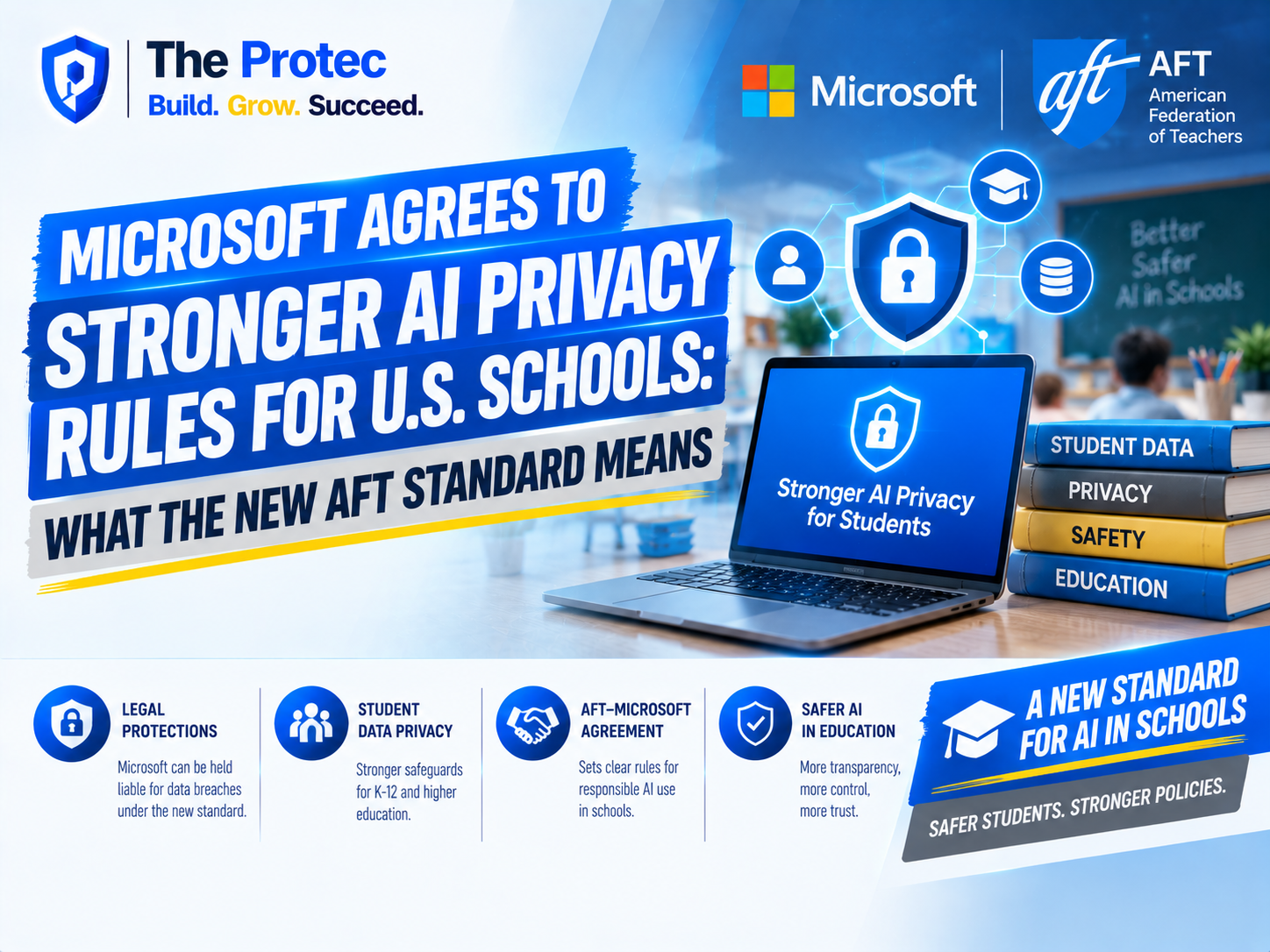
That rapid adoption makes the AFT-Microsoft agreement on AI privacy and safety an important development for U.S. schools. Microsoft’s decision to accept a stronger standard advocated by the American Federation of Teachers signals that education-focused AI cannot be governed only by a vendor’s general terms of service. Schools need clear limits on how student and educator information is collected, retained, analyzed, shared, and used to improve AI models.
The agreement also has implications beyond Microsoft. It gives districts, teachers’ unions, school boards, and technology leaders a practical benchmark for evaluating every AI product—not just Microsoft Copilot. Although the standard is not a new federal law, it can influence contracts, procurement requirements, school AI policies, and expectations across the education technology market.
What Is the AFT-Microsoft Agreement?
The AFT-Microsoft agreement establishes privacy and safety expectations for the use of Microsoft AI in education. Its central premise is straightforward: AI tools used by schools should protect students and educators by design rather than requiring individual users to understand complex privacy settings or negotiate with a global technology provider.
The standard focuses attention on several core principles associated with responsible AI in schools:
- Limiting the collection and use of student and educator data to legitimate educational purposes.
- Providing transparency about what an AI system does, what information it processes, and where its limitations lie.
- Preventing school data from being repurposed for advertising, commercial profiling, or unauthorized AI model training.
- Applying appropriate security, access, retention, and deletion controls.
- Testing AI systems for foreseeable safety, accuracy, discrimination, and privacy risks.
- Maintaining human oversight when AI could affect instruction, evaluation, discipline, or access to educational opportunities.
These principles are significant because teachers and students routinely enter sensitive context into software. A seemingly harmless request to summarize an individualized learning plan, draft feedback on an essay, or translate a message to a family may reveal disability status, academic performance, behavior, language background, or other protected information.
The AFT-Microsoft agreement does not eliminate every risk or automatically make every Microsoft product appropriate for every student. Product editions, account types, administrative configurations, age restrictions, and contract terms still matter. Schools must confirm which commitments apply to the specific services they license.
Why AI Privacy for Schools Is Different
Student data privacy has always required special care, but generative AI introduces risks that are different from those created by a conventional learning management system or digital textbook. Traditional applications usually collect data through defined fields and predictable workflows. An AI assistant may accept unrestricted text, files, images, audio, or records, then infer additional information from that content.
AI student data can therefore include more than names, identification numbers, and grades. It may include prompts, uploaded assignments, chatbot conversations, generated responses, usage logs, behavioral patterns, inferred interests, and details about how a student solves a problem. Even if a prompt omits a name, its context may make the student identifiable.
Generative systems may also produce convincing but incorrect information. A chatbot could misinterpret a student’s work, invent a citation, reinforce a stereotype, or provide unsuitable advice. Privacy and AI safety in schools are consequently connected. A system cannot be considered safe merely because it encrypts data; schools must also evaluate how the system responds, what it infers, and how people use its output.
What the Standard Could Mean for Microsoft Copilot in Schools
Microsoft Copilot is not a single, uniform product. Copilot features can appear in web services, productivity applications, operating systems, administrative tools, and education-specific environments. The privacy protections available to a school-managed Microsoft 365 account may differ from those attached to a consumer account.
For Microsoft Copilot in schools, the new standard strengthens the expectation that education customers receive clear answers to practical questions. Does Microsoft retain prompts and responses? Can authorized administrators access them? Are they used to train foundation models? Which subcontractors process the information? How long are logs kept? Can the district delete them? What content filters and age-appropriate safeguards are active?
Districts should not assume that a familiar logo answers these questions. They should review the documentation for the exact Copilot service, license, and identity configuration being deployed. Students and employees should access approved AI through managed school accounts rather than personal accounts whenever possible. Consumer AI services may have different data-use terms and fewer administrative controls.
The agreement may also encourage Microsoft to offer clearer education documentation, stronger default settings, and more visible controls. Microsoft explains its broader responsible AI governance through its Responsible AI program, but districts still need product-specific contractual assurances.
The Standard Is a Benchmark, Not a Replacement for Law
The AFT Microsoft agreement is best understood as an accountability and procurement standard. It does not replace the Family Educational Rights and Privacy Act, the Children’s Online Privacy Protection Act, the Protection of Pupil Rights Amendment, state student privacy statutes, breach-notification laws, accessibility requirements, or district obligations under existing contracts.
It also does not create one comprehensive set of AI regulations for schools. The U.S. legal environment remains fragmented, with obligations depending on a student’s age, the data involved, the institution, the purpose of processing, and state law. Federal guidance, state legislation, collective bargaining, vendor agreements, and local policies all contribute to the rules schools must follow.
Schools can consult the U.S. Department of Education’s Student Privacy Policy Office resources when assessing federal student privacy responsibilities. Legal counsel should review high-risk implementations, especially those involving special education records, mental health information, biometric data, automated monitoring, or decisions about individual students.
What the Agreement Means for Teachers and Students
Teachers need usable rules, not blanket bans
Educators are often placed in an impossible position: they are encouraged to innovate but given little guidance about which AI tools are approved or what information may be entered. A strong school AI policy should define acceptable uses with examples. Drafting a generic lesson outline may be permitted, while uploading identifiable student records to an unapproved chatbot should be prohibited.
Teachers should also know when AI-generated content requires verification, attribution, or disclosure. AI should assist professional judgment, not quietly replace it. An educator remains responsible for checking the accuracy, appropriateness, accessibility, and potential bias of generated material.
Students deserve privacy without losing access to useful tools
Student AI privacy should not depend on a child’s ability to read lengthy legal terms. Schools and vendors should use age-appropriate notices, protective defaults, and data minimization. Students should understand when they are interacting with AI, what information they should not share, and where to report unsafe or inaccurate responses.
Equity is equally important. AI detection software, automated risk scoring, remote monitoring, and behavioral analysis can disproportionately affect multilingual learners, students with disabilities, and students from historically marginalized groups. High-impact uses require evidence of validity, bias testing, an appeal process, and meaningful human review.
How Administrators Can Build Stronger School AI Policies
The Microsoft AI privacy commitment gives administrators a useful starting point, but implementation requires local governance. A district can strengthen student data protection through the following actions.
1. Create an inventory of AI systems
Identify standalone AI products as well as AI features embedded in existing platforms. Record the product owner, purpose, user population, data categories, account type, integrations, retention period, and contract status. “Free” classroom tools belong in the inventory because they may create some of the greatest privacy exposure.
2. Classify uses by risk
Not every application needs the same review. Generating a fictional reading passage is lower risk than analyzing identifiable student work. Automated recommendations involving discipline, special education, mental health, grading, admissions, or threat assessment should receive heightened scrutiny and, in some cases, be prohibited.
3. Put AI privacy standards into contracts
Marketing promises can change. Contracts should address purpose limitation, model training, data ownership, security, subcontractors, deletion, audit rights, incident notification, legal compliance, and what happens when the agreement ends. Schools should require written confirmation that protected school data will not be sold, used for targeted advertising, or used to train general-purpose models without valid authorization.
4. Minimize the data sent to AI
Schools should configure tools to process the least information necessary. Identifiers should be removed when possible, integrations should receive limited permissions, and retention periods should be short and documented. Staff training should explicitly cover prompts, attachments, screenshots, recordings, and copied text.
5. Preserve meaningful human oversight
AI output should not be the sole basis for consequential decisions about a student or employee. Policies should identify who reviews output, how errors can be challenged, and who is accountable. Human review must be substantive rather than a quick approval of an opaque recommendation.
6. Test safety before and after deployment
Predeployment reviews should examine hallucinations, harmful content, bias, prompt injection, unauthorized disclosure, accessibility, and age suitability. Monitoring should continue after launch because models, features, and vendor terms can change. Districts need a process for suspending a tool when new risks emerge.
7. Involve educators, families, and students
School AI policies are more effective when the people affected help design them. Teachers can identify real classroom workflows, technology teams can assess security, privacy officers can evaluate data practices, and students can describe how tools are actually being used. Families should receive clear explanations and channels for questions or complaints.
Questions Schools Should Ask Every AI Vendor
The AFT standard can be translated into a consistent vendor questionnaire. Before approving an AI tool, schools should ask:
- What student, educator, device, and usage information does the service collect?
- Are prompts, files, outputs, metadata, or feedback used to train or improve any model?
- Is data shared with subprocessors, affiliates, advertisers, or data brokers?
- Can the district configure retention and permanently delete its information?
- How does the vendor separate school-managed data from consumer data?
- What safety testing has been completed for children and educational settings?
- How are inaccurate, biased, or harmful outputs reported and corrected?
- Does the system generate profiles, scores, or inferences about individual students?
- What happens to school data when a feature, model, or contract changes?
- Will the vendor provide prompt notice of security incidents and material policy changes?
A vendor that cannot answer these questions clearly may not be ready for use in a school environment, regardless of how impressive its demonstration appears.
A Broader Shift in AI in Education
Microsoft’s acceptance of an education-focused privacy and safety standard reflects a broader shift from experimentation to governance. Schools are no longer asking only what generative AI can do. They are asking whether it is appropriate, contractually protected, instructionally sound, secure, accessible, and accountable.
Other AI providers will face pressure to meet comparable safeguards. Districts can accelerate that change by using common procurement language instead of accepting different privacy standards for every vendor. Unions and professional associations can contribute educator expertise, while policymakers can establish enforceable minimum protections across jurisdictions.
The most important lesson is that responsible adoption does not mean choosing between innovation and privacy. Well-designed AI can support teaching and learning while collecting less information, imposing firm limits on secondary use, and preserving human judgment. The AFT-Microsoft agreement makes those protections a more visible part of the market for Microsoft AI education products—and a reasonable expectation for every provider serving schools.
Frequently Asked Questions
Does the AFT-Microsoft agreement apply to every Microsoft AI product?
Schools should not assume universal coverage. Applicability may depend on the specific product, education license, managed account, contract, and configuration. Districts should confirm the protections for each Copilot service or AI feature in writing.
Can schools safely enter student information into Microsoft Copilot?
Only when the district has approved the exact service, verified its contractual and technical protections, and determined that the use complies with applicable law and policy. Even in approved systems, staff should minimize identifiable data and avoid entering information that is unnecessary for the task.
Does the agreement create new federal AI regulations for schools?
No. It is an influential privacy and safety standard rather than a federal statute. Existing federal and state privacy laws still apply, and schools remain responsible for procurement reviews, policy enforcement, staff training, and risk management.
What should a district do first when developing an AI policy?
Begin with an inventory of current AI use. The district can then classify risks, identify unapproved tools, set rules for sensitive data, establish vendor-review requirements, and train staff and students. Policies should be reviewed regularly as products, laws, and technical capabilities evolve.
Why does this agreement matter beyond Microsoft schools AI?
It creates a benchmark that schools can use with other vendors. If one major provider can commit to stronger data limits, transparency, safety testing, and human oversight, districts have a stronger basis for requesting equivalent protections from every AI company seeking access to classrooms.