







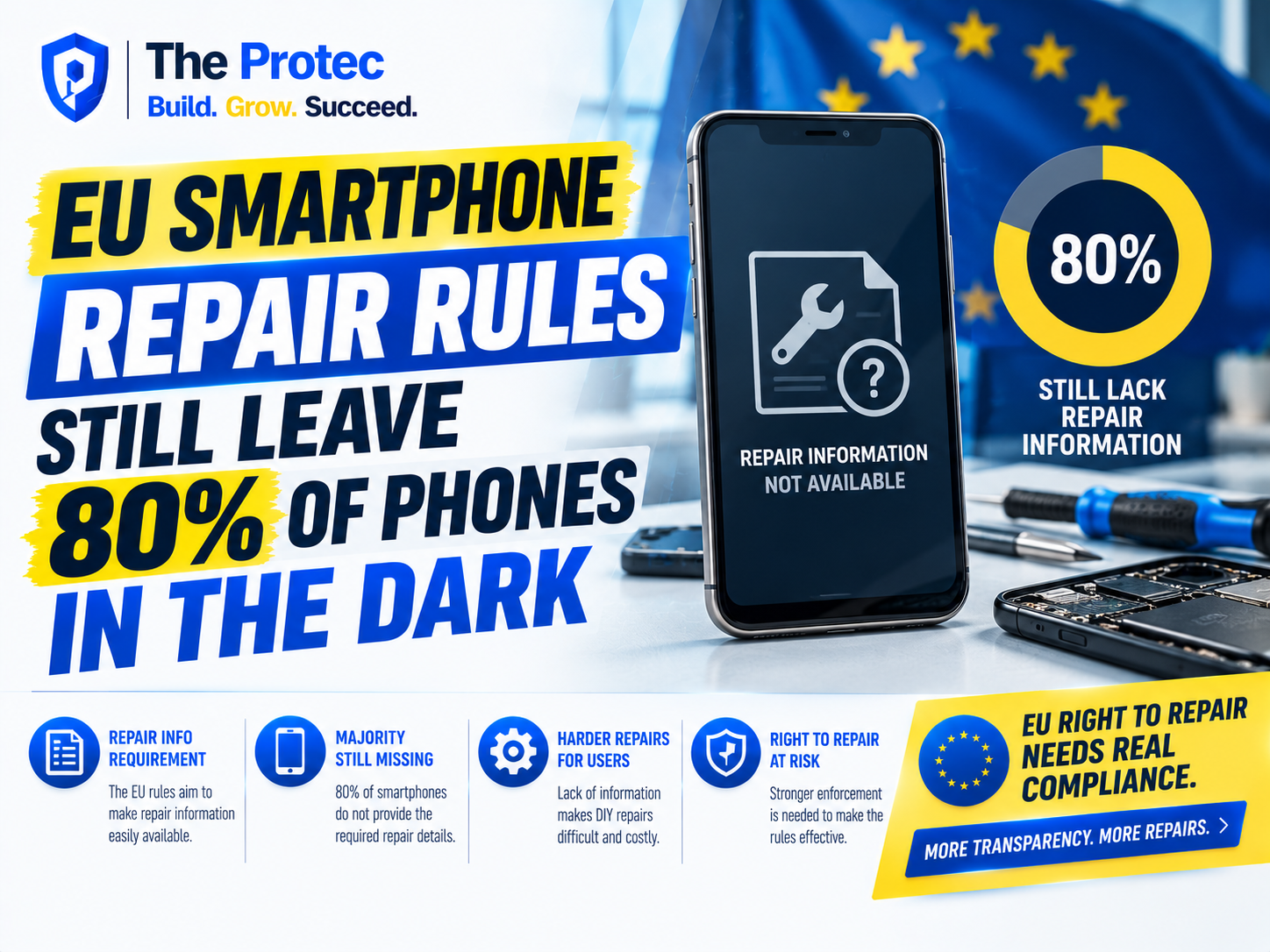
Latest EU smartphone repair rules were supposed to make a simple question easier to answer: can this phone be repaired? Yet reports and market checks suggest that around 80% of phones still lack adequate repair information. Consumers may see sustainability claims, longer software promises or a repairability class, but often cannot find a complete manual, parts catalog, price list or clear explanation of which repairs are realistically possible.
That gap matters because repairability is not created by regulation alone. A phone is only meaningfully repairable when parts, instructions, tools, diagnostics and software support are available at a reasonable cost. If any one of those pieces is missing, a technically replaceable component can remain practically inaccessible.
The EU smartphone repair rules now combine ecodesign standards, energy labels and a broader right-to-repair framework. On paper, this is one of the world’s most ambitious attempts to improve smartphone sustainability. In practice, fragmented disclosures, gated documentation and expensive assemblies continue to make comparison and repair harder than expected.
What the EU smartphone repairability rules require
Since June 20, 2025, smartphones and slate tablets newly placed on the EU market have been covered by dedicated ecodesign and energy-labelling requirements. The rules address durability, battery performance, operating-system support, spare parts and access to repair information.
Covered devices receive an EU energy label showing more than energy efficiency. It also includes battery endurance, resistance to repeated drops, ingress protection and a repairability class. A QR code connects shoppers to the European Product Registry for Energy Labelling, or EPREL, where additional model data should be available.
The associated EU repairability requirements include several important obligations:
- Manufacturers must make specified spare parts available for years after a model is no longer sold.
- Certain components must be accessible to end users, while a broader range must be supplied to professional repairers.
- Parts generally have to be delivered within defined time limits, typically five to ten working days.
- Professional repairers must be able to obtain relevant repair and maintenance information under regulated conditions.
- Batteries must meet endurance targets, including retaining at least 80% of their initial capacity after 800 charging cycles under the prescribed test conditions.
- Manufacturers must provide operating-system updates for a minimum period linked to the end of a model’s time on the market.
The European Commission’s smartphone and tablet guidance explains how the ecodesign standards and new label work together. These requirements are a major advance over relying on voluntary environmental promises. They do not, however, guarantee that every consumer will find everything needed to complete a repair.
Why 80% of phones can still lack useful repair information
The apparent contradiction comes down to the meaning of “repair information.” A manufacturer can satisfy a specific disclosure obligation without publishing the complete, consumer-friendly repair package people expect. A repairability class on a label is information, but it is not a screen-replacement guide. A parts list supplied through a professional portal is not the same as a public catalog with current prices and availability.
Audits behind the four-in-five finding commonly look for practical details such as service manuals, disassembly sequences, parts identification, required tools, diagnostic procedures and ordering routes. Many phone listings fail that broader test even when the device displays an official label or is covered by EU smartphone regulations.
Repair documents are scattered
Smartphone repair information may be divided among a product page, support site, EPREL record, authorized-service portal and third-party parts distributor. Model names can differ by storage capacity, region or carrier, while documents may be filed under internal product codes. A determined technician might assemble the necessary information, but an ordinary buyer comparing phones is unlikely to do so.
Professional access is not public access
Some EU smartphone rules permit manufacturers to ask professional repairers to register, demonstrate competence or accept a reasonable fee before receiving technical material. Those safeguards can be justified where battery handling, security or electrical safety is involved. They can also create friction for independent shops and exclude owners who want to understand a repair before purchasing a device.
This is one reason a phone can score well in a regulated assessment while having no freely accessible manual comparable to the guides associated with iFixit smartphone repair. The legal right to obtain information and the practical ability to find it instantly are not identical.
Information can exist without prices or stock
A parts catalog is of limited value when it omits prices, shows persistent out-of-stock notices or bundles inexpensive components into costly assemblies. If a cracked charging port requires replacement of a large circuit-board module, the phone may be repairable in a laboratory sense but uneconomical to fix.
Consumers also need stable part numbers, compatibility notes and a clear period of availability. Without those details, it is difficult to calculate whether a repairable smartphone will remain supportable throughout its expected life.
Why manuals and parts information matter
Modern smartphones are densely packed, adhesive-heavy devices containing fragile cables, cameras, biometric sensors and lithium-ion batteries. Opening one without the correct sequence can turn a routine repair into a damaged display, torn cable or battery safety incident.
A useful manual should identify fasteners, adhesives, cable locations, heat limits, calibration steps and post-repair tests. It should also explain whether water-resistance seals must be replaced and whether the phone will display warnings after fitting a new component. Exploded diagrams and standardized part numbers help repairers order the correct item before opening the device.
Parts information is equally important for competition. Independent shops cannot provide reliable quotes if only authorized centers know component prices. Refurbishers cannot plan inventory when compatibility is unclear. Consumers cannot compare lifetime costs when a battery price is hidden until they contact support.
This is why the smartphone right to repair is ultimately an information issue as much as a mechanical one. A replaceable battery behind pull tabs is useful. A replaceable battery with instructions, an orderable seal, affordable tools and no unnecessary software lock is far better.
How manufacturers are responding to EU smartphone regulations
Manufacturer responses vary widely. Some brands have expanded self-repair programs, published manuals and partnered with established parts distributors. Others focus on authorized-service networks while offering only the minimum public information required for labels and product registration.
New phone designs increasingly use battery pull tabs, modular charging boards and more standardized screws. Longer software-support commitments are also becoming normal among premium and midrange devices. These changes suggest that EU smartphone regulations are influencing global product design, especially because creating a separate European version is often inefficient.
However, several familiar barriers remain:
- Genuine displays, camera modules and back covers can cost enough to discourage repair.
- Parts pairing may trigger warnings, disable features or require manufacturer-controlled calibration.
- Official tools and diagnostic software may be unavailable to consumers.
- Self-repair programs may cover only a limited selection of high-volume models.
- Manuals sometimes describe module replacement without supporting component-level repair.
Manufacturers argue that controls around biometric sensors, batteries and device security protect users. Repair advocates counter that safety can be preserved through authenticated tools, documented procedures and transparent calibration access rather than exclusive service channels.
Can a phone repairability score reveal what shoppers need?
The EU label’s repairability class is valuable because it gives shoppers a standardized signal at the point of sale. The underlying phone repairability score considers factors such as disassembly depth, fasteners, tools, parts availability, software support and access to repair information.
Standardization is the score’s greatest strength. Manufacturer claims such as “eco-conscious design” are difficult to compare, while a common methodology makes it possible to distinguish models using the same framework. The label may also push companies to improve design decisions that raise a device from one class to another.
But a summarized grade inevitably hides trade-offs. Two phones can receive a similar class even if one has an easily replaced battery but an expensive display, while the other has affordable parts but more difficult disassembly. A score recorded when a model launches may not immediately show later stock shortages, price increases or deteriorating support.
The best approach would combine the headline class with a public, model-specific breakdown. Shoppers should be able to see parts prices, promised availability dates, manual links, tool requirements and software-pairing restrictions before buying. That would turn the score from a broad indicator into an actionable ownership forecast.
How the wider EU right to repair changes the picture
The ecodesign rules govern how covered products are designed and supported. The EU right-to-repair directive adds consumer rights after a product fails. Member states were required to transpose the directive by July 31, 2026, making this a critical stage for enforcement and national implementation.
For products covered by EU repairability rules, manufacturers must offer repair within the legal framework and cannot automatically steer every customer toward replacement. The directive also targets contractual, hardware and software practices that obstruct independent repair unless those restrictions can be objectively justified.
It further supports clearer repair offers and a future European repair platform intended to help consumers locate repairers. Right to Repair Europe continues to track implementation and remaining loopholes through its repair advocacy and policy work.
Still, smartphone repair laws will only be effective if national authorities test real purchasing and repair journeys. Checking that a PDF technically exists is not enough. Regulators need to verify that parts can actually be ordered, arrive on time, work after installation and remain reasonably priced.
What would make the EU smartphone rules work better?
The next phase should focus on measurable access rather than formal availability. Stronger implementation could include:
- A single public repair page for every model, linked directly from its EPREL record.
- Upfront prices for parts, tools, shipping and required calibration services.
- Downloadable manuals for common repairs without professional registration.
- Machine-readable parts lists using stable model and component identifiers.
- Regular checks of stock, delivery times and software functionality after repair.
- Repairability score updates when manufacturers change prices or support conditions.
- Penalties that outweigh the commercial benefit of withholding information.
Policymakers should also distinguish safety controls from commercial lock-in. A secure calibration process can protect biometric data without forcing every repair through one authorized network. Similarly, water resistance can be maintained by supplying genuine seals and test procedures rather than suggesting that independent repair is inherently unsafe.
What consumers should check before buying a repairable smartphone
The energy label is a useful starting point, not the final verdict. Before purchasing, search for the exact model’s battery and display prices, public manuals and software-support end date. Check whether genuine parts are sold directly, whether calibration is required and whether a local independent shop has repaired the model.
Look beyond marketing terms and ask practical questions: Can the battery be replaced without changing the display? Is the USB port modular? Are seals included with replacement parts? Will a new camera or screen retain all features? A phone with a slightly lower headline specification but dependable repair support may deliver better value over five or six years.
FAQ: EU smartphone repairability
Do EU smartphone repair rules require every manual to be public?
No. The framework requires access to specified repair and maintenance information, but some technical material can be directed to registered professional repairers. This distinction helps explain why consumers may see a repairability label yet struggle to find a complete public service manual.
Does a high phone repairability score guarantee a cheap repair?
No. A strong score indicates favorable design and support characteristics under the official methodology. Actual repair cost still depends on parts pricing, labor, shipping, availability, diagnostics and whether software calibration is required.
Can manufacturers block third-party smartphone repairs?
The EU right-to-repair framework limits unjustified hardware, software and contractual barriers. Manufacturers may retain restrictions supported by legitimate safety, privacy or intellectual-property concerns, but they should not use those arguments as blanket reasons to prevent independent repair.
Why do so many phones still lack adequate repair information?
Information is often fragmented, restricted to professional portals or missing practical details such as prices, stock and calibration instructions. Compliance with individual disclosure rules therefore does not always produce the complete, accessible repair package consumers expect.
Will the new rules make smartphones last longer?
They should improve durability, battery longevity, parts access and software support. Their real impact will depend on enforcement, affordable components and whether manufacturers remove unnecessary technical barriers. Regulation has created the foundation, but transparent implementation will determine whether more phones are actually repaired instead of replaced.
Transparency is the real test
The EU has moved smartphone sustainability from voluntary promises toward enforceable standards. Repairability classes, parts duties and stronger consumer rights are meaningful achievements. Yet the reported lack of adequate information for around 80% of phones shows why legal coverage cannot be confused with real-world usability.
A successful repair system must let people discover what can be fixed, understand the process, obtain the part and restore full functionality at a sensible price. Until that journey becomes routine across brands and models, the EU smartphone repairability revolution will remain more visible on labels than on repair benches.