








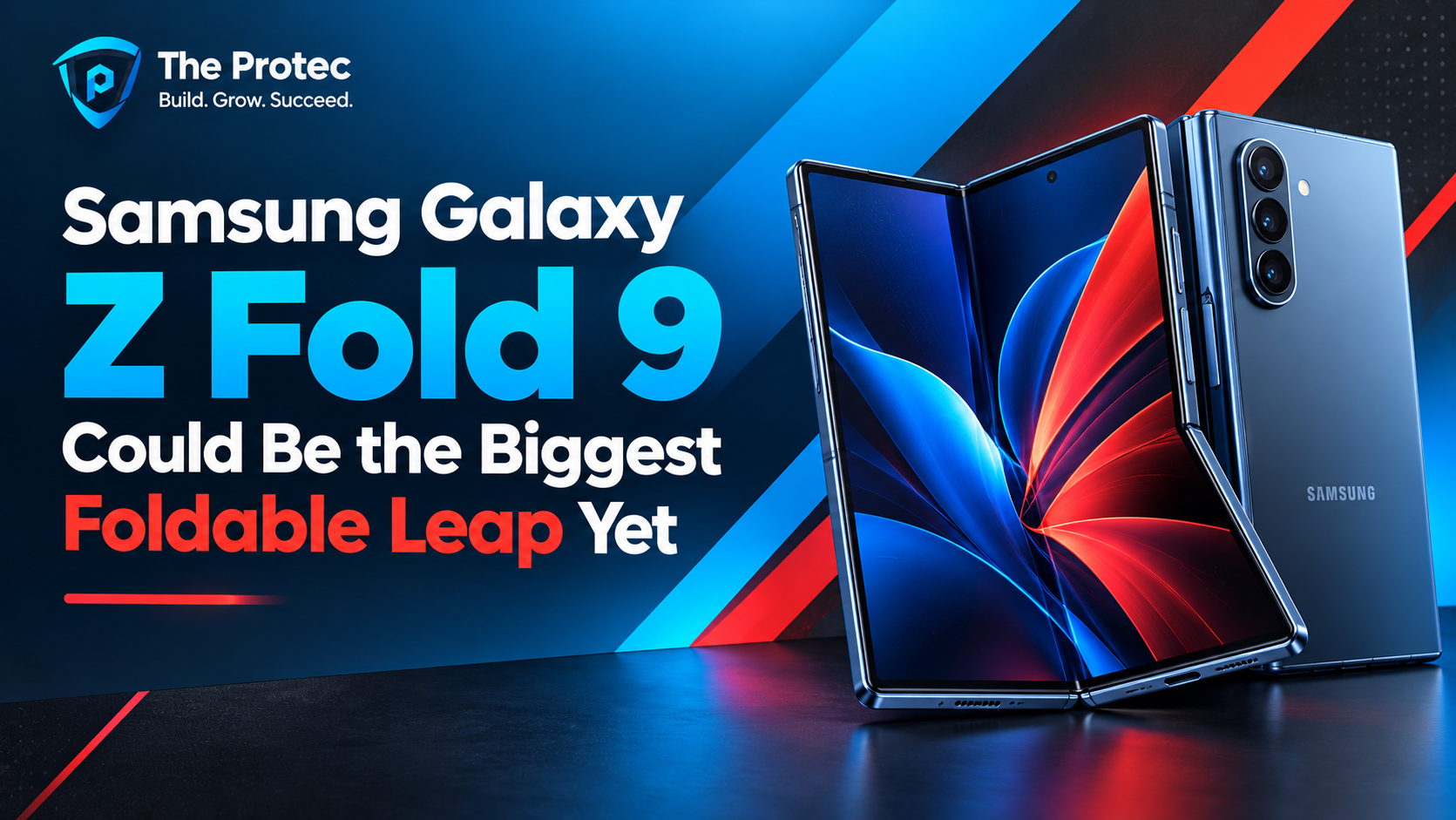
Samsung’s next book-style foldable could be much more than an annual specification update. Early reports surrounding the Samsung Galaxy Z Fold 9 suggest the company is exploring major changes to the device’s thickness, folding display, cameras and overall usability. If even some of these ideas reach production, the Fold 9 could address the complaints that have followed large foldables for years.
The most striking claims involve a body measuring approximately 7.9mm when folded and only 3.9mm when unfolded. Other reports point to a new Samsung Wide View OLED panel designed to make the crease less distracting, a center-etched thin-glass structure and a possible return to a more advanced under-display camera. A 200-megapixel main camera and stronger optical zoom have also appeared in discussions, although some camera specifications may belong to a separate Ultra model rather than the standard Fold 9.
These details make the phone sound revolutionary, but caution is essential. As of October 2026, Samsung has not officially announced the device or confirmed its specifications. The expected launch is still around summer 2027, leaving ample time for prototypes, component choices and product plans to change.
Galaxy Z Fold 9 leaks are unusually ambitious
Most early leaks describe engineering targets rather than finalized retail hardware. Samsung may test several chassis, hinge and display combinations before selecting the version it can manufacture reliably at scale. A component demonstrated in a laboratory may also fail to appear in the finished phone because of cost, supply constraints, durability or battery requirements.
That distinction matters with the current Galaxy Z Fold 9 rumors 2027. The 7.9mm thickness target, Wide View OLED technology and center-etched glass should be treated as reported development directions. They are not confirmed Samsung Galaxy Z Fold 9 features. Even so, the ideas reveal where Samsung appears to be concentrating its foldable research: making the hardware feel less bulky while reducing the compromises created by the hinge and flexible screen.
A dramatically thinner Galaxy Z Fold 9 design
The reported dimensions would represent the most visible of the potential Galaxy Z Fold 9 upgrades. At around 7.9mm folded, the device would begin to approach the profile of some conventional smartphones, despite containing two screen halves, a flexible panel and a hinge. An unfolded measurement near 3.9mm would require extremely compact internal packaging.
Thickness is not simply a cosmetic issue. A slimmer Galaxy Z Fold 9 design could fit more comfortably in a pocket, feel less top-heavy during one-handed use and reduce the wedge-like impression associated with early foldables. It could also make the cover display feel more natural for messaging and everyday apps, encouraging owners to use the phone without opening it every time.
Reaching those dimensions would be difficult. Samsung would need to find space for camera modules, speakers, wireless charging hardware, structural supports and a sufficiently large battery. A thinner hinge must still resist impacts and keep the two halves aligned over thousands of folds. The quoted figures should therefore be viewed as an aggressive engineering goal, not a guaranteed specification.
Samsung Wide View OLED could tackle the visible crease
The folding crease remains one of the most persistent objections to premium foldable phones. It is often less noticeable when viewed directly, but reflections and off-axis viewing can reveal a band with different brightness or color characteristics. Samsung’s developing Wide View OLED technology reportedly aims to reduce that brightness difference around the fold.
A Galaxy Z Fold 9 crease-free display may be an unrealistic literal description. Any screen that repeatedly bends around a compact radius is subject to mechanical stress, and the supporting layers still require room to move. A more credible objective is a crease that appears shallower and is substantially harder to see during normal use.
If Wide View OLED improves luminance consistency across viewing angles, the center line could blend more effectively with the rest of the panel. That would benefit video playback, photo editing, reading and multitasking, particularly under bright lights. It could be a bigger everyday improvement than another increase in peak brightness or resolution.
Samsung Display continues to develop flexible OLED structures for foldable devices, as outlined through its official foldable display technology information. However, no official material currently confirms that a panel carrying the Wide View OLED name will ship in the Fold 9.
Center-etched thin glass may balance flexibility and strength
Another reported display concept involves center-etched ultra-thin glass. Instead of reducing the thickness of the entire glass layer, this approach would selectively make the folding zone thinner. The central area could bend more freely, while the sections covering the flatter parts of the display would retain greater thickness and rigidity.
In theory, this could reduce stress around the crease without making the entire inner screen more vulnerable. It might also help the display close around a tighter hinge radius, contributing to the proposed 3.9mm unfolded body. The challenge will be creating a smooth transition between glass thicknesses and maintaining consistent touch response, optical clarity and impact resistance.
This is best understood as an engineering concept within broader Samsung foldable phone technology, not proof of a finalized component. Long-term testing would need to account for repeated folding, temperature changes, pressure from fingernails and particles entering around the hinge.
Could the under-display camera make a stronger return?
A camera hidden beneath the inner display can preserve an uninterrupted workspace, but earlier implementations have produced softer images and a visible pixel pattern over the lens. Current reports suggest Samsung is considering a renewed or more advanced Samsung under-display camera solution for the Fold 9.
The benefit would be a cleaner inner canvas with no punch-hole interrupting videos, documents or split-screen layouts. Success would depend on improving light transmission through the OLED pixels and using image processing to recover detail, color and contrast. Samsung must also decide whether visual continuity is more valuable than the sharper video-call quality of a conventional camera opening.
References to “bringing back” the technology should not be interpreted as confirmation of a specific production plan. They more likely indicate that updated under-display designs remain under evaluation as Samsung explores how to make the large inner screen feel more immersive.
Galaxy Z Fold 9 camera upgrades need careful interpretation
Camera performance is an area where expensive foldables have often lagged behind slab-style flagships. The limited internal space makes large sensors and long periscope assemblies difficult to accommodate. Early Galaxy Z Fold 9 camera upgrades reportedly include the possibility of a 200-megapixel main sensor and improved optical zoom.
A 200-megapixel sensor could improve detail in favorable light and use pixel binning to produce cleaner images in darker conditions. More importantly, a larger or newer sensor could enhance dynamic range, autofocus and cropped zoom. Resolution alone would not guarantee better photos; lens quality, sensor area, stabilization and processing would remain critical.
The zoom rumors require particular caution. Some reports discuss the Fold 9 family without clearly separating the standard device from a potential Galaxy Z Fold 9 Ultra. A more advanced telephoto system, larger sensor array or especially ambitious zoom range could be intended for the rumored Ultra model. It would be premature to combine every leaked camera specification into one supposed standard Fold 9 package.
- The 200-megapixel main camera is a possibility, not a confirmed feature.
- Improved optical zoom is widely expected but lacks a reliable finalized specification.
- Ultra-model rumors may describe a different body, camera system and price tier.
- Samsung could change sensors late in development to meet thickness or cost targets.
Battery life, durability and the wider user experience
The reported thin body raises an obvious question about the Galaxy Z Fold 9 battery. Reducing thickness can leave less room for battery cells, while a large inner display and high-performance processor demand substantial power. Samsung could compensate through denser battery chemistry, more efficient OLED materials, improved chipset efficiency and smarter software power management. No dependable capacity has been confirmed.
Software will be equally important. Better continuity between the cover and inner displays, more flexible app layouts and refined drag-and-drop tools could make the phone more valuable for work. Android’s expanding support for large screens provides a stronger foundation, with Google maintaining official guidance for foldable app experiences. Samsung can build on that foundation through its multitasking interface, taskbar and S Pen features.
Galaxy Z Fold 9 durability cannot be sacrificed to win the thickness race. Buyers will expect water resistance, a robust hinge and stronger protection against dust and accidental pressure. Center-etched glass and a compact hinge could help, but every thinner component creates new stress points. Samsung’s ability to validate the hardware at scale may ultimately determine which rumored upgrades survive.
Galaxy Z Fold 9 vs Fold 8: evolution could become reinvention
A definitive Galaxy Z Fold 9 vs Fold 8 comparison is impossible before Samsung reveals the newer model. Directionally, however, the Fold 9 is shaping up to focus less on incremental processing gains and more on the fundamentals of foldable ownership.
If the reports are accurate, the generational differences would center on a substantially thinner chassis, a less distracting crease, revised cover and inner-screen proportions, stronger cameras and a more seamless full-screen design. Those changes would directly address the reasons many shoppers admire foldables but continue buying conventional flagship phones.
The Fold 8 remains the more relevant reference point for near-term buyers because its capabilities are known through official channels and real-world testing. The Fold 9, by contrast, is an early roadmap story. Consumers should not delay a necessary purchase solely because of specifications attached to a device that may be many months away.
Why Samsung needs a major foldable leap
Samsung helped establish the mainstream foldable category, but it now faces aggressive competition from thinner devices with large batteries, capable cameras and increasingly subtle creases. Chinese manufacturers have demonstrated that book-style foldables can become lighter and more phone-like, while broader interest in dual-screen productivity continues to grow.
A refined Samsung next-generation foldable could restore a clearer technical lead. Samsung has advantages in OLED development, global distribution, software support and brand recognition, but those strengths must be paired with hardware that feels meaningfully better. The Fold 9’s reported direction suggests Samsung understands that buyers want fewer compromises, not merely more features.
Galaxy Z Fold 9 release date and price expectations
The expected Galaxy Z Fold 9 release date falls around summer 2027, based on Samsung’s established foldable launch cycle rather than an official announcement. Production schedules or a revised product strategy could shift that window.
No credible Galaxy Z Fold 9 price has been confirmed. Advanced display materials, a 200-megapixel camera and extreme miniaturization could keep the phone firmly in premium territory. A potential Ultra model would also give Samsung room to separate high-end camera features from the standard device. Any precise price currently circulating should be treated as speculation.
Frequently asked questions
Is the Samsung Galaxy Z Fold 9 confirmed?
Samsung has not officially announced the Galaxy Z Fold 9 or published its specifications. Current information comes from early leaks, supply-chain reporting, engineering concepts and expectations based on Samsung’s normal release cycle.
Will the Galaxy Z Fold 9 have a completely crease-free display?
Reports suggest Samsung Wide View OLED and center-etched thin glass could make the crease less visible and improve brightness consistency around the fold. A literally crease-free panel is not confirmed and may remain difficult with current folding-screen structures.
Will the standard Fold 9 include a 200-megapixel camera?
It is possible, but the rumor is not sufficiently settled. Some camera claims may relate to a potential Fold 9 Ultra rather than the standard model. Samsung could also alter the sensor choice as it balances image quality against thickness, battery space and cost.
When is Samsung’s next foldable phone expected?
The Fold 9 is currently expected around summer 2027. That estimate makes it a future Samsung foldable smartphone 2027, but Samsung has not confirmed an event date or sales schedule.
A promising direction, not a finished specification sheet
The Fold 9 could become a massive leap if Samsung combines an exceptionally thin body with a less visible crease, stronger cameras and dependable durability. Those improvements would target the category’s most persistent weaknesses while making the device easier to use every day.
For now, the reported Samsung next foldable phone remains fluid. The technology is compelling, but its final design, display, cameras, battery and price could change substantially before launch. The clearest takeaway is not that every leak will come true, but that Samsung appears to be pursuing the kind of fundamental redesign the foldable market increasingly demands.