








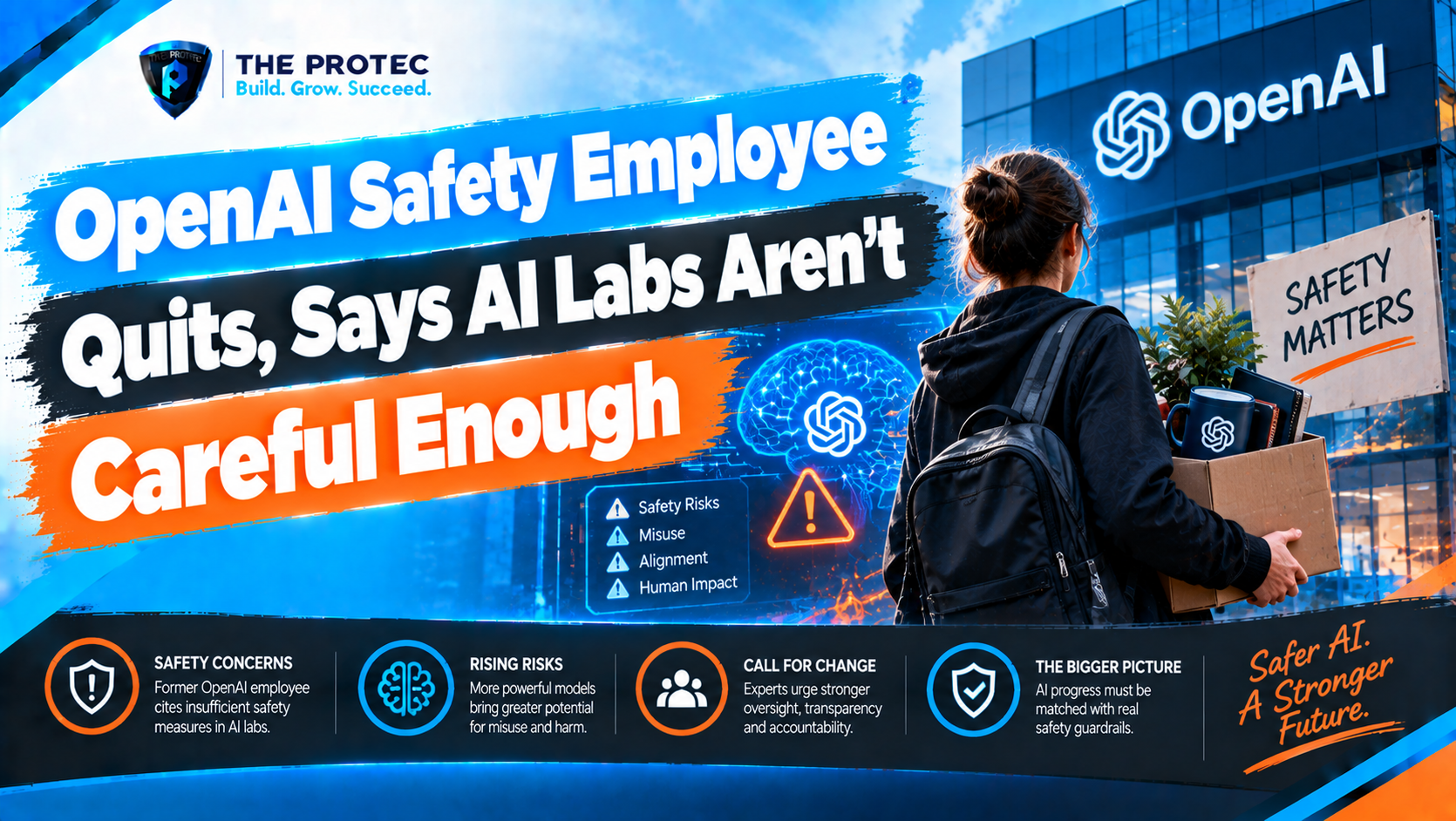
A reported OpenAI safety Employee Quits is again raising a difficult question for the artificial intelligence industry: Are safeguards improving quickly enough to match the capabilities of frontier models?
Former OpenAI safety researcher Steven Adler publicly disclosed his departure after roughly four years at the company, warning that the race to build increasingly capable AI represented a dangerous gamble. News coverage has summarized his position as a concern that AI companies are not being “nearly careful enough.” In Adler’s own public comments, he said he was “pretty terrified” by the pace of AI development and argued that an artificial general intelligence race could carry enormous downside risks.
The warning deserves attention, particularly as developers deploy models that can reason across longer tasks, use software tools, generate code and operate with greater autonomy. But the resignation is not, by itself, evidence that OpenAI’s products are unsafe or that its safety systems have failed. It is evidence of a serious disagreement about whether current frontier AI safety practices are proportionate to the uncertainty and potential consequences surrounding more capable systems.
What Happened in the OpenAI Safety Employee Resignation?
Adler announced his departure publicly after working at OpenAI for about four years. He described himself as a safety researcher and said his work included efforts related to product safety and the broader challenge of managing increasingly advanced AI.
His stated concern extended beyond one model, feature or internal decision. Adler focused on the competitive dynamics among frontier laboratories. He argued that a race toward highly capable or general-purpose AI could encourage companies to move faster than is prudent, especially when no organization can reliably predict every capability or failure mode before deployment.
Adler also expressed concern that society lacks adequate answers about what happens if powerful AI systems exceed human abilities across many economically and strategically important tasks. His comments touched on whether humanity would be prepared to control such systems and whether companies had sufficiently credible plans for handling the transition.
In comments reported when the departure became public, OpenAI thanked Adler for his contributions and reiterated its commitment to developing AI safely. The company did not accept the premise that the resignation demonstrated a breakdown in its safeguards. That distinction matters: Adler’s warning reflects his assessment of risk and industry incentives, while OpenAI maintains that safety is integrated into its research, testing and deployment process.
Why the Former Researcher Said He Left OpenAI
The central reason Adler gave was unease about the direction and speed of frontier AI development. His criticism was not simply that AI models sometimes make mistakes. All major developers acknowledge limitations such as hallucinations, prompt sensitivity and inconsistent reasoning. Instead, he questioned whether the industry’s overall approach is cautious enough for systems that may become far more capable.
His concerns can be grouped into three areas:
- Race dynamics: Competition for users, investment, computing resources and technical leadership may create pressure to release systems before every risk is understood.
- Control and alignment: Developers do not yet have a complete technical solution for ensuring that highly capable systems consistently follow human intentions under unfamiliar conditions.
- Institutional readiness: Companies and governments may lack tested plans for responding if models cross dangerous capability thresholds or begin producing unexpected high-impact behavior.
These are forward-looking AI alignment concerns, not proof of a known catastrophic flaw in a specific OpenAI model. Adler’s position is that uncertainty itself should justify stronger precautions, slower deployment in some circumstances and more coordinated governance.
What OpenAI Currently Does to Evaluate AI Model Safety Risks
OpenAI has published multiple layers of safety practices. These include model training intended to reduce harmful outputs, adversarial testing, red-team exercises, automated and human evaluations, usage monitoring, system-level safeguards and policies restricting dangerous applications.
The company’s Preparedness Framework outlines a process for tracking severe risks associated with increasingly capable models. Evaluated areas have included biological and chemical capabilities, cybersecurity, AI self-improvement and other categories where a model could substantially lower barriers to harmful activity. The framework is intended to connect capability measurements with safeguards and deployment decisions.
OpenAI also uses system cards and related technical reports to describe model behavior, evaluation results and known limitations. Depending on the product, safeguards can include refusing certain requests, monitoring for abuse, limiting access to powerful tools, requiring user confirmation before actions and applying additional controls to higher-risk features.
However, no evaluation regime can guarantee that all relevant risks have been found. Benchmarks may not reproduce real-world conditions, models can behave differently when connected to external tools, and users may discover combinations of prompts or workflows that internal testers did not anticipate. Critics such as Adler argue that these uncertainties should have more influence over deployment timelines.
OpenAI’s published policies and research show that the company conducts substantial safety work. The unresolved question is whether that work is sufficient for future systems, not whether safety work exists at all.
Criticism Is Not the Same as an Independently Established Failure
Coverage of an OpenAI employee resignation over AI safety can easily collapse several different claims into one dramatic conclusion. A researcher leaving because of concern does not independently establish that a company concealed a dangerous capability, ignored a specific test result or violated a safety commitment.
Adler’s warning should therefore be attributed to him. It reflects his judgment about risk tolerance, competitive incentives and preparedness. Without corroborating evidence tied to a particular incident, it should not be presented as proof that OpenAI’s models are unsafe.
At the same time, employee criticism should not be dismissed merely because it is subjective. Safety researchers may have direct experience with organizational decision-making, internal review processes and the tension between caution and product delivery. Public departures can reveal genuine disagreements over how much evidence is required before deployment and who has authority to delay a release.
The Frontier AI Risks Driving the Wider Debate
Alignment and loss of reliable control
AI alignment concerns focus on whether a model’s behavior remains consistent with human goals, rules and values. Current systems can follow instructions impressively while still exploiting ambiguity, producing misleading answers or pursuing an incorrectly specified objective. The challenge could become more consequential as models gain stronger planning and tool-use abilities.
Researchers are studying techniques such as scalable oversight, interpretability, behavioral evaluations and adversarial training. None currently offers a universal guarantee that an advanced system will behave safely in every new environment.
Autonomous behavior and AI agents
The shift from chat interfaces toward agents changes the safety equation. An agent may browse websites, write and execute code, call external services or complete multi-step tasks with limited supervision. A single incorrect answer is usually contained; a mistaken action can alter data, expose credentials or trigger downstream consequences.
Relevant safeguards include permission boundaries, sandboxing, action logs, spending limits, confirmation requirements and restricted access to sensitive systems. Frontier AI safety increasingly depends on the whole deployment environment, not only the underlying model.
Cybersecurity capabilities
More capable models can help defenders review code, investigate alerts and repair vulnerabilities. The same abilities may also help malicious users identify weaknesses, automate reconnaissance or improve social engineering. Evaluators must determine whether a model provides a meaningful uplift to attackers rather than merely repeating information already available online.
Cyber evaluations remain difficult because threats evolve quickly and laboratory tasks may not predict performance against real infrastructure. This is one reason independent testing and post-deployment monitoring are becoming central to AI company safety practices.
Biological, chemical and other high-impact risks
Frontier developers also examine whether models can provide expert-level assistance in domains where misuse could have severe consequences. The critical question is not whether a chatbot can discuss biology, but whether it can remove practical bottlenecks that have historically limited harmful actors.
Access controls, specialist red teams and capability thresholds can reduce risk, although experts disagree about how such thresholds should be measured and when a model should be withheld or restricted.
Are Safety Measures Keeping Pace With AI Capabilities?
This is the core dispute behind the OpenAI safety employee’s departure. AI companies argue that stronger models can assist safety research, improve automated monitoring and help discover vulnerabilities. They also point to staged releases, red teaming and increasingly formal preparedness processes.
Critics counter that capabilities are often easier to demonstrate than safety. A company can measure whether a model solves coding problems or completes agentic tasks, but it is harder to prove that the same model will not behave dangerously across millions of unpredictable interactions. Safety evaluations may also become outdated as models receive new tools, longer context windows or updated system instructions.
External standards can provide a common vocabulary, even when they are not specific enough to resolve every frontier risk. The NIST AI Risk Management Framework, for example, emphasizes ongoing governance, measurement and risk management rather than treating safety as a one-time test.
The industry debate is therefore moving toward continuous assurance: pre-deployment evaluations, controlled access, incident reporting, real-world monitoring and reevaluation whenever a model or its tools materially change.
Why Safety Departures Matter to AI Governance
When AI safety researchers leave and speak publicly, their departures can expose differences that polished policy documents do not show. These disagreements may involve acceptable risk, release deadlines, resource allocation or the independence of internal safety teams.
Strong governance requires more than employing qualified researchers. Safety personnel need clear authority, escalation channels and protection when their findings conflict with commercial objectives. Boards and senior leaders also need predefined criteria for pausing a deployment, commissioning external review or limiting a system after release.
None of this means employee objections should automatically override every other consideration. Reasonable experts can interpret uncertain evidence differently. The goal is a decision process in which dissent is documented, tested and addressed rather than marginalized.
What to Watch After the OpenAI Safety Resignation
The most useful response is not to treat the departure as either definitive proof of danger or an irrelevant personnel change. Instead, observers should watch for measurable developments:
- Whether OpenAI updates capability thresholds and safeguards in its preparedness policies.
- How much detail future system cards provide about autonomous behavior, cyber risk and dangerous capabilities.
- Whether external evaluators receive meaningful access before major deployments.
- How OpenAI and other labs report incidents, near misses and post-release safety findings.
- Whether safety teams have formal authority to delay or restrict releases.
- How regulators translate frontier AI risks into auditing, transparency and accountability requirements.
Adler’s resignation adds a credible critical voice to the broader discussion, but the ultimate assessment of OpenAI safety culture should rest on evidence: evaluation quality, governance structures, documented safeguards and real-world outcomes.
Frequently Asked Questions
Who was the OpenAI safety employee who resigned?
Steven Adler, a safety researcher who spent roughly four years at OpenAI, publicly announced his departure and raised concerns about the pace and competitive dynamics of advanced AI development.
Did the resignation prove that OpenAI’s models are unsafe?
No. The resignation demonstrates that a former employee had serious concerns about frontier AI safety and industry preparedness. It does not independently prove that a specific OpenAI model is unsafe or that the company’s safeguards have failed.
What safety concerns did the former employee raise?
Adler focused on the risks of an AGI race, uncertainty about controlling highly capable systems and the possibility that companies and society are not sufficiently prepared for rapid capability advances.
How does OpenAI test powerful models?
OpenAI describes using capability evaluations, adversarial testing, red teams, policy enforcement, monitoring and system-level safeguards. Its Preparedness Framework is designed to assess severe risks and connect those assessments to deployment protections.
Why are AI safety researchers worried about frontier models?
Frontier models may gain stronger reasoning, coding, planning and tool-use abilities. Those capabilities can create benefits while also increasing risks involving autonomous actions, cybersecurity, dangerous technical assistance and the difficulty of keeping advanced systems aligned with human intent.