







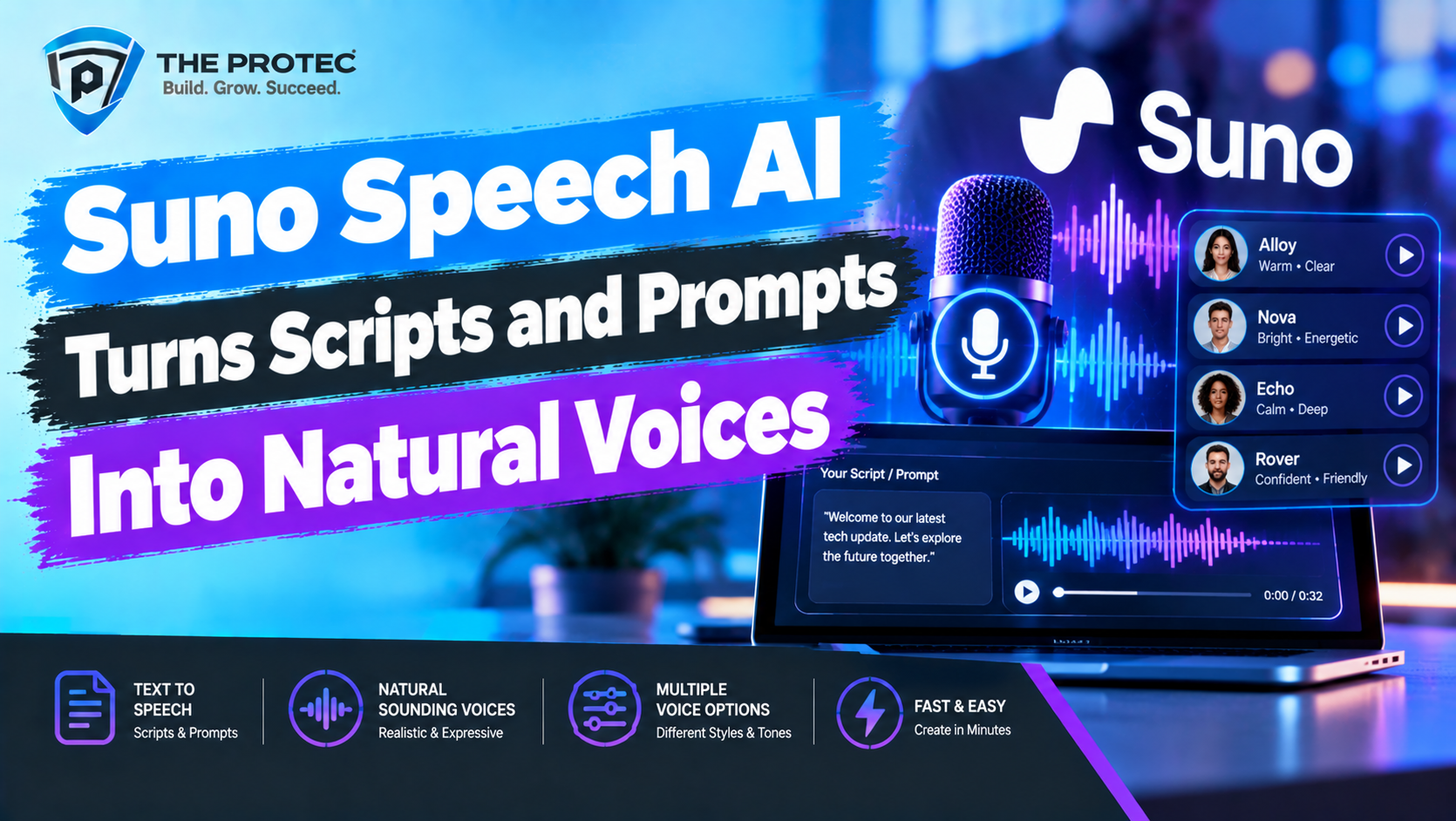
Suno, best known for making generative music creation accessible through simple text prompts, is expanding its focus on AI audio. Suno Speech AI brings the same prompt-driven philosophy to spoken-word production, allowing users to generate voices from written scripts or natural-language descriptions of how a passage should sound.
The move matters because convincing speech requires more than reading text aloud. A useful AI speech generator must interpret context, place emphasis correctly, maintain a consistent delivery and handle pauses, pacing and emotion without making the result sound mechanical. Suno’s speech technology is intended to address those creative dimensions, positioning spoken audio as something users can direct rather than merely convert from text.
This expansion also puts Suno alongside a growing field of companies developing generative AI voices for narration, media production, applications and conversational experiences. Yet several important details—including the complete list of supported voices and languages, access tiers, pricing and commercial licensing terms—must be evaluated from Suno’s current product documentation rather than inferred from its music service.
What Is Suno Speech AI?
Suno Speech AI is a generative-audio technology for producing spoken output from scripts and prompts. In a conventional text-to-speech workflow, a user chooses a preset voice, enters text and adjusts a small number of settings such as speed. A generative speech model can take a broader direction, interpreting both the words to be spoken and instructions about their performance.
A user might provide a finished narration script, for example, and request a calm documentary delivery with deliberate pacing. Another prompt could ask for an energetic product introduction, a restrained dramatic reading or a friendly explanation that sounds conversational rather than formal. The goal of voice generation from prompts is to let creators describe intent in ordinary language instead of manipulating every acoustic parameter manually.
That does not mean every vocal attribute is necessarily available as a separate control. Prompt interpretation, preset selection and editable controls are different product features. Suno’s public demonstrations and launch descriptions indicate an emphasis on expressive voice generation, but users should consult the official Suno website for the current interface, feature availability and account requirements.
How Suno Speech Generation Works
The Suno AI speech model operates at the intersection of language understanding and audio generation. First, it must process the script: identifying sentence structure, punctuation, meaning and likely emphasis. It must then translate performance instructions into vocal qualities before producing an audio waveform or another playable audio representation.
For creators, the process can be understood through two main inputs:
- Scripts: The exact words that the generated speaker should deliver.
- Natural-language prompts: Directions covering the intended voice, mood, delivery, pacing, audience or creative context.
A prompt could describe a confident host speaking at a moderate pace, with short pauses after key statements. The system may use that context to determine rhythm, intensity and intonation. The resulting Suno text to speech output should therefore be judged not only on pronunciation, but also on whether it follows the requested performance.
As with other AI audio generation systems, results may vary with script complexity. Long sentences, unusual names, technical abbreviations, multilingual passages and ambiguous punctuation can expose weaknesses. Breaking a production into shorter sections, adding punctuation and rewriting unclear performance instructions may improve consistency.
What Makes AI-Generated Speech Sound Natural?
Human speech contains continuous variation. People speed up, slow down, breathe, hesitate and change pitch depending on meaning. They also stress words in ways that can alter the interpretation of a sentence. A technically accurate reading can still sound artificial if it applies identical timing and energy throughout.
The reported appeal of Suno voice AI is its ability to generate or interpret several parts of a performance together:
- Voice character: The general qualities that make a speaker sound warm, bright, authoritative, intimate or animated.
- Tone: The emotional attitude of a passage, such as reassuring, serious, enthusiastic or reflective.
- Pacing: How quickly words are delivered and whether speed changes naturally across a script.
- Prosody: Patterns of stress, pitch and rhythm that communicate meaning beyond the words.
- Pauses: Brief silences that separate ideas, create emphasis or make narration easier to follow.
- Delivery: The broader performance style, including energy, formality and conversational flow.
These elements distinguish modern AI voice synthesis from older speech engines designed primarily for intelligibility. The strongest generative systems attempt to model a complete performance. They can still produce artifacts, inconsistent emotion or misplaced emphasis, so professional projects require human review and often multiple generations.
Suno Speech AI Versus Suno Music Generation
Suno’s move into speech may look like a simple extension of its music platform, but speech synthesis and music generation solve different problems. Music models typically organize melody, harmony, rhythm, instrumentation, vocals and song structure. Speech models prioritize linguistic accuracy, speaker consistency, intelligibility and natural prosody.
Spoken-word production is also less tolerant of certain mistakes. A strange musical transition may be treated as a creative choice, while a mispronounced company name or altered number can make a narration unusable. Speech systems must preserve the supplied language precisely while still performing it expressively.
Suno does have a history with generative speech research, including Bark, an earlier text-prompted audio model capable of producing speech and other sounds. The new focus on Suno speech generation therefore represents an expansion of its current product direction beyond songs, rather than the company’s first encounter with synthetic speech. Its experience with generative audio could help Suno connect music, voice and sound design in broader creation workflows, although integrations should not be assumed until they are officially released.
Potential Uses for the Suno AI Voice Generator
Narration and audiobooks
Creators could use AI speech from scripts to produce draft narration, educational material, accessibility audio or finished spoken content where licensing permits. Prompt-based delivery may be especially useful when different chapters need distinct moods. Long-form projects will still need pronunciation checks, loudness normalization and continuity review.
Podcasts and spoken shows
AI narration tools can generate introductions, summaries, fictional characters or translated segments. They may also help creators prototype a format before hiring performers. Transparent labeling is important when listeners could reasonably believe that a synthetic host is a real person.
Video production
Video teams often need voice-overs before an edit is locked. A Suno AI voice generator could provide temporary tracks for timing and potentially final narration for explainers, advertisements, social videos or training content. Promptable pacing may reduce the editing required to fit speech within a scene.
Games and interactive applications
Interactive products require more flexibility than fixed recordings. Generative speech could support character dialogue, dynamic instructions and responses shaped by user actions. Real-time applications additionally depend on latency, developer access, moderation and output consistency; these capabilities should be treated as separate from basic speech generation unless Suno confirms them.
Business and educational content
Organizations could generate onboarding material, internal presentations, product walkthroughs and course narration. However, high-stakes uses involving medical, legal, financial or safety information require strict review. A natural voice does not guarantee that the underlying script is accurate.
Voices, Languages, Controls, Access and Pricing
Product launches often evolve rapidly, and demonstrations do not always represent features available to every account. As of October 2026, anyone evaluating the Suno Speech AI model should verify five areas in Suno’s official documentation before planning a production workflow.
- Supported voices: Confirm whether Suno provides a fixed voice library, generated voice styles, user-created voices or any form of authorized custom voice.
- Languages and accents: Do not assume that a model supports every language equally. Quality may differ by language, regional accent and code-switching scenario.
- Creative controls: Check whether tone and pacing are controlled through prompts, interface settings, presets or a combination of methods.
- Access and pricing: Determine whether speech is available broadly, in staged access, through a subscription or under usage-based limits.
- Commercial rights: Review the terms applying specifically to speech output, including restrictions involving public figures, third-party material and monetized use.
Suno’s music subscription terms should not automatically be treated as the terms for Suno’s latest AI product. Likewise, an audio file being downloadable does not by itself establish commercial rights. Businesses should retain records of the applicable terms, plan level, generation date and source materials used in each project.
Speech Generation Is Not Automatically Voice Cloning
Voice generation and voice cloning are related but distinct concepts. A system can create AI-generated voices from a general description or a licensed preset without copying an identifiable person. Voice cloning usually involves reproducing vocal characteristics from recordings of a specific speaker.
That distinction is essential when discussing voice cloning and AI speech. The ability to request a vocal style does not prove that a product supports cloning, and cloning shown in a research demonstration may not be available in the public interface. Users should rely on Suno’s explicit feature descriptions and policies rather than assuming that all AI voice technology works the same way.
If custom likeness features are offered, responsible safeguards may include documented consent, speaker verification, restrictions on impersonation and a process for reporting misuse. The exact protections must be assessed product by product.
Consent, Copyright and Disclosure Responsibilities
Natural generative AI voices introduce risks because listeners may not know whether speech is authentic. A synthetic voice could be used to imitate a performer, misrepresent a public figure or create a false endorsement. Even when a platform permits an output technically, the user remains responsible for how that audio is deployed.
Consent should be explicit when an identifiable person’s voice is involved. Permission to record someone is not necessarily permission to train, clone or commercially deploy a synthetic likeness. Contracts should define approved contexts, duration, compensation, editing rights and whether the voice model may be reused.
Copyright and publicity rights vary by jurisdiction. Scripts can contain protected text, while vocal identity may be covered by publicity, privacy, passing-off, contract or unfair-competition laws rather than copyright alone. Organizations should seek qualified legal advice for campaigns involving recognizable voices or copyrighted source material.
Disclosure also builds trust. Labels such as “AI-generated narration” can help audiences interpret synthetic media, particularly in news, advertising, education and political communication. The U.S. Federal Trade Commission has published guidance and enforcement information concerning artificial intelligence and deceptive practices, reinforcing the need to avoid impersonation and misleading claims.
What Suno’s Speech Expansion Means for Generative Audio
Suno’s shift toward speech reflects a broader convergence across audio production. Music, narration, dialogue, sound effects and translation are increasingly becoming parts of connected generative workflows. A creator may eventually move from a written concept to a soundtrack, narrator and supporting audio within the same production environment.
The immediate test for Suno Speech AI will be practical reliability. Expressive demos can attract attention, but creators need predictable pronunciation, controllable performances, clear licensing and manageable generation costs. Enterprise users will also look for privacy protections, team administration, security documentation and stable developer options.
If Suno combines ease of use with transparent rights and effective safeguards, its speech model could become a significant extension of the platform. The launch shows that Suno no longer wants to be viewed only as an AI music company; it is positioning itself more broadly within generative audio.
Frequently Asked Questions
What does Suno Speech AI generate?
It generates spoken audio from scripts and natural-language prompts. Prompts can describe the desired performance, including elements such as tone, pacing, energy or context, subject to the controls and voices available in the current product.
Is Suno Speech AI the same as a standard text-to-speech tool?
Not exactly. Both convert text into speech, but generative speech aims to interpret creative direction and produce a more expressive performance. Traditional text to speech AI may focus more narrowly on clear pronunciation and fixed voice settings.
Can Suno clone a person’s voice?
Voice generation should not be confused with voice cloning. Users should check Suno’s official documentation to determine whether authorized custom voices or likeness features are supported. No one should imitate an identifiable person without appropriate consent and legal rights.
Can Suno-generated speech be used commercially?
Commercial use depends on the terms attached to the speech product, account tier and intended use. Users should review Suno’s current speech-specific license rather than assuming its music terms apply automatically.
Which languages and voices does Suno support?
Availability may change as the product develops. Consult Suno’s current product documentation for the official voice and language list, and test pronunciation and delivery before using generated speech in a public project.