








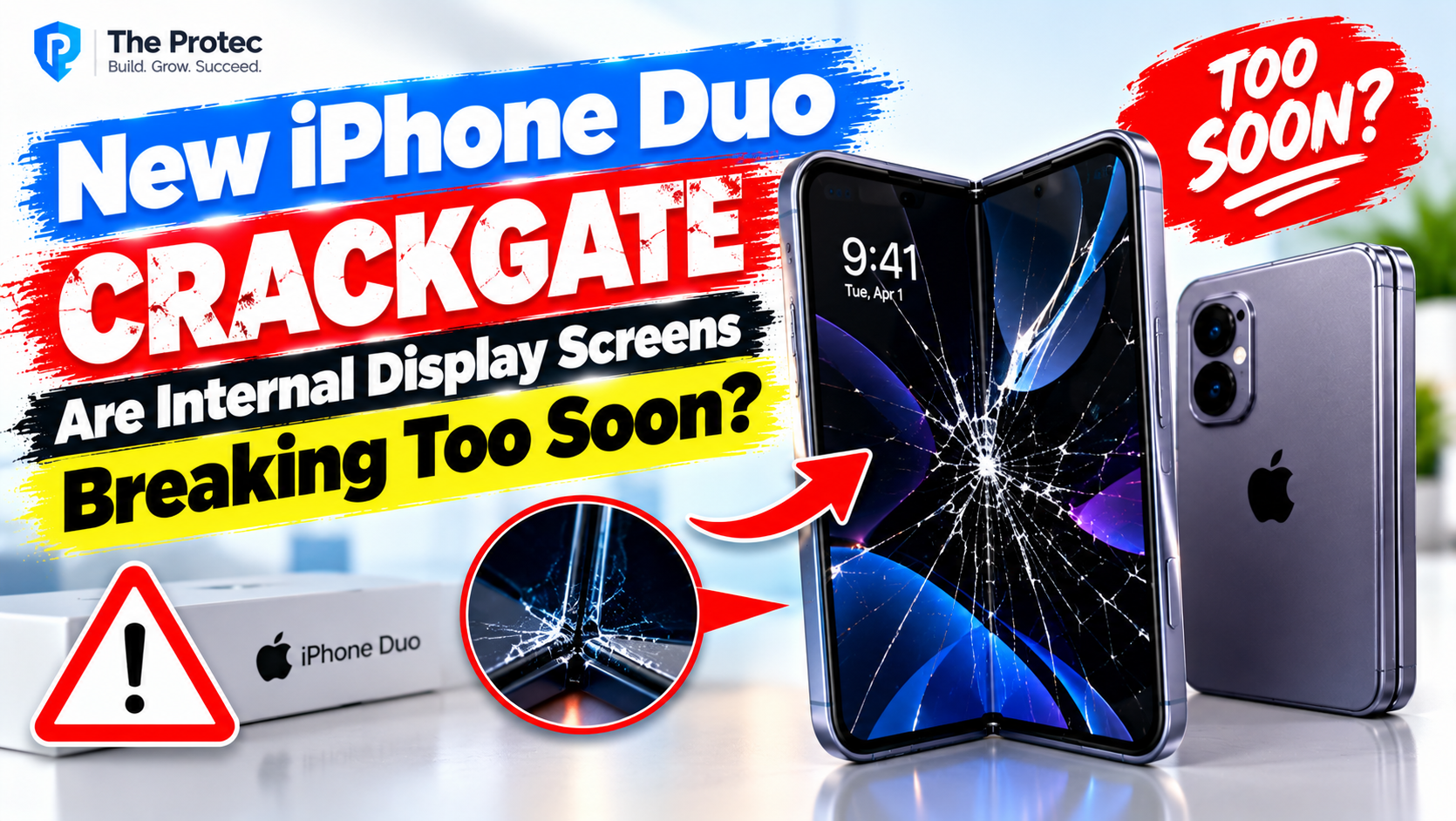
Cracks reportedly running along the folding hinge have placed the new iPhone Duo under scrutiny almost immediately after launch. The most concerning account describes an iPhone Duo internal display crack appearing after the owner had opened the phone fewer than 20 times. Images circulated with early coverage appear to show damage close to the crease, where a foldable display experiences its most obvious mechanical movement.
That account has been attributed to original reporting by MacRumors, but it needs to be characterized carefully. The fewer-than-20-openings figure is an affected owner’s account, not the result of an independently controlled durability test. Repetition by additional websites or social accounts does not turn the same incident into multiple confirmed cases, and photographs alone cannot reveal how a device was handled, whether it suffered an impact, or what an Apple inspection found.
Reports also say Apple replaced the customer’s phone. That response is important, but it does not by itself establish that Apple identified a manufacturing defect. The available public account does not conclusively show whether the replacement was processed as standard warranty service, a discretionary customer-care accommodation, or another type of exchange. No cited Apple statement confirms a widespread iPhone Duo hinge problem or product-wide display defect.
So, does the new iPhone Duo Crackgate label fit? The reports deserve investigation, especially because the inner screen is central to the appeal and cost of a foldable phone. For now, however, “Crackgate” is best understood as the name of an emerging controversy—not proof that iPhone Duo screen breaking is common.
What are iPhone Duo owners reporting?
The earliest claims focus on cracks appearing on or close to the internal display’s folding line. In the most widely repeated story, an owner reportedly found that the main screen had failed after fewer than 20 openings. The timing made the claim particularly alarming: a premium foldable should not experience catastrophic display damage during ordinary setup or light launch-day use.
There are limits to what this report establishes. The opening count was supplied by the owner and was not observed by an independent testing organization. It should therefore be treated as a firsthand customer allegation rather than a measured finding about foldable iPhone hinge durability. Even if the account is entirely accurate, a single early failure cannot reveal the typical lifespan of the design.
Photographs associated with iPhone Duo cracked screen reports appear to place the visible damage near the hinge or crease. That apparent similarity matters because repeated damage in the same location can eventually help investigators identify a pattern. Yet images can show only the final condition of a device. They generally cannot establish when a fracture began, whether pressure was applied to the display, whether debris entered the folding area, or whether the phone experienced an earlier drop.
The circumstances surrounding other circulating images are less clear. Some posts may be reposts, crops, or retellings of an original incident rather than separate devices. Without distinct owners, original photographs, service records, and independently confirmed timelines, it would be misleading to publish a total number of affected phones. There is not yet enough transparent evidence to calculate a failure rate or conclude that every image represents a separate launch-day failure.
This distinction is essential in fast-moving hardware news. A firsthand statement is stronger than an unattributed repost. An original photograph with reliable provenance is more useful than a compressed screenshot. An independent teardown or repeatable durability test carries more evidentiary weight than either. At present, the iPhone Duo launch day reports raise a credible question, but they do not answer how widespread the issue may be.
How has Apple responded to the reported display failure?
Coverage of the principal incident says Apple replaced the affected owner’s iPhone Duo. If accurately reported, that was a favorable outcome for that customer and suggests Apple was willing to resolve the immediate complaint. It is not, however, equivalent to a formal acknowledgment that the phone had a defective hinge, panel, or manufacturing process.
Companies sometimes replace recently purchased devices before completing a broader technical investigation. A replacement can be authorized under warranty, a retailer’s return policy, an escalation by customer relations, or a discretionary launch-period accommodation. Unless Apple or the customer provides documentation identifying the service classification, it is not possible to say conclusively which explanation applies here.
No official Apple statement cited in the available source trail confirms systemic Apple foldable phone display issues. Nor has the reported individual exchange been accompanied by a publicly identified iPhone Duo repair program, recall, or model-specific service notice. That could change if Apple collects more affected units or releases new guidance, but one replacement should not be presented as confirmation of a known design defect.
Apple’s warranty terms generally cover defects in materials and workmanship, while accidental or externally caused damage may be excluded. Actual iPhone Duo warranty repair eligibility would depend on the applicable terms, the country or region, coverage status, and Apple’s inspection of the device. Owners can review Apple’s published hardware warranty information, although local consumer laws may provide additional rights.
Consumers should not assume that every iPhone Duo screen replacement will be free. A crack judged to result from impact, misuse, foreign material, or other accidental damage may be handled differently from an unexplained panel failure on an undamaged launch-day device. Conversely, owners should not assume that a crack near the hinge will automatically be rejected. The condition of the phone and the service provider’s findings will matter.
Why might a foldable display crack near the hinge?
A foldable display must repeatedly bend through a tightly controlled radius. Unlike conventional smartphone cover glass, the flexible panel, protective layers, adhesives, support structure, and hinge system all move in relation to one another. That makes the crease a mechanically demanding area even when a device is operating normally.
Several factors could potentially contribute to an internal-display failure. They include uneven hinge alignment, abnormal pressure beneath the panel, a flaw in a display layer, adhesive problems, manufacturing contamination, trapped debris, impact damage, or handling outside the recommended conditions. Temperature and the force used to close a device can also affect folding systems in general.
These are possible explanations, not confirmed causes of the reported iPhone Duo durability issues. A crack following the fold line might suggest stress around the hinge, but its location alone cannot prove an iPhone Duo hinge problem. A proper diagnosis may require physical inspection, magnification, hinge measurements, internal examination, and analysis of the damaged display stack.
Independent testing could provide useful context by opening and closing multiple retail units under controlled conditions. Even then, a test would need an adequate sample size and realistic environmental controls. One phone surviving thousands of cycles would not prove that no defective units exist, just as one early iPhone Duo display failure would not demonstrate that the entire model is unreliable.
Is the new iPhone Duo Crackgate label justified?
“Crackgate” is an effective shorthand for the controversy because it captures the seriousness of a folding screen cracking during reportedly light use. It is not yet a scientifically supported conclusion about the product line. A responsible assessment must separate the existence of a complaint from the prevalence and cause of the complaint.
Evidence of a broader defect would require more independently documented cases, preferably with original images, confirmed ownership, known handling histories, and Apple inspection results. Similar crack patterns across unrelated devices would strengthen the case for a shared cause. Data about the total number of phones in customers’ hands would also be necessary to place the reports in context.
At this stage, the denominator is unknown. Even several confirmed failures could represent a very low rate among a large launch population, while a rapidly growing group of matching failures could indicate a more meaningful problem. Reposts of one incident cannot provide that information.
Apple’s future response will be another important signal. A technical support bulletin, revised care guidance, extended repair coverage, or formal service program would substantially change the assessment. So would independent evidence reproducing iPhone Duo screen breaking during normal use. Until then, the nickname describes attention around the claims rather than a proven product-wide fault.
Should current owners and prospective buyers be worried?
Owners should take the reports seriously without assuming their phones are destined to fail. Inspect the inner display under good lighting, particularly around the crease, and look for lines, lifting layers, unusual bulges, dead pixels, or touch-response problems. Check the hinge area for visible debris, but do not insert tools or attempt to lift any display layer.
Follow Apple’s care and handling instructions, avoid pressing hard on the flexible screen, and do not force the phone closed if resistance feels abnormal. A protective film applied at the factory should not be removed unless Apple explicitly instructs otherwise. Owners should also avoid unapproved screen protectors or accessories that could interfere with folding.
If an unexpected crack appears, stop repeatedly opening the phone to test it. Photograph the display, frame, and hinge from several angles, note when the problem was first observed, and preserve the receipt or other proof of purchase. Contact Apple or an authorized service provider promptly and request a written assessment where available. Back up important data before surrendering the device for inspection or replacement.
Prospective buyers can monitor verified owner reports, independent durability testing, and official repair guidance. There is no current basis for assuming every device is at risk, but it would also be premature to dismiss the reports simply because the documented sample is small. Early anecdotal evidence cannot establish long-term Apple foldable iPhone durability in either direction.
Frequently asked questions
Did an iPhone Duo screen really crack after fewer than 20 openings?
An owner reportedly said the internal screen failed after fewer than 20 openings, and the account has been attributed to MacRumors reporting. The opening count remains a customer-supplied claim, not an independently observed durability test. Public photographs may document damage, but they cannot independently confirm the number of folds or the complete handling history.
Did Apple replace the cracked iPhone Duo?
Published accounts say Apple replaced the principal customer’s device. The publicly described information does not conclusively establish whether this was a standard warranty replacement, a discretionary accommodation, or a formal finding that the phone contained a defect. Apple has not been shown acknowledging a model-wide problem through that individual exchange.
Has Apple announced an iPhone Duo repair program?
No broader service program, recall, or official defect acknowledgment is identified in the reporting discussed here. Owners should check Apple’s current support information or contact an authorized provider because policies and technical guidance can change as additional devices are examined.
Does a crack along the crease prove the hinge is defective?
No. Its location makes hinge-related stress one possibility, but panel construction, manufacturing variation, debris, impact, pressure, and handling conditions could also be relevant. The root cause cannot be reliably diagnosed from photographs alone.
The measured verdict on iPhone Duo Crackgate
The reported inner-screen cracks deserve attention because a display failure can be expensive and disables the feature that defines a foldable phone. The account of failure after fewer than 20 openings is especially concerning and warrants careful investigation.
What remains unknown is just as important: the number of independently confirmed devices, the actual failure rate, the underlying cause, and whether Apple’s reported replacement reflected warranty findings or customer-service discretion. Until stronger evidence, reproducible testing, or an official investigation becomes available, new iPhone Duo Crackgate should remain a closely watched controversy—not a declaration that Apple’s foldable phone is broadly defective.