








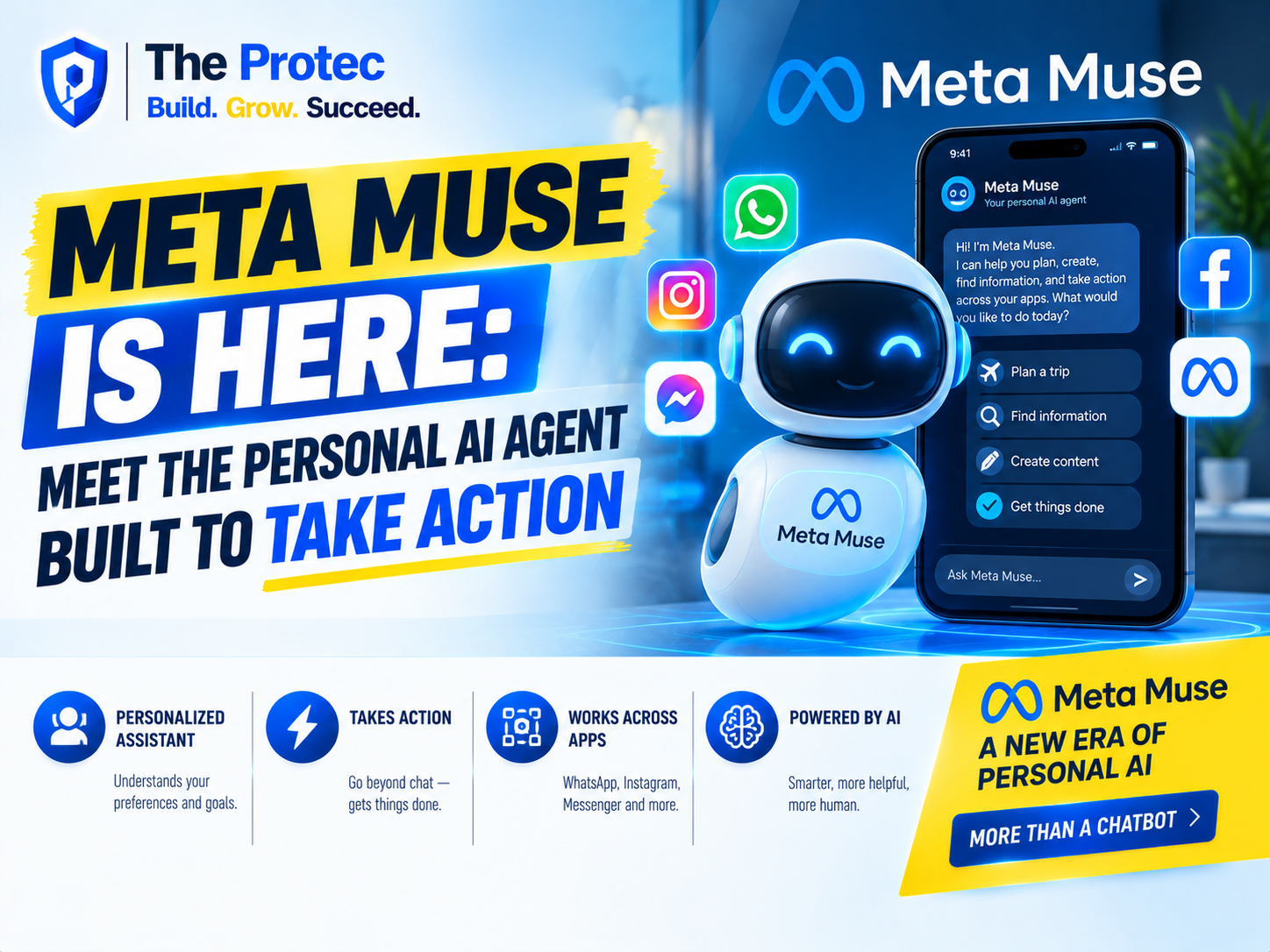
Most chatbots wait patiently for a prompt. You ask a question, they produce an answer, and the interaction ends. Meta Muse points toward a more ambitious model: a personal AI agent that can understand what you are trying to accomplish, retain useful context and potentially take action across the apps you already use.
That distinction matters. A chatbot can suggest restaurants for a birthday dinner. An agent could compare options, ask friends when they are available, create a poll in WhatsApp and remind the group to respond. Instead of merely explaining how to complete a task, it could help carry that task through to completion.
As of September 2026, the capabilities and availability associated with Meta Muse may vary by account, platform and region as Meta tests and expands its AI products. Some details also remain subject to product updates and official documentation. Even so, the direction is clear: Meta wants AI to become more personal, persistent and useful inside its enormous social ecosystem. The bigger question is whether people are ready to let an assistant move from the chat box into their daily lives.
What Is Meta Muse?
Meta Muse is best understood as a new generation of Meta personal AI agent rather than another question-and-answer bot. Its potential value comes from combining conversational intelligence with memory, planning, tool use and access to services within Meta’s ecosystem.
A traditional assistant responds to individual requests. The Meta Muse AI agent could interpret a broader objective, break it into steps and coordinate those steps over time. If a user asks for help organizing a weekend trip, for example, Muse might identify the travelers, gather preferences, summarize suggestions shared in a group conversation and prepare a proposed itinerary.
This does not mean the Meta Muse AI assistant should be expected to act without boundaries. Meaningful actions, especially those involving messages, purchases, personal data or public posts, need clear permission and confirmation. The defining idea is not unlimited autonomy. It is controlled delegation: users decide what the agent may do, while the agent reduces the work required to do it.
Why Meta Muse Is More Than a Traditional Chatbot
The first wave of generative AI made natural conversation widely accessible. The next wave is focused on agency. AI agents do not simply generate text; they can reason through multi-step goals, call approved tools, monitor progress and adapt when something changes.
A capable personal AI agent generally needs several connected abilities:
- Context awareness: It should understand the current conversation, relevant preferences and the task’s history.
- Planning: It should convert a broad request into smaller, manageable actions.
- Tool use: It should interact with calendars, messaging features, search tools or other authorized services.
- Memory: It should remember useful details without retaining information the user did not intend to save.
- Proactive assistance: It should surface reminders or next steps at the right time rather than waiting for another prompt.
- User control: It should explain planned actions and request approval when consequences extend beyond the conversation.
Meta Muse could bring these elements together in a setting that already contains social connections, business conversations, communities and media. That existing context is Meta’s biggest advantage, but it is also the source of its most difficult privacy questions.
How Meta Muse Could Work Across Meta’s Ecosystem
Meta does not need to persuade billions of people to adopt an entirely new communication habit. Its platforms are already where users chat with relatives, follow creators, discover products and contact businesses. According to the company’s official Meta AI information, its assistant strategy spans multiple apps and devices. Muse could extend that strategy from conversational help toward coordinated action.
Meta Muse on WhatsApp
WhatsApp may be the most natural home for a Meta personal AI agent. Many everyday tasks already begin in its chats: arranging dinners, planning trips, sharing shopping lists, confirming appointments and communicating with businesses.
A Meta Muse WhatsApp experience could summarize a long group thread, identify unresolved decisions and create a short list of next steps. With permission, it might draft messages, generate a poll, suggest meeting times or remind participants about a deadline. For business interactions, it could help users compare information received from several merchants without requiring them to search through separate conversations.
The important design challenge is visibility. People should always know when Muse is reading selected context, what it plans to do and whether a message will be sent in their name. Private conversations must not silently become a general-purpose data source for an AI agent.
Instagram, Messenger and Facebook
On Instagram, Muse could help users turn saved posts into actionable plans. A collection of recipes might become a weekly meal plan, while travel reels could be organized into a realistic itinerary. Creators could use the agent to sort common questions, outline content ideas or prepare replies while retaining final editorial control.
Messenger offers many of the same coordination opportunities as WhatsApp. Facebook adds events, groups and Marketplace, allowing an agent to help track community activities, compare listings or organize information shared across a group. The usefulness would come from connecting these surfaces carefully, not from giving Muse unrestricted access to everything.
Wearables and Ambient Assistance
Meta’s work in smart glasses also creates a path for Muse to become more ambient. A multimodal agent could respond to what a user sees or hears, provide a reminder during an activity or capture a request for later. The experience would feel less like opening a Meta Muse app and more like having an assistant available across devices.
That possibility moves Muse closer to Meta’s broader vision of personal superintelligence: AI designed around an individual’s goals, context and agency. The phrase Meta personal superintelligence is ambitious, but the practical test is simple. Can the technology make ordinary tasks easier without becoming intrusive?
From Prompts to Proactive Action
The most significant change introduced by agentic AI is the shift from reactive to proactive assistance. Today, a user may ask a chatbot to draft a checklist. Tomorrow, that assistant could notice that two checklist items remain incomplete, ask whether help is needed and carry out an approved next step.
Imagine asking Meta Muse to coordinate a family celebration. The agent might collect preferences from a WhatsApp group, identify dates that work, organize venue suggestions found on Instagram and prepare a final plan. If someone cancels, it could flag the conflict and propose alternatives. The task continues even though the original prompt was sent days earlier.
Muse Spark could play an important role in this experience as an entry point for creating or launching agent-driven tasks. Whether presented as a creation feature, recommendation layer or shortcut system, Muse Spark would need to make automation understandable. Users should be able to see what triggers an action, which information is involved and how to stop or edit the workflow.
Meta Muse vs ChatGPT, Claude and Gemini
Comparisons between Meta Muse and established assistants depend on how Muse develops. ChatGPT, Claude and Gemini are all evolving beyond basic chat, so the competition is not simply about which model writes the best answer. It is about which assistant can combine intelligence, tools, context and trust most effectively.
Meta Muse vs ChatGPT
ChatGPT has developed into a broad productivity environment with research, file analysis, multimodal interaction and agent-style task completion. Its strength is versatility across personal and professional use cases.
Meta Muse could differentiate itself through native social context. Rather than asking users to move information into a separate workspace, it may operate where conversations and plans already exist. ChatGPT may remain the more flexible standalone destination, while Muse could feel more embedded in daily communication.
Meta Muse vs Claude
Claude is widely associated with careful writing, document analysis, coding and complex reasoning. It has also emphasized transparent, controlled interaction. In a Meta Muse vs Claude comparison, Claude may appeal more strongly to users working with large documents or structured professional tasks.
Muse’s potential advantage is coordination across social services. Its challenge will be demonstrating that convenience does not weaken privacy, accuracy or user control. An agent acting in personal conversations must meet a different trust threshold from an assistant summarizing an uploaded report.
Meta Muse vs Gemini
Gemini benefits from Google’s ecosystem, including search, Android and productivity applications. That gives it substantial reach across information discovery and work. Meta Muse vs Gemini may therefore become a contest between two kinds of context: Google’s knowledge and productivity context versus Meta’s social and communication context.
Neither approach guarantees the best experience. The winning assistant may be the one that asks for the least unnecessary access, explains its decisions clearly and lets users move their information between services.
The Trust Problem Meta Muse Must Solve
An AI answer can be corrected. An AI action can have immediate consequences. A mistaken recommendation is inconvenient; a message sent to the wrong group, an unwanted booking or an inaccurate business response can cause real harm.
Meta Muse therefore needs layered safeguards. Low-risk actions such as organizing notes may happen automatically. Higher-risk actions should require confirmation. Users also need an activity history showing what the agent accessed, recommended and completed.
Privacy controls must be equally specific. People should be able to select which conversations, contacts and services Muse can use. Memory should be editable, temporary when appropriate and easy to delete. Established resources such as the NIST AI Risk Management Framework offer useful principles for building accountable systems, but Meta will still need to prove those principles through product design.
Security presents another concern. An agent that can act across multiple apps becomes a valuable target for scams, malicious instructions and account compromise. Strong authentication, action limits and defenses against prompt injection will be essential.
Will There Be a Standalone Meta Muse App?
Some users will search for a Meta Muse app, but a standalone download may not be the most important part of the strategy. Muse could be more valuable as an identity and assistance layer available within WhatsApp, Instagram, Messenger, Facebook and compatible devices.
A dedicated app could still provide a central dashboard for memories, permissions, active tasks and connected services. That would give users one place to inspect what the agent knows and revoke access. The ideal model may combine both approaches: convenient assistance inside Meta’s platforms and centralized control in a clearly labeled interface.
What Meta Muse Means for the Future of AI Agents
Meta Muse reflects a broader change in how technology companies define an assistant. The goal is no longer limited to producing fluent responses. Companies are building systems that can observe context, form plans, use tools and work toward outcomes.
If Meta executes well, Muse could make agentic AI understandable to mainstream users because it would appear inside familiar interactions. People may not think of themselves as building AI workflows. They will simply ask for help arranging an event, managing a conversation or following up on a plan.
Success, however, will not be measured by how many actions the Meta AI agent can perform. It will be measured by whether those actions are relevant, reversible and genuinely authorized. The best personal agent should feel capable without being controlling and proactive without becoming invasive.
Frequently Asked Questions About Meta Muse
What is the Meta Muse AI agent?
Meta Muse is a personal AI agent concept designed to move beyond one-off chatbot answers. Its potential capabilities include understanding context, planning multi-step tasks, using approved tools and helping users take action across Meta’s platforms.
How could Meta Muse work with WhatsApp?
Meta Muse WhatsApp features could summarize group discussions, identify decisions, draft replies, create polls and coordinate plans. Any access to private conversations or action taken on a user’s behalf should be permission-based and clearly disclosed.
Is Meta Muse better than ChatGPT, Claude or Gemini?
It is too early to name a universal winner, and each assistant has different strengths. Muse’s most distinctive advantage could be integration with Meta’s social and messaging ecosystem. ChatGPT offers broad versatility, Claude is strong in document-focused reasoning, and Gemini benefits from Google’s search, mobile and productivity services.
Does Meta Muse act without asking permission?
A trustworthy implementation should distinguish between low-risk assistance and consequential actions. Sending messages, making purchases, publishing content or sharing personal information should require explicit authorization and, in many cases, final confirmation.
Why is Meta Muse important?
Meta Muse matters because it illustrates the transition from AI tools that answer questions to AI agents that help complete goals. If that transition succeeds, interacting with AI may become less about crafting prompts and more about safely delegating everyday work.
The Bottom Line
Meta Muse represents a compelling next step for consumer AI: an assistant that does not merely talk about a task but helps move it forward. Meta’s reach across messaging, social platforms and connected devices gives it an unusual opportunity to make personal agents part of everyday life.
That opportunity comes with serious responsibility. Context can make an AI assistant useful, but personal context is sensitive. Proactivity can save time, but unwanted actions quickly destroy trust. Muse will need transparent permissions, reliable confirmations and meaningful user control at every stage.
If Meta gets that balance right, the age of the passive chatbot may give way to something more consequential. We will not just ask AI what to do. We will decide what it may do for us.