







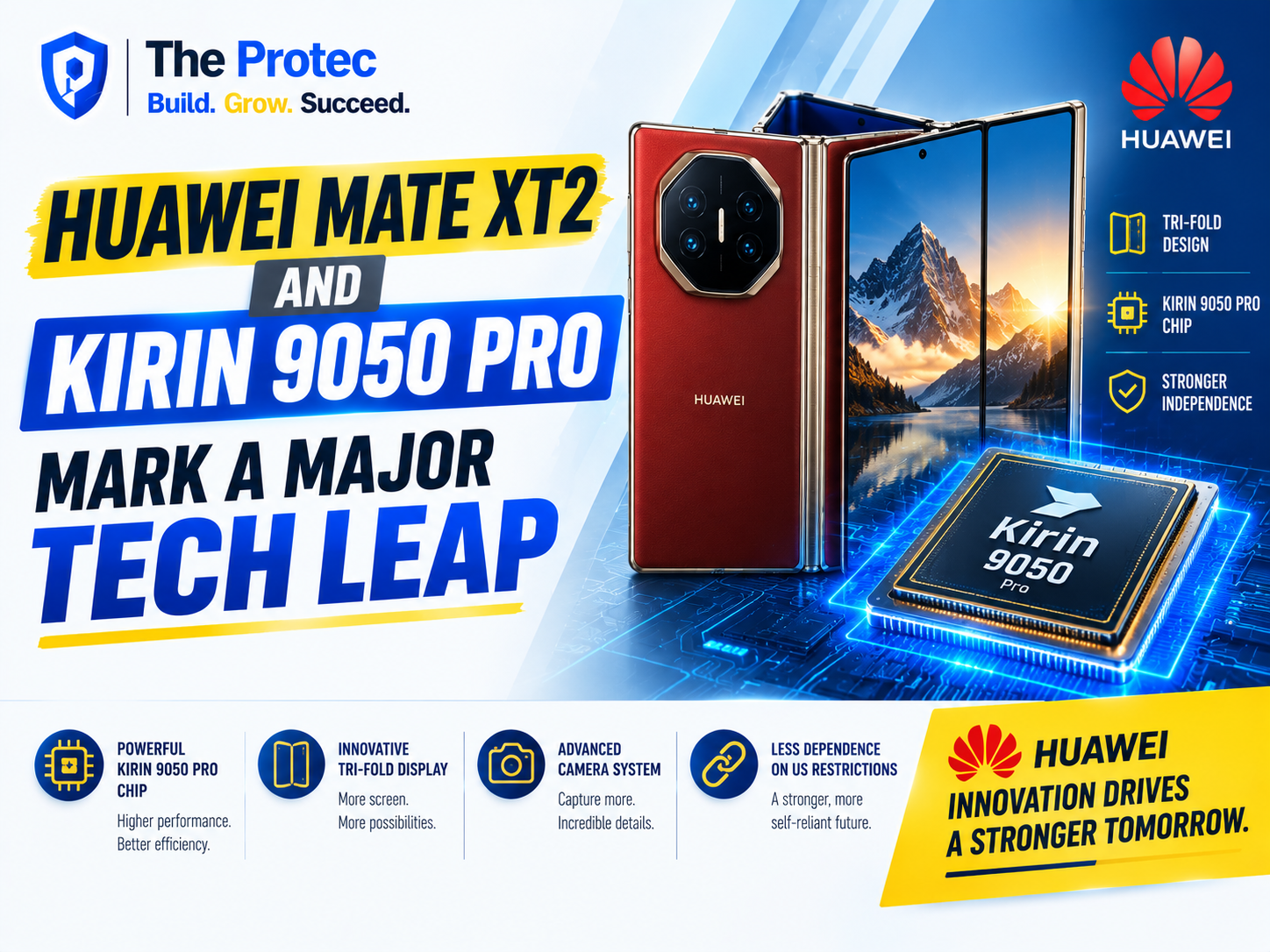
The Huawei Mate XT2 attracts attention for an obvious reason: it turns a single smartphone into a tablet-sized device through an unusually ambitious tri-fold design. Yet the folding display may not be the most consequential technology inside it. That distinction belongs to the Kirin 9050 Pro, a Huawei chip that says far more about the company’s direction than another flexible screen ever could.
Huawei has spent years operating under US restrictions that limit its access to advanced semiconductor manufacturing equipment, chip design tools and international suppliers. Those controls were expected to slow the company’s ability to produce competitive flagship processors. Instead, the Huawei Kirin 9050 Pro arrives as the centerpiece of a premium Huawei smartphone built to handle demanding multitasking, computational photography, artificial intelligence and three-screen configurations.
The result is not simply a new Huawei foldable phone. The Mate XT2 is a highly visible demonstration that Huawei continues to advance its smartphone chip technology while building more of the surrounding hardware and software stack within China. The fascinating question is no longer whether the restrictions affected Huawei. They clearly did. It is how the company managed to keep moving forward despite them.
The Huawei Mate XT2 Is More Than a Tri-Fold Spectacle
The original appeal of a Huawei tri-fold phone is easy to understand. Two hinges allow the device to transition between a conventional smartphone, a larger intermediate display and an expansive tablet-like canvas. It is a compelling idea for reading, video, desktop-style productivity and running multiple apps side by side.
That flexibility also creates engineering problems that do not exist on an ordinary slab phone. A tri-fold device must coordinate multiple display regions, continuously monitor hinge positions and redraw applications as the usable screen changes. It must do this without obvious hesitation, excessive heat or a dramatic drop in battery life. Its processor therefore carries a heavier burden than the silicon inside a typical flagship handset.
The Mate XT2 specs are best understood as an integrated system rather than a checklist of isolated components. Its defining features include:
- A dual-hinge, three-panel form factor that supports phone, intermediate and tablet-style layouts.
- A large flexible OLED display designed for adaptive multitasking and immersive media.
- The Kirin 9050 Pro platform for application processing, graphics, AI workloads and connectivity.
- Advanced camera processing that relies heavily on computational imaging.
- Huawei’s latest software optimizations for seamless app transitions between display modes.
- Premium materials, reinforced hinge engineering and a battery system shaped around an unconventional chassis.
- Satellite communication capabilities in supported markets and configurations.
Some low-level specifications, especially those involving semiconductor fabrication and exact architectural changes, remain less transparent than the specifications of globally distributed chips from Apple, Qualcomm or MediaTek. That makes independent testing and teardown analysis particularly important. It also means precise claims about the manufacturing node, transistor density or imported production equipment should be treated cautiously unless Huawei or a credible laboratory confirms them.
Why the Kirin 9050 Pro Matters
The Kirin 9050 Pro matters because it has to make the Huawei Mate XT2 feel like a flagship rather than an experimental display attached to compromised internals. A device this complex needs sustained processing performance, responsive graphics and efficient background management. Peak benchmark scores alone cannot deliver that experience.
Huawei’s priorities appear to center on balanced system performance. The chip must rapidly resize app interfaces as the phone unfolds, drive a large number of pixels, process multiple camera streams and accelerate on-device AI features. It must also manage modem activity and thermal limits inside a body divided by two hinges and several tightly packed internal sections.
That makes sustained performance more revealing than a short benchmark burst. If the Kirin 9050 Pro can maintain smooth multitasking, stable frame rates and reliable camera processing without uncomfortable heat, Huawei has solved a broader systems-engineering challenge. The company does not necessarily need to win every synthetic benchmark to deliver a convincing premium product.
The processor is also strategically important. Kirin development gives Huawei greater control over the interaction between silicon, HarmonyOS, imaging algorithms, connectivity and power management. Apple has demonstrated the value of that vertical approach for years. Huawei is pursuing a comparable level of integration under very different supply-chain conditions.
Kirin 9050 Pro Performance Goes Beyond CPU Speed
Modern mobile processors are collections of specialized engines, not simply faster CPUs. The Huawei Kirin 9050 Pro must divide work among general-purpose processing cores, graphics hardware, image signal processors, neural processing units, memory controllers and communication components. The quality of that coordination directly affects how the Mate XT2 behaves.
Multitasking across three display configurations
A Huawei trifold phone can change its usable screen area in seconds. The software may need to preserve a video, document and messaging session while reorganizing all three for a larger canvas. Efficient scheduling and memory management are essential because reloading applications would make the transformation feel slow and unfinished.
Computational photography
Flagship camera performance increasingly depends on silicon. Multiple exposures may be captured and combined before the user sees the final image. Noise reduction, motion detection, portrait separation, color reconstruction and high-dynamic-range processing all compete for processing resources. The Kirin 9050 Pro gives Huawei a platform for tuning those operations specifically around the Mate XT2 camera system.
On-device artificial intelligence
The industry is moving toward AI tasks that run locally rather than sending every request to a cloud server. Translation, transcription, image editing, semantic search and personal assistance can benefit from lower latency and stronger privacy when performed on the device. Huawei’s neural processing technology is consequently one of the most important parts of the new chip, even if CPU and GPU results receive more attention.
Power and thermal control
Efficiency is especially important in a thin foldable. The Mate XT2 has less freedom to use a conventional battery shape or a large, uninterrupted cooling system. Huawei must balance clock speeds, display power, wireless connectivity and surface temperature across several sections. Intelligent workload allocation can matter as much as the chip’s theoretical maximum speed.
How Did Huawei Advance Despite US Restrictions?
The Kirin 9050 Pro exists against the backdrop of the Huawei US restrictions introduced and expanded over several years. Huawei’s addition to US trade-control lists constrained its ability to purchase products and technologies containing certain American intellectual property without authorization. The official US Bureau of Industry and Security Entity List provides the regulatory context behind many of those limitations.
The restrictions affected access to leading foundries, advanced lithography systems, electronic design automation software and other parts of the semiconductor supply chain. Because modern chip production depends on equipment and intellectual property from several countries, replacing any one missing component can be extraordinarily difficult.
Huawei’s response appears to involve several overlapping strategies. It has invested in domestic suppliers, accumulated engineering expertise, redesigned components around available production methods and optimized software for its own hardware. China’s broader semiconductor industry has also increased spending on fabrication, packaging, materials, design tools and manufacturing equipment.
None of this means the Huawei US ban had no effect. Restrictions can raise costs, reduce yields, limit production volumes and make it harder to match the density or efficiency of chips made on the most advanced global processes. Progress under those conditions may require more engineering effort for each performance gain.
Huawei can compensate in several ways. Larger caches, architectural tuning, advanced packaging, selective acceleration and close software integration can extract more practical performance from a process that may not lead the industry in transistor density. Better scheduling can send workloads to the most appropriate engine, while HarmonyOS optimizations can reduce unnecessary processing.
This is why the Kirin 9050 Pro should not be judged only by an assumed fabrication node. Manufacturing technology remains crucial, but the user experiences the complete platform. Huawei’s statement is that coordinated domestic chip design, software and device engineering can still produce a sophisticated flagship.
A Milestone for China’s Semiconductor Ambitions
The Mate XT2 is also a showcase for the wider China semiconductor ecosystem. Smartphones require processors, radio-frequency components, memory, displays, sensors, power-management chips and precision manufacturing. Increasing domestic participation across that list is a much larger project than producing one headline processor.
The Kirin 9050 Pro does not prove that every dependency has disappeared. Nor does it establish that Chinese manufacturers have reached parity with the world’s most advanced fabrication lines in every metric. What it demonstrates is that constraints can accelerate investment in alternative supply chains and encourage deeper integration among chip designers, device manufacturers and software developers.
There are still critical unknowns. Independent analysts will want reliable information about die size, yields, packaging, modem efficiency and production volume. Availability matters because a technically impressive processor made in limited quantities has a different commercial impact from one that can support millions of devices.
Even with those caveats, the direction is significant. The Mate XT2 turns Huawei semiconductor progress into something consumers can hold, unfold and evaluate. That makes the chip’s strategic importance easier to understand than an isolated laboratory announcement.
Huawei’s Hardware and Software Integration Is the Real Advantage
Huawei controls more of the Mate XT2 experience than many Android manufacturers control in their devices. It develops the phone, Kirin platform, imaging pipeline, operating-system features, cloud services and connected-device ecosystem. Current product information across the company’s broader smartphone range is available through the official Huawei smartphone site.
This integration allows Huawei to optimize for the unusual tri-fold format at several levels. The hinge sensors can inform the operating system about the device’s physical state. HarmonyOS can then adjust window layouts, refresh behavior and background activity. The chip can prioritize the graphics, AI or camera engines required for the current mode.
That coordination is difficult to capture in a specification table. A rival processor may post a higher score while running generic software, yet the tightly optimized Kirin platform may still produce smoother transitions or better battery behavior in this specific device. Conversely, software optimization cannot fully erase limitations in raw graphics performance or manufacturing efficiency. Meaningful reviews must examine both.
What the Mate XT2 Means for the Foldable Phone Market
Most foldable phones follow one of two templates: a compact clamshell or a book-style device. The Mate XT2 challenges manufacturers to consider a third category that offers substantially more screen area without requiring a separate tablet.
Its success will depend on more than novelty. Durability, thickness, weight, repairability, app support and price remain serious concerns. Two hinges create more potential failure points, while a large exposed flexible display demands careful protection. Buyers will also expect long-term software support from a device positioned at the top of the market.
Even if tri-fold phones remain premium products, they can influence mainstream hardware. Battery chemistry, hinge miniaturization, flexible glass, display drivers and adaptive software developed for the Mate XT2 may eventually improve less expensive foldables. The Kirin 9050 Pro similarly gives Huawei a foundation that can inform future phones with more conventional designs.
The Biggest Statement Is Technological Persistence
The Huawei Mate XT2 is designed to look futuristic, but its deeper significance comes from persistence. Huawei faced restrictions aimed at some of the most difficult technologies to reproduce, including advanced semiconductor capabilities. Rather than retreating from premium smartphones, it paired an extraordinarily demanding form factor with a new flagship Kirin platform.
Questions remain about how the Huawei Kirin 9050 Pro compares with the best rival chips in efficiency, graphics performance and manufacturing scale. Those questions require transparent testing, not patriotic narratives or dismissive assumptions. But the chip does not need to be the absolute industry leader to qualify as a major achievement.
The Mate XT2 shows that Huawei can still combine custom silicon, ambitious industrial design and an increasingly independent software ecosystem. Its tri-fold screen may be what people notice first. The Kirin 9050 Pro is what makes the device a statement about where Huawei—and potentially China’s semiconductor industry—intends to go next.
Frequently Asked Questions
What is the Kirin 9050 Pro?
The Kirin 9050 Pro is the flagship Huawei chip powering the Mate XT2. It coordinates CPU, graphics, AI, imaging, memory and connectivity workloads while supporting the phone’s demanding tri-fold display and multitasking features.
Why is the Huawei Mate XT2 important?
The Huawei Mate XT2 combines an advanced three-panel foldable design with Huawei’s latest in-house mobile platform. It demonstrates progress in flexible hardware, system integration and semiconductor development despite continuing trade restrictions.
Is the Huawei trifold phone faster than other flagships?
That depends on the workload. Peak benchmark results are only one measure of performance. Sustained speed, thermal stability, AI acceleration, camera processing and software optimization are particularly important for evaluating the Mate XT2.
Did US restrictions stop Huawei from making advanced chips?
No, but they made development and manufacturing more difficult. Huawei has responded by investing in domestic supply chains, redesigning hardware around available technologies and integrating its chips more closely with its software.
What should buyers examine beyond the Mate XT2 specs?
Potential buyers should consider hinge durability, display protection, battery life, heat management, application compatibility, repair options and software support. These factors will determine whether the tri-fold design is practical beyond its initial visual impact.