








Artificial intelligence can now write software, summarize contracts, analyze medical images, generate marketing campaigns, and complete multistep office tasks. That rapid progress has made one career question increasingly urgent: If AI can perform work once reserved for educated professionals, which workers will still have an advantage?
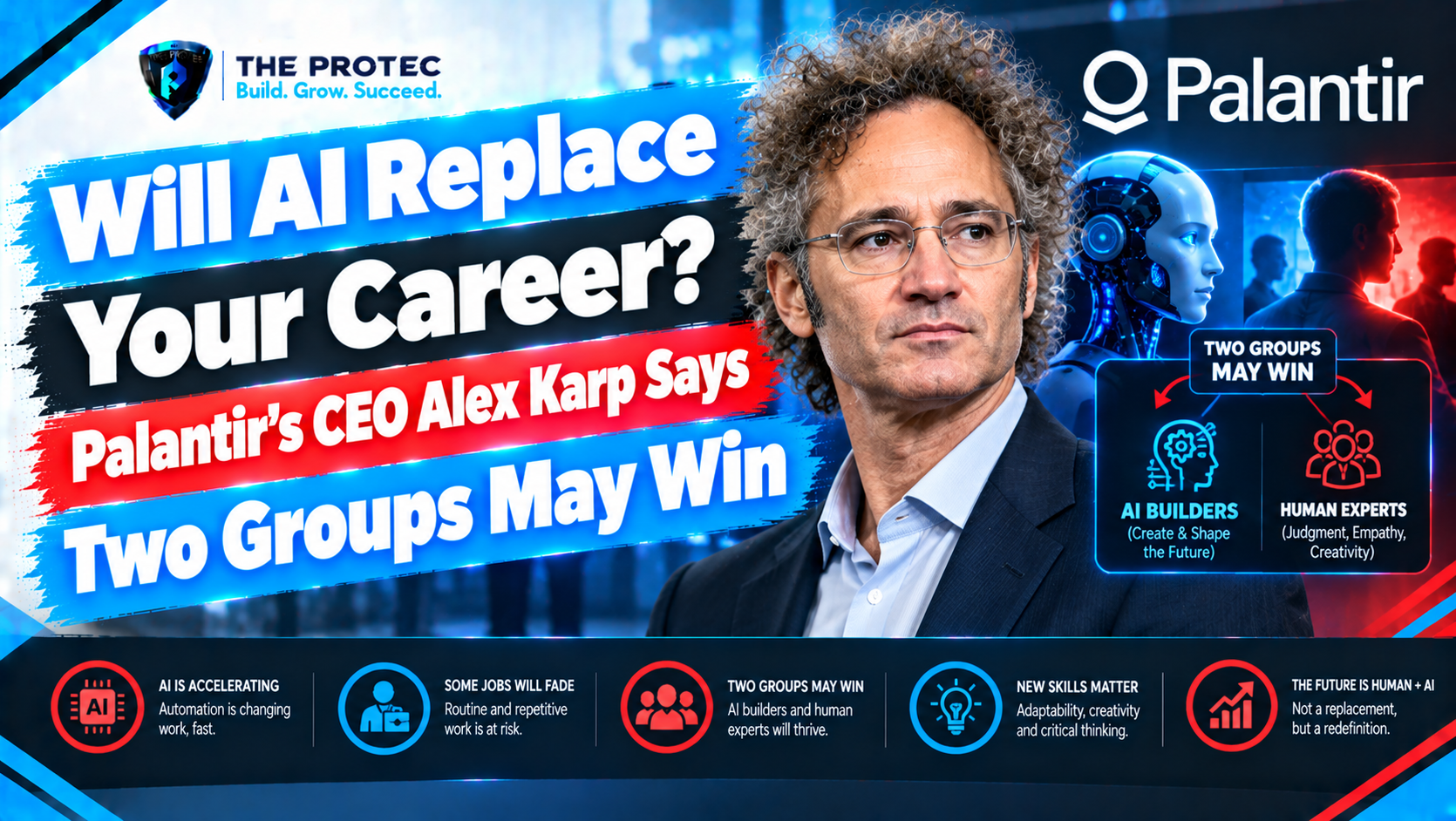
Palantir CEO Alex Karp has offered a provocative answer. In public comments about AI and the job market, Karp has argued that two broad groups may be comparatively well positioned: vocationally trained workers who solve physical problems and neurodivergent people whose thinking may differ from conventional patterns. His argument challenges the long-standing assumption that a four-year degree automatically provides more security than technical or trade training.
However, the Alex Karp AI prediction is an opinion about the future—not proof that particular careers are safe. Labor research presents a more nuanced picture in which AI changes tasks faster than it eliminates complete occupations. Understanding that distinction is essential for realistic AI career planning.
What Is the Palantir CEO’s AI Jobs Prediction?
Karp’s central argument is that AI will place pressure on many jobs built around routine intellectual output while increasing the relative value of people who can work in unpredictable physical settings or approach problems in unconventional ways. Electricians, plumbers, HVAC technicians, and similar trades feature prominently in that view because their work cannot be reduced easily to text generation or screen-based automation.
The second group in Karp’s prediction is neurodivergent workers. Neurodivergence is an umbrella concept that can include autism, ADHD, dyslexia, dyspraxia, and other cognitive differences. Some people in these communities may demonstrate strong pattern recognition, sustained focus on specific interests, systems thinking, or a willingness to question established assumptions.
These Palantir CEO comments on AI and jobs should not be interpreted as a guarantee. A trade credential does not prevent automation, and neurodivergence does not automatically confer specialized abilities or career success. Karp is identifying qualities that may become valuable—not defining two universally AI-proof groups.
Why Skilled Trades Are Difficult to Automate Completely
Generative AI performs best when work takes place in a digital environment with abundant data and recognizable patterns. Skilled trades operate in the physical world, where conditions vary from one building, machine, and job site to another.
An electrician may need to trace undocumented wiring through an older property, interpret local codes, identify a hidden fault, communicate risks to a customer, and manipulate tools in a confined area. A plumber may encounter corroded fittings, nonstandard renovations, limited access, or water damage that changes the repair plan. HVAC installation and equipment maintenance similarly require diagnosis, lifting, calibration, safety decisions, and adaptation on site.
Several characteristics make these careers less likely to be automated end to end:
- Physical dexterity: Trade work often requires precise movement, tool handling, climbing, crawling, and operating in irregular spaces.
- Unstructured environments: Homes, factories, and commercial buildings are less predictable than controlled production lines.
- Real-time judgment: Workers must recognize hazards, revise plans, and make decisions when documentation is incomplete.
- Accountability: Electrical, plumbing, refrigeration, and mechanical work can involve licensing, inspections, and serious safety consequences.
- Human interaction: Technicians explain options, negotiate access, reassure customers, and coordinate with other contractors.
This does not mean electricians and AI automation will remain separate. AI can interpret manuals, prepare estimates, optimize routes, detect equipment anomalies, and help diagnose faults. Robotics may also handle more standardized construction tasks. The more likely near-term outcome is an AI-assisted tradesperson rather than a fully autonomous replacement.
Neurodivergent Workers and AI: Opportunity Without Stereotypes
Karp’s emphasis on people who think differently reflects a broader technology-sector interest in neurodivergent talent and innovation. Teams can benefit when members notice unusual patterns, challenge default assumptions, or examine systems from perspectives that homogeneous groups may overlook.
Yet neurodiversity in technology must be discussed carefully. Neurodivergent people are not a single workforce category with identical traits. One autistic employee may excel at data analysis, while another may thrive in design, customer advocacy, operations, or hands-on work. ADHD may support rapid ideation in one setting while creating executive-function challenges in another. Individual ability, training, interests, accommodations, management quality, and workplace culture all matter.
Palantir’s hiring reputation emphasizes unconventional problem-solving and demonstrated ability. The company’s Meritocracy Fellowship also offers a pathway for selected recent high school graduates outside the traditional college pipeline. It is important not to mislabel that program: online discussion of a “Palantir neurodivergent fellowship” can blur Karp’s comments about neurodivergence with a separate fellowship focused on alternatives to conventional degree-based recruiting.
Employers seeking neurodivergent talent should focus on accessible recruitment, clear expectations, flexible communication, suitable sensory environments, and role-specific support—not assumptions that every candidate possesses a particular technical gift.
Which Jobs Face the Greatest AI Exposure?
Predictions about jobs safe from AI often confuse exposure with replacement. If AI can perform 30 percent of an occupation’s tasks, the occupation may be redesigned rather than eliminated. Employers might increase output, reduce entry-level hiring, change staffing ratios, or shift workers toward responsibilities requiring judgment and accountability.
Routine office and administrative work
Data entry, basic bookkeeping, scheduling, document formatting, standard customer responses, and repetitive reporting have relatively high automation exposure. AI agents can now move information between applications and execute structured workflows. Human review remains necessary when records are ambiguous, regulations apply, or errors carry financial consequences.
Software development
AI coding tools can generate functions, tests, documentation, and debugging suggestions. That may reduce the time required for routine programming, but software engineering also includes requirements discovery, architecture, security, deployment, integration, and responsibility for failures. Entry-level tasks may change substantially even if experienced developers remain essential.
Knowledge-intensive professions
Law, finance, medicine, consulting, education, and media are highly exposed to AI assistance because much of their work involves language or pattern analysis. Nevertheless, professional judgment, confidential relationships, regulation, ethical decisions, and liability make complete replacement harder. The affected task is often research or drafting, not the entire profession.
Hands-on trades and care work
Skilled trades, nursing support, emergency response, repair, and many personal services generally require more physical presence and interpersonal judgment. They are not immune: diagnostic software, remote monitoring, prefabrication, and robotics will alter workflows. Their overall task mix is simply harder to automate with software alone.
What Independent Research Says About AI Job Displacement
Independent findings broadly support the idea that clerical and highly digitized roles face substantial exposure, but they do not establish a simple divide between disappearing office jobs and secure trade careers. The International Labour Organization’s refined global index of generative AI exposure found that roughly one in four jobs worldwide has some exposure to generative AI. Its central conclusion was that job transformation is more likely than widespread full automation.
Through October 2026, verified employment trends continue to show uneven effects. Companies are integrating AI into customer service, software development, analysis, recruiting, and back-office operations, while adoption is constrained by reliability, data quality, cybersecurity, regulation, and implementation costs. Layoffs attributed broadly to AI may also reflect restructuring, economic conditions, or earlier overhiring.
Research therefore supports concern about AI job displacement, especially for repetitive tasks, but not confident claims that entire professional categories will vanish on a fixed timetable.
Vocational Training vs. a College Degree
Karp’s position also feeds a larger debate about college degrees versus skilled trades. Vocational education can offer lower tuition, shorter training, paid apprenticeships, and faster entry into occupations with persistent local demand. Experienced electricians, plumbers, HVAC specialists, and industrial maintenance technicians can earn competitive incomes, particularly after gaining licenses or building businesses.
Trade careers also have costs. The work may be physically demanding, injury risks can be higher, earnings vary by region, and career progression may require business or supervisory skills. Some workers eventually need to move away from field labor.
A four-year degree usually costs more and does not guarantee employment, but it can provide broader theoretical knowledge, professional networks, and access to occupations that require credentials. Degrees in engineering, healthcare, science, education, and other fields can remain valuable when paired with practical experience.
The strongest choice depends on cost, aptitude, location, desired flexibility, and occupational requirements. Vocational training and college are not mutually exclusive; workers can combine apprenticeships, certifications, community college courses, employer training, and later degrees.
Skills Needed in the AI Era
Instead of searching for careers AI cannot replace, students and workers should build a portfolio of capabilities that remains useful as tools evolve:
- Develop domain expertise. AI output is more valuable when a knowledgeable person can verify it and recognize errors.
- Learn to use AI critically. Prompting matters, but validation, source checking, privacy awareness, and workflow design matter more.
- Choose work with real-world friction. Physical systems, complex stakeholders, regulation, trust, and unpredictable conditions are difficult to automate completely.
- Strengthen human communication. Listening, negotiation, leadership, teaching, and conflict resolution remain important across technical and trade roles.
- Keep credentials current. Licenses, apprenticeships, vendor certifications, and continuing education signal competence as job requirements change.
- Preserve career flexibility. Combine technical skill with project management, business knowledge, safety expertise, or customer service.
The safest strategy is not to avoid AI. It is to become the person who can apply AI within a valuable field while taking responsibility for outcomes the technology cannot reliably own.
Frequently Asked Questions
What two groups does Alex Karp believe have an AI-era advantage?
Karp has highlighted vocationally trained workers, including skilled tradespeople, and neurodivergent people who may approach problems differently. This is his forecast, not a verified guarantee that members of either group will avoid disruption.
Are electricians, plumbers, and HVAC technicians AI-proof?
No occupation is fully AI-proof. These trades are less susceptible to complete software automation because they require physical dexterity, on-site judgment, safety awareness, and adaptation. AI will still influence diagnostics, scheduling, estimating, training, and equipment monitoring.
Will AI replace software developers and office workers?
AI is already automating portions of coding and office work. Routine, standardized tasks face the greatest pressure, while roles involving architecture, judgment, security, relationships, and accountability are more resistant. Many jobs will be redesigned rather than removed entirely.
Is vocational training safer than earning a college degree?
Not universally. Vocational training can be less expensive and lead quickly to in-demand work, while a degree offers broader access to professions and career paths. The better option depends on the occupation, training quality, total cost, regional demand, and the individual’s strengths.
The Bottom Line
Alex Karp’s future-of-work argument captures a real shift: practical problem-solving and cognitive diversity may become more valuable as AI handles routine digital production. But labels such as “AI-proof careers” create false certainty. The durable advantage belongs to adaptable workers who combine domain expertise, sound judgment, human skills, and the ability to use new technology without surrendering responsibility to it.