







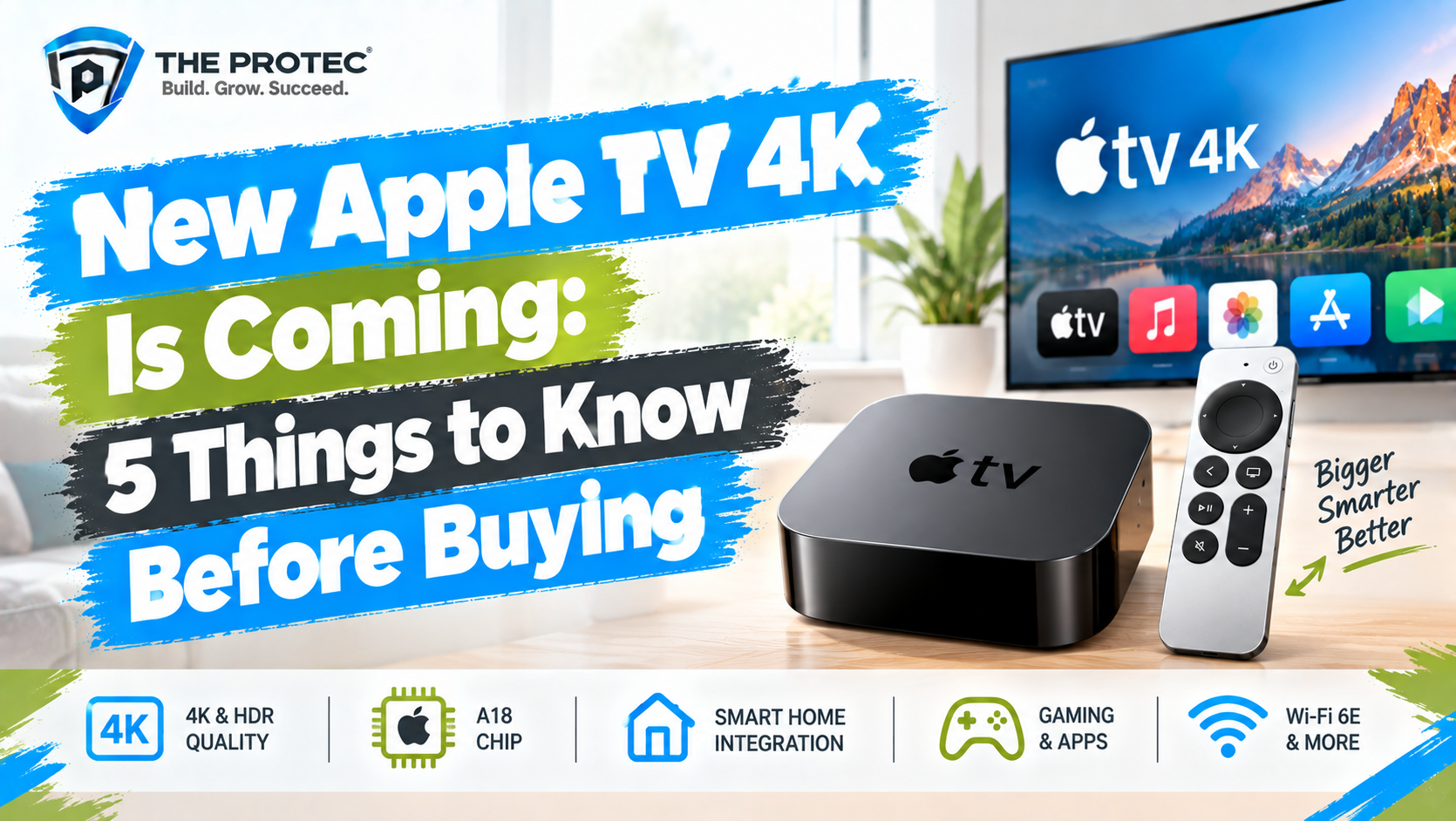
Apple TV hardware rarely follows the predictable annual cycle of the iPhone, which makes buying one at the right time unusually difficult. The current Apple TV 4K remains one of the fastest and most polished streaming devices available, but reports of a next-generation Apple TV have given prospective buyers a reason to pause.
The expected refresh could deliver a newer A-series processor, faster wireless connectivity, stronger gaming performance, and a better foundation for upgraded Siri or Apple Intelligence features. It may also deepen the device’s role as an Apple smart home hub. None of those details should be treated as final, however. At publication, Apple had not officially confirmed the new model’s processor, price, specifications, or release date.
Before spending money on the current box, here are the five most important things to understand about the new Apple TV 4K, along with a practical Apple TV 4K buying guide for existing owners and first-time buyers.
1. The Apple TV 2026 release date remains unconfirmed
Reports about an Apple TV 4K refresh have circulated for some time, but Apple has not established a regular launch schedule for its streaming box. That makes any Apple TV 4K 2026 release date a rumor until the company announces the product through an event, press release, or store update.
An autumn launch window would make strategic sense because it could place the device alongside major tvOS updates, holiday sales, and Apple’s entertainment announcements. Apple could also introduce it quietly through its newsroom rather than dedicating presentation time to it. Both approaches have been used for lower-profile hardware updates.
Buyers should therefore be cautious with reports that cite an exact date. Supply-chain information and software references can indicate that hardware is being tested, but development plans can change. Apple may delay a product, adjust its specifications, or decide that an update does not need a major launch event.
The practical takeaway is simple: if your current streamer works well, waiting for an official announcement is sensible. If you need a reliable streaming device immediately, the possibility of a refresh should not automatically rule out the current Apple TV 4K.
2. Price rumors point to evolution, not necessarily a bargain box
The current-generation Apple TV 4K launched in the United States at $129 for a 64GB Wi-Fi configuration and $149 for a 128GB model with Gigabit Ethernet and Thread networking. Retail prices, regional pricing, and availability can vary, so buyers should verify current terms on Apple’s official Apple TV 4K specifications page.
Apple TV 4K 2026 price rumors sometimes suggest that Apple could lower the entry cost to compete more directly with Roku, Amazon Fire TV, and Google TV products. A lower price is plausible, especially if Apple wants to expand its services audience, but it is not confirmed. Apple could just as easily preserve the existing tiers while adding more storage, faster networking, or a redesigned remote.
A dramatic move into the budget-streamer market appears less certain. Apple TV 4K has traditionally been positioned as a premium streaming box built around speed, privacy, long software support, and integration with iPhone, AirPods, HomePod, Apple Arcade, and Apple Fitness+. Competing on experience rather than the lowest price remains consistent with that strategy.
Value will depend on more than the headline Apple TV 4K price. Storage, Ethernet, Thread support, remote features, and included connectivity should all be compared. A $20 difference can be worthwhile if the more expensive version serves as a more capable smart-home hub or supports a wired network.
The current third-generation Apple TV 4K uses the A15 Bionic, a processor that already makes tvOS navigation, app launches, and 4K streaming feel fast. For ordinary Netflix, Apple TV+, YouTube, or live-TV viewing, a new Apple TV processor upgrade is unlikely to transform picture quality by itself. Streaming quality is influenced more directly by the source video, codec support, internet connection, television, and HDR implementation.
Rumors have linked the next-generation Apple TV to a newer Apple TV A-series chip, with the A17 Pro chip appearing in some speculation. Apple has not confirmed that choice. Even if the A17 Pro is used, performance could differ from an iPhone because cooling, clock speeds, power limits, and tvOS optimization all affect real-world results.
A faster processor would still have meaningful benefits. It could shorten loading times, improve multitasking, make demanding screensavers and interfaces smoother, and give developers more room for sophisticated apps. The biggest gain may be Apple TV 4K gaming performance. A newer GPU could support richer Apple Arcade titles, more advanced effects, and potentially console-class games already adapted for recent Apple silicon.
Modern media hardware could also add or improve codec decoding. That could make the box more efficient when playing newer streaming formats, although support for any specific codec should not be assumed until it appears in Apple’s technical specifications.
For most owners of the current A15 model, Apple TV faster performance would probably feel incremental during everyday streaming. Owners of older HD or early 4K models would notice a larger jump in responsiveness, app compatibility, wireless performance, and gaming.
4. Apple Intelligence and upgraded Siri are possibilities, not promises
One reason the rumored processor matters is its potential neural-processing capability. A newer chip could provide the hardware foundation for Apple TV Apple Intelligence support or more advanced on-device Siri functions. That does not mean Apple Intelligence will automatically arrive on the new box.
Apple must design television-specific experiences, establish privacy and processing requirements, and decide which tasks belong on the device, on another Apple product, or in the cloud. Memory capacity may be just as important as the processor. Until Apple identifies compatible hardware and features, claims about Apple TV Siri AI features remain speculative.
Useful television applications could include more natural content searches, conversational follow-up questions, improved dialogue recognition, personalized recommendations, smarter subtitle controls, and easier smart-home commands. An upgraded Siri might understand requests such as finding a family movie under two hours, replaying a line of dialogue with captions, or showing a particular security camera without requiring rigid phrasing.
These features would make a larger difference than slightly faster menu animations, but buyers should not purchase rumored hardware based on them alone. The safest approach is to evaluate the product using capabilities available at launch. Future software should be considered a bonus, not a guarantee.
Apple TV is more than an Apple streaming device. It can function as an Apple home hub, allowing automations and remote control of compatible lights, locks, thermostats, sensors, cameras, and other accessories. It can also help coordinate Matter products within Apple’s Home ecosystem.
The current 128GB Apple TV 4K with Ethernet includes Thread networking, while the lower-priced Wi-Fi configuration does not include the same Thread radio. Thread creates a low-power mesh network for supported smart-home accessories, while Matter provides a common interoperability standard across major platforms. The Connectivity Standards Alliance offers additional information through its official Matter overview.
Possible Apple TV smart home features in a refresh include newer Thread hardware, more consistent support across configurations, faster Wi-Fi, improved device discovery, and more responsive camera or doorbell views. Reports have also raised the prospect of updated Apple-designed wireless technology, but exact Apple TV 4K Wi-Fi upgrades remain unconfirmed.
Apple could make every new configuration a Thread border router, simplifying a confusing difference between today’s models. Better local processing might also improve automation reliability and reduce dependence on cloud services. Those changes would be meaningful for a household building around HomeKit, Matter, and Thread, even if video playback looked identical.
Still, a new Apple TV will not solve every smart-home problem. Accessory firmware, network design, wireless interference, and ecosystem compatibility remain important. Buyers should check whether their devices support Apple Home, Matter, or Thread rather than assuming that all connected products will work together.
Apple TV 4K current generation vs. new model
The current Apple TV 4K already supports 4K video, Dolby Vision, HDR10+, HDR10, and Dolby Atmos with compatible content and equipment. It offers HDMI connectivity, Wi-Fi 6, Bluetooth, a USB-C Siri Remote, and optional Gigabit Ethernet. Those fundamentals are unlikely to become obsolete when a refresh arrives.
The expected model is more likely to refine the experience than reinvent it. Potential improvements include a newer processor, stronger graphics, updated wireless hardware, expanded Thread support, and readiness for future Siri features. A higher frame-rate mode or additional media formats are possible, but there is no reason to treat them as confirmed Apple TV 4K new features.
For movie and television streaming, the current model should remain highly competitive. A processor alone cannot improve a film mastered in 4K Dolby Vision, and both generations may deliver nearly identical output on the same television. The new model could separate itself through gaming, smart-home performance, connectivity, and long-term software headroom.
Should you buy Apple TV 4K now or wait?
Wait if you already own the current generation
Owners of the A15-based model should usually wait. Its streaming performance, HDR support, Dolby Atmos output, and interface remain excellent. Upgrade only if Apple confirms a feature you will actually use, such as significantly better gaming, broader Thread support, a needed connectivity option, or exclusive Siri capabilities.
Consider waiting if you are replacing an older Apple TV
If an older box remains functional, waiting through the rumored launch window could provide clearer pricing and specifications. Moving from an Apple TV HD or early Apple TV 4K to either the current or next model should be substantial, so comparing both after an announcement is ideal.
A failing device, unreliable smart-TV software, or a new home theater can justify buying now. The current model is mature, fast, and compatible with major audiovisual standards. A discount can make it especially attractive, but confirm whether you need Ethernet and Thread before choosing a configuration.
Compare alternatives if price is the priority
Apple TV 4K alternatives include Roku devices, Amazon’s Fire TV Stick 4K Max and Fire TV Cube, and Google TV products such as the Google TV Streamer. Roku emphasizes simplicity, Fire TV integrates closely with Alexa and Amazon services, and Google TV offers broad recommendations and Google Home integration.
Apple TV 4K is typically the stronger fit for households invested in iPhone, AirPods, HomePod, Apple services, and Apple Home. It may be the best streaming device for buyers who value speed, privacy, ecosystem integration, and an uncluttered experience, but less expensive alternatives can handle mainstream 4K streaming well.
Frequently asked questions
Has Apple confirmed a new Apple TV 4K?
No final processor, price, release date, or AI feature should be considered official until Apple announces it. Current information about a next-generation Apple TV should be treated as reporting or rumor, even when it comes from sources with strong track records.
Will a new Apple TV improve 4K picture quality?
Not necessarily. The current model already supports 4K, Dolby Vision, HDR10+, and other major formats. A refresh may add media capabilities or improve processing efficiency, but source quality, television performance, calibration, and bandwidth will continue to have a larger effect on the viewing experience.
Could the new Apple TV use an A17 Pro chip?
The Apple TV A17 Pro chip has appeared in speculation, but Apple has not confirmed it. A newer A-series processor could improve graphics, app performance, gaming, and machine-learning capacity, though the exact benefits would depend on memory, cooling, software, and developer support.
Is the current Apple TV 4K still worth buying?
Yes, particularly when discounted or needed immediately. It remains a fast and capable streaming box with premium video and audio support. Buyers who already own it, or who are especially interested in future AI and smart-home features, have more reason to wait.
What upgrade would matter most?
For current owners, exclusive software capabilities, substantially better gaming, expanded Thread and Matter support, or major connectivity improvements would matter more than a modest speed increase. Until those features are confirmed, the current model remains the safer benchmark for comparison.
The bottom line
The Apple TV 4K rumors point toward a sensible hardware refresh rather than a complete redesign. A faster A-series processor, improved wireless networking, stronger smart-home support, and room for upgraded Siri could make the new model more versatile. None of those specifications should influence a purchase as though they were final.
If you own the current generation, wait for confirmed details. If you have an aging but usable Apple TV, waiting may also protect you from buying just before a refresh. If you need a dependable premium streamer today, the existing Apple TV 4K still delivers excellent performance and broad home-theater support. The right decision depends less on rumors and more on which confirmed features solve a problem in your living room.