








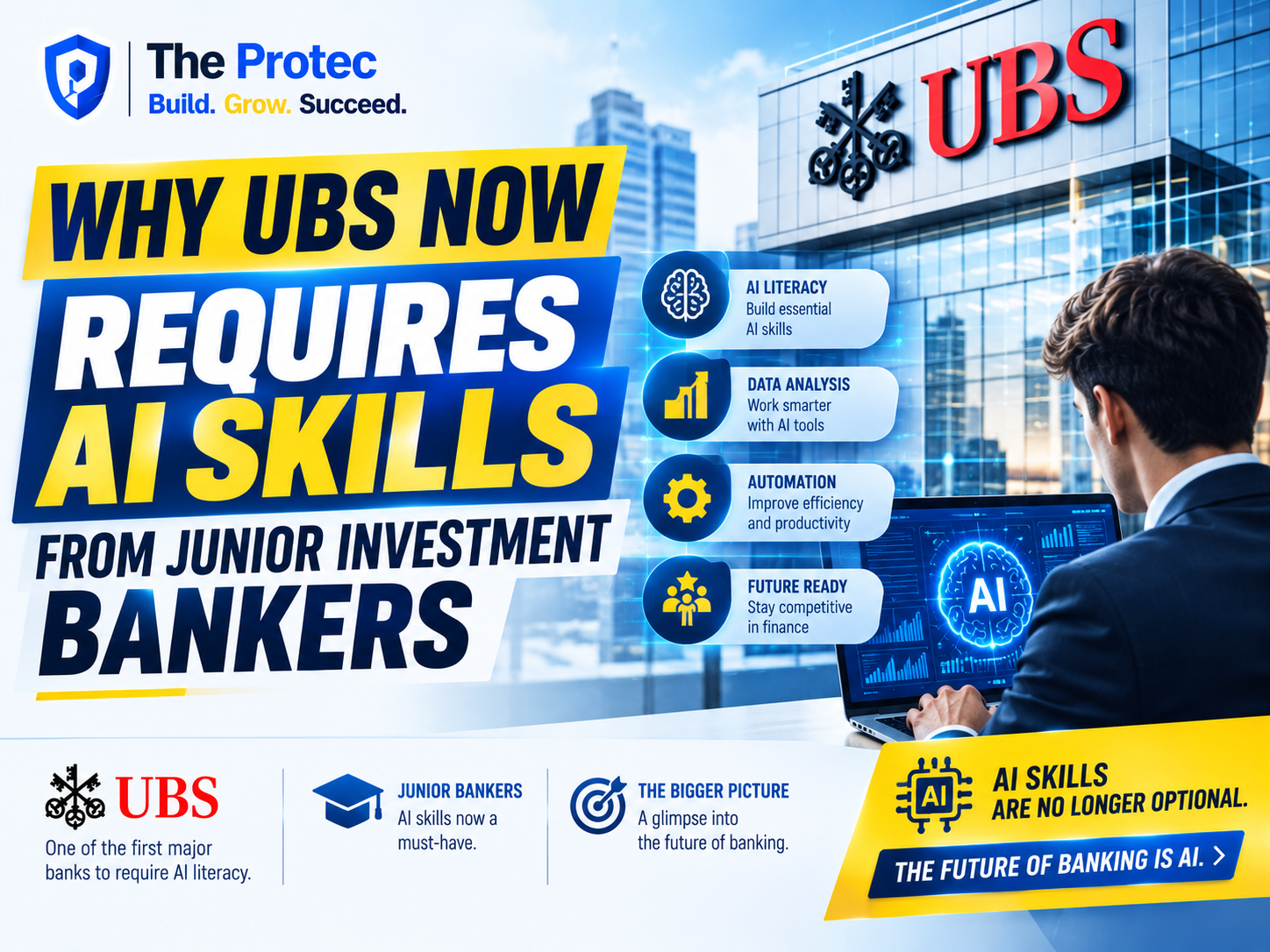
For generations, aspiring investment bankers were told to master financial modeling, accounting, valuation and presentation skills. Those foundations still matter, but UBS is adding another capability to the list: the ability to work effectively with artificial intelligence.
The bank’s growing emphasis on AI skills and AI literacy for junior investment bankers is more than a technology initiative. It represents a major shift in how professional talent may be evaluated. Entry-level employees are no longer being hired only for what they know or how many hours they can work. They are increasingly expected to know how to direct, verify and improve the output of intelligent systems.
As of September 2026, generative AI is becoming embedded in research, document analysis, deal preparation and internal knowledge tools across financial services. UBS hiring priorities therefore offer an early view of the future of banking jobs—and potentially the future of graduate recruitment throughout the professional economy.
What the UBS AI Skills Shift Actually Means
The headline that UBS requires AI skills should not be interpreted as meaning every junior banker must become a machine-learning engineer. Investment banking remains a client, judgment and finance profession. Most analysts will not be expected to train large language models or build production software.
Instead, UBS AI skills increasingly center on practical fluency: knowing when an AI tool is useful, giving it precise instructions, evaluating its response and recognizing when human review is essential. A junior banker may use approved systems to locate information, summarize documents or create a first draft, but remains accountable for accuracy and confidentiality.
This distinction matters. AI literacy is not the same as casual familiarity with a public chatbot. In a regulated bank, it includes data governance, model limitations, intellectual property, security and auditability. UBS hiring is signaling that these capabilities are becoming part of professional competence rather than an optional technical interest.
Why AI Literacy Matters to Investment Banks Now
Investment banking contains many workflows suited to AI assistance. Analysts process large quantities of information, compare company disclosures, review transaction materials, update presentations and search for relevant market evidence. Generative AI can accelerate portions of this work, especially when connected to secure internal data and controlled document systems.
There is also a competitive reason for the change. Banks face pressure to provide faster analysis and better client service while controlling costs. If an AI-enabled analyst can retrieve information, test assumptions and prepare materials more efficiently, the technology can increase the capacity of an entire deal team.
Recruiting candidates with existing AI literacy is often easier than trying to build new working habits after they arrive. The broader labor trend supports that approach. The World Economic Forum’s Future of Jobs research identifies AI, big data and technological literacy among the fastest-growing skill areas. Finance employers are now translating that macro trend into concrete expectations for graduates.
How Generative AI Is Changing Investment Banking Workflows
AI in banking is developing less as a single replacement technology and more as a layer across existing tasks. For junior investment bankers, the most visible changes are likely to occur in five areas:
- Research and information retrieval: Approved AI systems can search internal knowledge, public filings and research libraries using natural-language questions. This may reduce the time spent manually locating background information.
- Document review: Generative AI can extract themes, obligations, risks or financial references from long documents. Analysts still need to confirm every important point against the source.
- Drafting and editing: AI can help structure memos, refine presentation language and produce preliminary summaries. The banker must ensure that the final communication is accurate, specific and appropriate for the client.
- Financial analysis support: AI assistants can explain formulas, identify inconsistencies or help automate repetitive spreadsheet steps. They cannot replace disciplined modeling or independent validation.
- Meeting preparation: Teams can use secure tools to organize prior interactions, summarize relevant developments and generate questions before a client conversation.
The result is not the disappearance of junior work. It is a change in its composition. Less time may be spent on mechanical searching and first drafts, while more time is devoted to checking outputs, interpreting evidence and improving the quality of advice.
Which AI Skills Do Graduates and Junior Bankers Need?
The most valuable AI skills for graduates are practical, transferable and grounded in professional responsibility. Candidates seeking investment banking jobs should focus on the following areas.
1. Clear Instruction and Workflow Design
Effective use begins with defining the task. Junior professionals should be able to provide context, specify an output format, set constraints and break complicated requests into stages. This is more durable than memorizing collections of fashionable prompts.
2. Verification and Critical Thinking
Generative models can produce convincing errors, omit context and confuse similar facts. Analysts must trace claims to reliable sources, check calculations and challenge unexpected results. In finance, fluent output is never a substitute for evidence.
3. Data and Model Literacy
Graduates do not need advanced computer science credentials, but they should understand basic concepts such as training data, hallucinations, context windows, bias and model evaluation. Spreadsheet automation, data visualization, SQL or introductory Python can provide an additional advantage.
4. Security and Compliance Awareness
Confidential client information must not be placed into unapproved tools. AI literacy jobs in regulated industries require an understanding of access controls, data classification and record-keeping. Knowing when not to use AI can be as valuable as knowing how to use it.
5. Communication and Business Judgment
An AI system may generate ten possible answers, but a banker must decide which one matters. Strong writing, commercial awareness, listening and client empathy remain essential. The objective is not simply to create content faster; it is to produce better professional outcomes.
How AI Skills Required by UBS Could Change Hiring
Traditional finance interviews test technical knowledge, motivation and behavior under pressure. As AI skills become required, firms may add practical assessments that evaluate how candidates use technology rather than whether they can recite AI terminology.
An applicant might be asked to critique an AI-generated company summary, identify unsupported claims or explain how a research task should be divided between a person and a model. Such exercises reveal judgment, verification habits and risk awareness. They are also harder to game than listing “prompt engineering” on a résumé.
Universities may respond by integrating AI into finance, accounting and business courses. Candidates will need opportunities to use these tools transparently while still demonstrating independent reasoning. A blanket ban on AI does little to prepare students for employers that expect controlled, accountable use.
Will AI Literacy Become Standard Across Finance?
UBS is unlikely to be an isolated case. Commercial banking, asset management, insurance, consulting, auditing and legal services all involve document-heavy processes and knowledge work. As enterprise AI platforms mature, AI literacy could become as routine as spreadsheet proficiency.
That does not mean every vacancy will be labeled as an AI job. Many AI literacy jobs will retain familiar titles—analyst, associate, adviser or risk specialist—while the required toolset changes underneath. This is a defining feature of the emerging AI workforce: technology is altering ordinary roles faster than it is creating entirely new professions.
Hiring may also become more selective. If AI allows smaller teams to handle more routine output, employers may recruit fewer junior workers while expecting each hire to contribute sooner. Conversely, productivity gains could expand transaction capacity and create new roles in AI governance, model risk, data quality and workflow design. Both outcomes may occur in different parts of the market.
How AI Could Reshape Career Paths for Young Professionals
The historic junior-banker model relied heavily on repetition. Analysts developed pattern recognition by building models, checking documents and revising presentations many times. If AI takes over part of that repetition, banks must ensure that employees still learn how the underlying work is done.
Young professionals should not allow automation to create shallow expertise. Someone who accepts a generated valuation without understanding the assumptions cannot advise a client responsibly. The strongest candidates will combine traditional finance knowledge with the ability to supervise AI output.
Career progression could also accelerate for people who use automation to spend more time on industry insight and client interaction. New hybrid paths may emerge for bankers who specialize in AI-enabled execution, financial data products, technology governance or the redesign of deal workflows.
How Candidates Can Prepare for AI Investment Banking
Students and entry-level workers should begin with the fundamentals: accounting, valuation, Excel, financial statements and concise business writing. AI capability should sit on top of that base, not replace it.
- Practice comparing AI answers with primary sources such as company filings.
- Learn to document prompts, assumptions, corrections and final decisions.
- Build familiarity with spreadsheets, data tools and basic automation.
- Study privacy, confidentiality and responsible AI principles.
- Prepare interview examples showing how AI improved a process without weakening quality control.
Candidates can also monitor the skills and technology language used on the UBS careers website. Job descriptions often provide a clearer picture of changing expectations than broad predictions about AI and employment.
Frequently Asked Questions
Does UBS require junior bankers to be AI programmers?
No. The emphasis is primarily on AI literacy and effective use of approved tools, not advanced model development. Coding and data skills may help, but financial knowledge, judgment and communication remain central.
What are the most important AI skills for investment banking jobs?
Key skills include precise task definition, source verification, critical thinking, secure data handling and awareness of model limitations. Basic automation or data analysis can make a candidate more competitive.
Will generative AI replace junior investment bankers?
It is more likely to automate parts of their workload than eliminate the role entirely. Banks still need people to validate analysis, understand clients, manage risk and take responsibility for decisions. Team sizes and entry-level duties may nevertheless change.
Can graduates mention public AI tools during interviews?
Yes, but they should emphasize responsible use. A strong answer explains the objective, the verification process and the precautions taken with data. Simply claiming frequent chatbot use does not demonstrate professional AI literacy.
A New Baseline for Professional Readiness
The importance UBS places on AI skills marks a turning point in graduate hiring. Technology fluency is moving from a specialist advantage to a baseline expectation within high-value professional work.
For aspiring bankers, the winning formula is not finance or AI. It is finance strengthened by AI, governed by judgment and supported by rigorous verification. As other employers follow, that combination is likely to define who thrives in the future of banking jobs.