




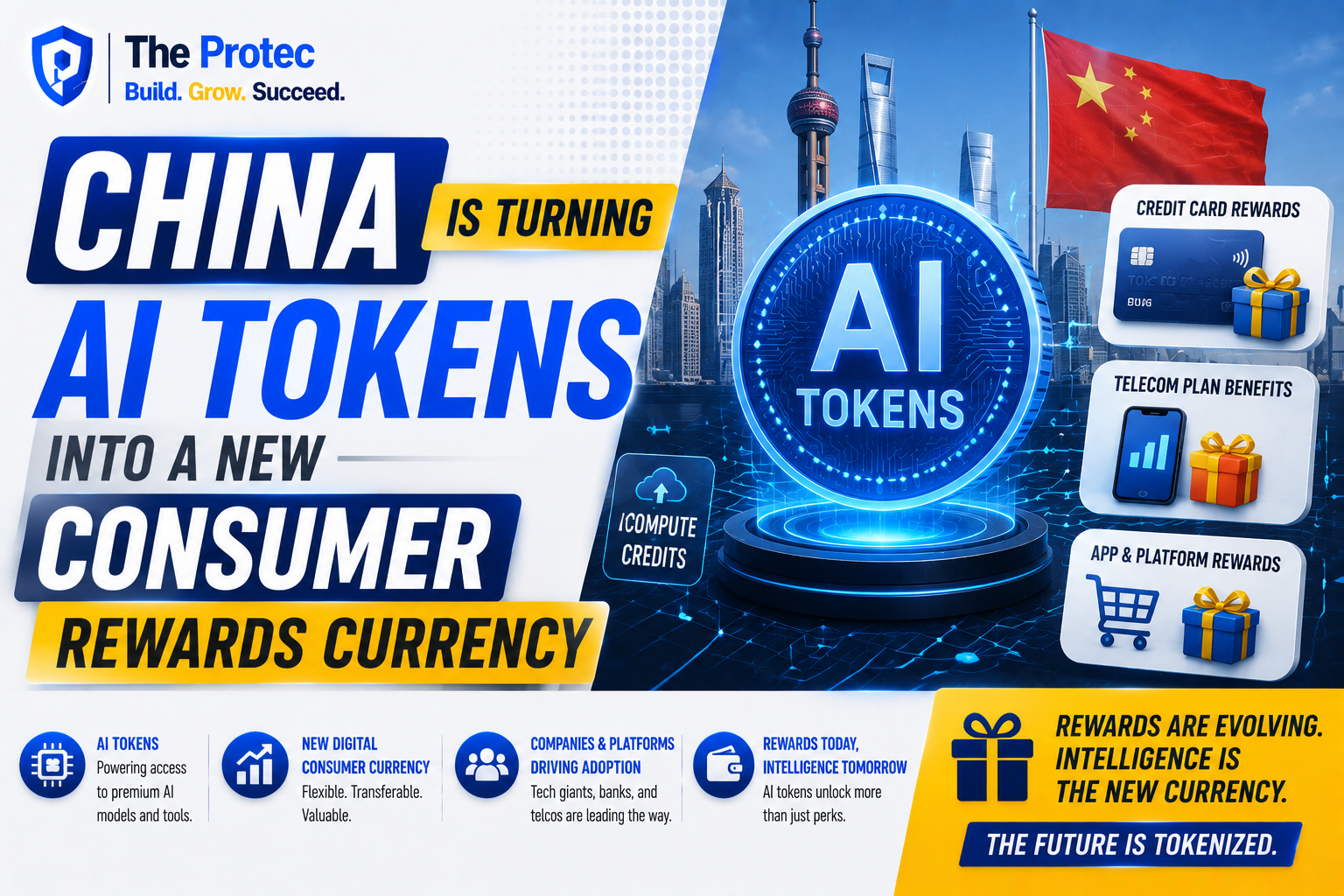
China’s next consumer rewards battle may not be fought with airline miles, shopping points, or video subscriptions. It may be fought with AI tokens: digital credits that pay for conversations with advanced models, image generation, research tools, coding assistance, and other forms of AI computing.
Chinese technology providers, banks, telecom operators, and consumer platforms are experimenting with ways to place these credits inside familiar products. A customer might receive AI token rewards after opening an account, spending with a credit card, renewing a mobile plan, or buying a connected device. Instead of redeeming points for merchandise, that customer can use the benefit to access an AI assistant or another computing-intensive service.
The idea is still developing, and most China AI tokens are not money in the legal sense. They are usually non-transferable service credits with restrictions and expiration dates. Yet the model is important because it turns an invisible technical resource—AI computing—into something consumers can earn, save, and spend. If enough services adopt compatible credits, AI tokens could begin to function like a specialized consumer currency.
What AI Tokens Actually Represent
The word “token” has two related meanings in artificial intelligence. At the technical level, a token is a small unit of text processed by a large language model. A word may be represented by one token or divided into several tokens, depending on the language and model. Providers commonly calculate API usage according to the number of input tokens sent to a model and output tokens generated in response.
A consumer AI token benefit does not always correspond directly to one technical token. Companies may instead issue a bundled allowance, such as a certain number of model tokens, a fixed monetary credit, a package of premium requests, or a monthly quota of AI services. The underlying benefit is access to computing capacity.
This makes AI computing credits closer to cloud-service vouchers than cryptocurrency. They generally do not live on a public blockchain, fluctuate in an open market, or give the holder ownership in an AI company. Most cannot be transferred between users or exchanged for cash. Their value comes from what they unlock inside a provider’s ecosystem.
- Model tokens: Allowances measured according to text sent to and generated by an AI model.
- Usage credits: A monetary balance applied against API calls or premium AI features.
- Request packages: A defined number of searches, images, documents, or advanced reasoning tasks.
- Computing-time benefits: Access to cloud inference, graphics processors, or specialized AI applications.
How the China AI Token Economy Reaches Consumers
AI computing has traditionally been sold to developers and businesses through cloud platforms. The emerging AI token economy changes the distribution model. Companies can acquire computing capacity in bulk, package it as a recognizable benefit, and deliver it through products that millions of people already use.
AI Token Rewards
Loyalty programs are a natural entry point. A platform can award AI token rewards for purchases, subscriptions, referrals, daily activity, or participation in a promotion. Those credits might pay for document summaries, language tutoring, virtual characters, image creation, or enhanced search.
The attraction for companies is straightforward: digital credits can have a high perceived value without carrying the fulfillment and logistics costs of physical rewards. They also encourage customers to return to the issuing platform. Every redemption introduces the user to another AI feature and generates data about which services people find useful.
AI Tokens and Credit-Card Perks
Credit-card issuers have long used points, lounge access, streaming memberships, and shopping discounts to attract specific customer groups. AI tokens credit cards extend that strategy to students, developers, creators, entrepreneurs, and knowledge workers.
A bank or card partner can offer a monthly AI computing allowance, discounted access to a model platform, or bonus credits after qualifying purchases. The underlying tokens may be supplied by an AI company rather than issued directly by the bank. In that structure, the card acts as the distribution channel while the technology provider gains customers and recurring usage.
Unlike a conventional statement credit, the value is restricted to designated AI services. That limitation makes the benefit less flexible, but it can also make it feel distinctive—particularly when premium model access would otherwise require a separate subscription.
AI Tokens in Telecom Plans
Telecom operators have an even stronger reason to explore AI token plans. They already bundle data, cloud storage, entertainment, device financing, and family services into monthly contracts. Adding an AI allowance turns computing into another metered utility alongside voice and mobile data.
A telecom plan could include access to an AI assistant, cloud-based photo editing, live translation, call summarization, or a set amount of third-party model usage. Operators can also connect these benefits to AI phones and other devices whose most advanced features depend on cloud inference.
This approach could be especially influential because consumers understand monthly allowances. Just as a plan may include a certain amount of data, it could include a pool of AI computing credits. Additional tokens could then be purchased when the allowance runs out.
Why DeepSeek Tokens Helped Accelerate the Model
DeepSeek has played a major role in making the economics of consumer AI more visible in China. Its models demonstrated that capable reasoning and language services could be offered at highly competitive usage prices, while its public API structure made token-based billing easier for developers and businesses to understand.
The company’s official API pricing documentation separates input and output usage and shows how caching can affect costs. Prices and model terms can change, but the broader lesson remains: AI intelligence can be metered in small, standardized units and resold through applications.
DeepSeek tokens are therefore more than a developer concern. Lower inference costs allow a bank, telecom operator, handset maker, or online platform to sponsor meaningful amounts of usage without paying for an unlimited subscription. A promotional allowance can be generous enough for a consumer to experience the product while still giving the issuer predictable costs.
DeepSeek is not the only factor. China’s major cloud platforms, model developers, super-apps, device brands, and internet companies are all competing to place AI inside daily workflows. The scale of that competition creates a large market for AI computing credits that can work across productivity, education, entertainment, and customer service.
Why AI Computing Credits Appeal to Chinese Companies
AI tokens solve several commercial problems at once. First, they reduce the friction of trying a paid AI service. Consumers may hesitate to begin another subscription, but they are more likely to test an assistant when access arrives as a free card or telecom benefit.
Second, tokens make variable computing costs manageable. An unlimited plan exposes the provider to heavy users who generate expensive workloads. A defined allowance creates a clear ceiling while allowing customers to buy more credits if they need them.
Third, token rewards can strengthen ecosystem loyalty. Credits tied to one model, app store, cloud platform, or device encourage customers to remain within that environment. This is similar to the role of airline miles, except the reward is consumed through digital work rather than travel.
Finally, the model helps companies segment users. Basic tasks may consume few credits, while advanced reasoning, large document analysis, video generation, and agentic workflows consume more. Providers can create different tiers without redesigning the entire service.
Could AI Tokens Become a Real Consumer Currency?
AI tokens already exhibit some currency-like properties. They represent measurable value, can be allocated to an account, and can be spent on a growing range of digital services. Consumers may also compare competing offers according to how much AI computing each one provides.
However, three developments would be necessary before they resemble a broader consumer currency.
- Portability: Users would need to spend credits across multiple AI models and applications rather than inside one closed platform.
- Transparent conversion: Consumers would need a reliable way to compare one provider’s token allowance with another’s, accounting for model quality and workload.
- Persistent value: Credits would need reasonable expiration policies and stable redemption terms so that users could treat them as more than temporary coupons.
Technical tokens alone are not fully interchangeable. One million tokens processed by a lightweight model are not equivalent to the same quantity processed by a frontier reasoning model. Image and video generation also use different pricing units. A future AI consumer market may therefore standardize around monetary computing credits or workload categories rather than raw token counts.
The most plausible outcome is not a replacement for the yuan. It is a new category of restricted digital value, similar to mobile data, cloud credits, game currency, and loyalty points. AI tokens could become widely accepted within connected commercial ecosystems while remaining subject to national payment, consumer-protection, cybersecurity, and data rules.
The Risks Behind AI Token Plans
Consumers should look beyond the headline token amount. A large allocation may have limited practical value if it applies only to an inexpensive model, expires quickly, or excludes advanced functions. Providers should disclose which model is covered, how usage is calculated, whether unused credits roll over, and what happens when the balance reaches zero.
Privacy is another concern. Redeeming sponsored credits may connect activity across a bank, telecom provider, AI platform, and device account. Clear consent and strict limits on data sharing are essential, particularly when users submit business files, personal conversations, health questions, or financial information.
There is also a risk of lock-in. Once people build workflows, saved prompts, custom agents, and document libraries around one platform, switching becomes difficult. Free AI token rewards can be an effective acquisition tool, but users should understand the long-term price after a promotion ends.
Finally, regulators may scrutinize misleading valuations, automatic top-ups, youth access, and credits that become transferable or tradable. The more closely tokens resemble stored value, the more likely they are to attract rules beyond ordinary loyalty programs.
What Comes Next for China’s AI Consumer Market
China’s combination of large digital platforms, aggressive model competition, extensive mobile payments, and powerful telecom distribution makes it a natural testing ground for consumer AI computing. The global expansion of AI is also accelerating: the Stanford AI Index has documented rapid improvements in model capability, investment, adoption, and inference economics.
The next stage will likely bring more sophisticated bundles. Premium credit cards may offer high-end reasoning access, student plans may include tutoring credits, and device purchases may come with allowances for image or video generation. Telecom operators could let households share a pool of AI computing just as families share mobile data.
If consumers begin evaluating products according to their included AI allowance, tokens will have crossed an important threshold. They will no longer be merely a technical billing unit. They will be a visible part of the value people receive from banks, networks, devices, and digital memberships.
Frequently Asked Questions
Are China AI tokens a cryptocurrency?
Usually not. Most China AI tokens are centralized service credits used to access models or applications. They are generally not blockchain assets, cannot be freely traded, and cannot be converted into cash. Their rules are set by the company that issues or sponsors them.
What can consumers buy with AI tokens?
Depending on the provider, consumers may use them for chatbot conversations, advanced reasoning, coding help, document analysis, image generation, translation, educational tools, or other cloud-based AI services. Some plans express the benefit as requests or monetary credits rather than raw tokens.
How do AI tokens in telecom plans work?
A telecom operator can bundle a monthly AI allowance with a mobile, broadband, or device plan. Customers redeem the credits through the operator’s assistant or a partner service. Usage above the included allowance may require an add-on package or separate payment.
Will AI computing credits replace money?
That is unlikely. AI computing credits are more likely to become a specialized consumer benefit comparable to loyalty points or mobile data. Their influence could still be substantial if users can redeem them across multiple models, devices, and applications.
What should consumers check before choosing an AI token offer?
Check the eligible models, expiration date, usage calculation, privacy terms, overage price, geographic restrictions, and whether credits roll over. The practical quality of the included AI service matters more than the advertised number of tokens.