









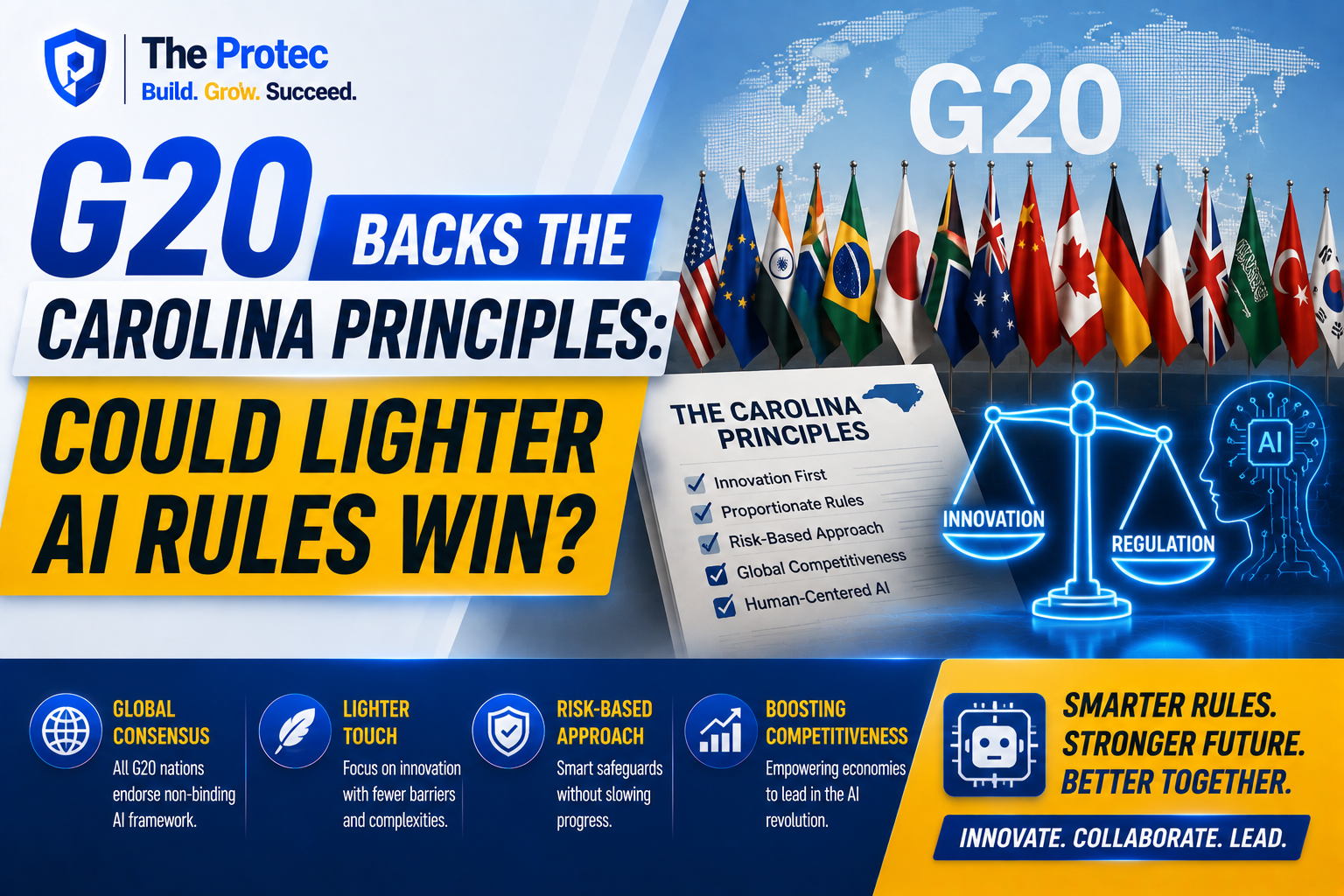
Artificial intelligence policy has reached an unusual turning point. Governments agree that powerful AI systems require oversight, yet they remain divided over how quickly rules should be written, how detailed they should become, and whether rigid requirements could be outdated before they take effect.
The unanimous G20 endorsement of the non-binding Carolina Principles brings a new option into that debate. Rather than creating another comprehensive rulebook, the principles support a lighter, more adaptable model of technology governance. Their broad direction emphasizes proportionate oversight, international cooperation, innovation, and policy that can respond to changing risks.
That consensus matters. G20 members represent the world’s largest developed and emerging economies, including jurisdictions pursuing very different approaches to artificial intelligence regulation. Agreement does not create enforceable law, but it signals that governments see value in a common foundation that is flexible enough to bridge those differences.
The central question is whether that flexibility will improve AI governance or simply delay difficult regulatory decisions. If the Carolina Principles influence national policy, they could give developers and technology companies more room to experiment. They could also test whether a lighter regulatory approach can protect the public without slowing the next generation of AI systems.
What Are the Carolina Principles?
The Carolina Principles are a non-binding framework for the governance of AI and other forms of emerging technology. Instead of prescribing one regulatory system for every country, they establish shared policy direction while leaving governments free to choose their own laws, institutions, and enforcement methods.
The framework reflects several ideas that have become central to modern G20 AI policy: regulation should be proportionate to risk, rules should remain adaptable as technology develops, and governments should avoid unnecessary barriers to beneficial innovation. It also recognizes the importance of cooperation across borders because AI models, data services, cloud platforms, and digital products rarely remain inside a single jurisdiction.
This structure makes the Carolina Principles closer to a policy compass than a statute. They can inform legislation, regulatory guidance, technical standards, public procurement, and voluntary industry practices, but they do not impose penalties or directly create legal obligations.
That distinction is essential. Endorsement does not mean G20 members have agreed to eliminate existing AI regulation or adopt identical rules. It means they have accepted a shared premise: effective AI governance does not always require the most prescriptive approach available.
Why Did All G20 Members Support Them?
Unanimous support is notable because G20 members have different political systems, economic priorities, levels of technical capacity, and attitudes toward digital regulation. Several practical factors help explain why the Carolina Principles could attract such broad backing.
They preserve national flexibility
A non-binding framework allows each government to translate common objectives into its domestic context. Countries with established AI laws can use the principles as an interoperability guide, while countries still developing an AI regulation framework can treat them as a starting point. No member has to abandon its preferred regulatory model.
They lower the cost of international agreement
Binding treaties take years to negotiate and can struggle to keep pace with fast-moving technology. Flexible principles are easier to update and can create alignment before governments are ready to accept formal obligations. That makes them especially useful for foundation models, autonomous agents, synthetic media, robotics, and other capabilities changing faster than conventional legislative cycles.
They acknowledge the economic stakes
AI has become part of national competitiveness policy. Governments want safeguards, but they also want domestic businesses to build models, attract investment, improve productivity, and participate in global supply chains. A light-touch US AI framework and similarly innovation-oriented approaches can appeal to countries concerned that compliance costs may concentrate AI development among a small number of wealthy companies.
They offer common ground without demanding uniformity
The G20 includes supporters of comprehensive legislation, sector-specific oversight, voluntary standards, and state-led technology strategies. The Carolina Principles do not resolve those differences. Instead, they create a shared layer beneath them, potentially helping national systems communicate without becoming identical.
Readers can follow the group’s broader policy agenda through the official G20 website.
What Does a Lighter Approach to AI Regulation Mean?
“Lighter touch” is sometimes mistaken for no regulation. In practice, it usually means regulating outcomes and measurable risks rather than prescribing every technical process in advance.
Under this model, a low-risk AI feature used to organize personal notes would not face the same expectations as a system making employment decisions or controlling critical infrastructure. Oversight could become stricter as potential harm, deployment scale, autonomy, or access to sensitive data increases.
A flexible AI technology policy may rely on a combination of existing consumer protection law, privacy rules, competition policy, sector regulators, technical standards, testing requirements, and targeted restrictions for high-risk uses. Guidance and regulatory sandboxes can be used where evidence is still developing.
The attraction is speed. Developers can release useful applications without first navigating a broad approval system, while regulators can focus resources on areas where failures would have serious consequences. Rules can also be revised as testing methods improve or new risks emerge.
The weakness is uncertainty. Broad principles may be interpreted differently across jurisdictions, and voluntary commitments may have little effect on irresponsible actors. A lighter approach succeeds only when regulators have the expertise, authority, and willingness to intervene when evidence of harm appears.
How the Carolina Principles Differ From Stricter AI Laws
More prescriptive artificial intelligence regulation typically defines categories of systems, establishes duties for providers and deployers, requires documentation, and attaches penalties to noncompliance. The European Union’s risk-based AI regime is the clearest example, with obligations that vary according to a system’s intended use and risk profile. Details of that framework are available from the European Commission.
The Carolina Principles operate at a different level. They seek compatibility around policy goals without supplying a single compliance architecture. Their influence is therefore likely to appear indirectly—in national strategies, agency guidance, international standards, procurement rules, and agreements on testing or incident reporting.
- Legal force: Strict laws create enforceable duties; the Carolina Principles establish shared expectations.
- Technical detail: Prescriptive regimes define processes and documentation; principles leave implementation choices to governments and organizations.
- Adaptability: Legislation can be difficult to amend; principles can respond more quickly to new capabilities and evidence.
- Consistency: Detailed laws offer clearer obligations within one market; flexible frameworks may produce greater variation.
- Innovation impact: A lighter system can reduce early compliance costs, but unclear expectations may still complicate investment and product planning.
These models are not necessarily rivals. The principles could act as an international bridge across stricter and lighter national regimes, identifying common outcomes while allowing different legal paths.
What G20 Backing Could Mean for Developers and Startups
For developers, the most valuable result would be greater interoperability. A company releasing an AI product internationally currently faces a growing patchwork of definitions, disclosure rules, safety expectations, and sector-specific requirements. Shared G20 concepts could make it easier to design one governance process that satisfies several markets.
Developers may also gain more freedom to test new architectures and applications before detailed rules solidify around today’s technology. This is important for smaller teams working on AI agents, scientific tools, accessibility products, cybersecurity systems, and specialized models. Early compliance expenses can determine whether a startup reaches the market at all.
However, non-binding principles do not erase legal risk. Companies must still comply with privacy, intellectual property, consumer protection, employment, product safety, and cybersecurity laws. Startups should not interpret lighter AI regulation as permission to postpone governance.
A sensible internal approach would include documenting intended uses, evaluating foreseeable misuse, tracking model and data limitations, testing high-impact features, monitoring deployed systems, and creating a process for reporting incidents. These practices can support trust while preparing companies for future regulation.
Larger technology companies may benefit from flexibility too, but they could face stronger expectations. Frontier model developers possess more resources, serve more users, and can create broader systemic effects. Proportionate governance should therefore mean fewer burdens for genuinely low-risk products—not equal treatment regardless of capability or scale.
Could the Principles Accelerate AI Innovation?
They could, particularly if governments use them to remove duplicative requirements and create clear routes for experimentation. Regulatory sandboxes, mutual recognition of testing methods, shared terminology, and coordinated standards would make it easier to develop products across multiple markets.
A principles-based model may also avoid freezing the industry around dominant technical methods. Detailed rules written for one type of model can unintentionally discourage safer architectures that work differently. Outcome-focused policy gives teams more freedom to demonstrate that an alternative approach meets the same safety objective.
Yet regulatory restraint does not automatically produce useful innovation. Businesses also need reliable infrastructure, skilled workers, access to computing resources, competitive markets, and public confidence. Serious incidents involving discrimination, fraud, privacy, or unsafe autonomous behavior could trigger abrupt restrictions and weaken adoption.
The strongest innovation policy is therefore not simply the least restrictive. It is predictable, proportionate, technically informed, and capable of responding quickly. The Carolina Principles will influence the future of AI only if governments convert their broad goals into credible institutions and practical guidance.
What Could Global Adoption Mean for Technology Governance?
The principles could become a diplomatic reference point beyond the G20. Smaller economies often draw from major international frameworks when building national digital policy. A flexible model may be particularly attractive where regulators lack the resources to administer a complex licensing or conformity-assessment system.
Global adoption could also push AI governance toward interoperability rather than uniformity. Governments might agree on baseline outcomes—such as accountability, security, transparency, and remedies—while using different mechanisms to achieve them. International standards and assurance practices could then connect those systems.
The danger is fragmentation hidden behind shared language. Two countries may endorse “risk-based” regulation while defining risk, responsibility, and acceptable evidence very differently. Progress must therefore be measured through implementation, not the number of governments repeating the same principles.
The Risks of Keeping the Framework Non-Binding
The Carolina Principles’ greatest strength is also their central vulnerability. Flexibility made consensus possible, but it can permit selective implementation. Governments may promote innovation language while neglecting accountability, and companies may highlight voluntary commitments without changing how systems are developed.
A credible light-touch framework still needs enforcement at the edges. Regulators require access to technical expertise, incident information, and effective remedies. High-impact systems may need independent evaluation, while developers of advanced models may need stronger cybersecurity and risk-management practices than ordinary software businesses.
Policymakers must also ensure that lighter regulation does not shift the cost of experimentation onto workers, consumers, creators, or marginalized communities. Public consultation and accessible complaint mechanisms remain important even when governance is principles-based.
Ultimately, the test is not whether the framework produces fewer rules. It is whether it produces better outcomes with less unnecessary friction.
What to Watch Next
The next phase will reveal whether the G20 Carolina Principles become an active AI governance framework or remain a diplomatic statement. Important signals include references in national AI strategies, cooperation among regulators, compatible testing standards, cross-border incident reporting, and practical support for startups.
It will also be worth watching whether governments distinguish clearly between ordinary AI applications and frontier capabilities. A genuinely proportionate system should allow broad experimentation with low-risk tools while applying closer scrutiny to systems capable of causing widespread or irreversible harm.
The unanimous endorsement does not settle the global AI regulation debate. It does, however, shift the question. Governments are no longer choosing only between comprehensive legislation and inaction. The Carolina Principles suggest a third path: coordinated, adaptable governance that begins lightly but can become firmer as risks grow.
Frequently Asked Questions
Are the Carolina Principles legally binding?
No. The Carolina Principles are a non-binding policy framework. They do not create direct legal obligations or replace national laws. Their impact depends on how G20 members incorporate them into domestic regulation, agency guidance, standards, procurement, and international cooperation.
Do the G20 Carolina Principles oppose AI regulation?
No. They support governance that is proportionate, adaptable, and sensitive to innovation. A lighter approach can still include enforceable rules for high-risk uses, consumer protection, cybersecurity, privacy, and other areas where AI systems may cause significant harm.
How could the principles help AI startups?
Shared policy concepts may reduce conflicting requirements across markets and make experimentation easier. Startups could benefit from regulatory sandboxes, clearer risk tiers, and recognition of common testing practices. They will still need responsible development processes and compliance with existing laws.
Will the Carolina Principles replace stricter frameworks such as the EU AI Act?
That is unlikely. The principles are broad enough to coexist with stricter legislation. Their more realistic role is to improve communication and interoperability among different national systems rather than replacing them with one global model.
Could light-touch governance make advanced AI less safe?
It could if flexibility becomes an excuse for weak oversight. The approach works best when low-risk innovation faces limited friction while high-impact and frontier systems receive stronger evaluation, monitoring, security, and accountability. Effective enforcement remains necessary even under a principles-based framework.