








Budget laptops have traditionally been built around compromise. Manufacturers chose inexpensive materials, reused forgettable designs, installed whatever components met a price target, and competed through discounts. Apple’s MacBook Neo challenges that formula. Instead of presenting affordability as a sacrifice, the MacBook Neo laptop packages a carefully defined experience around modern styling, approachable colors, efficient hardware, and the familiarity of macOS.
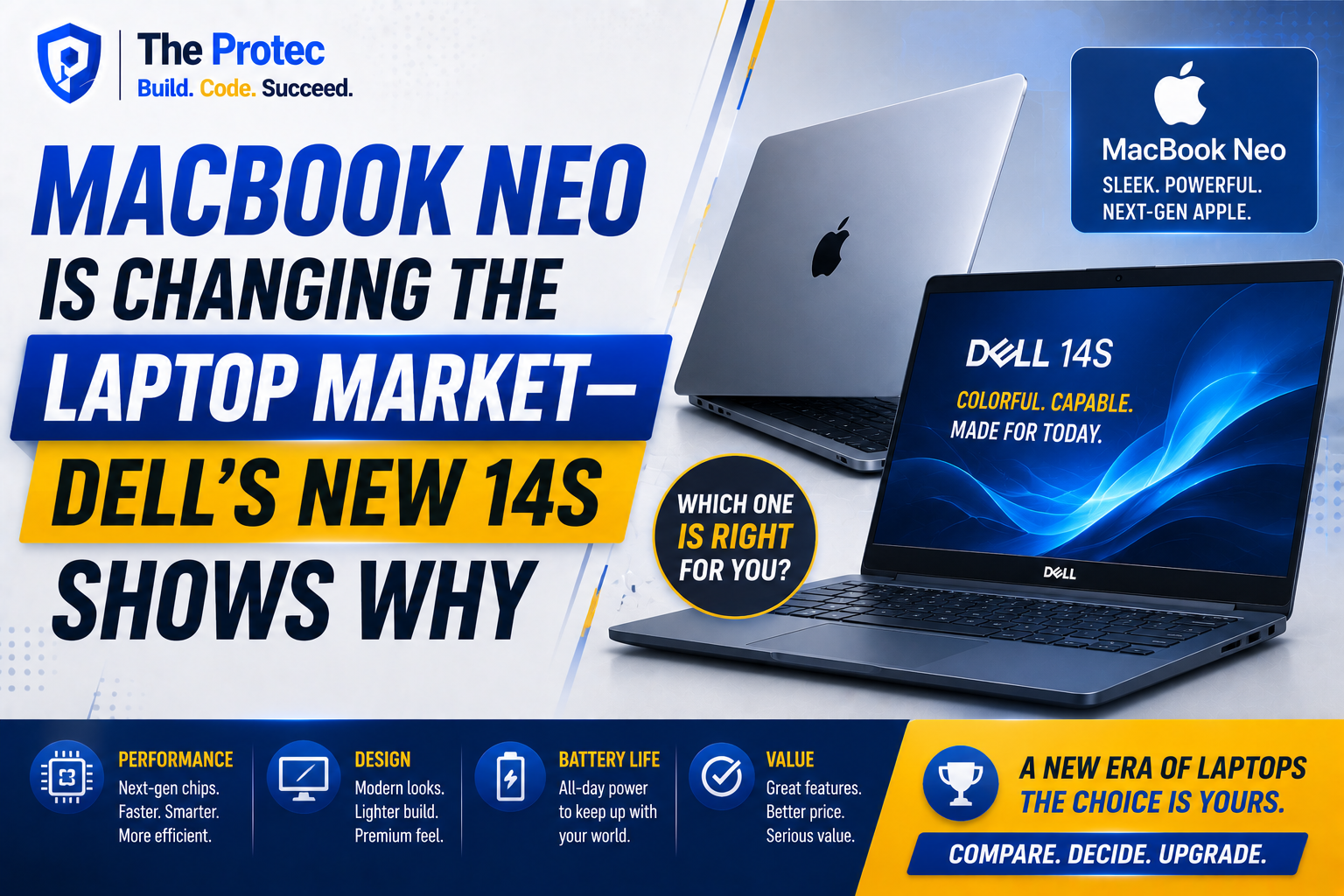
Dell’s new 14S is one of the clearest signs that the strategy is influencing the wider market. This colorful Windows laptop does not simply chase the MacBook Neo with a lower price. It reflects a broader shift toward affordable computers that are visually distinctive, easier to understand, and desirable for reasons beyond a specification sheet.
The emerging MacBook Neo vs Dell 14S contest therefore matters even to shoppers who buy neither machine. It shows how Apple is applying its product-design playbook to a more accessible category—and why Windows manufacturers are rethinking what budget laptops should look and feel like.
MacBook Neo Changes the Meaning of an Affordable Mac
The significance of MacBook Neo begins with positioning. For years, the MacBook Air served as Apple’s least expensive mainstream notebook, but its premium construction and pricing kept it above much of the high-volume Windows market. Older Air models sometimes became cheaper after replacements arrived, yet that was different from designing a Mac specifically for more price-conscious buyers.
MacBook Neo creates a clearer entry point. Its appeal is not based on being the fastest MacBook or the thinnest professional computer. It offers the qualities that mainstream customers notice every day: responsive performance, quiet operation, dependable battery life, a polished operating system, and a recognizable design.
That approach puts pressure on budget laptops that still treat appearance, trackpad quality, speakers, webcams, and battery optimization as secondary concerns. Apple is effectively arguing that an affordable notebook can be focused without looking or feeling disposable.
Dell 14S Shows That Color Is Becoming a Competitive Feature
Dell’s 14S demonstrates how Windows brands can answer without merely producing another silver MacBook look-alike. Its colorful presentation is strategically important because color gives a relatively conventional 14-inch laptop an immediate identity. It also helps Dell reach students, younger buyers, families, and everyday users who view a computer as a personal object rather than office equipment.
Color is not new to consumer technology, but PC manufacturers have often limited their least expensive models to black, gray, or dark blue. More expressive finishes were reserved for special editions or premium devices. MacBook Neo helps reverse that logic by making personality part of the accessible-laptop proposition.
The Dell 14S laptop follows the same market insight while retaining a Windows identity. It pairs a familiar clamshell format with a livelier visual direction and the practical flexibility associated with mainstream PCs. The result is a product intended to catch attention online and on a retail shelf before a buyer starts comparing processors.
MacBook Neo vs Dell 14S: Design Philosophies Compared
The two laptops approach design from different ecosystems, but they share an important goal: reduce the visual stigma attached to lower-priced hardware.
MacBook Neo favors cohesion
Apple’s advantage is control. The enclosure, chip, operating system, power management, and core applications can be tuned as parts of one product. That cohesion allows the MacBook Neo to feel deliberate even when Apple makes cost-saving choices. A limited number of ports or configurations can be presented as simplicity rather than complexity.
The Neo’s recognizable profile and curated finishes also preserve its connection to the wider MacBook family. Buyers are not simply purchasing a cheap computer; they are getting an accessible version of Apple’s notebook experience.
Dell 14S favors choice and familiarity
Dell works within a broader component and software ecosystem. That creates challenges for consistency, but it also enables more choice. Depending on the market and configuration, shoppers may find different processors, memory capacities, storage options, displays, and connectivity combinations.
The Dell 14S also benefits from conventions many Windows users expect, including broader peripheral compatibility and a less restrictive approach to ports. Its design does not need to copy Apple’s minimalism. Dell can use color to create personality while competing through flexibility.
MacBook Neo Price Pressure Reaches the Windows Market
The MacBook Neo price is central to its impact, but the story is larger than one advertised number. Regional pricing, education offers, storage selections, memory configurations, and retailer promotions can all change the real cost. Shoppers should compare currently available models through the official Apple Mac lineup rather than relying solely on a launch headline.
What matters strategically is that MacBook Neo moves a current Apple notebook closer to the territory occupied by better-equipped budget and midrange PCs. That changes the conversation. A Windows manufacturer can no longer assume that every value-focused buyer will reject a Mac on price alone.
Dell can respond in several ways with the 14S:
- Offer a lower starting price for shoppers with strict budgets.
- Include more memory or storage at a comparable price.
- Use frequent retail promotions to improve short-term value.
- Provide more ports and configuration choices without requiring adapters.
- Serve buyers who need Windows-only applications or management tools.
This is why direct price comparisons require care. A low-cost 14S configuration may beat the Neo at checkout, while a better-equipped Dell can approach or exceed the MacBook’s price. The correct comparison is between configurations that meet the same workload—not simply the cheapest listing for each name.
Hardware Positioning: Efficiency Meets PC Flexibility
MacBook Neo benefits from Apple’s emphasis on system efficiency. Apple silicon allows the company to balance performance, heat, and battery consumption without chasing the highest possible wattage. For web work, streaming, documents, communication, light creative tasks, and education, sustained responsiveness often matters more than impressive peak benchmark results.
This hardware strategy can make modest specifications perform better than buyers expect. It also means that memory and storage decisions deserve attention because Apple notebooks traditionally offer limited or no post-purchase upgrades. Saving money on the initial configuration can become expensive if the machine runs out of capacity later.
The Dell 14S represents the more varied PC approach. Available hardware can differ by country and retailer, so processor names, display quality, memory layout, and battery size must be checked carefully. Dell’s flexibility can produce excellent value, but it places more responsibility on the shopper.
When evaluating either laptop, buyers should look beyond the processor badge and compare:
- Installed memory and whether it can be upgraded.
- Usable storage after the operating system and recovery files.
- Display brightness, color quality, resolution, and refresh rate.
- Real-world battery performance rather than maximum laboratory claims.
- Port selection, charging standards, webcam quality, and wireless support.
Current Dell 14S configurations and regional availability can be checked on Dell’s official laptop catalog.
macOS Polish vs Windows Versatility
Software may be the biggest difference in the MacBook Neo vs Dell 14S decision. MacBook Neo offers macOS, deep integration with other Apple devices, and a relatively consistent update experience. Features that move messages, files, passwords, photos, calls, and tasks across Apple products strengthen the Neo’s value for someone who already owns an iPhone or iPad.
Apple’s controlled platform can also reduce setup friction. There are fewer hardware variables, and the company can optimize macOS for a small family of machines. That simplicity is particularly attractive to students, families, and users who want a laptop to work predictably without frequent maintenance.
The Dell 14S runs Windows, giving it access to a vast selection of applications, games, peripherals, business systems, and specialist utilities. It is often the safer option for organizations that rely on Windows administration, for courses requiring PC-specific software, or for households with established Windows workflows.
Windows is also becoming more central to AI-assisted computing. Search, writing support, image tools, live communication features, and on-device acceleration are increasingly built into everyday workflows. The value of those capabilities depends on the exact 14S hardware, however. Buyers should verify whether a configuration meets the requirements for the Windows AI features they expect instead of assuming every model provides the same experience.
Which Laptop Offers Better Value?
Value depends on what the buyer wants to keep for several years. MacBook Neo makes a compelling case when battery efficiency, software consistency, portability, and Apple ecosystem integration rank above port variety. Its focused configuration structure can also make the buying process less confusing.
Dell 14S can provide better value for someone who prioritizes Windows compatibility, configuration freedom, external-display options, familiar ports, or aggressive sale pricing. It may also be easier for a family or school to fit different 14S configurations to different budgets.
Neither machine should be selected by brand alone. Entry-level models often contain the largest compromises, whether that means restricted storage, limited memory, a basic display, or fewer ports. The better purchase is the configuration that remains comfortable after operating-system updates and growing application demands.
Why Windows Manufacturers Are Rethinking Budget Laptops
The influence of MacBook Neo extends beyond Dell. Affordable PCs are competing with tablets, refurbished premium notebooks, Chromebooks, and increasingly capable smartphones. Winning solely through processor specifications is difficult when many shoppers cannot distinguish one mobile chip from another.
Design, color, battery life, setup quality, and ecosystem benefits are easier to understand. Dell’s 14S suggests that Windows manufacturers recognize this change. A budget machine can have a clear audience and emotional appeal instead of functioning as the least expensive collection of available components.
This shift could improve the category in several ways. Manufacturers may reduce confusing model overlap, invest more in input devices and displays, introduce brighter finishes, and tune fewer configurations more carefully. They may also focus marketing on complete experiences instead of benchmark charts.
Apple is not guaranteed to dominate this segment. Windows brands retain major advantages in distribution, enterprise relationships, repair networks, component choice, and pricing flexibility. But MacBook Neo raises the standard they must meet.
Who Should Buy the MacBook Neo or Dell 14S?
Choose MacBook Neo if:
- You already use Apple devices and value seamless integration.
- You want a simple, consistent laptop for everyday work or education.
- Battery efficiency and quiet operation are high priorities.
- You prefer macOS and do not require Windows-only software.
Choose Dell 14S if:
- You need Windows for work, school, gaming, or specialist applications.
- You want more configuration and connectivity choices.
- You are willing to compare individual specifications for the best deal.
- You prefer a colorful laptop without entering Apple’s ecosystem.
Frequently Asked Questions
Is MacBook Neo a budget laptop?
MacBook Neo is best understood as an accessible Mac rather than an ultra-cheap notebook. It targets buyers considering higher-quality budget laptops and mainstream midrange PCs while preserving the design and software qualities associated with Apple.
Is the Dell 14S a good MacBook alternative?
Yes, particularly for buyers who want Windows, broader software compatibility, more configuration choices, or a colorful consumer design. The exact value depends on the processor, memory, display, storage, and battery included in the selected Dell 14S laptop.
Which is better, MacBook Neo or Dell 14S?
MacBook Neo is likely the stronger fit for users who prioritize macOS, efficiency, and Apple integration. Dell 14S is more suitable for users who need Windows flexibility, varied hardware options, and competitive promotional pricing.
Why is MacBook Neo important to the laptop market?
It brings Apple’s design-led strategy into a more price-sensitive category. Competitors must now offer more than acceptable performance at a low cost. Dell’s colorful 14S shows how Windows manufacturers can respond with stronger styling, practical choice, and a clearer value proposition.
The Budget Laptop Is Becoming Desirable
MacBook Neo is changing the laptop market because it reframes affordability as focus rather than failure. Dell’s new 14S shows that the response is already taking shape: more personality, clearer positioning, and greater attention to the complete ownership experience.
The winner will not necessarily be the laptop with the lowest sticker price or fastest benchmark. It will be the machine that best balances design, useful performance, software, longevity, and daily comfort. For consumers, that is an encouraging development. Budget laptops are finally being designed as products people can want—not merely products they can afford.