








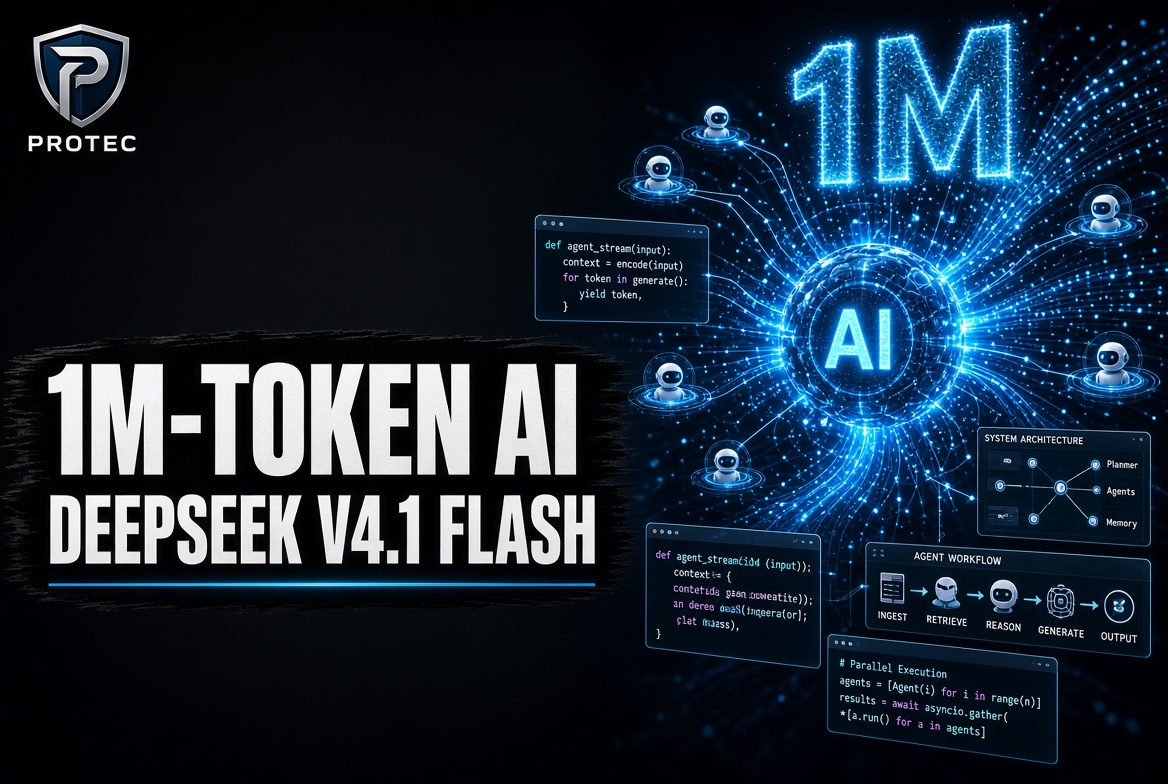
DeepSeek V4.1 Flash 1017 is aimed at a demanding corner of the AI market: developers who want strong coding, reasoning, visual understanding, and agentic capabilities without the premium inference costs associated with many frontier models. The October 17 snapshot is particularly notable because OpenRouter lists an approximately one-million-token context window, placing it among the large context window AI models designed for repository analysis and extended AI agent workflows.
That headline deserves careful interpretation. A DeepSeek million token context window could let a model inspect substantial codebases, documentation sets, logs, specifications, and tool results in one session. It does not mean the model will remember every detail perfectly, accept the theoretical maximum through every provider, or produce better answers simply because more text is supplied.
This analysis separates DeepSeek’s reported improvements from independently demonstrated performance. It also examines the practical questions developers should ask before adopting DeepSeek V4.1 Flash 1017: How reliable is it across a real repository? Can it call tools consistently? What does a completed task cost? How well does it retrieve facts buried deep in a long prompt? Those answers matter more than any isolated benchmark score.
What is DeepSeek V4.1 Flash 1017?
DeepSeek V4.1 Flash 1017 is the October 17 snapshot of the DeepSeek V4.1 Flash family. The date-coded identifier is useful for reproducibility because a stable snapshot lets development teams test against a fixed model rather than a moving alias that may silently change behavior.
At publication, the snapshot identifier and listed context capacity should be cross-checked against the model card, Hugging Face metadata, and the OpenRouter model directory. DeepSeek’s own release material describes improvements in reasoning, coding, visual tasks, and agent-oriented behavior. These are vendor-reported claims, not proof that the model will outperform every competing system in production.
The “Flash” label indicates an emphasis on efficient inference. In practice, that positioning makes the model relevant to startups, coding-tool vendors, and teams building agents that may generate many model calls per task. Fast, inexpensive calls can be more valuable than a marginal benchmark advantage when an agent must repeatedly inspect files, run tests, interpret failures, and revise a patch.
What DeepSeek says has improved
Reasoning and coding
The DeepSeek AI model update is presented as a refinement of multi-step reasoning and code generation. Reported improvements cover understanding programming requirements, following dependencies, generating patches, and maintaining a plan over longer tasks. For developers, the meaningful test is not whether the model can solve a self-contained algorithm problem. It is whether it can modify an unfamiliar repository without breaking interfaces, tests, or established conventions.
DeepSeek also describes stronger agentic coding capabilities. That can include choosing tools, reading results, correcting failed assumptions, and continuing until a task reaches a verifiable outcome. Agentic performance is fragile, however. A model can write excellent code while still calling a tool with malformed arguments or claiming success before tests have passed.
Visual reasoning
DeepSeek’s reported visual reasoning gains make the model potentially useful for interpreting interface screenshots, architecture diagrams, charts, error captures, and scanned technical material. A DeepSeek vision model could, for example, compare an implementation against a UI reference or turn a system diagram into an initial configuration plan.
Developers should confirm that their selected endpoint actually accepts image inputs. Model-family capabilities, provider routes, and API features are not always identical. Visual benchmark claims should also be evaluated using real screenshots and diagrams rather than only clean academic images.
Reported benchmarks versus verified performance
DeepSeek V4.1 Flash benchmark results and release-card comparisons are useful starting points, but they remain company-reported unless a third party reproduces them under equivalent conditions. Scores can change with prompting, tool scaffolding, sampling settings, test contamination controls, and the amount of inference-time computation allowed.
Before publication or procurement, teams should record the benchmark version, pass criteria, tool access, token budget, and competing model configuration. A result produced with repository tools and repeated attempts is not directly comparable to a single-call result from another model.
How a one-million-token context can help developers
OpenRouter lists roughly 1,000,000 tokens of context for the DeepSeek V4.1 Flash 1017 route. That is large enough, in theory, to hold several million characters of source code and documentation. Actual capacity varies with tokenization, message formatting, images, provider limits, and reserved output space.
- Large-codebase analysis: Teams can provide many source files, tests, configuration files, schemas, and commit notes together, helping the model connect behavior across modules.
- Dependency tracing: A long context LLM for coding can follow types, imports, interfaces, and call paths across files instead of analyzing snippets in isolation.
- Documentation processing: The model can compare implementation details with lengthy API references, migration guides, and internal engineering standards.
- Extended debugging: Developers can retain logs, previous hypotheses, test outputs, and attempted fixes during a long troubleshooting session.
- Agent memory: Multi-step agents can preserve plans, tool observations, repository maps, and validation results without summarizing after every action.
More context is not automatically better. Very long prompts increase preprocessing time and cost, and important details may become harder to retrieve when surrounded by irrelevant material. Models can miss facts in the middle of a prompt, confuse similar files, or favor recent instructions. Retrieval, code indexing, file ranking, and structured summaries remain valuable even with a DeepSeek 1 million token context.
The listed context window is also not a promise that every API request can use the full amount. Providers may impose lower limits, reserve tokens for output, reject large image payloads, or route requests to infrastructure with different constraints. Developers should inspect endpoint metadata and test progressively larger payloads before designing around the theoretical maximum.
DeepSeek AI API pricing and billing conditions
Pricing must be tied to a provider and model identifier. At the October 17 publication check, OpenRouter’s listing for the snapshot quoted approximately $0.06 per one million input tokens and $0.24 per one million output tokens. Billing is token-based, and generated tokens cost more than prompt tokens. The listing did not expose a separate snapshot-specific cached-input discount; unless route metadata says otherwise, cached tokens should not be assumed to receive a lower rate.
- Input: approximately $0.06 per 1 million tokens through the checked OpenRouter route.
- Output: approximately $0.24 per 1 million tokens through that route.
- Cached input: no separately advertised discounted rate for this snapshot at the publication check.
- Conditions: routing, provider availability, platform fees, minimum charges, and price updates may affect the final bill.
DeepSeek’s official API documentation should be treated as the source of record for direct-endpoint aliases, cache rules, and direct pricing. A date-stamped OpenRouter snapshot is not necessarily available under the same name through DeepSeek’s direct API, and prices for aliases such as a general chat model must not be presented as the price of Flash 1017.
The low advertised rates make this an affordable AI API for developers, but token price is only one part of the DeepSeek API cost comparison. A model that needs four attempts, repeatedly reloads a repository, or generates excessively long plans may cost more per successful patch than a higher-priced model that completes the task once. Measure total cost per accepted outcome, including tool execution and engineering review.
DeepSeek API tutorial with an OpenAI-compatible client
The following Python example uses OpenRouter’s documented OpenAI-compatible endpoint. It submits a bounded coding task and handles an empty or refused response. Store the API key in an environment variable rather than source code.
import os
from openai import OpenAI

client = OpenAI(
    base_url="https://openrouter.ai/api/v1",
    api_key=os.environ["OPENROUTER_API_KEY"],
)

response = client.chat.completions.create(
    model="deepseek/deepseek-v4.1-flash-1017",
    messages=[
        {
            "role": "system",
            "content": (
                "You are a repository coding assistant. Explain assumptions, "
                "return a minimal patch, and include tests. Do not claim that "
                "tests passed unless tool output confirms it."
            ),
        },
        {
            "role": "user",
            "content": (
                "Refactor this Python cache so concurrent callers cannot create "
                "duplicate entries. Preserve the public API and propose pytest "
                "tests for the race condition.nn<insert relevant files here>"
            ),
        },
    ],
    temperature=0.2,
    max_tokens=3000,
)

message = response.choices[0].message
if not message.content:
    raise RuntimeError("The model returned no text response")

print(message.content)
if response.usage:
    print("Usage:", response.usage)
For large repositories, do not concatenate files blindly. Generate a repository map, select relevant paths, preserve filenames around each excerpt, and ask the model to request additional files when necessary. Log prompt, completion, cache, latency, and retry data so costs can be audited.
How to evaluate DeepSeek Flash 1017 properly
A useful evaluation should resemble the workload the model will face after deployment.
- Repository-level coding: Use issue reports from real projects and score whether patches compile, pass tests, preserve APIs, and follow local conventions.
- Debugging: Provide incomplete logs and misleading symptoms. Measure root-cause accuracy, unnecessary edits, and the number of iterations required.
- Tool use: Test schema compliance, argument accuracy, recovery from tool errors, and whether the model waits for results before declaring success.
- Long-context retrieval: Place relevant facts at the beginning, middle, and end of large inputs. Check exact retrieval and cross-file reasoning as context grows.
- Vision: Evaluate screenshots, diagrams, dense dashboards, and low-quality images representative of production inputs.
- Latency: Record time to first token and total completion time at multiple context sizes. Million-token preprocessing may be expensive even when generation is fast.
- Token consumption: Compare the full cost per completed task, including retries, summaries, tool messages, and rejected outputs.
DeepSeek vs Claude and GPT for coding
A fair DeepSeek vs Claude coding comparison should not assume one winner for every task. Claude models are often favored for careful code explanation, instruction adherence, and coherent repository changes. GPT models benefit from mature tooling ecosystems, structured output support, and broad multimodal integration. Exact capabilities and context limits depend on the selected model and endpoint rather than the brand name.
DeepSeek V4.1 Flash 1017 may be more attractive where inference cost, long input capacity, and high call volume dominate the decision. Claude or GPT may justify higher prices if they require fewer retries, produce safer patches, or call tools more reliably. Speed also varies by provider load, geographic routing, prompt length, and output size.
The right comparison is therefore cost per completed, validated task. Run the same repository issues through each model with equivalent tools, token budgets, and retry policies. Have engineers review correctness without seeing the model name, then compare success rate, latency, token usage, and review time.
Limitations developers should plan for
DeepSeek V4.1 Flash 1017 can still hallucinate APIs, invent files, overlook security implications, or generate plausible tests that fail to exercise the defect. Large prompts add context-processing overhead and may reduce responsiveness. Output limits can also prevent a model from returning an entire migration even when the input fits comfortably.
Agent applications need safeguards: restricted tool permissions, patch review, test execution, timeouts, spending limits, and explicit completion criteria. Sensitive repositories should not be submitted until the provider’s retention, logging, and data-processing terms have been reviewed.
Finally, benchmark methodology matters. Vendor results can demonstrate potential, but independent testing is needed to establish reliability on a particular language, framework, repository size, and agent architecture.
Is DeepSeek V4.1 Flash 1017 worth using?
DeepSeek V4.1 Flash 1017 is a compelling candidate for low-cost coding assistants, repository search, documentation analysis, and multi-step software agents. Its listed million-token capacity is most valuable when paired with intelligent file selection and retrieval rather than used as an excuse to send everything on every call.
Start with a controlled pilot. Pin the 1017 snapshot, verify the actual endpoint limit, measure long-context recall, and compare total task costs against current Claude and GPT alternatives. Use the model for high-volume analysis or first-pass patches, but retain automated tests and human approval for consequential changes. If it delivers reliable results with fewer expensive retries, it could be one of the best affordable coding AI API options for agentic development.
Frequently asked questions
Does DeepSeek V4.1 Flash 1017 really support one million tokens?
OpenRouter lists an approximately one-million-token context window for the snapshot. The usable request size can be lower because of provider restrictions, message overhead, images, and space reserved for output. Test the exact endpoint rather than relying only on model-family metadata.
Is the model available through an OpenAI-compatible API?
Yes, OpenRouter exposes the snapshot through an OpenAI-compatible chat-completions endpoint. DeepSeek’s direct API is also OpenAI compatible, but its model aliases, availability, pricing, and limits may differ from the OpenRouter snapshot.
Is DeepSeek better than Claude or GPT for coding?
Not universally. DeepSeek may offer a strong cost and context advantage, while particular Claude or GPT models may perform better on tool reliability, complex patches, or instruction following. Compare validated task completion rather than isolated benchmark scores.
Should developers send an entire repository in one prompt?
Usually not. Even with a million-token window, repository maps, retrieval, dependency-aware file selection, and concise summaries improve latency and reduce irrelevant context. Full-repository input is most useful when cross-cutting analysis genuinely requires it.