





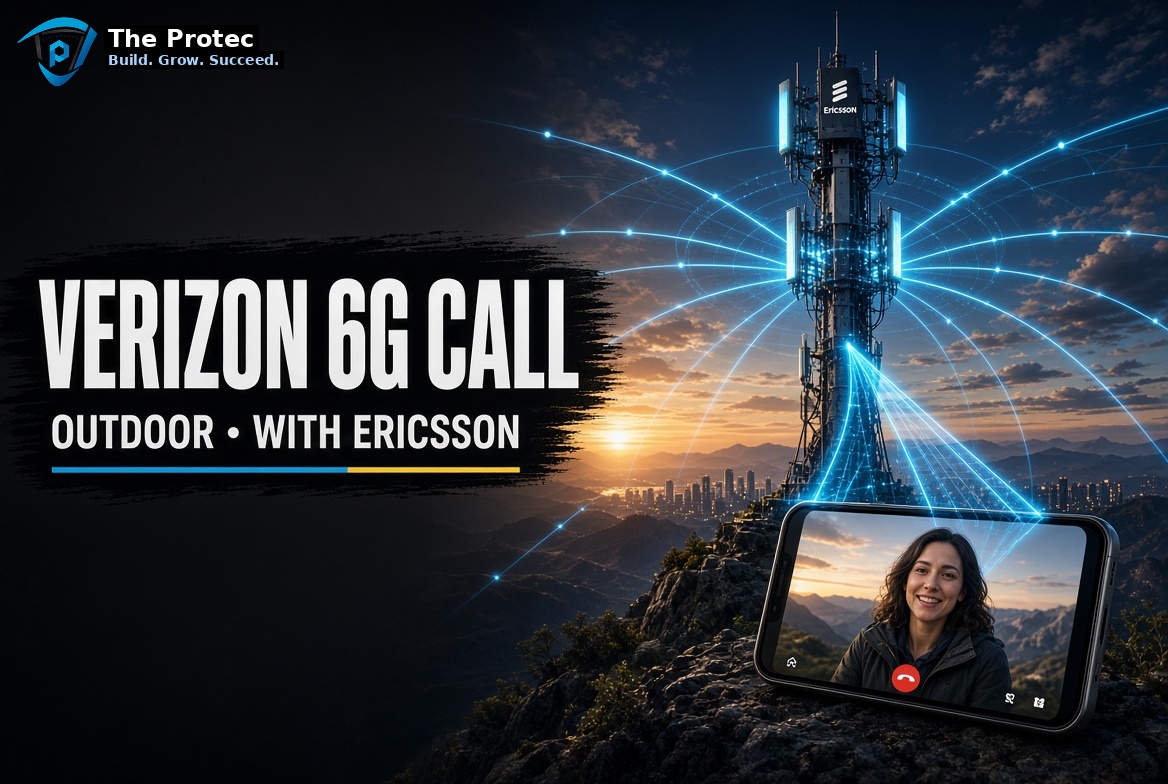
Verizon 6G, until now largely associated with laboratory research and long-term network planning, has taken an important step into real-world conditions. On October 15, 2026, Verizon and Ericsson announced that they had completed what the companies describe as the first pre-standard 6G field call in the 7 GHz frequency range. The test originated from a Verizon commercial network site in Concord, California.
This was not a commercial launch, a public network upgrade or a demonstration that consumers can begin using 6G. It was an outdoor proof of concept designed to evaluate how experimental radio technology behaves beyond a controlled laboratory. That distinction is central to understanding why the Verizon 6G test matters.
Laboratories are essential for integrating hardware and software, but they cannot reproduce every obstruction, reflection, building material or environmental change encountered by a live wireless network. Moving Ericsson’s experimental equipment into the field lets engineers examine coverage, throughput, latency and stability under conditions that more closely resemble eventual deployment.
What Verizon and Ericsson Announced
The Verizon Ericsson 6G project used a commercial Verizon network location as the setting for specialized, pre-standard equipment. According to the companies’ October 15 announcement, the system included an Ericsson 6G proof-of-concept base station, a pre-standard 6G protocol stack and experimental user equipment operating with a 400 MHz carrier in the 7 GHz range.
The phrase “pre-standard” is important. The global technical specifications that will define commercial 6G have not been finalized, and the trial did not use a finished consumer product or a fully standardized radio interface. It instead gave engineers a platform for studying possible technologies, propagation characteristics and network designs while standards development continues.
Verizon and Ericsson characterize the connection as the first outdoor 6G call of its kind in this spectrum range. That is a company claim about a research milestone, not evidence of a globally available service. A field call in this context is also better understood as an experimental wireless connection than as an ordinary consumer voice call.
Details originate from the companies’ official disclosures through the Verizon newsroom and Ericsson press releases. Telecom industry coverage has similarly treated the event as an early research step rather than a commercial rollout.
How the Verizon 6G Field Trial Works
The Verizon 6G Concord, California, deployment is notable because it combines an outdoor site with a configurable indoor testing environment. Engineers test user equipment outside and inside an approximately 12-by-8-foot mobile enclosure. The enclosure can be fitted with different wall and window materials to study how signals travel from the outdoor base station into an enclosed space.
This arrangement provides more useful information than a simple line-of-sight demonstration. Wireless signals behave differently when they encounter glass, exterior walls, insulation, foliage and other obstacles. Some materials absorb radio energy, while others reflect or scatter it. The effect can change with frequency, distance, antenna orientation and weather conditions.
The broader Verizon 6G field trial is intended to examine:
- Outdoor coverage and signal consistency over distance
- Throughput and latency across changing radio conditions
- Connection stability during extended testing
- Line-of-sight and non-line-of-sight performance
- The effects of buildings, obstacles and foliage
- Signal penetration from outdoors into enclosed areas
- Performance through different wall and window materials
The companies have not presented the demonstration as a consumer speed contest. No responsible comparison can be made between an experimental system and today’s mature commercial networks without consistent devices, locations, spectrum, network configurations and workloads. The value of the Verizon 6G outdoor test is the engineering data it can generate, not an unverified headline speed.
Why the 7 GHz Range Is Drawing Attention for 6G
Spectrum is one of the most consequential questions in 6G network development. Lower frequencies generally provide broad coverage and stronger building penetration but offer limited amounts of contiguous bandwidth. Much higher frequencies can support wide channels, yet their propagation and coverage characteristics can make broad-area deployment more difficult.
The 7 GHz range is attracting research interest because it could offer a middle-ground option. It may provide access to additional bandwidth while retaining more practical coverage characteristics than extremely high-frequency spectrum. A 400 MHz 6G carrier, such as the one used in this proof of concept, gives researchers substantial bandwidth for evaluating new radio designs and potential services.
That does not mean the entire 7 GHz range will become a universal 6G band. Verizon and Ericsson did not identify the exact frequencies used in the field call. The wider range also includes existing services and users whose needs must be considered.
Any future 7 GHz 6G spectrum allocation will depend on national regulators, international coordination, coexistence studies and decisions made through standards organizations. Different countries may authorize different portions of spectrum or impose different technical conditions. The trial demonstrates research interest in the band; it does not settle those policy questions.
Why Moving Outdoors Is a Significant Milestone
An integrated laboratory system proves that experimental components can communicate under controlled conditions. An outdoor field system begins answering a harder question: Can the concept remain useful when the radio environment becomes unpredictable?
Real networks must handle moving objects, changing interference, blocked paths, reflections and users located inside buildings. Coverage can vary from one side of a structure to another. Leaves and branches can affect propagation, while windows with metallic coatings may behave differently from ordinary glass. Even small changes in equipment placement can alter performance.
Testing these conditions helps Verizon and Ericsson identify where algorithms, antennas, radios or network software need improvement. The results can also inform channel models used to simulate future deployments. Better models allow researchers to estimate how many sites might be required, where equipment should be placed and how a network could maintain stable connections.
The Concord trial therefore represents a transition from component integration toward practical validation. It remains early research, but outdoor testing exposes problems that may not appear inside a lab.
6G vs. 5G: Different Stages, Not a Fair Speed Race
Today’s 5G networks are standardized, commercially deployed and supported by a broad ecosystem of smartphones, modems, radios and network software. They serve consumers and businesses using low-band, mid-band and millimeter-wave spectrum, depending on the operator and location.
The pre-standard 6G field call serves a different purpose. It evaluates possible building blocks for next-generation wireless networks before specifications and commercial products exist. It should not be interpreted as proof that an ordinary 6G user experience is already faster or more reliable than 5G.
Over time, researchers expect 6G development to explore wider bandwidths, improved spectral efficiency, more adaptive radio systems and tighter integration of communications, sensing and computing. AI-native network functions may help networks optimize resources and respond to changing conditions. Those are development goals, however, not guaranteed features demonstrated by this single test.
For now, 5G remains the commercial platform. Continued 5G Advanced work will also influence 6G by refining technologies and operational practices that can carry into the next generation.
What the Findings Could Eventually Enable
If 6G research ultimately produces higher-capacity, lower-latency and more dependable networks, the benefits could extend beyond faster phone downloads. Mobile broadband may become more consistent in dense locations and indoor environments, particularly if new spectrum can be combined effectively with existing bands.
Potential long-term applications include:
- AI-native services: Networks could coordinate cloud, edge and device-based AI workloads with more dynamic resource management.
- Industrial automation: Factories and logistics sites may use highly reliable wireless links for sensors, machinery and real-time control.
- Robotics: Mobile robots could exchange richer environmental data and coordinate tasks with edge systems.
- Immersive communications: Advanced spatial video, extended reality and telepresence could require sustained capacity and predictable latency.
- Connected devices: Future networks may support a wider mix of devices with different power, coverage and performance requirements.
The indoor portion of the test is especially relevant because many wireless sessions occur inside homes, offices, stores and industrial buildings. Understanding 6G signal penetration through buildings will be necessary before operators can judge where 7 GHz systems might be practical and where lower-frequency coverage layers would still be required.
These applications remain long-term expectations. The Concord test evaluates radio behavior and does not demonstrate every possible 6G service.
When Will 6G Be Available?
There is no verified commercial Verizon 6G release date. The Concord demonstration should not be confused with a launch timeline, and Verizon has not turned its commercial site into an ordinary 6G access point for customers.
The path from a pre-standard 6G field call to service includes several major steps. Industry organizations must develop and finalize technical specifications. Regulators must determine which spectrum can be made available and under what conditions. Chipmakers, device manufacturers and infrastructure suppliers must then build interoperable equipment that complies with those standards.
Operators will also need to test security, reliability, mobility, power consumption, network integration and deployment economics. Additional field trials will likely examine more locations, frequencies, antenna configurations and environmental conditions.
Current phones do not have 6G phone compatibility and cannot connect to the experimental Concord network as a normal consumer service. Commercial compatibility will require future chipsets, radio components, antennas and software designed for whatever standards and frequency bands are eventually adopted.
What the Verizon Ericsson First 6G Call Really Shows
The most important result is not that 6G has arrived. It is that Verizon and Ericsson have moved an integrated experimental system into a complex outdoor environment where meaningful propagation and performance data can be collected.
By using a 400 MHz carrier, a proof-of-concept base station and configurable indoor materials, the companies can study 6G coverage and stability instead of relying only on theoretical models. That work may influence future equipment designs, spectrum discussions and standards contributions.
The demonstration is an early checkpoint in the future of mobile networks: technically significant, commercially preliminary and still subject to years of standards, regulatory and product development.
Frequently Asked Questions
Was this a commercial Verizon 6G launch?
No. It was a pre-standard proof-of-concept field demonstration using specialized Ericsson equipment at a Verizon network site. It is not available as a consumer service.
Where did the first outdoor 6G call take place?
Verizon and Ericsson conducted the field call from a Verizon commercial network site in Concord, California. Testing included outdoor user equipment and equipment placed inside a configurable mobile enclosure.
What spectrum did the Verizon 6G test use?
The system operated in the 7 GHz range with a 400 MHz carrier. The companies did not disclose the exact frequencies, and future commercial spectrum use remains subject to regulatory and standards decisions.
Can existing smartphones connect to the test network?
No. Current smartphones are not designed for this experimental pre-standard radio system. Future 6G access will require compatible devices based on finalized standards and authorized spectrum bands.
Does the test prove that 6G is faster than 5G?
No. The field trial studies coverage, throughput, latency, stability and signal penetration, but it is not a fair consumer comparison with commercial 5G. Verizon and Ericsson did not present it as proof of a consumer speed record.