








Margaret Hamilton, the pioneering computer scientist whose work helped carry astronauts to the Moon and establish software engineering as a serious technical discipline, has died at 90. Her death marks the loss of one of the most influential figures in computing—a leader who recognized earlier than most that software could be as essential to a mission as rockets, engines and physical instruments.
As director of the Software Engineering Division at the Massachusetts Institute of Technology’s Instrumentation Laboratory, Hamilton led teams responsible for crucial flight software used during NASA’s Apollo missions. Their programs ran on the Apollo Guidance Computer, helping astronauts navigate, control spacecraft and land on the Moon despite computing resources that appear astonishingly limited by modern standards.
The Margaret Hamilton legacy is not simply that her code reached the Moon. It is that she and her colleagues developed practical ways to make complex software reliable, testable and resilient under conditions in which failure could cost lives. Their approach influenced software engineering history and remains relevant wherever computers control spacecraft, vehicles, medical equipment, energy systems or other safety-critical technology.
From Mathematics to NASA Computer Programming
Born in Paoli, Indiana, Hamilton studied mathematics and philosophy at Earlham College before graduating in 1958. After college, she worked at MIT, where she programmed systems used for weather prediction and research associated with meteorologist Edward Lorenz. She later joined MIT Lincoln Laboratory and contributed to software for the Semi-Automatic Ground Environment, or SAGE, air-defense project.
These early assignments introduced Hamilton to large computer systems at a time when programming was neither standardized nor widely respected as a profession. Programmers frequently worked directly with hardware constraints, developing techniques without mature textbooks, established degree programs or the extensive tools available to software teams today.
Hamilton eventually joined MIT’s Instrumentation Laboratory, now known as Draper Laboratory, which had been selected to develop the Apollo spacecraft’s guidance and navigation system. She rose to lead the division producing onboard flight software for the command and lunar modules. A detailed NASA profile of Margaret Hamilton describes her leadership and contributions to the Apollo program.
Margaret Hamilton and the Apollo Guidance Computer
The Apollo Guidance Computer was one of the most advanced embedded computers of its era, but its capabilities were tiny compared with those of a modern phone, laptop or smartwatch. Memory was measured in kilobytes, processing capacity was tightly constrained and software updates could not be downloaded after launch. Programs had to operate predictably while exposed to vibration, radiation, electrical disturbances and incomplete or unexpected input.
The computer itself was an extraordinary collaborative achievement involving MIT designers, NASA engineers, astronauts, contractors and manufacturers. Its permanent programs were stored in rope memory, a labor-intensive technology in which wires were physically woven through or around magnetic cores to represent binary instructions. Late changes were expensive, making early planning and rigorous verification essential.
Margaret Hamilton’s Apollo software teams developed the logic that allowed the computer to perform navigation, guidance, control and spacecraft-management functions in real time. They had to anticipate interactions among software, hardware, astronauts and mission procedures. The result was not merely a collection of calculations. It was an integrated system designed to keep operating when conditions departed from the ideal plan.
Why NASA Apollo Guidance Software Had to Be Exceptionally Reliable
A conventional application can often be restarted after an error. Apollo mission software had no such luxury. During critical flight phases, a crash, delayed calculation or incorrect command could endanger the crew and spacecraft within seconds. Communication delays and limited ground visibility also meant that the onboard system needed a degree of independent fault handling.
Hamilton advocated treating software with the same seriousness applied to other engineering disciplines. That meant carefully defining requirements, analyzing interfaces, testing abnormal conditions and identifying possible human errors. Her teams built simulations and repeatedly exercised the software against failures, timing conflicts and unexpected commands.
This philosophy extended to what Hamilton described as asynchronous software—the reality that events do not always occur in a convenient, predetermined sequence. An astronaut might select the wrong mode, a sensor might send excessive data or several high-priority events might happen together. Mission-critical software needed to recognize what mattered most and preserve essential functions rather than fail indiscriminately.
The Apollo 11 Computer Alarms That Proved the Design
The best-known demonstration of this resilience occurred during the Apollo 11 lunar landing. As the lunar module Eagle descended toward the Moon, its guidance computer displayed the 1201 and 1202 program alarms. The computer was receiving more work than it could complete within its processing cycle, partly because rendezvous radar information was consuming resources during the descent.
The alarms did not mean the computer had simply stopped. The operating system’s executive software recognized the overload, discarded lower-priority work and restarted interrupted tasks while preserving the calculations most important to guidance and control. The system informed the astronauts and Mission Control that an overload had occurred while continuing to support the landing.
Ground controllers quickly determined that the descent could proceed because the computer was still completing its critical jobs. Neil Armstrong and Buzz Aldrin landed safely, making Apollo 11 one of the defining achievements in human exploration.
Hamilton’s team did not single-handedly cause the successful response, nor did one person write every relevant instruction. The priority scheduling, restart protection, alarm behavior and mission procedures emerged from collaborative Apollo software development. However, Hamilton’s leadership helped foster the engineering culture that anticipated overloads and designed the system to recover gracefully. That distinction is important: her documented achievement is more compelling than the simplified claim that she alone created Apollo’s software.
How Hamilton Helped Define Software Engineering
The expression “software engineering” existed in limited use before and during the Apollo era, but Hamilton became one of its most visible early advocates. She used the term to insist that software deserved formal engineering status rather than being treated as secondary clerical work. At first, she recalled, the phrase could provoke amusement. The success of Apollo helped validate the concept.
Several practices associated with Margaret Hamilton software engineering now appear foundational:
- Priority-based execution: The system distinguished mission-critical calculations from work that could be postponed or abandoned during overload.
- Fault detection and recovery: Software was expected to detect abnormal behavior, report it and preserve essential functions where possible.
- Rigorous testing: Teams tested ordinary operations as well as timing problems, invalid actions, hardware faults and unusual combinations of events.
- Human-centered safeguards: The software accounted for interactions between astronauts and machines rather than assuming flawless human input.
- End-to-end systems thinking: Programmers considered how code would interact with hardware, procedures, communications and mission objectives.
- Requirements discipline: Because memory and processor time were scarce, every capability had to be justified, understood and carefully implemented.
These principles remain central to aviation, robotics, cybersecurity, medical devices, autonomous transportation and modern spacecraft. Contemporary systems have vastly greater computing power, but they also contain millions of lines of code, depend on networks and face threats that Apollo engineers never encountered. More capacity has not eliminated the need for disciplined design; it has expanded the number of ways systems can fail.
A Collaborative Achievement, Not a Lone-Programmer Myth
Popular accounts sometimes describe Hamilton as the person who wrote the Apollo 11 computer software. That shorthand obscures the scale of the project. Apollo mission technology was created by thousands of people across NASA, universities and private contractors. Software involved programmers, mathematicians, test specialists, hardware engineers, mission planners and astronauts who helped refine operational requirements.
Hamilton’s role was nevertheless exceptional. She directed the MIT division responsible for onboard software and shaped how its teams approached reliability and unexpected conditions. Leadership in a project of that size involved technical decision-making, coordination, testing strategy and responsibility for the completed system—not personally typing every line.
Recognizing collaboration does not diminish her contribution. It places it accurately within one of history’s most complex engineering programs and shows why effective technical leadership is itself a major achievement.
A Trailblazer for Women in Computer Science
Hamilton built her career when women performed substantial programming work but were often denied equal recognition, advancement and authority. Early software development was sometimes undervalued precisely because it was associated with women and viewed as less tangible than hardware engineering.
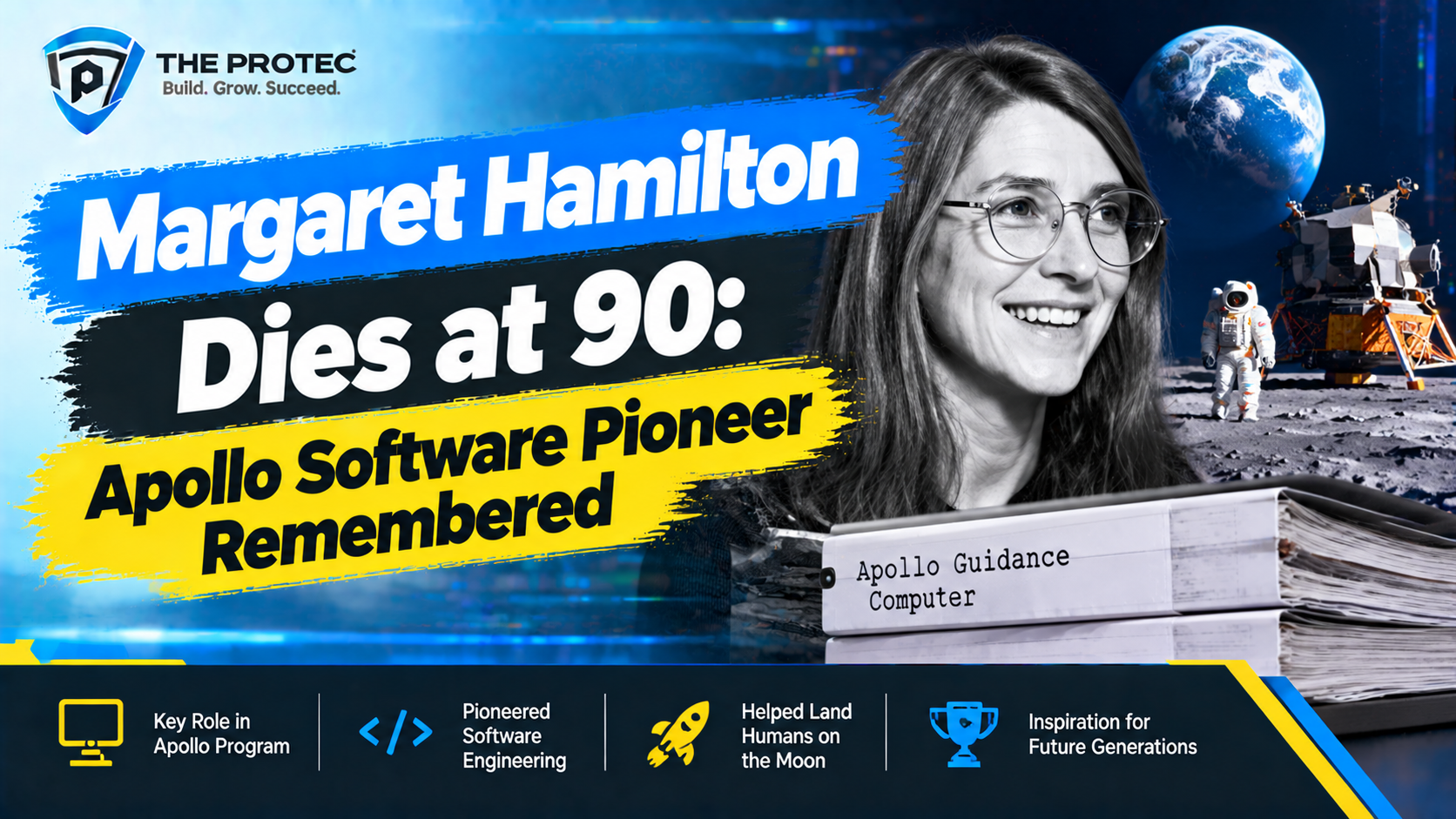
Photographs of Hamilton standing beside towering stacks of Apollo program listings became an enduring image of women in computer science. More important than the image was the authority she exercised: she led a critical technical organization whose work had to function hundreds of thousands of miles from Earth.
After Apollo, Hamilton founded Higher Order Software and later Hamilton Technologies, continuing her work on systems design, error prevention and software-development methods. NASA honored her with an Exceptional Space Act Award, and she received the Presidential Medal of Freedom in 2016. The Smithsonian’s account of her Apollo work further documents her place in computing history.
Why the Margaret Hamilton Legacy Matters Now
Modern society depends on software at a scale the Apollo teams could scarcely have imagined. Code manages hospital equipment, power grids, financial infrastructure, aircraft, satellites and increasingly autonomous machines. Artificial intelligence is also being integrated into high-impact systems, raising urgent questions about testing, explainability, monitoring and safe failure.
Hamilton’s work offers a durable lesson: engineers must design for reality, not merely for ideal operating conditions. Computers will become overloaded. Sensors will fail. People will make mistakes. Requirements will conflict. A safe system must determine what is most important, expose problems clearly and move toward a controlled state.
Her example also challenges the assumption that better hardware automatically produces more dependable technology. The Apollo Guidance Computer succeeded with severe limits because its software was purpose-built and carefully verified. Today’s abundant processing power can encourage unnecessary complexity, hidden dependencies and insufficient testing. Hamilton’s emphasis on prevention, priority and system-level reasoning remains a valuable counterweight.
Remembering a NASA Software Pioneer
Margaret Hamilton dies at 90 with a legacy extending far beyond the Moon landings. She helped prove that software was not an accessory to advanced machinery but an engineering system capable of determining whether a mission succeeded or failed.
Her career connects the earliest era of practical computer programming to today’s software-dependent world. Every engineer building a system that must remain dependable under pressure works in a field Hamilton helped define. Apollo showed what rigorous software could accomplish; her life helped ensure that the people creating it would be recognized as engineers.
Frequently Asked Questions
What did Margaret Hamilton do for NASA?
Margaret Hamilton led the Software Engineering Division at MIT’s Instrumentation Laboratory, which developed essential onboard flight software for NASA’s Apollo command and lunar modules. Her responsibilities included technical leadership, software reliability, testing and the design of systems that could handle errors and unexpected events.
Did Margaret Hamilton write all of the Apollo 11 software?
No. Apollo 11 computer software was a collaborative achievement involving large teams at MIT, NASA and contractor organizations. Hamilton led a key software division and made major documented contributions, but she was not the sole programmer or creator of the complete Apollo system.
How did Apollo software help during the Moon landing?
During Apollo 11’s descent, the guidance computer became overloaded and generated 1201 and 1202 alarms. Its priority-based executive software discarded lower-priority work, preserved essential guidance tasks and recovered without abandoning the landing sequence.
Did Margaret Hamilton invent the term software engineering?
Hamilton is widely credited with helping popularize and legitimize “software engineering,” although versions of the term appeared elsewhere during the emerging discipline’s early years. Her lasting contribution was insisting that software be developed with engineering rigor and demonstrating that approach through Apollo.
Why is Margaret Hamilton important to modern technology?
Her work advanced principles now used in safety-critical systems: rigorous testing, priority scheduling, fault detection, recovery, human-error safeguards and system-wide design. Those ideas remain essential as software controls transportation, healthcare, infrastructure, spacecraft and AI-enabled technology.