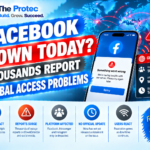







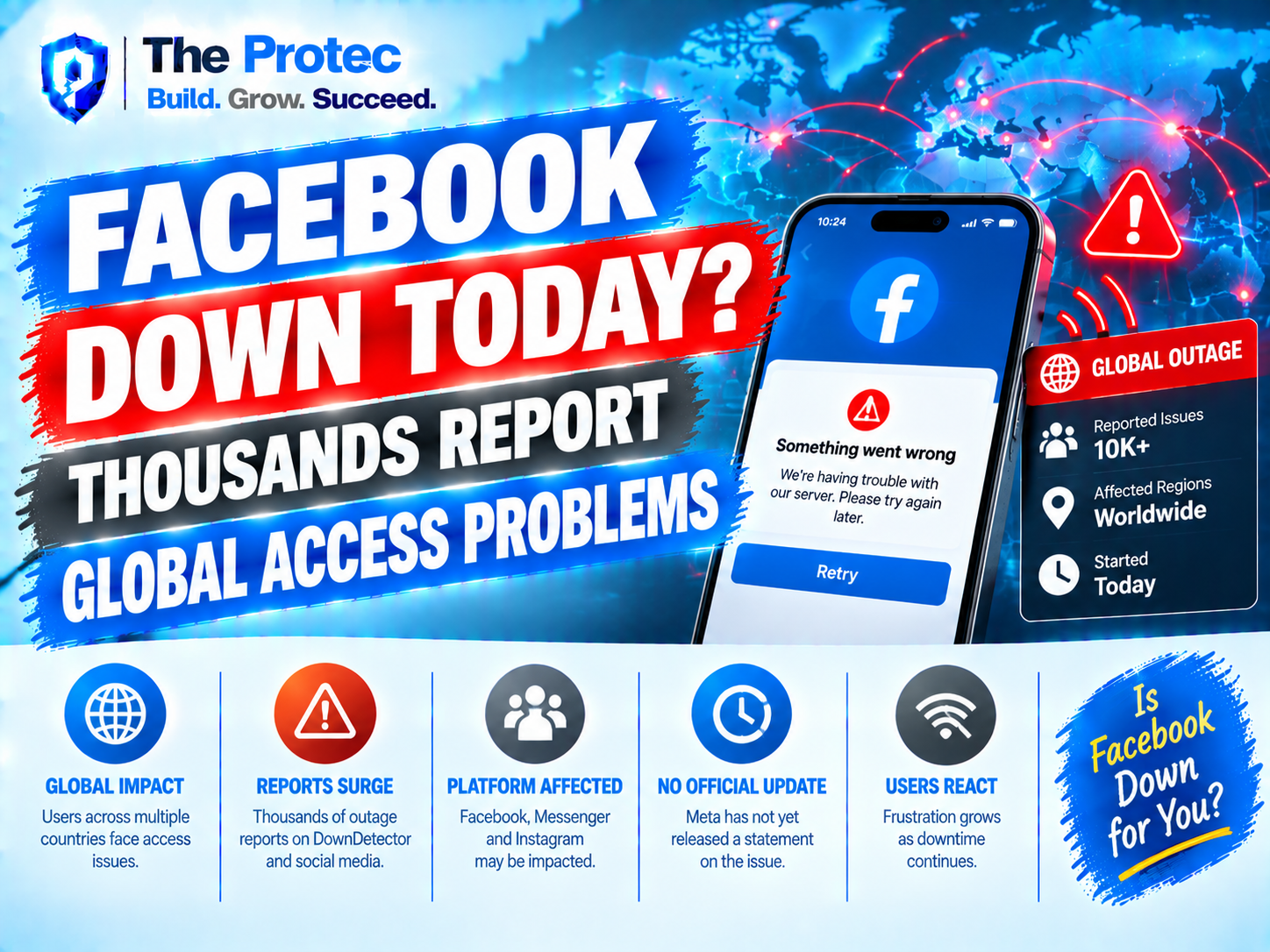
Facebook users across multiple countries reported widespread access and loading problems on September 21, 2026, prompting a surge in searches for “Facebook down today” and “is Facebook down right now.” Thousands of user-submitted outage reports appeared during the disruption, with people describing blank feeds, failed logins, error messages, and content that would not refresh in the Facebook app or on the website.
The sharp increase in reports on Downdetector was the first widely visible indication of a broader Facebook outage. However, Downdetector figures do not represent every affected account. They count reports voluntarily submitted by users, meaning the actual number of people experiencing Facebook access problems may be significantly higher—or the reporting spike may overrepresent users in certain locations.
At the time of writing, the situation remained fast-moving. Some users reported that Facebook had started working again, while others continued to encounter intermittent app, website, and login failures. No universally confirmed explanation for the disruption had been announced, so claims circulating about the cause should be treated as speculation unless Meta provides an official technical update.
Is Facebook Down Right Now?
Facebook experienced a significant service disruption on September 21, with thousands of people reporting that the social network was unavailable, slow, or only partially functional. The reports came from users in multiple countries and affected more than one method of access, indicating that the problem was not limited to a single mobile carrier, device model, or web browser.
Whether Facebook is down right now for a particular user may depend on location, account, platform, and the stage of Meta’s recovery process. Large online services are rarely restored everywhere at exactly the same moment. A service can begin recovering in one region while users elsewhere continue to see errors. Individual Facebook features may also return at different times.
The latest recovery picture is mixed: user reports indicate that access has returned for some people, but intermittent Facebook problems today have continued for others. Without an official all-clear covering Facebook’s consumer services, it is more accurate to describe the platform as recovering unevenly than to declare the outage fully resolved worldwide.
Downdetector Spike Signals a Facebook Outage Today
The disruption became highly visible when reports rose sharply on Facebook’s Downdetector page. Downdetector collects status reports from users and compares current activity with the normal reporting volume for that time of day. A sudden spike can be a useful sign that many people are experiencing the same issue.
It is important to interpret that data correctly. A Downdetector spike is not a direct measurement of Facebook’s infrastructure, and its total is not the total number of affected users. One report may represent a household, workplace, or organization where many people cannot connect. Conversely, social media attention can encourage more people to submit reports during a highly visible incident.
Downdetector is therefore best treated as an early warning signal rather than a definitive technical diagnosis. When a reporting spike appears alongside complaints from different countries, networks, and device types, it strongly suggests a platform-side problem. It does not reveal the underlying cause or provide a guaranteed restoration time.
What Users Experienced While Facebook Was Down
The Facebook outage did not appear identical for everyone. Some users could open the platform but could not load new content, while others were unable to get beyond the login screen. This variation is common during large service incidents because Facebook relies on many interconnected systems for authentication, feeds, media, notifications, pages, groups, and messaging.
Commonly reported Facebook access problems included:
- The Facebook app opening to a blank or partially loaded feed.
- Posts, comments, photos, and videos failing to appear.
- “Something went wrong” or connection-related error messages.
- The news feed refusing to refresh despite a working internet connection.
- Unexpected logout prompts or Facebook login problems.
- The Facebook website loading slowly or not opening at all.
- Pages, groups, and profiles becoming temporarily unavailable.
- Notifications appearing but leading to content that would not load.
- Posts failing to publish or appearing to remain stuck during upload.
Some people reported that Facebook worked in a browser but not in the mobile app, or the reverse. That does not necessarily mean the issue was local. Web and mobile clients can use different delivery paths, cached data, authentication sessions, and application programming interfaces. A partial backend failure can therefore make the Facebook app not work even when portions of the website remain accessible.
Was the Facebook Website Down or Only the App?
Reports covered both major access methods. Users searching for “Facebook website down” described pages timing out, feeds failing to populate, and login attempts that did not complete. At the same time, mobile users said the Facebook app was down or trapped in a loading state.
A disruption affecting the app and website is a stronger indication of a Facebook-side incident than a problem isolated to one device. However, not every user was affected in the same way. Some sessions remained active, and cached posts could still appear even when Facebook’s servers were not delivering fresh content. Seeing an old feed does not necessarily mean the service is operating normally.
Users should also avoid assuming that a repeated login request means their account has been hacked. Authentication failures during an outage can produce unexpected sign-in screens or session errors. Before changing a password, check whether other users are reporting the same behavior. If there are genuine signs of unauthorized activity, account security steps should still be taken once service access is stable.
Is Facebook Messenger Down Too?
Some users reported Facebook Messenger problems during the wider disruption, including delayed conversations, messages that would not send, and chats that failed to load. The impact did not appear uniform, and Messenger remained available for some people even while the main Facebook feed was inaccessible.
Facebook and Messenger share parts of Meta’s account and infrastructure ecosystem, but they are not a single service. A Meta Facebook outage can affect authentication or shared backend systems while leaving portions of Messenger operational. It can also disrupt the Facebook app without causing a complete Messenger outage.
Users can test Messenger separately by opening its standalone app or web interface. A message that remains pending may indicate a Messenger-side issue, but it can also result from the sender’s network connection or the recipient being offline. During a broader Meta outage, repeated resending may create duplicate messages when service resumes.
Were Instagram, WhatsApp, or Other Meta Services Affected?
Facebook’s disruption naturally raised questions about a wider Meta outage. Meta operates Facebook, Instagram, Messenger, WhatsApp, and several business and virtual-reality services. These products share some infrastructure, but an outage affecting one platform does not automatically mean all Meta services are down.
During the September 21 incident, scattered complaints about other Meta products did not by themselves establish a complete, company-wide failure. The clearest concentration of user reports concerned Facebook. Messenger also showed signs of disruption for some users, while the status of other services varied by location and account.
Meta maintains an official status dashboard for a range of business products and developer services. It can provide useful technical context, although it may not reflect every consumer-facing Facebook problem immediately. Users should compare official updates with independent reporting rather than relying on a single source.
What Caused the Meta Facebook Outage?
No confirmed public explanation was available at the time of writing. That distinction matters because major outages quickly generate unsupported claims about cyberattacks, data breaches, server failures, software updates, and internet routing problems. A service disruption alone is not evidence that Facebook was hacked or that user data was exposed.
Large platforms can become unavailable for many reasons, including configuration errors, faulty software deployments, overloaded internal services, database failures, authentication issues, cloud infrastructure problems, or network routing changes. These are general possibilities, not confirmed causes of this Facebook outage.
Only Meta can provide an authoritative root-cause analysis based on its internal monitoring and incident records. Until the company identifies a cause, reports attributing the outage to a specific technical failure or malicious actor should be considered speculation. Users should be especially cautious with viral posts that offer no source or attempt to exploit the disruption with suspicious login links.
How to Check Whether Facebook Is Actually Down
When Facebook is not loading, a few quick checks can help determine whether the problem is global, regional, or limited to a device or connection.
- Check a reputable outage tracker for a sudden increase in Facebook reports.
- Ask someone using a different internet provider whether Facebook loads.
- Switch between Wi-Fi and mobile data to rule out a local network issue.
- Test both the Facebook website and mobile app.
- Try loading another major website to confirm the internet connection works.
- Look for official Meta statements or acknowledgments from trusted sources.
- Check whether only one feature, such as feeds or photos, is unavailable.
If reports are rising across different countries and networks, reinstalling the app is unlikely to solve the immediate problem. Waiting for Meta to restore service is usually the safest response during a confirmed Facebook outage today.
What to Do if Facebook Is Not Working Only for You
If outage reports have returned to normal but Facebook still does not work, the issue may be local. Start with low-risk troubleshooting before deleting data or changing account settings.
Check the connection
Open several unrelated websites or apps. Restart the router if the entire connection is unstable, or temporarily switch between Wi-Fi and cellular data. Workplace, school, and public networks may block Facebook or experience their own DNS and filtering problems.
Restart and update the app
Force-close Facebook, reopen it, and check the device’s app store for an update. Restarting the phone can also clear temporary processes that prevent the app from connecting correctly.
Try a private browser window
If the Facebook website is not loading, test it in a private or incognito window. If that works, stale cookies, cached files, or a browser extension may be interfering with the site. Clear Facebook-specific site data before wiping the entire browser history.
Disable VPNs and filtering tools temporarily
A VPN, private DNS service, ad blocker, firewall, or security extension can occasionally disrupt Facebook requests. Temporarily disabling one tool at a time can identify the conflict. Re-enable security protections after testing.
Avoid repeated password resets
During Facebook login problems, repeatedly changing a password can create additional confusion and may trigger automated security checks. Reset credentials only if the password is genuinely forgotten or there is credible evidence that the account has been compromised.
Facebook Recovery Status and What Happens Next
Recovery from a global-scale platform incident often happens gradually. Meta may restore core login and feed services first, while media uploads, notifications, search, pages, groups, or Messenger continue to experience delays. Users may also see brief failures as traffic returns and systems process queued activity.
The latest user reports suggest that Facebook access has returned for at least some affected users, but continued complaints indicate that recovery has not been perfectly uniform. A successful login or refreshed feed is a positive sign, though it does not confirm full worldwide restoration.
Users should avoid posting the same content repeatedly while service is unstable. Actions that appear to fail can sometimes be processed later, resulting in duplicate posts, comments, or messages. Businesses relying on Facebook should save unpublished text and media locally until platform performance is consistent.
Frequently Asked Questions
Is Facebook down today?
Yes. Thousands of user-submitted reports indicated a significant Facebook outage on September 21, affecting app and website access across multiple countries. Service has returned for some users, while others may still experience intermittent loading or login problems.
Why is Facebook not loading?
During the current incident, widespread reports suggest that many loading failures are related to Facebook’s service rather than individual devices. Meta has not publicly confirmed a specific cause, so claims about a server failure, cyberattack, or software update remain unverified.
Does the Downdetector total show everyone affected?
No. Facebook Downdetector figures count reports voluntarily submitted by users. They are useful for identifying unusual spikes but do not measure the total number of affected accounts or reveal the technical cause.
Is Facebook Messenger down as well?
Messenger problems were reported by some users, including delayed or failed messages, but the impact was not universal. Messenger may continue working even when the main Facebook app or website is unavailable.
Should I reinstall Facebook during the outage?
Usually not. If thousands of users are reporting the same problem, reinstalling the app is unlikely to help and may remove cached data or require a fresh login. Wait for the outage to ease, then troubleshoot locally if the Facebook app is still not working.
Has Facebook confirmed what caused the outage?
No confirmed root cause was available at the time of publication. General explanations circulating online should not be treated as fact unless they are supported by an official Meta statement or credible technical evidence.