






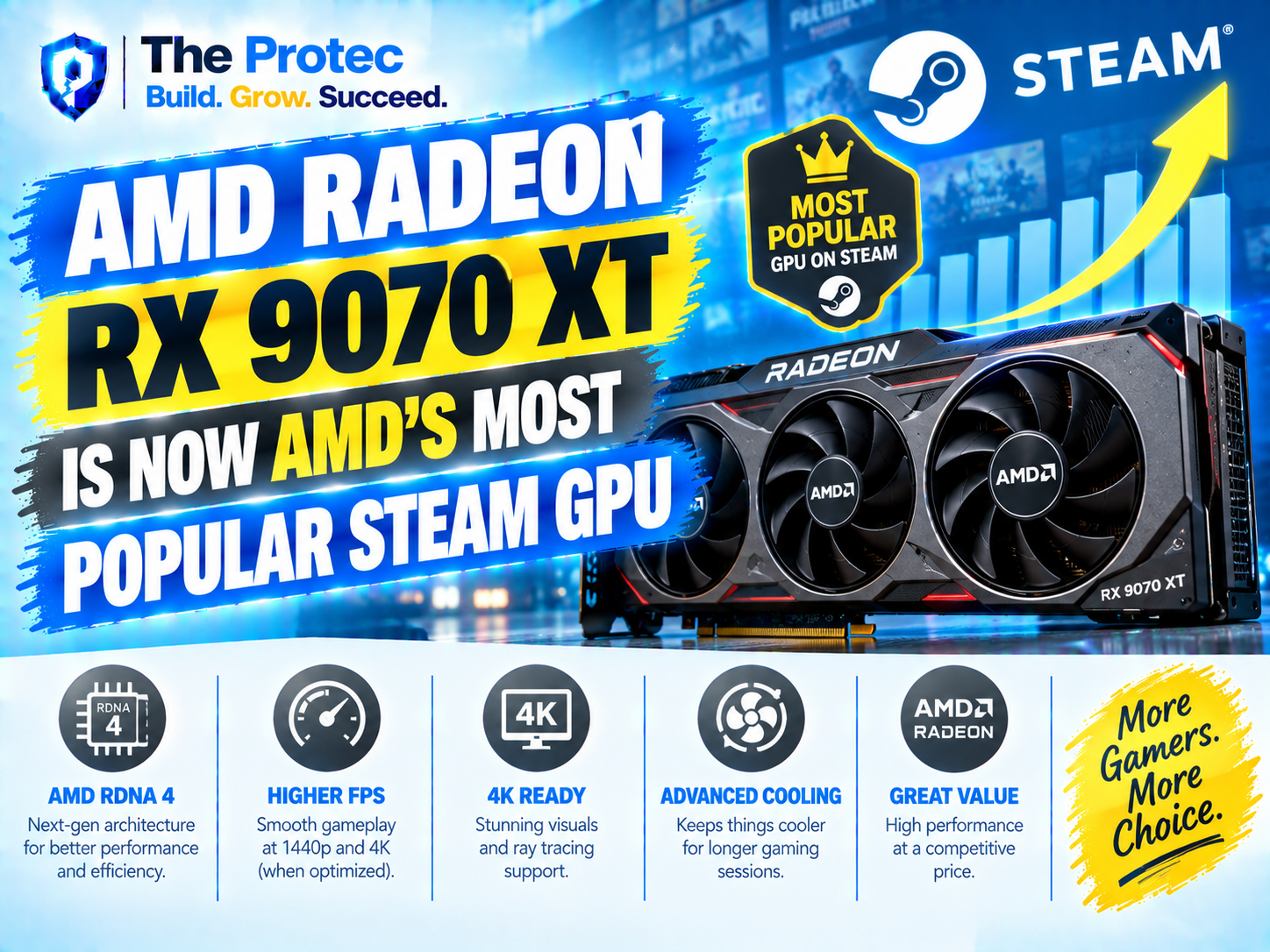
AMD has reached an important milestone in the PC gaming market. According to Valve’s August 2026 Steam Hardware Survey, the AMD Radeon RX 9070 XT is now the most popular individually identified AMD discrete graphics card on Steam. With a 1.46% share, it has moved ahead of the long-standing Radeon RX 6600 and given AMD’s RDNA 4 generation its clearest sign of mainstream visibility yet.
The result is notable because the Radeon RX 9070 XT is not an inexpensive entry-level product. It is a performance-focused AMD gaming GPU competing in a market still dominated by Nvidia GeForce hardware. Its rise suggests that AMD’s latest generation is attracting more enthusiasts, reaching buyers through better availability, and replacing older Radeon cards at a meaningful pace.
However, the milestone needs context. Becoming the most popular AMD GPU on Steam does not make the RX 9070 XT the most popular graphics card overall, nor does it mean AMD has overtaken Nvidia. Instead, it shows that AMD’s current flagship-class gaming option has become the strongest individually named Radeon product within Steam’s sampled installed base.
The headline figure from the August survey is the Radeon RX 9070 XT’s 1.46% share. That puts it ahead of the Radeon RX 6600, an older and much more affordable card that had remained one of AMD’s most visible discrete GPUs on Steam thanks to years of sales, aggressive discounts, and wide availability in budget gaming PCs.
The RX 9070 XT Steam Hardware Survey result is more impressive when viewed against its May position. The card increased from 1.33% in May to 1.46% in August, a gain of 0.13 percentage points. In relative terms, that represents growth of approximately 9.8% across those three months.
- May 2026 share: 1.33%
- August 2026 share: 1.46%
- Increase: 0.13 percentage points
- Relative growth: approximately 9.8%
A fraction of a percentage point may sound small, but Steam has an enormous global user base. Movement at this scale can reflect a substantial number of gaming systems. It is also difficult for a relatively new, higher-priced graphics card to climb quickly because Steam’s installed base includes years of older desktops, gaming laptops, and integrated graphics.
Valve publishes the Steam Hardware and Software Survey monthly, making it one of the most closely watched indicators of hardware adoption among active PC gamers. The August result establishes the RX 9070 XT as AMD’s leading individually identified discrete model in that dataset.
Why AMD RDNA 4 Is Gaining Visibility on Steam
The RX 9070 XT’s popularity reflects more than a single successful graphics card. It indicates that AMD RDNA 4 hardware is gaining enough traction to become visible within a large and diverse gaming population.
Strong Performance in a Competitive Segment
The Radeon RX 9070 XT targets gamers who want high-refresh-rate 1440p performance, capable 4K gaming, and a modern feature set without automatically moving to the most expensive GeForce tiers. That positioning has given AMD an opportunity to attract buyers who compare total gaming performance and memory capacity rather than purchasing solely on brand recognition.
AMD has also improved areas where previous Radeon generations faced criticism. RDNA 4 delivers stronger ray-tracing performance and more competitive upscaling and frame-generation capabilities. Those advances matter because modern PC gaming GPUs are increasingly judged on the complete experience, including image reconstruction, latency, media support, and performance in ray-traced games.
Availability and Sustained Sales Matter
A GPU cannot build Steam GPU market share if gamers cannot buy it. The RX 9070 XT’s continued rise suggests that retail supply has been sufficient to support ongoing adoption rather than only a short launch spike. Stable availability also allows system integrators to include the card in prebuilt gaming PCs, which can broaden its reach beyond enthusiasts who assemble their own systems.
The increase from May through August is especially encouraging for AMD because it points to sustained installations. Launch excitement may create an initial burst of sales, but several months of growth indicate that cards are continuing to enter active Steam systems.
Enthusiasts Upgrade Earlier Than Mainstream Users
The RX 9070 XT sits above mainstream Radeon products such as the Radeon RX 9060 XT. Enthusiasts buying a faster GPU tend to upgrade earlier in a product cycle, so it is reasonable for the higher-performance model to establish survey visibility quickly. The RX 9060 XT may eventually benefit from its more accessible pricing, but lower-cost cards often need more time and sales volume to spread across the installed base.
RX 9070 XT vs RX 6600: A Generational Shift
The RX 9070 XT vs RX 6600 comparison illustrates how the Radeon audience is changing. The Radeon RX 6600 became popular because it offered efficient 1080p gaming at a relatively low price. It also remained on sale for an extended period and received deep discounts as newer generations arrived.
By contrast, the RX 9070 XT serves a more demanding segment. It is designed for higher resolutions, more advanced graphics settings, and modern rendering features. Passing the RX 6600 therefore signals more than routine replacement of one model by another. AMD’s most visible discrete GPU on Steam is shifting from a value-oriented 1080p card to a significantly faster RDNA 4 GPU.
Several factors could be contributing to the RX 6600’s decline relative to the newer card. Owners may be upgrading, aging systems may be used less frequently, and new gaming PCs are less likely to ship with the older GPU. Meanwhile, every newly installed RX 9070 XT adds to the newer model’s share.
Other Radeon generations remain fragmented across multiple products, including desktop and mobile variants. This makes the 1.46% RX 9070 XT market share particularly meaningful: one current AMD Radeon GPU has consolidated enough demand to move above every other specifically identified Radeon discrete card.
How the RX 9070 XT Compares With Nvidia on Steam
The milestone does not change the broader AMD vs Nvidia GPU balance. Nvidia continues to hold a commanding lead across Steam’s overall graphics hardware results. Established GeForce products, including cards in the RTX 3060 and RTX 4060 families, have benefited from large desktop and laptop shipment volumes. Multiple GeForce models individually maintain substantial installed bases.
Nvidia’s strength comes from more than any single GPU. The company has extensive coverage across gaming laptops, prebuilts, enthusiast desktops, and older systems that remain active. Its generations also include numerous desktop, Max-Q, and laptop identifiers, creating a broad presence throughout the survey.
The RX 9070 XT’s 1.46% share should therefore be interpreted as a win within the AMD Radeon Steam ecosystem, not as evidence that Radeon has surpassed GeForce. Nvidia remains the dominant supplier represented in the survey, and AMD needs several successful products—not just one—to make a major change to its overall AMD GPU market share.
Even so, having a current-generation product become the most popular AMD discrete GPU is strategically valuable. It gives Radeon a stronger anchor in comparisons involving the best AMD GPU choices, demonstrates demand for RDNA 4, and can encourage developers to pay closer attention to optimization for newer Radeon hardware.
What This Says About AMD’s Position in PC Gaming
The result suggests that AMD is improving the quality of its active gaming installed base. Previous Radeon survey leaders were often older mainstream products that accumulated users through low prices over several years. The Radeon RX 9070 XT has reached the top of AMD’s individually identified rankings much earlier and from a higher performance class.
That is positive for AMD’s brand perception. Radeon GPU popularity has sometimes depended heavily on discounted last-generation hardware. The latest Steam Hardware Survey shows that gamers are also adopting AMD’s current architecture rather than waiting exclusively for clearance pricing.
There may also be a broader upgrade cycle at work. Demanding games, high-refresh-rate monitors, 1440p displays, and increasingly common ray-tracing effects are giving owners of older GPUs more reasons to upgrade. The RX 9070 XT is well positioned for users who have outgrown cards such as the RX 6600 but do not want to enter the highest-priced portion of the market.
For shoppers searching for the best AMD GPU 2026 options or an AMD gaming GPU 2026 upgrade, Steam adoption provides a useful signal of real-world momentum. It does not prove that one product is right for every buyer, but a growing installed base can support driver feedback, troubleshooting resources, game-specific optimization, and community knowledge.
Important Limitations of the Steam Hardware Survey
Steam’s survey is useful, but it is not a complete GPU sales report. Valve samples participating Steam users, and monthly changes can be affected by sampling, regional participation, gaming café systems, software detection, and the timing of survey invitations.
The data also measures detected systems rather than retail shipments. A graphics card can sell well without appearing immediately if the buyer does not use Steam, is not surveyed, or has not installed the card in an active system. Conversely, older hardware can retain a meaningful share for years even after new retail sales have stopped.
Identification is another complication. Generic categories such as AMD Radeon Graphics may include hardware that is not assigned to a precise retail model. Integrated GPUs, mobile variants, and unusual device identifiers can make direct comparisons less straightforward. That is why the correct description is that the RX 9070 XT is the most popular individually identified AMD discrete GPU—not necessarily the largest AMD graphics category of every kind.
Monthly changes should also be treated as trends rather than exact measurements of worldwide market share. The rise from 1.33% to 1.46% is meaningful because it occurred over multiple survey periods, but future results may still fluctuate.
What to Watch Next for Radeon RX 9070 XT Popularity
The next test is whether the RX 9070 XT can maintain its lead and continue gaining share. Seasonal PC purchases, game launches, pricing changes, and competition from both Radeon and GeForce products could alter the rankings.
The Radeon RX 9060 XT is another model to watch. Its mainstream positioning gives it access to a larger potential audience, although it must accumulate enough sales to overcome the enormous number of older GPUs already in use. If both cards rise, AMD RDNA 4 could establish a broader Steam footprint rather than relying on a single standout product.
For now, the August milestone is a credible success. The AMD Radeon RX 9070 XT has overtaken the RX 6600, increased its share over several months, and become the clearest indicator that RDNA 4 is finding an audience among active PC gamers.
Frequently Asked Questions
Is the RX 9070 XT the most popular GPU on Steam?
No. It is the most popular individually identified AMD discrete GPU in Valve’s August 2026 Steam Hardware Survey. Nvidia still has a much larger overall presence, and several GeForce models have broader installed bases.
The AMD Radeon RX 9070 XT reached a 1.46% share in the August survey. It was at 1.33% in May, meaning it gained 0.13 percentage points, or approximately 9.8% relative to its May share.
Which AMD GPU did the RX 9070 XT overtake?
It moved ahead of the Radeon RX 6600, a popular RDNA 2 card known for affordable 1080p gaming. The change places a newer, higher-performance RDNA 4 product at the top of AMD’s individually identified discrete GPU rankings.
Does the result mean AMD is beating Nvidia?
No. The result is an important AMD milestone, but Nvidia remains dominant in total Steam GPU market share. AMD would need sustained growth across several desktop and mobile Radeon products to significantly narrow the overall gap.