








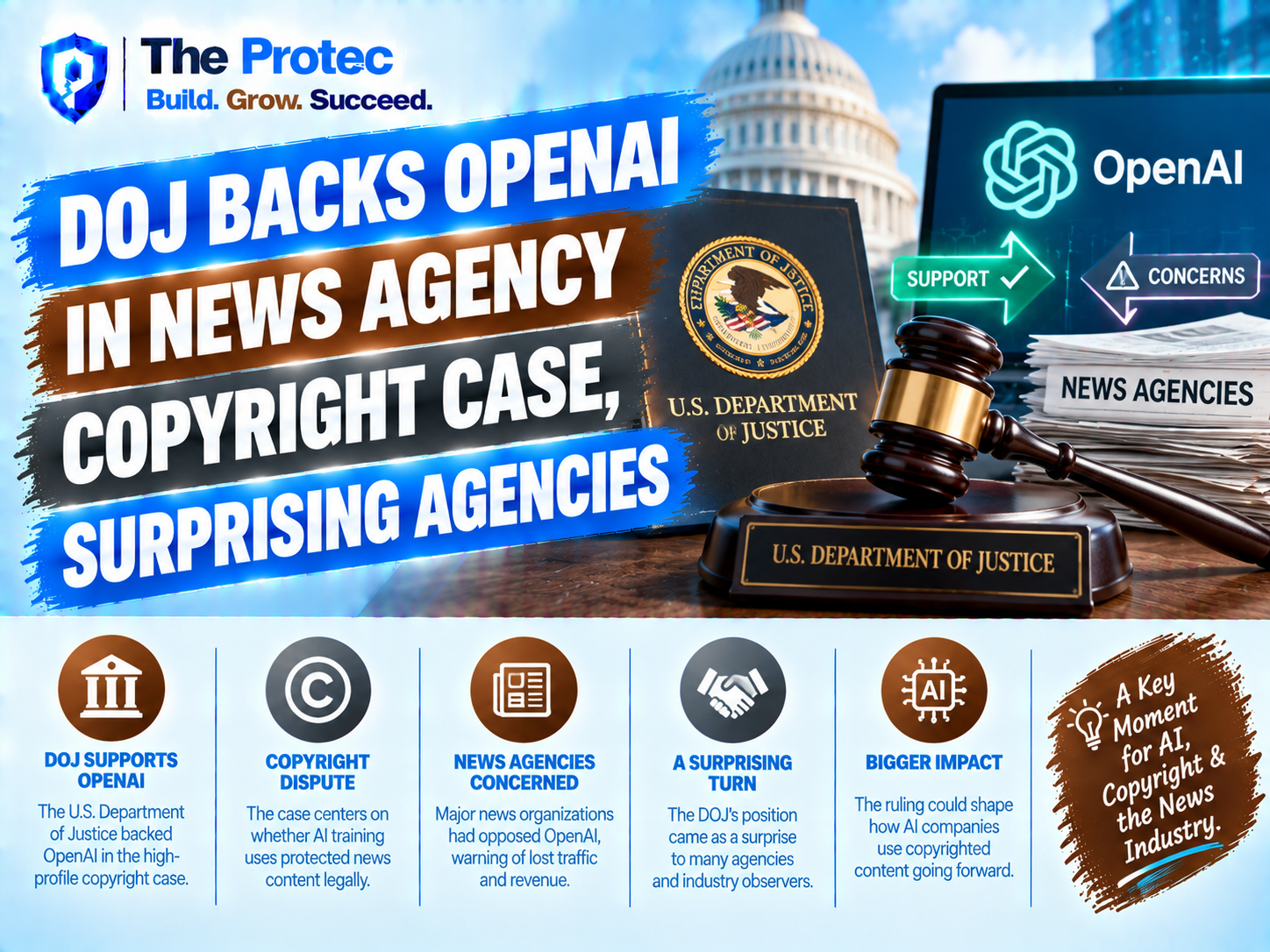
The U.S. Department of Justice has stepped into one of the most consequential disputes over generative AI and copyright. In a September 2026 filing, the DOJ supported important parts of OpenAI and Microsoft’s position in the copyright lawsuit brought by The New York Times, arguing that training artificial intelligence systems on copyrighted material can, under appropriate circumstances, qualify as fair use.
The intervention is significant on its own. What made it especially unusual, however, was reporting that key federal intellectual property institutions—including the U.S. Copyright Office and the U.S. Patent and Trademark Office—were caught off guard by the filing. That reported lack of coordination exposed potential tension inside the federal government over how aggressively the United States should defend AI development when established copyright interests are at stake.
The DOJ OpenAI copyright case filing does not decide the lawsuit, rewrite copyright law, or automatically make AI training lawful. It is a statement of the federal government’s legal and policy position in a pending case. The court must still evaluate the parties’ evidence, the statutory fair-use factors, and disputed questions about how OpenAI’s models were trained and how their outputs affect publishers.
Even with those limitations, the filing could shape the developing relationship between AI and copyright law in the United States. The case presents a fundamental question: When an AI company copies protected works to identify patterns and build a model, is that a transformative computational use, or is it commercial copying that threatens the original publisher’s market?
What the DOJ filed in the OpenAI New York Times lawsuit
The Justice Department submitted a statement of interest supporting OpenAI and Microsoft on central questions raised by The New York Times’ claims. A statement of interest allows the United States to explain its interpretation of federal law and identify government interests that may be affected by a case, even when the government is not a plaintiff or defendant.
The DOJ copyright filing reportedly emphasized that copying protected material during AI training is not automatically infringement. Under U.S. law, copying may be permitted when it constitutes fair use, a context-dependent doctrine that considers the purpose of the use, the nature of the copyrighted work, the amount used, and the effect on the market for the original.
In practical terms, the US Justice Department’s OpenAI position asks the court to examine what the training process does rather than treating the presence of copyrighted training data as the end of the analysis. OpenAI and Microsoft contend that models analyze large collections of material to learn statistical relationships, language structures, and patterns—not to create a conventional archive from which users simply retrieve complete articles.
That argument does not mean every form of AI training is fair use. The legality of a particular system may depend on where the data came from, whether access restrictions were bypassed, how much material was copied, what the model retains, whether safeguards prevent reproduction, and whether outputs substitute for the protected works.
Why the DOJ says AI training can qualify as fair use
The government’s position rests heavily on the idea of transformative use. Courts have previously found that certain large-scale copying activities can be fair when technology uses works for a new analytical or functional purpose. Search indexing, text analysis, and other computational processes have sometimes received favorable fair-use treatment even though they required copying complete works at an intermediate stage.
OpenAI’s legal battle extends that principle into more difficult territory. Generative models do not merely identify where a document can be found. They can produce new text in response to prompts, summarize subjects, imitate formats, and occasionally reproduce passages resembling training material. Those capabilities make the fair-use analysis more complicated than earlier cases involving search or non-expressive data analysis.
The DOJ’s argument is therefore best understood as a position that AI training can be fair use—not that all AI training is categorically protected. The court would still need to consider the following issues:
- Purpose and character: Whether training transforms source material into a system that performs a meaningfully different function, and how the model’s commercial purpose affects the analysis.
- Nature of the works: Whether the training material consists primarily of factual reporting, highly creative expression, or a combination of both.
- Amount copied: Whether copying entire articles was technically necessary for the claimed transformative purpose.
- Market effect: Whether model outputs replace subscriptions, licensing opportunities, article access, or emerging markets for authorized AI training.
Fair use is not determined by a single factor. A court could accept that model training has a transformative purpose while still finding that particular outputs, data-acquisition practices, or market effects weigh against an AI company.
AI leadership enters the national-interest argument
The DOJ also connected the dispute to broader national interests. Advanced AI is increasingly treated as strategically important to economic competitiveness, cybersecurity, scientific research, defense, and geopolitical influence. From that perspective, overly restrictive AI copyright rules could make it harder for American companies to build leading models or compete with developers operating in jurisdictions with different data rules.
This policy argument helps explain why DOJ backs OpenAI and Microsoft on the training question. If obtaining individual licenses for every work in a web-scale dataset were treated as an absolute prerequisite, developers argue that training frontier models could become prohibitively expensive or practically impossible. The largest companies might still negotiate extensive licenses, but startups, universities, and nonprofit researchers could struggle to participate.
National competitiveness, however, is not one of the four statutory fair-use factors. It may provide context for the government’s interpretation, but it does not erase the rights Congress granted to authors and publishers. Critics of the filing argue that industrial policy should not silently replace copyright analysis or require news organizations to subsidize commercial AI development.
That distinction matters. The documented government position is that copyright law should leave room for transformative AI training and that American AI leadership has public consequences. The criticism is that such reasoning may undervalue the economic investment required to produce reliable journalism. Those are competing legal and policy views, not settled facts.
Why the Copyright Office and USPTO were reportedly surprised
The most striking procedural detail was that the U.S. Copyright Office and USPTO were reportedly caught off guard by the DOJ filing. The surprise does not necessarily establish that either institution formally opposes the Justice Department’s position. It does, however, raise questions about interagency consultation on an issue crossing copyright, innovation, competition, and national technology policy.
The institutional roles are different. The Copyright Office, located within the Library of Congress, advises Congress and administers significant parts of the copyright system. It has spent years examining artificial intelligence, authorship, digital replicas, licensing, and the use of protected works in model training. Its official Copyright and Artificial Intelligence initiative reflects a detailed, copyright-focused approach to these questions.
The USPTO, part of the Department of Commerce, addresses patents and trademarks while contributing to administration-wide policy on intellectual property and emerging technology. It also engages with questions involving innovation incentives and the development of AI tools.
If these institutions did not receive meaningful advance notice, the episode suggests that the administration’s litigation strategy may have moved faster than its broader intellectual property coordination. It may also reflect a deeper divide between agencies focused on promoting technological capacity and institutions focused on preserving incentives for human creators.
Being surprised should not be confused with issuing a contrary legal conclusion. Unless an office formally publishes a response, observers should avoid presenting reported frustration or lack of consultation as an official rejection of the DOJ’s position.
What The New York Times argues against OpenAI and Microsoft
The New York Times OpenAI lawsuit presents a sharply different account of the technology. The publisher alleges that OpenAI and Microsoft copied its journalism at enormous scale to develop profitable products without permission or payment. In its view, the defendants used the newspaper’s investment in reporting, editing, verification, and analysis as valuable raw material for competing commercial services.
The Times also argues that generative AI outputs can compete with publishers. A user who receives an article summary, explanation, or detailed answer through an AI assistant may have less reason to visit the original website, subscribe, or interact with the publisher’s advertising. Examples of allegedly memorized or closely reproduced passages are relevant because they challenge the claim that models only learn abstract patterns.
Market substitution could become one of the most important issues in the OpenAI copyright lawsuit. Publishers maintain that the relevant harm is not limited to verbatim reproduction. AI products may satisfy demand for information derived from journalism even when the wording is different. They may also weaken a potential licensing market in which model developers pay for access to trusted archives and current reporting.
OpenAI and Microsoft dispute the characterization that their products function as replacements for The Times. They argue that isolated examples of problematic output do not accurately represent how the systems generally operate and that models create a wide range of new uses rather than republishing a database of articles. The court will need to separate technical evidence from competing descriptions of the same system.
The filing is not a binding ruling
The DOJ’s intervention carries institutional weight, but it is not a judicial decision. The judge is not required to adopt the government’s reasoning, and the statement of interest does not resolve factual disputes. It also does not create a nationwide safe harbor for generative AI copyright practices.
The case remains unresolved. Depending on how it proceeds, the court may address threshold issues, examine evidence about AI training data copyright, evaluate allegedly infringing outputs, or decide that certain questions require a fuller factual record. Any eventual district court decision could also be appealed.
This limitation is particularly important amid headlines suggesting that the government has declared AI training legal. It has not. The DOJ has advocated an interpretation in a specific lawsuit. Binding rules would come from a court’s final decision, legislation enacted by Congress, or potentially regulations within the authority granted to an agency.
Why this AI copyright lawsuit could reshape U.S. rules
The OpenAI Microsoft lawsuit could influence far more than one publisher and two technology companies. Courts across the country are considering claims brought by authors, artists, news organizations, software developers, and other rights holders. Those cases involve different works and technical facts, but many turn on the same unresolved question: how existing copyright principles apply when protected expression is copied for machine learning.
A broad ruling favoring fair use could give AI developers greater confidence to train on lawfully accessible material without negotiating universal licenses. A ruling favoring The Times could encourage licensing, narrower datasets, stronger output controls, and more detailed documentation of training sources. A mixed outcome is also possible—for example, a court might distinguish training from outputs or treat unauthorized acquisition differently from computational analysis.
The dispute may also push Congress to clarify AI copyright law rather than leaving policy to case-by-case litigation. Possible approaches include transparency obligations, collective licensing systems, opt-out mechanisms, provenance standards, or targeted remedies for outputs that reproduce protected expression.
For publishers and AI companies, the immediate lesson is that data governance now carries legal and strategic importance. Documentation of sources, licenses, filtering methods, model behavior, and market impact may be as influential as abstract arguments about innovation.
FAQ: DOJ support for OpenAI in the NYT case
Did the DOJ rule that AI training is fair use?
No. The DOJ filed a statement of interest arguing that the use of copyrighted works for AI training can qualify as fair use. Only the court can rule on the claims before it, and fair use depends on the specific facts.
Why were the Copyright Office and USPTO reportedly caught off guard?
Reporting indicated that the institutions were not adequately informed or consulted before the filing. That is notable because both contribute expertise on intellectual property and innovation policy. Surprise alone does not prove that either office officially disagrees with the DOJ.
What does The New York Times claim OpenAI did wrong?
The Times alleges that OpenAI and Microsoft copied its journalism at scale without authorization, used that material to build commercial products, and created outputs capable of reproducing or substituting for the publisher’s content.
Does national security override copyright law?
No. AI leadership and national competitiveness may inform government policy, but courts must apply copyright statutes and precedent. National-interest arguments do not automatically override creators’ exclusive rights or determine fair use.
What happens next in the OpenAI legal battle?
The court must consider the parties’ legal arguments and factual evidence before issuing rulings. The litigation could produce decisions on training, model outputs, market harm, or other issues, and major rulings may be appealed. Until then, the legal status of many generative AI training practices remains unsettled.
The bottom line
The September DOJ filing gives OpenAI and Microsoft influential government support for the proposition that AI training can be transformative fair use. It also frames leadership in artificial intelligence as a matter of national economic and strategic importance.
At the same time, the reported surprise inside the Copyright Office and USPTO shows that the federal government’s approach to generative AI copyright is not necessarily seamless. The New York Times continues to argue that large-scale copying and market substitution threaten the economic foundation of professional journalism.
No final winner has been declared. The court’s eventual treatment of training, outputs, licensing markets, and publisher harm could determine how far existing copyright doctrine can stretch to accommodate generative AI—and where Congress may need to establish clearer AI copyright rules.