









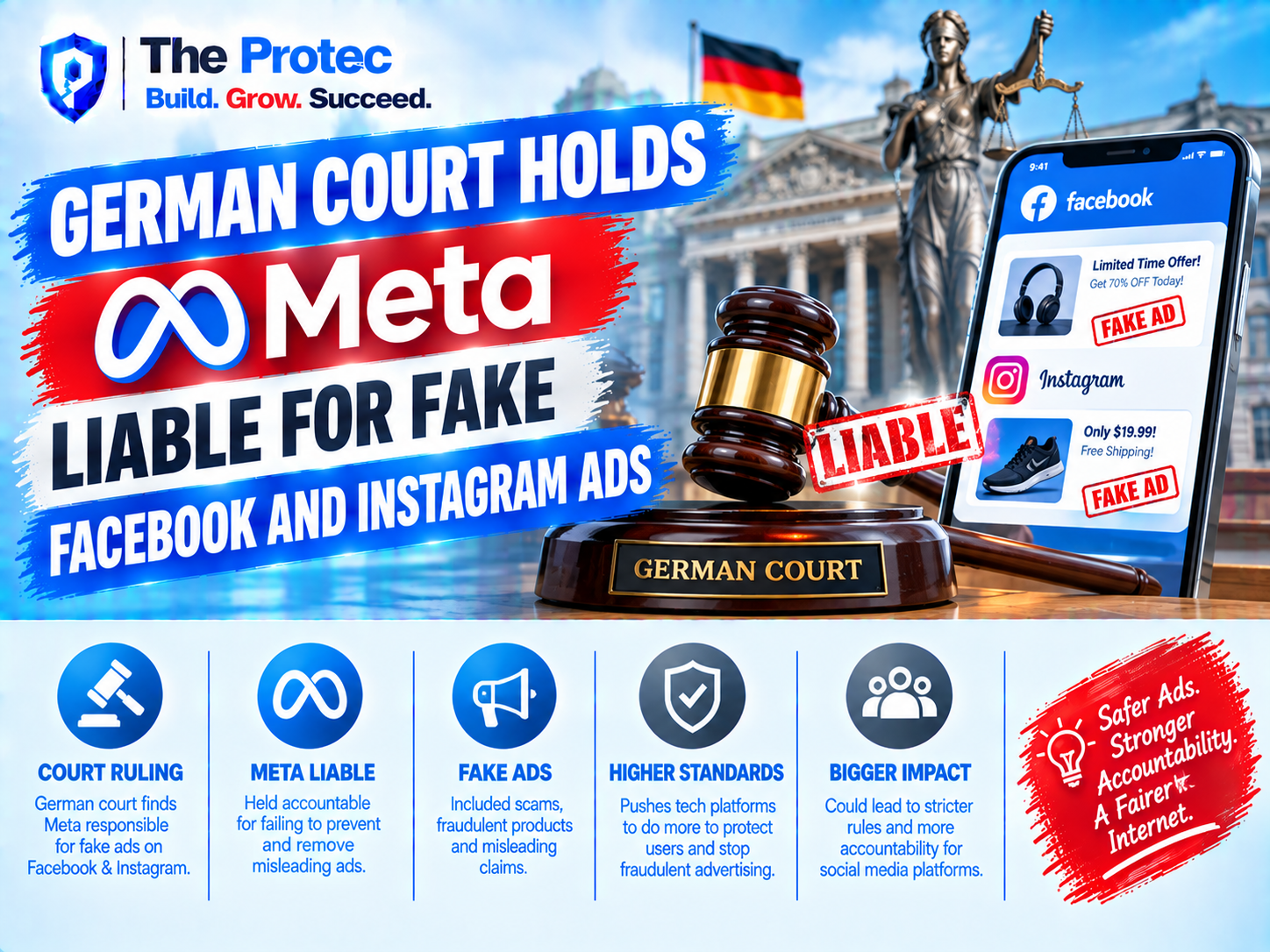
Fraudulent investment offers, fabricated celebrity endorsements and cloned news articles have become familiar features of the online scam economy. Many reach potential victims through paid placements that look like ordinary Facebook or Instagram advertising. A German court has now put greater legal pressure on the company operating those platforms, holding Meta liable in connection with fake advertisements distributed through its services.
The German court Meta ruling matters because it challenges a defense commonly associated with online intermediaries: that the platform merely provides the technical infrastructure while advertisers remain responsible for what they publish. The decision does not make Meta automatically liable for every dishonest advertisement uploaded by a third party. It does, however, reinforce the principle that a platform cannot necessarily remain passive when it has sufficiently specific knowledge of unlawful ads and fails to respond effectively.
That distinction is central to understanding both the documented ruling and its wider significance. The court focused on the circumstances before it, including the misleading nature of the advertising, Meta’s role in distributing it and the response expected after the company became aware of the problem. Broader claims that German courts have imposed universal liability for all social media scam ads would go beyond what the decision establishes.
What the German Court Found About Meta Fake Ads
The disputed material involved advertisements presented to users through Meta’s commercial advertising systems on Facebook and Instagram. The ads used deceptive content and unauthorized associations to make fraudulent offers appear credible. Techniques commonly found in campaigns of this kind include manipulated photographs, invented quotations, false news branding and links to websites designed to collect personal information or persuade victims to transfer money.
The court treated the ads as more than neutral user posts that happened to appear on a social network. They were paid advertisements delivered through systems controlled and monetized by Meta. That commercial context did not by itself make the platform the author of each claim, but it was relevant when assessing Meta’s responsibilities and ability to intervene.
A critical element was knowledge. Once a platform receives a sufficiently clear notification identifying unlawful content, European intermediary protections do not provide unconditional immunity. The court found that Meta could be required to act against identified Meta fake advertisements and, depending on the similarity and circumstances, prevent the same unlawful campaign from simply resurfacing in a minimally altered form.
The ruling therefore concerns Meta’s response to known illegality rather than a finding that Meta created the fraudulent message or participated in the underlying scam. It also reflects a practical concern: removing one URL or one advertisement may accomplish little when scammers can duplicate the creative, change an account name and relaunch the campaign within hours.
The Legal Basis for Holding Meta Responsible
German platform-liability cases sit at the intersection of national civil law and harmonized European digital regulation. Depending on the claim, the relevant national rules can include protections for personality rights, name and image rights, unfair commercial practices, injunctive relief and principles governing responsibility for contributing to an unlawful interference.
At the European level, the Digital Services Act is especially important. Article 6 of the DSA preserves a conditional hosting exemption for services that lack actual knowledge of illegal activity and act expeditiously after obtaining such knowledge. Article 8, meanwhile, confirms that platforms cannot be subjected to a general obligation to monitor everything users transmit or store.
Those provisions must be read together. The absence of a general monitoring duty does not mean a service may ignore a precise, substantiated complaint. Conversely, notice of one illegal advertisement does not automatically establish that a platform knew about every unrelated scam appearing anywhere in its network.
The European Commission’s Digital Services Act overview explains the broader framework, including advertising transparency, notice-and-action mechanisms and risk-management duties for very large online platforms. Meta’s Facebook and Instagram services are subject to those enhanced obligations in the European Union.
The German court Meta ruling can consequently be understood as a notice-and-response decision with a prevention component. Where Meta has concrete knowledge of a clearly unlawful campaign, a court may expect more than the deletion of one isolated instance. Reasonable steps may be required to address equivalent versions, particularly where the same image, fraudulent narrative, destination or impersonated identity is used repeatedly.
Why Facebook and Instagram Appeal to Scam Advertisers
Facebook fake ads and Instagram fake ads are effective because they borrow credibility from familiar surroundings. Users see the same visual format used by established retailers, financial institutions and legitimate creators. A sponsored label indicates that a placement was purchased, but many people understandably interpret the platform’s acceptance of payment as evidence that an advertiser has been checked.
Scammers exploit several features of modern advertising technology:
- Precise audience targeting: Fraudsters can tailor messages to users based on location, age, interests or prior engagement.
- Rapid testing: Multiple headlines, images and landing pages can be tested to identify which combination attracts the most victims.
- Disposable accounts: New advertiser profiles, business pages and payment methods can replace assets disabled by the platform.
- Cross-platform distribution: A campaign can run across Facebook and Instagram through connected advertising tools.
- Synthetic media: Generative AI makes it easier to fabricate celebrity endorsements, fake interviews, cloned voices and convincing financial-news videos.
- Redirect chains: Review systems may see a benign destination while users are later redirected to a fraudulent investment or credential-harvesting site.
This asymmetry is one reason Meta advertising responsibility has become a prominent policy issue. Meta has access to data unavailable to ordinary users, including account relationships, billing patterns, device signals, repeated creative assets and coordinated activity across campaigns. Courts and regulators are increasingly examining whether large platforms make reasonable use of those signals after a threat has been identified.
What the Ruling Does Not Establish
The most important limit is that the ruling is not a declaration that Meta guarantees the truth of every advertisement. It does not transform Facebook or Instagram into the legal publisher of all third-party claims, nor does it abolish the DSA’s hosting protections.
It also should not be read as a general requirement to approve every advertisement manually. European law expressly rejects an unlimited monitoring obligation, and proportionality remains important. Courts must distinguish targeted measures against clearly identified violations from demands that require a service to make open-ended judgments about all future content.
Nor does a German judgment automatically determine how every court across the European Union will resolve different facts. The identity of the claimant, quality of the notice, type of illegality, recurrence of the advertisements and technical feasibility of prevention can all affect the result. Procedural posture matters as well: a first-instance or fact-specific decision may be appealed, narrowed or interpreted differently in later litigation.
Finally, platform liability is separate from the criminal responsibility of the scammers. The people creating false investment sites, impersonating public figures or stealing victims’ money remain responsible for the underlying fraud. A claim against Meta generally examines whether the platform contributed to continuing harm or failed to meet duties triggered by knowledge and control.
How the Meta Legal Ruling Could Change Advertising Practices
Although its formal scope is limited, the ruling creates incentives that extend beyond one campaign. If platforms face injunctions, damages exposure or recurring litigation after receiving notice of fake ads, prevention becomes less expensive than repeated legal disputes.
Meta may respond by strengthening advertiser verification, especially for financial products, cryptocurrency promotions and campaigns using public figures. Verification could include checks on business registration, payment ownership, account history and the relationship between an advertiser and the person featured in an ad.
Creative-matching systems are also likely to become more important. Image hashing, text similarity analysis, destination-domain intelligence and video fingerprinting can detect copies of previously confirmed scams. Effective systems must look beyond exact matches because criminals routinely crop images, add borders, mirror video or change a few words to evade automated enforcement.
Meta already offers public advertising information through the Meta Ad Library. Greater transparency could make that resource more useful by providing clearer advertiser histories, meaningful identity verification and accessible records of removed campaigns. Researchers and affected individuals also need efficient ways to report clusters of related ads rather than submitting a separate complaint for each variation.
Another likely change involves human escalation. Automated review can identify suspicious patterns, but it may miss context such as unauthorized celebrity use or a cloned German news website. Reports involving financial harm, impersonation or deepfake endorsements need prompt review by teams capable of evaluating local language and law.
Broader Implications for Social Media Platform Liability
The decision arrives as European regulators are moving from rulemaking to enforcement. Under the DSA, very large platforms must assess systemic risks, including risks linked to illegal content, consumer protection and manipulative practices. They must also implement proportionate mitigation measures and provide transparency about advertising.
Future claimants may cite the German court Meta ruling when arguing that paid distribution, detailed platform knowledge and ineffective repeat-removal measures justify liability. The strongest cases are likely to involve clear illegality, well-documented notices and near-identical advertisements that continued after Meta had an opportunity to act.
However, the ruling’s persuasive value will depend on the facts. A vague complaint stating that “many ads are scams” does not provide the same knowledge as a report identifying ad creatives, accounts, landing pages and the specific rights being violated. Courts will also consider whether proposed filtering measures are technically realistic and sufficiently targeted.
For Europe’s digital advertising industry, the direction is nevertheless clear: accepting payment for automated distribution does not eliminate the need for meaningful fraud controls. Platforms will be judged not only by whether they publish policies against online advertising fraud, but also by how those policies work when a documented scam repeatedly reaches users.
What Users and Businesses Should Do About Social Media Scam Ads
Users should treat urgency, guaranteed returns and celebrity-backed investment claims as warning signs. Before providing information or transferring money, they should visit the organization’s official website independently rather than relying on an advertising link. Screenshots, advertiser names, URLs, dates and payment records should be preserved if fraud is suspected.
Businesses and public figures targeted by impersonation should send specific notices that explain why the ad is unlawful and identify related versions. A structured record of reports and platform responses can become important if legal action is later necessary.
Legitimate advertisers also have an interest in stronger enforcement. Scam campaigns undermine trust in sponsored content and can increase compliance burdens for entire industries. Better verification may add friction, but it can also protect responsible companies from impersonation and reduce competition from fraudulent offers.
Frequently Asked Questions
Did the German court make Meta liable for every fake advertisement?
No. The decision is fact-specific and does not impose automatic liability for every fraudulent ad. Its significance lies in the conclusion that Meta can be responsible when it has adequate knowledge of unlawful advertising and fails to take appropriate action.
Does Meta have to monitor all Facebook and Instagram ads in advance?
Not as a general rule. The DSA prohibits imposing a universal monitoring obligation. Platforms may nevertheless have targeted duties after receiving a clear notice, including measures addressing materially equivalent copies of an identified illegal advertisement.
Why are paid ads treated differently from ordinary posts?
Paid ads use Meta’s commercial distribution infrastructure, generate revenue and can be targeted through platform tools. That does not automatically make Meta the advertiser, but the commercial relationship and Meta’s control over delivery can be relevant to a court’s assessment.
Could the ruling influence cases outside Germany?
Potentially. The judgment is not automatically binding on courts in other countries, but its reasoning may inform disputes involving the DSA, notice-based knowledge and repeat scam campaigns elsewhere in Europe.
What should someone do after losing money to an Instagram or Facebook scam ad?
The victim should contact their bank or payment provider immediately, preserve the advertisement and transaction evidence, report the account to Meta, and notify the appropriate police or consumer-protection authority. Legal advice may be appropriate where losses are substantial.
A Significant but Carefully Limited Decision
The German ruling marks an important step in the debate over social media platform liability. It recognizes that Meta fake ads are not solely a problem between an anonymous scammer and an individual victim when the campaign is delivered through a sophisticated, revenue-generating advertising system.
At the same time, the decision should be described accurately. It is not blanket liability, a guarantee against fraud or a mandate for universal surveillance. Its core message is narrower: once a platform has concrete knowledge of clearly unlawful advertising, deleting one instance while equivalent versions continue may not be enough. As synthetic media and automated scam campaigns become more convincing, that principle is likely to shape Meta’s advertising practices and future legal challenges throughout Europe.