








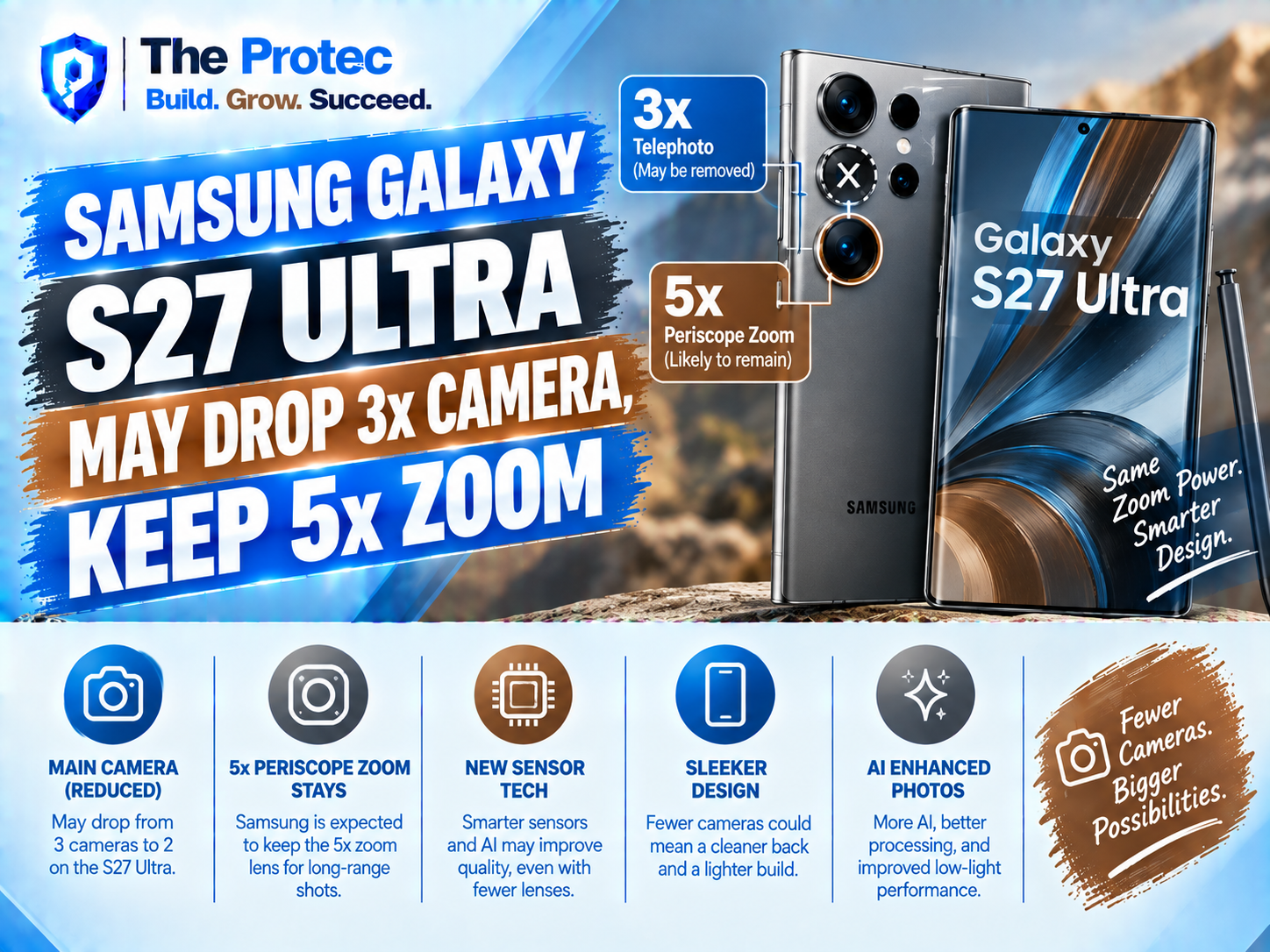
Samsung may be preparing one of its most consequential Ultra camera changes in years. According to early reports circulating as of September 2026, the Samsung Galaxy S27 Ultra could arrive without a dedicated 3x telephoto camera, leaving its longer 5x zoom lens to carry more of the photography workload.
Removing a camera might sound like an obvious downgrade, especially for a device expected to sit at the top of Samsung’s smartphone lineup. The practical outcome, however, would depend on what replaces the missing focal length. A higher-resolution main sensor, more sophisticated multi-frame processing and better image fusion could allow Samsung to cover approximately 3x zoom without a separate lens. Whether that approach can match a true optical telephoto camera in difficult conditions is the more important question.
Nothing about the Galaxy S27 Ultra camera configuration is official yet. The reported redesign should therefore be treated as an early leak rather than a confirmed specification. Even so, it offers a useful look at how Samsung could rethink mobile zoom around fewer but more capable sensors.
Galaxy S27 Ultra Camera Rumors at a Glance
- The Galaxy S27 Ultra 3x camera may be removed from the rear camera system.
- A dedicated Galaxy S27 Ultra 5x zoom camera is reportedly expected to remain.
- The main camera could use high-resolution cropping to cover intermediate zoom levels.
- Portrait photography and indoor 3x images may be the areas most affected by the change.
- Sensor resolution, aperture, sensor size and stabilization details remain unconfirmed.
- The Galaxy S27 Ultra release date has not been announced by Samsung.
How Samsung’s Current Ultra Camera Setup Works
Samsung’s recent Ultra phones divide photography among several fixed-focal-length cameras. The familiar arrangement includes an ultrawide camera, a high-resolution main camera, a short telephoto camera at approximately 3x and a longer telephoto camera around 5x. Samsung’s documented Galaxy S25 Ultra camera system provides a clear example of this multi-camera strategy.
Each lens has a particular role. The main camera handles most everyday scenes, the ultrawide captures expansive views, and the 3x camera fills the gap between standard framing and long-range zoom. At roughly a 70mm-equivalent field of view, 3x is also useful for portraits because it produces tighter framing without requiring the photographer to stand uncomfortably close to the subject.
The 5x telephoto is designed for more distant subjects, travel details, architecture, concerts and compressed landscape compositions. At higher zoom settings, Samsung can combine data from the optical telephoto camera with computational enhancement to extend reach beyond the lens’s native magnification.
If the Samsung S27 Ultra 3x zoom camera disappears, the phone would probably rely on the main sensor from 1x through much of the mid-range before transitioning to the 5x lens. That handoff would make the quality of the main camera and Samsung’s zoom processing more important than ever.
Why Would Samsung Remove the Galaxy S27 Ultra 3x Camera?
Smartphone interiors are intensely space-constrained. Every camera module competes with the battery, cooling hardware, wireless charging components, speakers and other sensors. Removing one telephoto module could create room for a larger main sensor, an upgraded 5x assembly, improved thermal management or a thinner internal design.
Cost and complexity could also influence the decision. Four rear cameras require four sensors, separate optics, calibration and image-processing profiles. If Samsung believes its main camera can deliver convincing 3x results through cropping, keeping a relatively small dedicated sensor may no longer provide enough benefit to justify the space it occupies.
The industry is also moving toward fewer compromises rather than simply more lenses. A large, high-resolution sensor can produce several usable focal lengths, while computational photography can blend information across cameras. The success of that strategy depends on execution, though. A reduced camera count is not automatically an upgrade.
What Losing the 3x Telephoto Could Mean for Photos
Mid-range zoom may become less consistent
The biggest concern is image quality between approximately 2x and 4.9x. A dedicated 3x telephoto captures that view optically across its sensor. Without it, the Samsung Galaxy S27 Ultra would need to crop into the main camera’s image, enhance the result computationally or combine information from multiple lenses.
In bright daylight, the difference could be small. Modern high-resolution sensors capture enough detail for clean crops, especially when the final image is saved at a lower resolution. Fine textures such as hair, foliage and distant lettering are more challenging after sunset, when cropping magnifies noise and reduces the amount of usable light contributing to the image.
Portrait photography could change noticeably
The Galaxy S27 Ultra 3x camera would be particularly relevant to portraits. Short telephoto framing is flattering for faces, keeps the photographer at a comfortable working distance and makes it easier to separate the subject from a busy background.
A 3x crop from the main camera can reproduce a similar field of view and perspective when the photographer stands in the same place. It does not necessarily reproduce the same optical character. A smaller effective capture area can increase noise, while differences in aperture and sensor behavior affect natural background blur. Samsung’s portrait software can simulate stronger separation, but accurate treatment of hair, glasses and transparent objects remains essential.
The retained 5x lens could produce attractive outdoor portraits with stronger background compression. Indoors, however, 5x may feel too tight and require more distance than the room allows. That makes the quality of the main camera’s simulated 3x mode critical.
Video transitions may require extra refinement
Video exposes camera handoffs more clearly than still photography. Changes in color, exposure, sharpness or stabilization can become visible when zooming from the main camera to a telephoto lens. Eliminating the 3x module would reduce the number of physical transitions, but it would also leave a wider digital range before the 5x camera takes over.
Samsung would need stable high-resolution readout, effective noise reduction and smooth lens switching to prevent mid-range footage from looking softer than clips recorded at 1x or 5x.
Could a High-Resolution Main Camera Replace 3x Optical Zoom?
In theory, a sufficiently detailed main sensor can provide a strong 3x crop. A 3x crop uses roughly one-ninth of the sensor’s total area because the image is cropped by a factor of three along both dimensions. On a 200-megapixel sensor, that region could contain around 22 megapixels before processing and other limitations are considered.
That calculation helps explain why the rumored Galaxy S27 Ultra camera changes may be technically realistic. Resolution alone, however, does not guarantee a sharp image. Lens resolving power, focus accuracy, sensor noise, motion, lighting and the image pipeline all determine how much meaningful detail survives.
Samsung could improve the result through several methods:
- In-sensor zoom: Reading a central portion of the main sensor can provide a tighter view without simply enlarging a completed low-resolution photo.
- Multi-frame processing: Combining several exposures can recover detail, control highlights and reduce noise.
- Cross-camera fusion: Information from the 5x camera may help refine central details at some intermediate zoom levels when alignment and lighting permit.
- Subject-aware sharpening: Processing can treat faces, text, foliage and other textures differently instead of applying uniform sharpening.
- Improved motion handling: Faster capture and alignment could prevent moving subjects from producing blur or fusion artifacts.
These techniques could make a main-camera crop competitive in good light. A dedicated telephoto still has an optical advantage because it directs its available pixels and lens design toward the narrower field of view. Low-light performance will likely be the decisive test if the rumor proves accurate.
What to Expect From the Galaxy S27 Ultra 5x Zoom
The encouraging part of the leak is that the Galaxy S27 Ultra 5x zoom reportedly remains part of the design. That would preserve a genuine long-telephoto option rather than forcing the main camera to cover the entire zoom range digitally.
A 5x module is typically well suited to distant details, wildlife in good light, stage photography and telephoto landscapes. It can also serve as the optical foundation for higher zoom levels, although quality will inevitably decline as digital magnification increases.
Reports about the Samsung S27 Ultra 5x zoom do not yet establish whether the hardware will be unchanged or upgraded. There is no dependable consensus on its sensor resolution, physical size, aperture, folded-lens design or focusing system. Retaining a 5x camera therefore should not be interpreted as confirmation that Samsung will reuse a specific existing sensor.
If the 3x camera is removed, Samsung could redirect space or cost toward a larger 5x sensor, brighter optics or better stabilization. Those improvements would help long-range photography, but they would not fully solve the gap below 5x. A fixed 5x lens cannot optically zoom backward to 3x; intermediate framing would still depend mainly on the primary camera and software.
Would Fewer Cameras Make the Galaxy S27 Ultra Worse?
Not necessarily. Camera count is a poor measure of overall image quality. Three excellent cameras with large sensors and carefully tuned processing can outperform four cameras when one module uses a small sensor or weak optics.
The real issue is coverage. The current short telephoto gives Samsung a dedicated tool for an extremely practical focal length. Removing it makes sense only if the replacement delivers comparable detail, color and motion performance under more than ideal daylight conditions.
A successful redesign could produce smoother zoom behavior, free space for better hardware and eliminate quality inconsistencies associated with a smaller 3x sensor. An unsuccessful redesign could leave users with softer indoor portraits and an obvious quality dip between the main and 5x cameras. Side-by-side testing will matter far more than the number of circles on the back of the phone.
Galaxy S27 Ultra Specs and Release Date Remain Unconfirmed
As of September 2026, Samsung has not officially revealed the Galaxy S27 Ultra specs, camera layout or launch schedule. Based on the company’s established Galaxy S release pattern, an announcement in the early part of the following calendar year would be a reasonable expectation, but it is not a confirmed Galaxy S27 Ultra release date.
Early Samsung phone camera rumors can change as prototypes are evaluated. Different test devices may use different sensors, and a camera omitted from one engineering sample could return before mass production. Supply considerations and final image-quality testing may also alter the plan.
For now, the most credible conclusion is limited: reports point to the possible removal of the dedicated 3x telephoto while the 5x camera survives. Claims about exact megapixel counts, apertures or revolutionary zoom performance should be viewed cautiously until Samsung announces the device.
The Bottom Line
The rumored Samsung Galaxy S27 Ultra camera redesign represents a calculated trade-off. Dropping the 3x lens could simplify the system and create room for more important upgrades, while a high-resolution main camera may cover short telephoto framing surprisingly well. Retaining 5x optical zoom would preserve the Ultra line’s long-range identity.
Still, 3x is one of the most useful smartphone focal lengths, particularly for people, pets and everyday detail shots. Samsung will need more than aggressive sharpening to replace it. If the final phone offers clean low-light crops, natural portraits and seamless transitions to the 5x lens, fewer cameras may not feel like a loss. Until official specifications and real-world samples arrive, the reported change remains one of the most important Galaxy S27 Ultra leaks to watch.
Frequently Asked Questions
Will the Samsung Galaxy S27 Ultra have a 3x camera?
Early reports suggest the Galaxy S27 Ultra may remove its dedicated 3x telephoto camera. Samsung has not confirmed this change, and the final retail hardware could differ from current leaks.
Is Samsung removing the 5x zoom camera as well?
No, the current rumor specifically indicates that the Galaxy S27 Ultra 5x zoom camera may remain. Its sensor, aperture and other hardware details have not been reliably established.
Can the main camera produce optical-quality 3x photos?
A high-resolution main sensor can create detailed 3x crops, particularly in bright conditions. It may struggle to equal a dedicated telephoto camera in low light or with moving subjects because cropping uses a smaller effective sensor area.
When is the Galaxy S27 Ultra release date?
Samsung has not announced a release date. The company’s usual launch cadence suggests an early-year unveiling is possible, but that timing remains an expectation rather than official information.
Would removing the 3x camera reduce portrait quality?
It could affect indoor and low-light portraits if Samsung relies entirely on main-camera cropping. Strong image processing, accurate depth mapping and a high-quality main sensor could minimize the difference, while the 5x camera may remain useful for tighter outdoor portraits.