







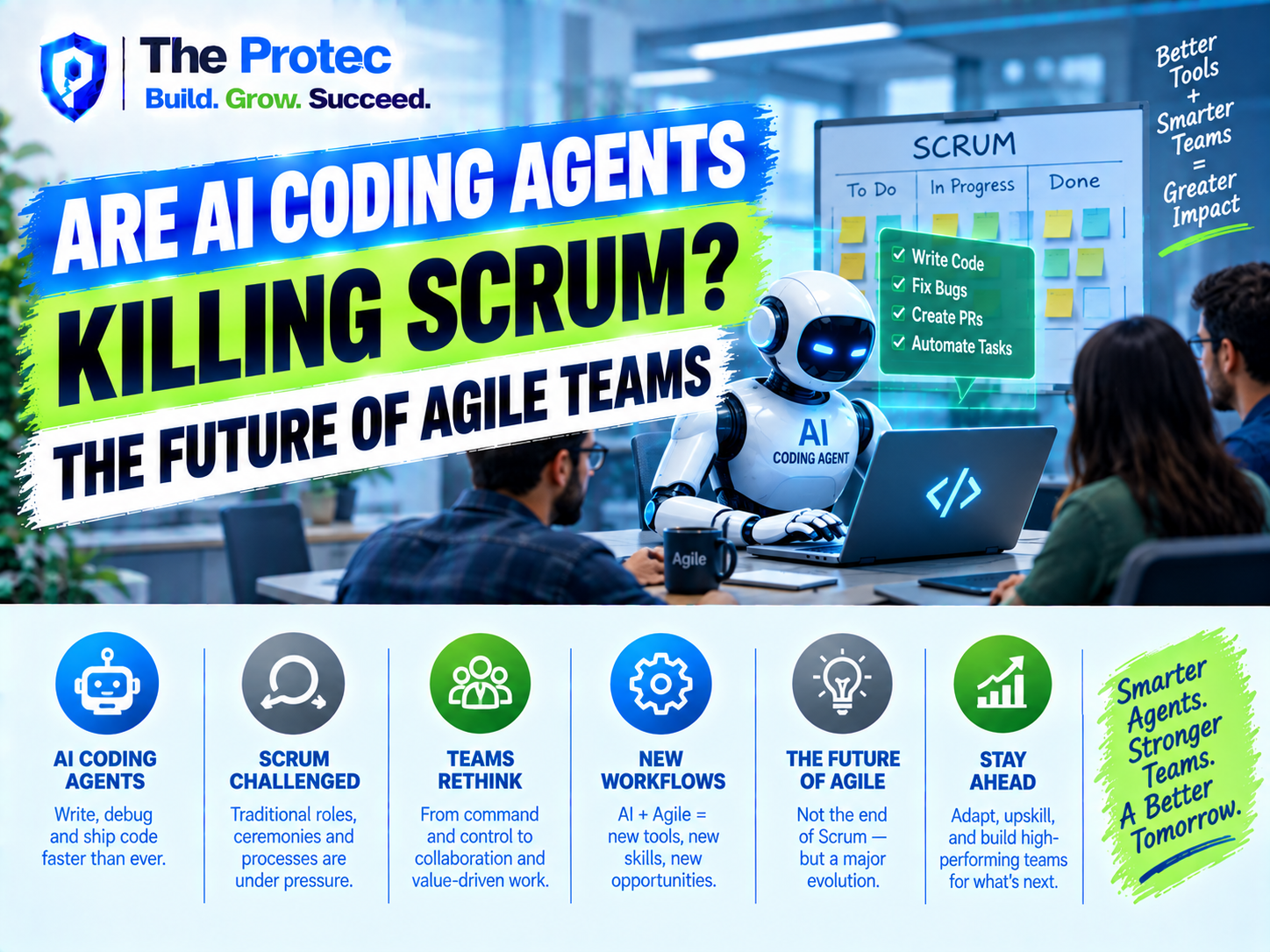
Scrum was designed for a world in which software work moved at human speed. Teams refined a backlog, selected a realistic amount of work, spent a sprint building it, and reviewed the result. That rhythm created focus and made uncertainty manageable.
AI coding agents are disrupting that rhythm. Modern coding agents can inspect repositories, implement features, write tests, diagnose failures, update documentation, and open pull requests. Some can complete multi-step development tasks in isolated environments while developers supervise several workstreams. A ticket that once occupied much of a sprint may now produce a reviewable implementation within hours.
This acceleration raises an uncomfortable question: Are AI coding agents killing Scrum?
Not exactly. They are exposing which parts of Scrum deliver genuine coordination and which parts became administrative habits. Sprint planning, estimation, daily standups, backlog management, code review, and testing are not disappearing, but their purpose and timing are changing. The emerging future of Scrum is less about managing developer activity and more about governing a fast, partially autonomous software delivery system.
Why AI Coding Agents Challenge Traditional Scrum
Traditional Agile software development assumes that implementation capacity is limited, relatively stable, and mostly human. A team estimates work, protects a sprint commitment, and measures progress over a fixed period. AI coding agents weaken each of those assumptions.
Agent capacity can expand by running tasks in parallel. Implementation speed varies dramatically depending on repository quality, available context, task clarity, and verification requirements. An agent may generate thousands of lines of code quickly, yet a human could spend longer validating architectural fit, security, and behavior. Coding is no longer always the dominant constraint.
This changes the economics of a sprint. If implementation takes one hour but clarification, review, testing, and deployment take three days, adding more tickets or agents does not improve delivery. It merely creates a larger queue of unreviewed work.
AI coding agents Scrum workflows must therefore optimize the complete value stream, not the volume of generated code.
Traditional Scrum vs. AI-Native Software Development
In a conventional Scrum workflow, a product owner prioritizes stories, developers select work during sprint planning, and the team progresses sequentially from implementation to testing and review. Capacity is often represented through story points or historical velocity.
AI-native software development looks different. Teams define outcomes and constraints, break work into agent-compatible tasks, dispatch multiple coding agents, and evaluate proposed changes through automated checks and human review. Planning and execution can overlap because agents continuously return results, questions, and failed attempts.
The contrast is not simply Scrum vs AI. Scrum is a coordination framework, while AI is a new form of production capacity. The tension appears when teams preserve ticket-heavy processes designed for slow implementation even though coding agent workflows operate continuously.
- Traditional Scrum batches decisions around sprint ceremonies; AI engineering workflows increasingly make decisions as evidence arrives.
- Traditional estimation predicts human effort; AI Agile development must also estimate ambiguity, review risk, and verification cost.
- Traditional velocity counts completed work; AI engineering teams need to measure outcomes, stability, and time to validated change.
- Traditional assignments match tickets to developers; AI-native teams match tasks to humans, agents, or a supervised combination.
The result may still be Scrum, but it is Scrum with shorter feedback loops and fewer assumptions about how implementation happens.
How Sprint Planning Changes with AI Coding Agents
Sprint planning remains useful when teams need a shared goal, coordinated dependencies, or a predictable review cadence. What changes is the level at which planning occurs.
Instead of filling a sprint with implementation tickets, teams can plan around customer outcomes, technical risks, and validated increments. The key questions become: What result are we trying to produce? What evidence will prove it works? Which constraints must an agent respect? Where is human judgment mandatory?
An effective agent-ready story needs more than a short user-story sentence. Coding agents perform better with acceptance criteria, relevant repository paths, architectural boundaries, testing expectations, examples, and explicit exclusions. This makes specification quality a central engineering skill.
Teams may also separate work into two planning horizons. Outcome planning can remain sprint-based, while task dispatch becomes continuous. Agents can pick up implementation, test generation, documentation, dependency upgrades, and defect investigation whenever capacity and context are available.
Backlog Management Becomes Context Management
AI coding agents can reduce the cost of implementation, but they do not automatically identify the right problem. A large backlog of vaguely written tickets may become even less useful because agents can generate low-value changes faster than stakeholders can evaluate them.
Backlog management is therefore shifting from maintaining an inventory of tasks to maintaining decision-ready context. Product owners and engineers need to clarify desired behavior, business priority, dependencies, nonfunctional requirements, and validation criteria.
Smaller, more dynamic backlogs may outperform carefully estimated queues. Teams can keep strategic opportunities visible while preparing detailed context only for work approaching execution. This avoids spending human time refining items that may never be built.
AI can assist with deduplication, impact analysis, acceptance criteria, and decomposition, but prioritization remains a business decision. The ability to build more does not remove the need to decide what should not be built.
Story Points and Estimation May Lose Influence
Story points were never intended to measure productivity, yet many organizations use them that way. AI developer productivity makes this practice even less reliable. The same task may take an agent minutes in a well-structured codebase and days in a legacy system with hidden dependencies and weak tests.
Teams may replace detailed point estimates with risk categories, confidence ranges, or forecasts based on cycle-time data. Useful dimensions include requirement ambiguity, architectural impact, security sensitivity, test coverage, and expected review effort.
Estimation does not vanish because stakeholders still need forecasts. However, estimating the cost of typing code matters less than estimating the path to a trusted production outcome. Flow metrics and probabilistic forecasts can become more informative than velocity, especially when agent performance changes frequently.
Do AI Engineering Teams Still Need Daily Standups?
A daily standup that asks each developer to recite yesterday’s activity offers little value when coding agents create and update work continuously. Agent dashboards, pull requests, test results, and issue histories can provide status automatically.
The meeting remains useful when it focuses on decisions and coordination. Teams should discuss blocked agents, unclear requirements, conflicting changes, overloaded reviewers, emerging risks, and discoveries that affect the sprint goal.
Some AI engineering teams may move toward asynchronous status summaries generated from development systems, reserving live conversations for exceptions. This preserves visibility without forcing developers to narrate information already captured by tools.
Code Review and Testing Become the New Bottlenecks
AI coding can create convincing implementations that compile and pass basic tests while still violating product expectations or architectural principles. As generation becomes cheaper, verification becomes more valuable.
Code review must evolve beyond checking syntax and style. Reviewers need to evaluate intent, system boundaries, security, maintainability, observability, data handling, and whether generated tests prove meaningful behavior. Large agent-produced pull requests should be avoided because review quality declines as change size grows.
AI software development also increases the importance of automated quality gates. Strong workflows may include unit and integration tests, static analysis, dependency scanning, secret detection, policy checks, performance tests, and isolated preview environments. Agents can generate and run many of these checks, but teams must design the evaluation system.
The coding agent workflow should treat tests as part of the task specification rather than cleanup after implementation. For high-risk changes, independent verification by another model or agent can provide an additional signal, but it should not replace accountable human approval.
Organizations can use research from the DORA program to keep attention on delivery performance and reliability rather than raw code output.
Developer Collaboration Shifts from Production to Orchestration
AI engineering teams do not eliminate collaboration. They create new reasons to collaborate. Developers must agree on architectural guardrails, reusable instructions, repository conventions, evaluation criteria, and escalation paths for agent failures.
Senior engineers may spend more time decomposing complex work, supervising parallel changes, reviewing decisions, and improving the environment in which agents operate. Junior developers can gain leverage from agents, but they still need enough system knowledge to recognize incorrect output. Without deliberate mentoring, teams risk producing developers who can prompt tools but cannot diagnose failures.
Product managers, designers, security specialists, and engineers may collaborate earlier because implementation is no longer the longest phase. Fast prototypes can turn abstract conversations into testable software, allowing stakeholders to refine requirements using working evidence.
The strongest AI engineering workflow is not a collection of isolated people delegating tickets to bots. It is a shared human-agent system with visible decisions and clear ownership.
How Teams Should Measure AI Developer Productivity
Lines of code, agent task counts, and pull-request volume are poor measures. They reward output even when that output increases complexity or review burden.
Better measures connect AI software engineering to delivered value:
- Time from approved idea to validated production change
- Lead time and cycle time, including review queues
- Deployment frequency and change failure rate
- Escaped defects, security findings, and rollback frequency
- Time spent clarifying, reviewing, and correcting agent output
- Customer adoption and measurable business outcomes
- Developer cognitive load and satisfaction
Teams should compare the entire system before and after adopting coding agents. Faster implementation accompanied by slower review and more defects is not a productivity gain.
What Remains Essential in the Future of Scrum
The Scrum Guide centers Scrum on transparency, inspection, adaptation, and a valuable product increment. Those principles remain relevant when AI performs part of the development work.
Teams still need a clear product goal, an ordered set of opportunities, shared quality standards, and frequent feedback from users. Retrospectives may become more important because AI engineering practices are changing rapidly. Teams must inspect where agents succeed, where they create hidden work, and which controls need improvement.
Scrum’s future depends on separating its core principles from rigid implementations. Two-week sprints, story points, exhaustive ticket hierarchies, and status-driven ceremonies are common practices, not immutable laws. Teams can retain empirical product development while changing the mechanics.
A Practical Path Toward AI Agile Development
Teams should not replace their software development methodology overnight. Begin with bounded, reversible tasks such as test creation, documentation updates, small bug fixes, refactoring, and dependency maintenance.
- Define which repositories and data agents may access.
- Create task templates with context, constraints, and acceptance criteria.
- Require small changes and automated checks before review.
- Track review time, rework, defects, and end-to-end cycle time.
- Keep human approval for sensitive or high-impact changes.
- Review ceremonies regularly and remove those that no longer support decisions.
As trust grows, teams can let agents handle broader multi-step tasks. The goal is not maximum autonomy. It is dependable delivery with the appropriate level of human control.
FAQ: AI Coding Agents and Scrum
Are AI coding agents making Scrum obsolete?
No. Coding agents challenge sprint batching, task estimation, and status ceremonies, but Scrum’s focus on goals, feedback, transparency, and adaptation remains useful. Teams may operate Scrum more continuously and with fewer administrative practices.
Can coding agents complete an entire sprint backlog?
They may implement many well-defined items, but completion also requires product validation, integration, security review, testing, and stakeholder acceptance. Generating code is only one part of delivering a trusted increment.
Should teams stop using story points?
Not automatically. If points help forecasting and conversation, they can remain. If agent variability makes them misleading, teams can use cycle-time data, risk categories, and confidence ranges instead.
What is the biggest risk of AI coding agents Agile teams should address?
The biggest risk is accelerating unvalidated work. Without clear specifications, quality gates, and ownership, agents can create review overload, security issues, duplicated logic, and technical debt faster than teams can detect them.
Scrum Is Not Dead, but Passive Scrum Might Be
AI coding agents are not killing Scrum. They are forcing software teams to reconsider practices built around scarce implementation capacity and slow feedback. Ticket volume, velocity, and ceremony attendance matter less when agents can produce code continuously.
The teams that benefit most will preserve disciplined product thinking while redesigning execution around rapid generation, strong verification, and human accountability. Scrum can remain part of that system, but only if it adapts. The future of Scrum is not humans competing with AI. It is teams using AI to shorten the distance between a valuable idea and reliable software.