







A submarine is designed to disappear. Beneath the surface, there may be no radar return, exhaust plume or visible wake to follow. What remains is sound: a faint mixture of propeller tones, machinery vibration, water flow and intermittent activity hidden inside an ocean full of waves, ships, marine animals and geological noise.
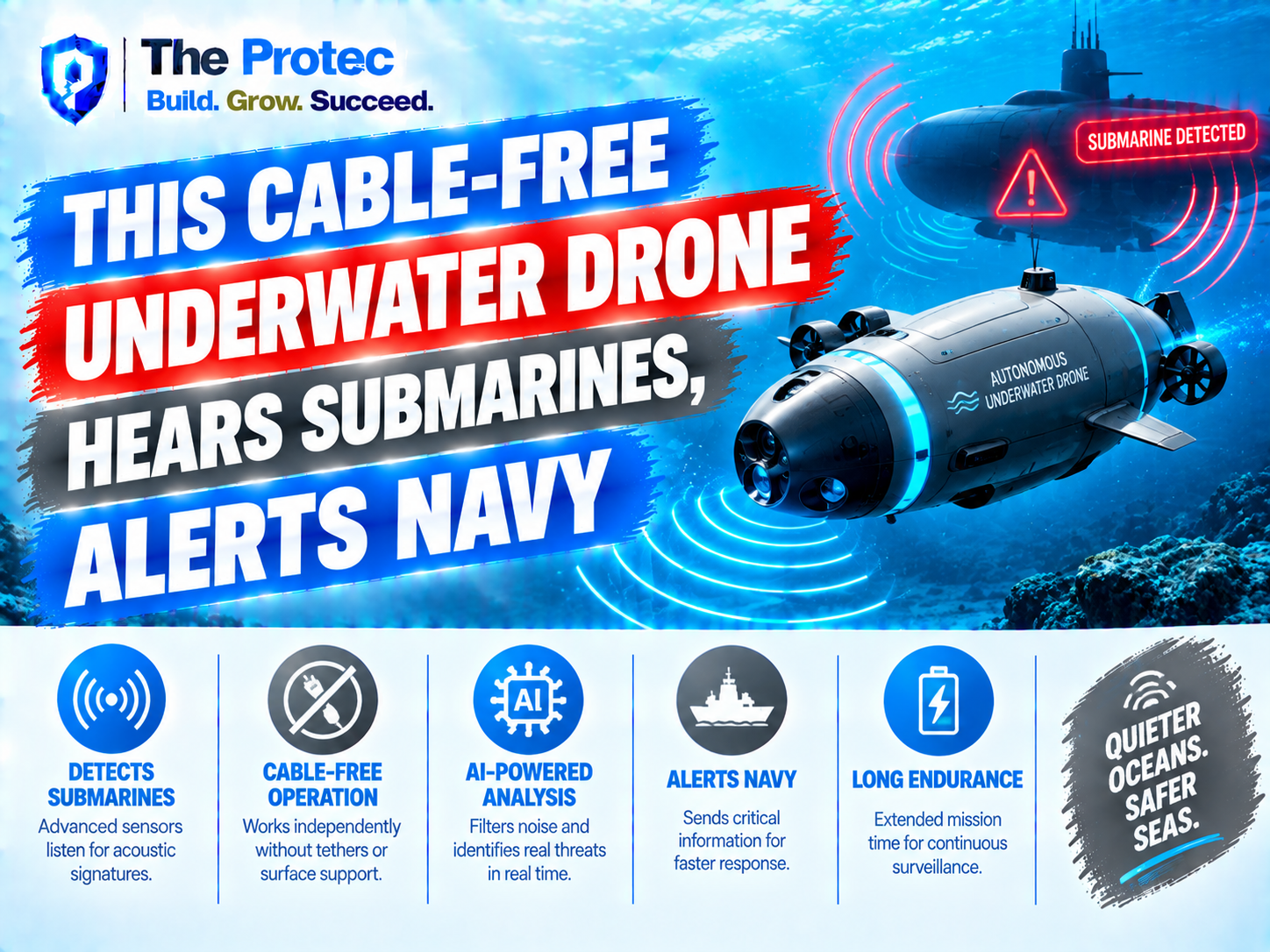
A new generation of cable-free underwater drone technology is being developed to find meaning in that acoustic clutter. Instead of streaming raw sonar data through a tether, an autonomous underwater vehicle can listen with onboard sensors, process the signal locally, classify possible submarine activity and transmit a compact alert through an available communications gateway.
The phrase “alerts the Navy in seconds” needs context. Rapid warning is technically possible after a high-confidence detection if the vehicle has immediate access to a surfaced antenna, buoy, nearby relay or acoustic communications network. It does not mean ordinary radio travels efficiently from deep water to a distant command center. The breakthrough is the combination of underwater acoustic detection, edge computing and autonomous communication—not a single magical sensor.
What Makes This Underwater Drone Different?
Traditional anti-submarine warfare relies on crewed ships, aircraft, fixed hydrophone arrays, sonobuoys and submarines. Those assets remain essential, but they can be expensive, geographically limited or risky to operate in contested waters. An underwater surveillance drone adds a persistent, distributed layer that can patrol or wait quietly without a physical cable connecting it to a ship.
A typical cable-free underwater drone may carry a hydrophone array, navigation sensors, onboard computing, secure data storage and one or more communication systems. Depending on its mission, it can follow a programmed route, drift with currents, glide through the water column or remain near a designated monitoring area.
“Cable-free” refers primarily to operation and data handling. The vehicle does not need a tether for power, control or continuous data transmission. It must instead manage finite battery capacity, make decisions locally and choose when and how to communicate.
Why Hearing Submarines Underwater Is So Difficult
Sound travels much farther through seawater than light or conventional radio, making acoustics the foundation of submarine detection technology. Yet the underwater soundscape is highly variable. Temperature, salinity and pressure change the speed and path of sound. Layers in the ocean can bend acoustic energy, create shadow zones or carry it over great distances.
Background noise is another challenge. Commercial vessels generate powerful low-frequency sound. Rain, wind and breaking waves alter ambient conditions. Whales, dolphins and snapping shrimp produce biological signals, while seismic activity and offshore construction add more interference. The National Ocean Service explains how sound moves through the ocean and why marine conditions strongly affect what a receiver can hear.
A submarine is not represented by one universal sound. Its acoustic signature changes with speed, depth, machinery state, propulsion design and surrounding conditions. Modern submarines are also engineered to suppress vibration and minimize cavitation. An underwater drone detects submarines only when sensor performance, geometry, environmental conditions and signal-processing quality make the target distinguishable from noise.
How Underwater Acoustic Detection Works
An autonomous underwater vehicle can use passive sonar, active sonar or a combination of both. Passive sonar listens without transmitting. Hydrophones convert pressure variations into electrical signals, allowing software to examine frequency, timing and direction. Passive sensing is discreet and energy-efficient, but it depends on the target producing detectable sound.
Active sonar emits a pulse and listens for echoes. It can reveal an object that is acoustically quiet, but transmitting consumes power and may expose the sensor’s position. Active sonar can also affect marine life, so its use may be constrained by mission rules, environmental regulation and operating area.
More advanced underwater sonar technology uses multiple hydrophones as an array. Differences in arrival time and phase help estimate where a sound originated. Signal processing can apply beamforming to focus on a direction, spectral analysis to identify tonal patterns and matched filtering to search for expected signal characteristics.
The vehicle may also fuse acoustic data with depth, current, magnetic, inertial and environmental measurements. This does not automatically identify a submarine, but it gives the detection algorithm better context and can reduce false alarms.
How AI Distinguishes a Submarine From Ocean Noise
The central challenge for AI submarine detection is classification. A conventional detector may flag energy within selected frequency bands or look for recurring tonal components. An AI underwater drone can add machine-learning models trained to recognize more complex relationships across time, frequency and sensor channels.
The processing pipeline generally begins by cleaning and segmenting incoming audio. Software can suppress self-noise from pumps, control surfaces or propulsion, then convert the remaining signal into representations such as spectrograms. A model evaluates whether a segment resembles a known vessel class, biological sound, weather event or unknown contact.
Running that model onboard is crucial. Continuous raw acoustic recordings can be too large to send over low-bandwidth underwater links. Edge processing allows the drone to transmit a small contact report containing the estimated location, bearing, confidence score, acoustic features and time of detection.
AI does not make identification infallible. Training data may not represent every ocean region or operating condition. A model trained on one sensor can perform differently on another, and adversaries may alter operating patterns to reduce detectability. Responsible AUV submarine detection therefore uses confidence thresholds, human review and repeated observations rather than treating one algorithmic result as unquestionable proof.
How a Wireless Underwater Drone Sends the Alert
A wireless underwater drone is not wireless in the same way as a smartphone. GPS and most radio-frequency signals do not penetrate seawater to useful operational depths. Underwater communication typically relies on acoustics, while high-speed radio or satellite links become available at the surface.
Several architectures can deliver a rapid warning:
Surface briefly: The AUV rises, extends an antenna and sends an encrypted message by satellite or radio.
Use a communication buoy: The submerged vehicle sends a short acoustic packet to a buoy, which forwards it through a radio, cellular or satellite network.
Contact another autonomous platform: An unmanned surface vessel or nearby underwater node acts as a relay.
Join an acoustic network: Multiple underwater sensors pass concise messages between nodes until they reach a connected gateway.
Acoustic modems work over useful underwater distances, but they offer far less bandwidth than modern terrestrial networks and may experience delay, interference or packet loss. That is why onboard processing matters: sending “probable submarine contact at this bearing and time” is practical, while transmitting hours of high-resolution audio is not.
Can It Really Alert Operators in Seconds?
Yes, but only under the right configuration. If an underwater surveillance drone is already connected acoustically to a nearby surface relay, a compact alert may reach operators within seconds of classification. If the vehicle must finish a listening cycle, travel to the surface or wait for a scheduled communications window, delivery could take minutes or longer.
Detection time and reporting time should also be separated. A model may classify a strong signal quickly, but a weak contact may require repeated samples to establish confidence. Public claims about instant submarine tracking technology should therefore specify the sensor range, sea conditions, relay architecture, confidence threshold and whether a human confirmed the result.
What Has Been Demonstrated—and What Remains Experimental?
The underlying components are real and established. Autonomous underwater vehicles navigate without tethers. Passive and active sonar systems detect underwater objects. Edge computers run machine-learning models, acoustic modems transfer data underwater, and surfaced platforms use satellite communications.
The harder question is how reliably those components perform together against quiet, operational submarines in realistic conditions. Public demonstrations often involve cooperative targets, controlled routes or known signatures. Those trials can validate engineering progress without proving unrestricted detection capability against every submarine.
As of September 2026, the most important trend is distributed autonomy: fleets are exploring networks of lower-cost sensors and uncrewed vehicles rather than depending only on a few premium platforms. Organizations such as NATO’s Centre for Maritime Research and Experimentation continue to study autonomy, sensing and maritime security. However, detailed military performance data—including detection ranges and classification accuracy—usually remains classified.
Accordingly, reports that an underwater drone detects submarines should be read as capability claims tied to specific tests, not proof of universal performance.
Military underwater drones could expand surveillance coverage without continuously exposing crewed vessels. Many vehicles can be distributed across chokepoints, ports, seabed infrastructure routes or open-ocean patrol areas. If one unit fails, the wider network may continue operating.
This model also changes the economics of surveillance. A smaller autonomous underwater vehicle can stay on station or move slowly while consuming less energy than a crewed ship. Operators can focus attention on alerts instead of manually reviewing every acoustic sample.
The same ocean surveillance technology has civilian uses. Acoustic platforms can monitor marine mammals, illegal fishing, shipping noise, underwater construction and seismic activity. Autonomous underwater surveillance may also help protect subsea cables, pipelines and offshore energy infrastructure, although rules for identification and response differ from military missions.
Endurance remains a major constraint. Propulsion, active sonar, onboard computing and communication all consume energy. Designers must balance speed, sensor duty cycle, processing demand and battery life.
Navigation is difficult without continuous GPS. An AUV uses inertial systems, depth sensors, acoustic positioning and periodic surface fixes, but errors can accumulate. Marine growth, corrosion, pressure, fishing gear and rough seas create additional reliability problems.
Cybersecurity is equally important. A compromised sensor could reveal patrol areas, accept false commands or inject misleading contacts. Secure boot processes, encrypted communications, authenticated updates and resilient mission logic are essential elements of underwater defense technology.
Finally, a detection is not automatically identification or permission to act. Naval operators must combine the drone’s report with intelligence, tracking history and other sensors. Human command remains critical when a contact could be a friendly submarine, civilian vessel or ambiguous environmental signal.
The Future of Autonomous Underwater Surveillance
The next step is not simply a more sensitive hydrophone. It is a coordinated system in which seabed sensors, gliders, powered AUVs, unmanned surface vessels, aircraft and command networks share selected information. One platform may detect a faint signature, another may reposition to confirm it, and a surface relay may deliver the report.
Future systems will likely use adaptive mission planning, improved low-power processors and models that learn environmental conditions without erasing human oversight. Better sensor fusion may reduce false positives, while standardized communication protocols could allow vehicles from different manufacturers or allied nations to cooperate.
The cable-free underwater drone is therefore best understood as an autonomous node in a larger naval surveillance technology network. Its value lies not only in hearing a possible submarine, but in deciding what matters and delivering an actionable warning before the opportunity to investigate disappears.
Frequently Asked Questions
Can an underwater drone detect any submarine?
No. Detection depends on distance, submarine noise, sensor quality, ocean conditions and the positions of both platforms. Very quiet submarines operating in unfavorable acoustic conditions may remain undetected.
How does an underwater drone communicate without a cable?
It can use an acoustic modem while submerged, send data through a buoy or autonomous surface relay, or surface temporarily to access radio and satellite networks. A cable-free design does not imply unrestricted high-speed communication from deep water.
Does AI identify the exact submarine?
AI can estimate whether a signal matches learned vessel or submarine characteristics, but exact identification may require multiple observations and corroboration from other intelligence sources. Confidence scores and human analysis remain important.
Is passive sonar better than active sonar for an AUV?
Neither is universally better. Passive sonar is discreet and efficient but relies on target noise. Active sonar can detect quieter objects through echoes, although it consumes more power and reveals that a transmitter is present. Mission needs determine the appropriate approach.