








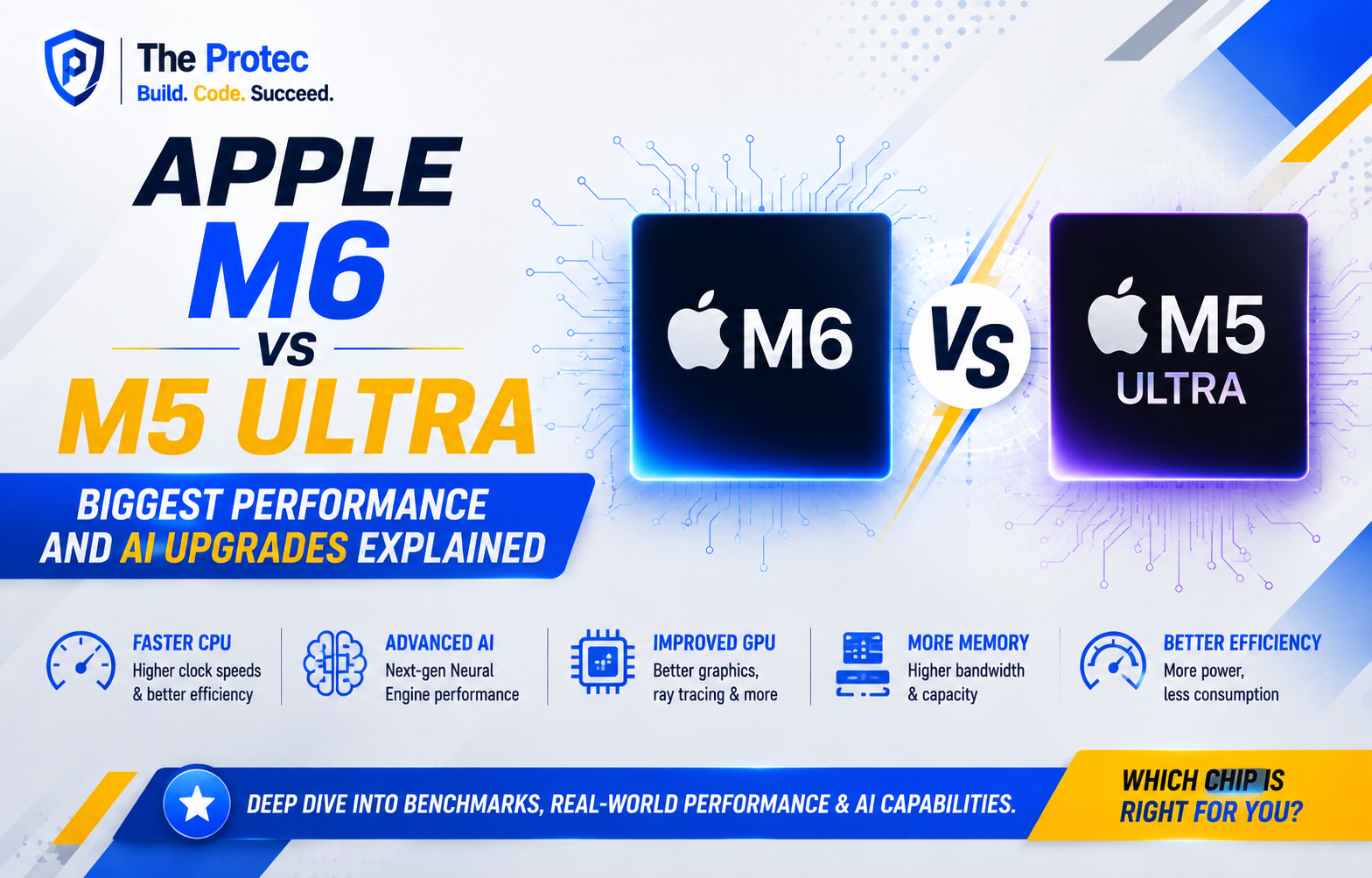
Apple’s silicon roadmap is moving toward an intriguing crossover: a newer-generation M6 chip built for efficient, mainstream Macs versus the M5 Ultra, a workstation-class processor designed to deliver maximum performance. Although the names suggest a simple generational contest, Apple M6 vs M5 Ultra is not a conventional head-to-head comparison. The chips occupy different performance tiers, have different power targets, and could appear in very different Mac systems.
The M6 chip is expected to introduce Apple’s next major architectural foundation, potentially combining a more advanced manufacturing process with updated CPU, GPU, Neural Engine, and packaging technologies. The M5 Ultra, meanwhile, represents the likely peak of the M5 family. If Apple follows its established Ultra strategy, it will combine two high-end M5 dies to provide considerably more CPU cores, GPU cores, unified memory capacity, and memory bandwidth than a standard M6.
As of August 2026, final Apple M6 performance figures and complete directly comparable benchmarks remain limited, so unsupported percentage claims should be treated cautiously. What can be assessed is how Apple’s architectural direction, product segmentation, and recent focus on on-device artificial intelligence are likely to shape these chips. Here is what the biggest performance and AI upgrades could mean for future Macs.
Apple M6 vs M5 Ultra: The Fundamental Difference
The most important distinction is generation versus class. M6 identifies a newer architectural generation, while Ultra identifies the highest-performance configuration within an earlier generation. A standard M6 may contain more advanced individual CPU and GPU cores, but the M5 Ultra can compensate through scale.
Apple’s Ultra-class processors have historically connected two Max-class dies through UltraFusion packaging. This approach allows macOS and professional applications to see the combined hardware as one system on a chip. Assuming the M5 Ultra follows that formula, its advantages should include:
- Far more CPU and GPU cores than the base M6
- A much wider unified memory interface
- Substantially higher maximum memory capacity
- Additional media engines for video production
- Greater sustained performance in a desktop cooling envelope
The M6 chip should prioritize a different balance. Its likely strengths are faster single-core responsiveness, improved performance per watt, newer AI acceleration, and better battery life. Those qualities matter more in MacBook Air, entry-level MacBook Pro, iMac, and Mac mini configurations than the enormous parallel throughput of an Ultra chip.
CPU Performance: Newer Cores Versus More Cores
CPU comparisons should be divided into single-threaded and multi-threaded performance. The M6 is likely to have the advantage in per-core speed because it can incorporate Apple’s newest performance-core and efficiency-core designs. Improvements may come from wider execution resources, larger or more effective caches, refined branch prediction, faster machine-learning instructions, and higher performance within a similar power envelope.
That would make everyday interactions feel exceptionally responsive. App launches, web browsing, code compilation steps that cannot be fully parallelized, photo adjustments, and many productivity tasks depend heavily on single-core performance. A base M6 could therefore outperform an M5 Ultra in selected lightly threaded tests despite being positioned far below it.
M5 Ultra performance should dominate when software can keep many cores active. Large software builds, scientific simulations, CPU-based 3D rendering, music production with extensive plug-in chains, virtualized development environments, and data-processing pipelines can take advantage of the Ultra chip’s greater core count. Its desktop-class cooling should also help it maintain high clock speeds during long workloads.
The practical conclusion is that M6 could be the faster-feeling chip for routine use, while M5 Ultra should remain the more powerful CPU platform for sustained, highly parallel work. A future M6 Pro, M6 Max, or M6 Ultra would be a more direct generational comparison with M5 Ultra.
GPU Architecture and Professional Graphics
Apple has been steadily turning the Mac GPU into a more capable platform for gaming, rendering, video effects, and machine learning. Recent architectural advances have included hardware-accelerated ray tracing, mesh shading, and dynamic caching, which allocates local memory more efficiently according to workload demand.
The M6 GPU could refine each of these technologies. More capable shader cores, faster ray-triangle processing, improved scheduling, and tighter coordination between graphics and machine-learning hardware would increase performance without requiring a dramatic rise in power consumption. This would be especially valuable in thin notebooks, where thermal limits matter as much as peak benchmark results.
However, the M5 Ultra is expected to provide vastly more total GPU cores. That scale should give it a decisive advantage in applications such as Blender, Cinema 4D, DaVinci Resolve, Final Cut Pro, and complex Metal-based visualization tools. It should also handle larger scenes because an Ultra-class Mac can support much more unified memory than a mainstream M6 system.
Gaming may present a more nuanced result. The M5 Ultra can offer greater raw throughput, but a newer M6 GPU may support architectural optimizations that improve frame pacing, upscaling, ray tracing, or efficiency. Game performance will also depend on developer optimization, graphics settings, and whether a title scales effectively across a very large GPU.
AI and Neural Engine Capabilities
Artificial intelligence is becoming central to Apple silicon rather than remaining an isolated feature of the Neural Engine. Modern Mac AI workloads can run across the CPU, GPU, Neural Engine, and unified memory subsystem. That is why comparing Apple AI chips solely by their advertised operations per second can be misleading.
The M6 Neural Engine is expected to focus on higher throughput and better efficiency for generative AI. Architectural changes could improve support for transformer models, lower-precision calculations, sparsity, and mixed workloads involving text, images, audio, or video. A faster Neural Engine would benefit system-level intelligence features, transcription, image analysis, voice processing, accessibility tools, and third-party applications.
The M5 Ultra could remain the stronger platform for large local models, even if its Neural Engine architecture is one generation older. Its decisive advantage is likely to be memory. Large language models need enough capacity to hold parameters, context, caches, and application data. High memory bandwidth is also critical because inference frequently depends on moving model weights quickly rather than performing conventional CPU calculations.
An M5 Ultra Mac with a large unified memory configuration could therefore run models that simply do not fit on an entry-level M6 machine. Its large GPU would also be valuable for developers using GPU-accelerated frameworks. Apple’s open-source MLX framework is particularly relevant because it is designed for machine learning on Apple silicon and takes advantage of unified memory.
For private, efficient, everyday on-device AI, M6 may deliver the better experience per watt. For training adapters, testing larger models, processing extensive media libraries, or serving demanding local inference workloads, M5 Ultra should offer greater total capability.
Unified Memory Capacity and Bandwidth
Unified memory remains one of Apple silicon’s most consequential design choices. Instead of maintaining separate pools for the CPU and GPU, Apple places memory within a shared architecture. This reduces unnecessary copying and lets different compute engines work on the same data.
A standard M6 is likely to gain faster memory technology or improved compression and caching, but its interface should remain narrower than that of an Ultra-class chip. M5 Ultra is expected to aggregate the memory channels of two Max-level dies, producing substantially more bandwidth. That bandwidth is essential for feeding a large GPU and supporting heavy AI, video, and simulation workloads.
Capacity may matter even more than headline speed. Professionals working with high-resolution footage, enormous photo catalogs, orchestral sample libraries, 3D assets, or local AI models can exceed the limits of mainstream systems. M5 Ultra should support significantly larger memory configurations and allow the GPU to access that capacity directly.
M6 could still improve real-world memory behavior through larger caches, more efficient data movement, and better memory compression. Those improvements may let it complete ordinary tasks using less bandwidth, reinforcing its efficiency advantage without challenging M5 Ultra’s workstation-scale capacity.
Power Efficiency and Thermal Performance
Apple M6 performance will be judged as much by energy use as benchmark speed. The chip is widely expected to benefit from a more advanced process and newer packaging techniques, although final specifications depend on Apple’s product schedule and manufacturing decisions. Smaller, denser transistors can improve performance, reduce power consumption, or provide a mixture of both.
In a MacBook, those gains could translate into longer battery life, quieter cooling, and higher sustained performance. They may also allow Apple to increase AI and graphics capability without making laptops thicker. A fanless M6 MacBook Air would prioritize efficient bursts of speed, while an actively cooled M6 MacBook Pro could sustain performance for longer.
M5 Ultra will consume more total power because it contains far more compute hardware. That does not make it inefficient. When measured by the amount of work completed, an Ultra chip can be highly efficient, particularly if it finishes a heavily parallel job much faster than a smaller processor. Its natural home is a desktop such as Mac Studio or Mac Pro, where cooling, acoustics, and continuous power delivery can be engineered around sustained workloads.
Media Engines and Creative Production
Dedicated media engines are another reason raw CPU and GPU benchmarks do not tell the whole story. Apple silicon can accelerate common professional codecs in hardware, improving editing responsiveness and export performance while reducing energy use.
An M6 should receive updated media capabilities and could improve efficiency for everyday editing, video calls, content creation, and modern codec playback. It may be an excellent option for photographers, podcasters, YouTubers, and editors working with moderately complex projects.
M5 Ultra should win in large multicamera workflows because an Ultra design can combine the media resources of two high-end dies. Multiple streams of high-resolution ProRes footage, effects-heavy timelines, batch encoding, and professional finishing are precisely the workloads that benefit from additional media engines, memory bandwidth, and sustained cooling.
Which Chip Is Better for Professional Workloads?
The right answer depends less on generation names and more on workload size. M6 should be attractive to developers, mobile creators, photographers, office professionals, and students who want excellent responsiveness and battery life. Its newer architecture could also make it the better choice for emerging AI features that are specifically optimized for the latest Neural Engine.
M5 Ultra should suit 3D artists, visual-effects teams, machine-learning developers, audio professionals, engineers, and video editors whose projects scale across many cores or require enormous memory. Apple’s broader machine-learning developer resources show how applications can distribute work across Apple silicon’s available acceleration technologies.
Buyers should evaluate project duration, memory requirements, portability, and software scaling. Paying for an Ultra chip makes little sense if an application uses only a few CPU cores. Conversely, choosing a base M6 for a workload that routinely exceeds its memory limit can cost more time than the initial saving is worth.
What M6 and M5 Ultra Could Mean for Future Macs
The M6 chip could establish the foundation for an entire family spanning ultraportable notebooks to high-end professional systems. Its most important contribution may be a stronger baseline: faster AI features, more capable integrated graphics, and higher efficiency in Macs bought by mainstream users.
M5 Ultra represents the opposite end of Apple’s strategy. It demonstrates how far the modular system-on-a-chip approach can scale before the M6 family reaches equivalent Pro, Max, and Ultra tiers. A Mac Studio is the most natural destination, while any role in a future Mac Pro would depend on Apple’s plans for expansion, memory configuration, and professional I/O.
Together, the chips illustrate Apple’s two-track roadmap. Architectural advances improve what each core can accomplish, while high-end packaging multiplies cores, memory channels, and accelerators for professional computing.
FAQ: Apple M6 vs M5 Ultra
Is Apple M6 faster than M5 Ultra?
M6 may be faster in single-core tasks and could offer newer graphics or AI features, but M5 Ultra should be much faster in heavily threaded CPU work, large GPU workloads, and tasks requiring extensive memory bandwidth. Final results depend on shipping configurations and independent benchmarks.
Which chip will be better for local AI?
M6 should provide efficient acceleration for everyday on-device AI. M5 Ultra is likely to be better for larger language, image, and multimodal models because it can offer more GPU resources, higher memory bandwidth, and substantially greater unified memory capacity.
Will M6 use less power than M5 Ultra?
Yes, in absolute terms a standard M6 should use far less power. M5 Ultra targets desktop workstations and contains much more compute hardware. The Ultra chip may nevertheless offer strong performance per watt when completing large parallel jobs.
Should professionals wait for M6 or buy an M5 Ultra Mac?
Professionals who need maximum multicore, GPU, media-engine, or memory performance should focus on M5 Ultra capabilities rather than waiting solely for a base M6. Users prioritizing portability, battery life, newer per-core architecture, and efficient AI may find an M6 Mac more suitable.
Is M6 the direct successor to M5 Ultra?
No. M6 succeeds the standard M5 generation, while M5 Ultra sits at the top of the M5 family. The true successor to M5 Ultra would be an eventual M6 Ultra, if Apple releases one.
Final Verdict
Apple M6 vs M5 Ultra is ultimately a contest between architectural freshness and workstation scale. M6 should deliver stronger per-core performance, improved AI efficiency, newer graphics technology, and better battery life. M5 Ultra should counter with overwhelming multicore throughput, a much larger GPU, more media engines, higher memory bandwidth, and greater unified memory capacity.
For most mobile users, M6 may be the more advanced and practical chip. For professionals whose income depends on rendering, compiling, simulation, video production, or large local AI models, M5 Ultra performance should remain in another class. The most meaningful buying decision will not come from the generation number, but from matching each chip’s architecture to the work it is designed to perform.