








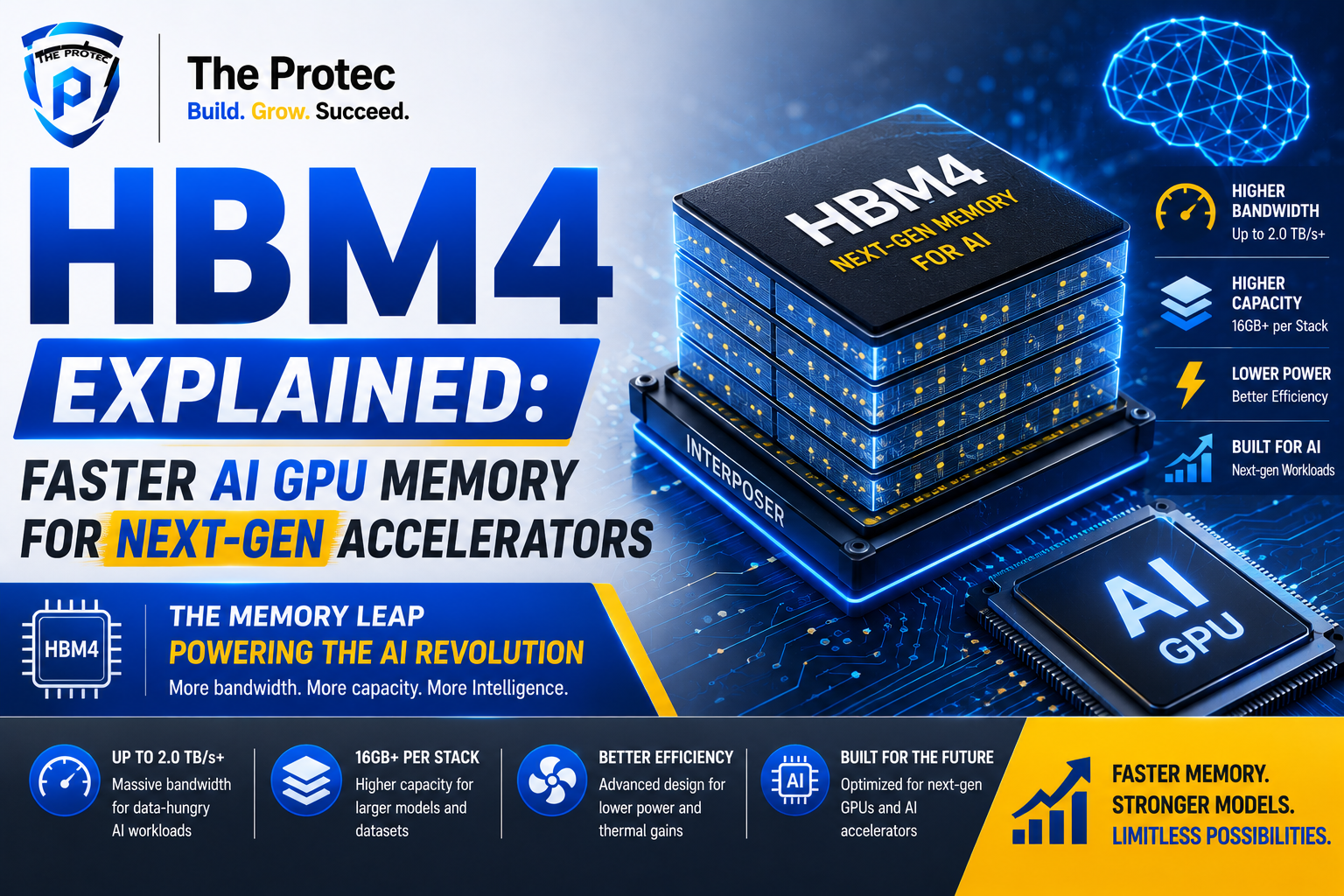
HBM4 Explained: Why AI GPUs Need Faster Memory
The AI hardware race is no longer just about adding more compute. In modern accelerators, the real bottleneck is often moving data fast enough to keep those compute engines busy. That is exactly why HBM4 memory has become one of the most important technologies in the AI stack. As model sizes grow, inference gets more demanding, and training clusters become more specialized, AI GPU memory must deliver far higher bandwidth without exploding power consumption or board complexity.
HBM4, or High Bandwidth Memory 4, is the next major step in stacked memory for accelerators, GPUs, and other data-intensive processors. It is designed to feed massive parallel workloads with more throughput per watt than conventional memory systems can provide. For AI workloads, that matters because every parameter fetch, activation lookup, gradient update, and attention calculation depends on a steady stream of data. When memory cannot keep up, even the fastest GPU cores sit idle.
In this article, we will break down what HBM4 is, how it differs from earlier generations, why memory bandwidth is now central to AI performance, and why next-generation AI accelerators increasingly depend on faster high-bandwidth memory to stay competitive.
What Is HBM4?
HBM4 is the latest evolution of stacked memory built to sit close to the processor and move data across extremely wide interfaces. Instead of relying on a few very fast pins like traditional memory systems, HBM4 uses many more data paths operating in parallel. That design creates far more aggregate bandwidth while using less power per bit transferred.
At a high level, HBM4 memory continues the same architectural idea that made previous HBM generations so valuable: place memory dies in a vertical stack, connect them with through-silicon vias, and pair them with a logic base die. This shortens signal paths, reduces electrical overhead, and enables dense, efficient data movement. For AI GPU memory, that combination is ideal because the workload is less about random desktop-style access and more about sustained, massive data throughput.
HBM4 is also expected to push capacities and bandwidth higher than previous generations, making it especially attractive for large language models, multimodal systems, and recommendation engines. Those applications do not just want more memory; they want memory that can continuously stream data at the rate the chip demands.
Why Memory Bandwidth Matters So Much for AI
AI acceleration is often described in terms of TOPS, TFLOPS, or tensor throughput, but raw compute numbers can be misleading. A GPU can have enormous arithmetic capability and still underperform if the memory subsystem cannot supply data fast enough. This is where memory bandwidth becomes a critical metric.
Bandwidth measures how much data can be transferred per second. In AI, higher bandwidth helps in several ways:
- It reduces stalls when loading model weights and activations.
- It supports larger batch sizes and higher throughput during training.
- It improves inference latency for models with heavy memory traffic.
- It keeps matrix engines, tensor cores, and other compute blocks fed continuously.
Large transformer models are especially memory hungry because attention mechanisms, KV caches, and parameter movement create sustained pressure on the memory subsystem. Even when compute is scaled up, the system can become memory bound. HBM4 addresses this by offering the kind of bandwidth that allows accelerators to scale more effectively as models grow.
In practical terms, AI GPU memory is not just a support component anymore. It is a primary performance enabler. The accelerator that can move data most efficiently often wins, even if two chips have similar compute specs on paper.
HBM4 vs. Earlier HBM Generations
To understand why HBM4 matters, it helps to look at the trajectory of stacked memory. Each generation of HBM has increased bandwidth, capacity, and efficiency while trying to preserve the core advantage of short, wide, low-power data paths. HBM2 and HBM2E made stacked memory practical for high-end GPUs. HBM3 raised the bar again and became a key component in many current AI accelerators. HBM3E further pushed bandwidth and is already important in leading-edge designs.
HBM4 continues that progression with a more ambitious goal: support the next wave of AI systems that are larger, denser, and more memory constrained than ever before. Compared with earlier HBM, HBM4 memory is expected to deliver:
- Higher bandwidth per stack
- Greater aggregate throughput across multi-stack configurations
- Improved power efficiency for data movement
- Better scalability for large GPU packages and advanced interposers
The most important shift is not just speed. It is the balance of speed and efficiency. In AI datacenters, bandwidth is valuable only if it can be delivered within thermal and power budgets. HBM4 is designed for that reality.
Power Efficiency Is Now a Performance Feature
For many years, memory discussions focused on speed alone. In AI infrastructure, that is no longer enough. Power has become one of the biggest constraints in scaling accelerators. A system may have enough rack space and enough demand, but if memory power consumption rises too quickly, the economics fall apart.
HBM4 improves the energy profile of AI GPU memory by moving large amounts of data over very short physical distances with wide interfaces. That lowers the energy cost per bit compared with systems that rely on longer traces and narrower channels. This matters because AI training clusters and inference servers can run around the clock, and memory traffic is constant.
Power efficiency also affects cooling, board design, and total system density. Less wasted energy means easier thermal management and more room to pack compute into a single accelerator module or rack. In the current AI market, the ability to deliver more throughput per watt is often as important as the ability to deliver more throughput overall. HBM4 is attractive because it improves both.
Why Next-Generation AI Accelerators Depend on HBM4
The shift toward larger foundation models, retrieval-augmented systems, agentic workflows, and multimodal inference has transformed memory requirements. Modern accelerators must handle enormous parameter sets, fast context expansion, and growing KV cache sizes. In training, they also need to move gradients and optimizer states efficiently across GPUs and nodes.
This is why next-generation AI accelerators increasingly depend on HBM4. Compute scaling alone cannot solve memory pressure. A chip with more tensor cores still needs a memory system that can keep those cores busy. HBM4 memory provides the bandwidth headroom needed for:
- Large model training with fewer memory stalls
- High-throughput inference serving
- Long-context workloads
- Distributed AI systems with heavy interconnect and memory traffic
As models grow more complex, memory has become a first-class design constraint. Chipmakers are not simply asking how much compute they can fit in a package. They are asking how much data that package can move, how efficiently it can move it, and how well it can sustain that performance under real workloads. HBM4 is central to those decisions.
HBM4 and the Rise of Co-Packaged Systems
Another reason HBM4 matters is the broader shift toward integrated accelerator packages. Advanced AI chips increasingly combine GPU cores, network interfaces, cache hierarchies, and stacked memory in tightly optimized packages. This design reduces latency and improves throughput, but it also increases the importance of memory placement and signal integrity.
HBM4 fits naturally into this world because it was built for short-reach, high-density integration. It works well with advanced packaging techniques that place memory close to compute dies, minimizing the distance data must travel. That is especially important in systems designed for scale-out AI infrastructure, where each package must be as efficient as possible.
Industry leaders are also pursuing heterogeneous accelerator designs that pair GPU compute with specialized engines for inference, networking, or data preprocessing. In those designs, HBM4 memory serves as the shared high-speed data pool that keeps every engine productive. Without that memory layer, the value of the whole package drops quickly.
What HBM4 Means for Training and Inference
Training and inference place different demands on memory, but both benefit from faster AI GPU memory.
Training
Training large models is one of the most memory-intensive tasks in computing. Forward passes, backward passes, gradient accumulation, and optimizer updates all create sustained traffic. HBM4 helps by increasing the amount of data that can be moved each second, which can improve device utilization and reduce bottlenecks in large-scale training jobs.
Inference
Inference is often thought of as lighter than training, but production inference can be just as demanding in different ways. Serving many users simultaneously, handling large prompt contexts, and maintaining low latency all create pressure on memory bandwidth. HBM4 memory supports faster token generation and better concurrency, especially for large models that must keep substantial state in memory.
In both cases, the core idea is the same: faster memory makes the accelerator more effective. Compute and memory must scale together, or the system becomes imbalanced.
Where HBM4 Fits in the Broader Memory Hierarchy
HBM4 is not replacing caches, SRAM, or system DRAM. Instead, it occupies the high-performance tier of the memory hierarchy, sitting close to the processor and handling the most bandwidth-sensitive data movement. The rest of the system still matters, including cache design, prefetching, interconnects, and software optimization.
However, as AI workloads become more memory bound, the value of HBM4 grows. It reduces dependence on slower off-package memory for the hottest data paths and gives hardware designers more room to optimize around the accelerator itself. In a well-balanced AI platform, HBM4 acts as the high-speed reservoir that feeds compute without forcing constant trips to slower memory layers.
This also means software teams need to think differently. Memory-aware model parallelism, tensor sharding, and kernel fusion all become more effective when paired with a strong HBM4-based platform. Hardware and software optimization now go hand in hand.
Challenges and Trade-Offs
HBM4 is powerful, but it is not free of trade-offs. Stacked memory is more complex and expensive to manufacture than conventional memory. Advanced packaging, yield considerations, and supply constraints can all affect availability and cost. For AI hardware buyers, this means HBM4-equipped accelerators will likely remain premium products, especially at the cutting edge.
There is also the issue of system-level design. Faster memory creates pressure on interconnects, power delivery, and thermal solutions. A chip cannot benefit from HBM4 if the surrounding platform cannot support it. That is why next-generation AI systems are designed holistically, with memory, compute, networking, and cooling all planned together.
Even with those challenges, the direction of the market is clear. The demand for memory bandwidth is growing faster than many other parts of the stack, and HBM4 is one of the few technologies positioned to meet that demand efficiently.
The Future of AI GPU Memory
Looking ahead, AI GPU memory will continue to evolve around three priorities: bandwidth, efficiency, and integration. HBM4 is the current milestone in that journey, but it is also a signal of where the market is heading. Future accelerators will likely rely even more heavily on advanced memory packaging, tighter compute-memory coupling, and software that is optimized to exploit wide, low-latency data paths.
As model architectures evolve, memory requirements will not get simpler. Long-context reasoning, real-time multimodal processing, and enterprise-scale inference all increase the pressure on the memory subsystem. In that environment, bandwidth is not a luxury. It is a requirement. HBM4 memory gives chip designers a way to keep pace without giving up power efficiency.
For organizations evaluating AI infrastructure, the message is straightforward: the best accelerator is no longer the one with the highest theoretical compute number. It is the one with the best balance of compute, memory bandwidth, and energy efficiency. HBM4 is becoming the memory technology that makes that balance possible.
FAQ
What is HBM4 in simple terms?
HBM4 is a type of stacked high-bandwidth memory designed to move very large amounts of data quickly and efficiently. It is built for AI accelerators, GPUs, and other chips that need far more bandwidth than traditional memory can provide.
Why is HBM4 important for AI GPUs?
AI GPUs often become limited by memory bandwidth rather than compute. HBM4 helps keep the GPU fed with data, which improves training throughput, inference latency, and overall accelerator utilization.
Is HBM4 better than HBM3E for AI workloads?
HBM4 is designed to go beyond HBM3E with higher bandwidth potential and stronger efficiency at scale. For cutting-edge AI workloads, that makes it a better fit for next-generation accelerators.
Does HBM4 improve power efficiency?
Yes. One of HBM4’s biggest advantages is delivering more data per watt by using short, wide, highly integrated memory paths. That helps reduce heat and improves datacenter efficiency.
Will HBM4 be used only in GPUs?
No. While AI GPUs are the biggest use case, HBM4 can also be valuable in other accelerators such as AI inference chips, HPC processors, and specialized data center silicon that needs extreme bandwidth.
Conclusion
HBM4 represents more than another memory upgrade. It reflects a major shift in how the AI industry thinks about performance. As models get larger and workloads become more data intensive, the winning accelerators will be the ones that can move data quickly, efficiently, and at scale. HBM4 memory is built for that challenge.
For AI GPU memory, the future is not just about capacity. It is about feeding compute fast enough to unlock the value of every chip in the system. That is why HBM4 is becoming a defining technology for next-generation AI accelerators and why memory bandwidth will remain one of the most important metrics in AI hardware design.
For a broader technical overview of high-bandwidth memory and its role in computing, see the SK hynix HBM4 overview and Micron’s high-bandwidth memory resources.