








Quantum computing has spent years moving from laboratory experiments toward machines that can run deeper, more useful calculations. IBM Quantum Nighthawk, announced on November 11, 2026, is the latest step in that transition. The next-generation Nighthawk r3 processor is designed to execute 10,000 quantum operations across 520 qubits, giving researchers more room to test complex circuits. The important question, however, is not whether the specifications sound impressive. It is whether they bring practical quantum computing meaningfully closer.
The short answer is yes—but with substantial qualifications. Nighthawk advances IBM’s ability to combine qubit scale with longer computations, two ingredients needed for useful quantum workloads. It does not show that quantum machines can replace conventional computers, nor does a processor specification by itself establish a real-world quantum advantage. Error rates, software performance, workload selection and error correction remain decisive.
What IBM Announced
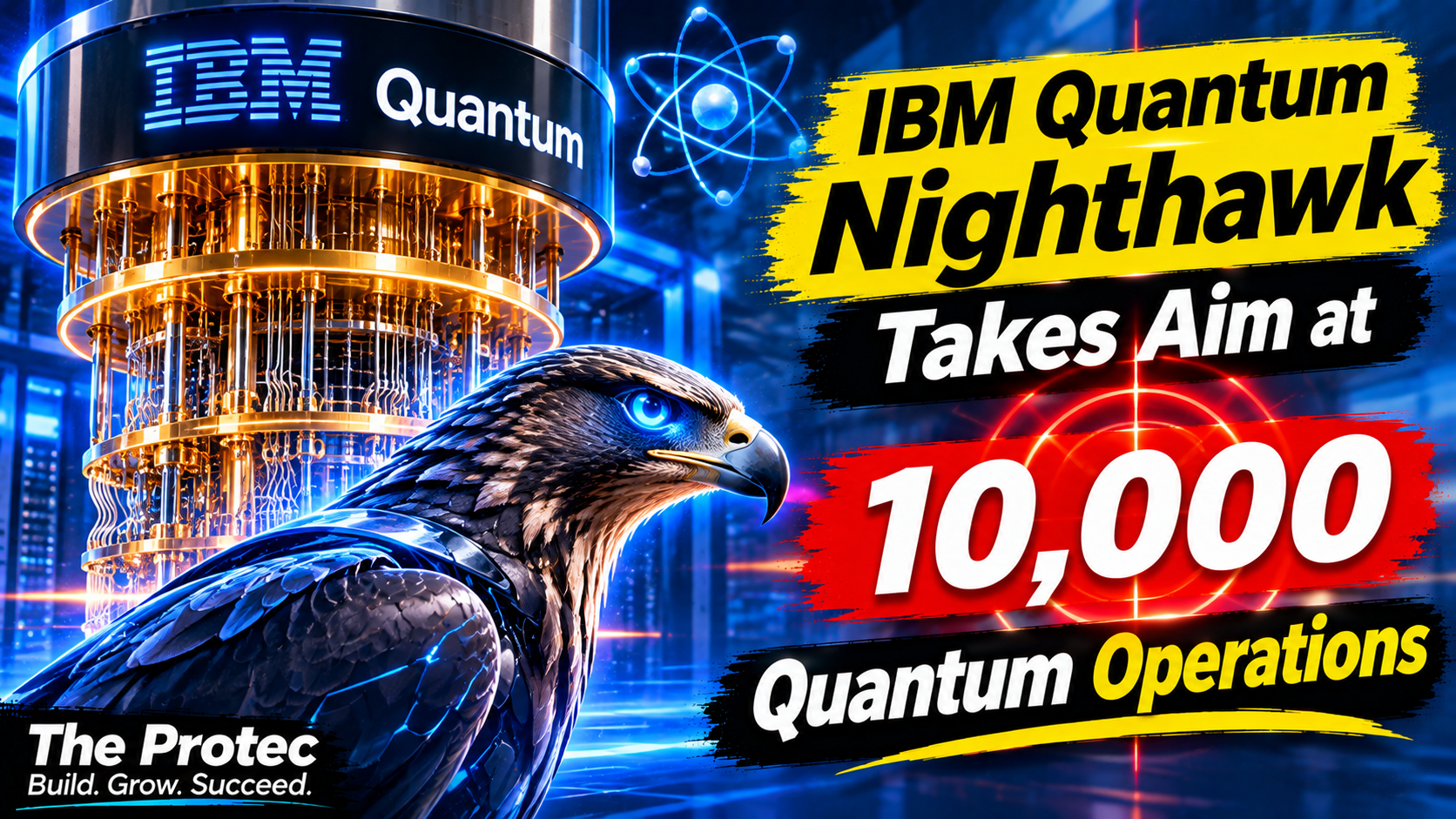
According to IBM’s official announcement portal, the IBM Nighthawk chip is a 520-qubit quantum processor designed to support as many as 10,000 quantum operations. The company presented the Nighthawk r3 generation as part of its broader hardware roadmap, which aims to move beyond 1,000 qubits in 2027.
- Processor size: 520 qubits, expanding the space available for quantum circuits and experiments.
- Operation target: Up to 10,000 quantum operations, indicating an ambition to execute deeper and more involved circuits.
- Roadmap position: A bridge between current systems and IBM’s stated goal of surpassing 1,000 qubits in 2027.
- Intended role: Supporting researchers as they investigate algorithms, error mitigation and possible routes to practical quantum advantage.
These are announced design capabilities and roadmap objectives. Their significance ultimately depends on measured system performance, including operation fidelity, qubit connectivity, calibration stability and the quality of results produced by complete workloads.
What Do 520 Qubits and 10,000 Operations Mean?
Qubits are not simply faster bits
A classical bit stores a value of either zero or one. A qubit can be prepared in a quantum state involving a combination of both possibilities until it is measured. Multiple qubits can also become entangled, creating correlations that certain quantum algorithms can exploit.
That does not mean a 520-qubit machine performs every task faster than a 520-bit conventional processor. Quantum speedups depend on carefully designed algorithms and suitable problems. Most everyday computing—including web services, databases, spreadsheets and graphics—remains better suited to classical hardware.
Quantum operations are the steps of a circuit
A quantum operation generally refers to an action within a quantum computation, such as applying a gate to one or more qubits. Gates manipulate quantum states so that a circuit can encode a problem, process information and eventually produce measurements.
The 10,000-operation target matters because useful circuits often need many sequential and coordinated steps. Yet operation count cannot be evaluated in isolation. If small errors accumulate faster than a circuit can tolerate them, a larger operation budget may not produce a trustworthy answer. The types of operations, their fidelity, circuit depth and hardware connectivity all affect the outcome.
In other words, the announced figure indicates the intended scale of computation, not 10,000 guaranteed business solutions. Independent workload results and transparent benchmarks will be necessary to understand what the processor can accomplish reliably.
How Nighthawk Advances the IBM Quantum Roadmap
IBM’s hardware strategy has consistently emphasized more than raw qubit totals. Scaling requires processors, control electronics, cryogenic infrastructure, compilers and runtime software to improve together. A larger chip is of limited value if users cannot map algorithms onto it efficiently or maintain usable circuit quality.
The IBM Quantum Nighthawk announcement combines two dimensions of progress: 520 qubits provide greater width, while the 10,000-operation target provides greater computational depth. Width allows a circuit to represent more quantum information. Depth allows it to perform more steps before noise overwhelms the result. Advancing both is more meaningful than increasing qubit count alone.
This generation may also give researchers a broader platform for testing circuit optimization, error-mitigation techniques and hybrid quantum-classical workflows. In a hybrid approach, a quantum processor handles selected operations while conventional systems manage data preparation, optimization, orchestration and result analysis. That model is more realistic than expecting a stand-alone quantum computer to replace an enterprise data center.
Why Scaling Beyond 1,000 Qubits Matters
IBM’s ambition to exceed 1,000 qubits in 2027 is important because many promising experiments require more qubits than are available after accounting for hardware constraints and error-management overhead. Additional capacity can support larger problem representations, more sophisticated validation and experiments that reserve qubits for detecting or reducing errors.
However, passing 1,000 physical qubits would be an engineering milestone, not a universal threshold for practical quantum computing. Physical qubits are the hardware elements in a processor. A logical qubit is an error-managed unit constructed from physical qubits and designed to preserve information more reliably. Depending on the hardware and error-correction method, creating useful logical qubits can require substantial physical resources.
IBM’s 2027 objective should therefore be read as a roadmap target rather than a promise that commercially transformative applications will arrive on a specific date. Execution quality, architecture and software will matter as much as the headline number.
The Remaining Obstacles to Practical Quantum Computing
The state of quantum computing in 2026 is defined by genuine hardware progress alongside unresolved scientific and engineering challenges. Nighthawk addresses scale and circuit capacity, but several barriers still separate advanced processors from dependable production systems.
- Noise and decoherence: Qubits are highly sensitive to environmental disturbances. Their states can degrade before a calculation is complete, introducing errors into the result.
- Gate fidelity: Every imperfect operation adds risk. As circuits grow longer, even small error probabilities can accumulate and undermine an otherwise promising calculation.
- Error-correction overhead: Fault-tolerant quantum computing requires errors to be detected and corrected without destroying the encoded information. Doing this at useful scale remains resource-intensive.
- Limited practical workloads: Researchers have proposed important applications in chemistry, materials, optimization and cryptography, but relatively few have demonstrated a decisive, repeatable advantage under commercially relevant conditions.
- Benchmark complexity: Qubit count and operation targets do not provide a complete comparison between processors. Connectivity, operation speed, fidelity, uptime and application-level accuracy can change the practical result.
These limitations explain why Nighthawk should not be described as a replacement for CPUs or GPUs. Conventional computers will continue to run mainstream workloads, while quantum processors are more likely to become specialized accelerators within larger computing environments.
Specifications Versus Demonstrated Quantum Advantage
A processor designed for 10,000 operations has the capacity to host more ambitious experiments, but capacity is not the same as demonstrated value. A credible claim of practical quantum advantage generally requires a quantum system to solve a meaningful problem more effectively than strong classical alternatives, with results that can be verified and reproduced.
That comparison must include modern classical algorithms and appropriate hardware—not an outdated or deliberately weak baseline. It should also account for the time and resources needed to prepare data, run the quantum circuit, mitigate errors and interpret the output.
Nighthawk’s specifications may create opportunities to pursue such demonstrations. Until application-level evidence is available, the responsible conclusion is that the chip expands the experimental frontier rather than settling the question of commercial quantum advantage.
What the Milestone Means for Businesses and Researchers
For business leaders
Organizations do not need to purchase a quantum computer or rebuild their technology strategies around Nighthawk. They should identify problems that might suit quantum methods, assess their exposure to future cryptographic risks and develop teams capable of evaluating technical claims. Cloud-based experimentation and small proof-of-concept projects can build knowledge without assuming near-term returns.
For researchers and developers
A 520 qubit quantum processor with a larger operation budget could enable experiments that were previously too wide or deep. Researchers can use that space to study algorithm design, circuit compilation, error mitigation and hybrid workflows. The most valuable findings may include clear evidence about which approaches do not scale, not only headline demonstrations.
For security teams
Nighthawk does not mean current encryption has suddenly been broken. Large-scale cryptographic attacks would require capabilities well beyond a processor specification, including mature fault-tolerant quantum computing. Nevertheless, organizations should continue inventorying cryptographic assets and planning migrations to post-quantum standards because those transitions can take years.
What to Watch Next
The next phase will be measured through evidence rather than processor announcements alone. Important signals include:
- Published fidelity, connectivity and system-level benchmark results.
- Applications that use a substantial portion of the processor rather than narrow demonstrations.
- Reproducible comparisons with leading classical methods.
- Progress toward stable logical qubits and lower error-correction overhead.
- Delivery against IBM’s target of scaling beyond 1,000 qubits in 2027.
Together, these indicators will show whether quantum computing breakthroughs are translating from impressive hardware specifications into reliable computational tools.
Is Practical Quantum Computing Getting Closer?
IBM Quantum Nighthawk makes the answer more encouraging, but not simple. Combining 520 qubits with a target of 10,000 operations could support larger and deeper experiments, while IBM’s roadmap points toward continued scaling. The announcement is meaningful evidence of engineering momentum.
Practical quantum computing will still require better error control, useful algorithms and repeatable advantages over classical systems. Nighthawk is best understood as enabling infrastructure for that search—not proof that the search is over.
Frequently Asked Questions
What is IBM Quantum Nighthawk?
IBM Quantum Nighthawk is IBM’s next-generation quantum processor family. The Nighthawk r3 processor announced on November 11, 2026, is designed to execute 10,000 quantum operations across 520 qubits.
Does 520 qubits make Nighthawk faster than a classical computer?
Not for computing in general. Quantum performance depends on the algorithm, error rates, circuit design and comparison being made. Conventional processors remain superior for most workloads, while quantum hardware targets specialized problems with quantum structure.
What does the 10,000-operation target prove?
It describes the intended scale of quantum circuits the processor is designed to support. It does not by itself prove that all such circuits will produce accurate results or deliver a practical advantage. Workload-level demonstrations are still necessary.
Is Nighthawk a fault-tolerant quantum computer?
The announcement should not be interpreted as proof of full fault tolerance. Fault-tolerant quantum computing requires logical qubits and robust error correction that allow long calculations to continue despite physical errors. Nighthawk advances hardware scale, but that broader challenge remains.
Why is IBM’s 1,000-qubit target important?
Exceeding 1,000 qubits could provide more resources for larger algorithms, error-management experiments and logical-qubit research. It would still be a roadmap milestone rather than automatic evidence that commercially useful quantum computing has arrived.