








Quantum computers promise to solve certain problems beyond the practical reach of conventional machines, but their basic units of information are exceptionally fragile. A small disturbance can corrupt a qubit, and useful calculations may require millions or billions of operations. That makes error correction one of the defining engineering challenges in quantum technology.
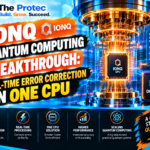
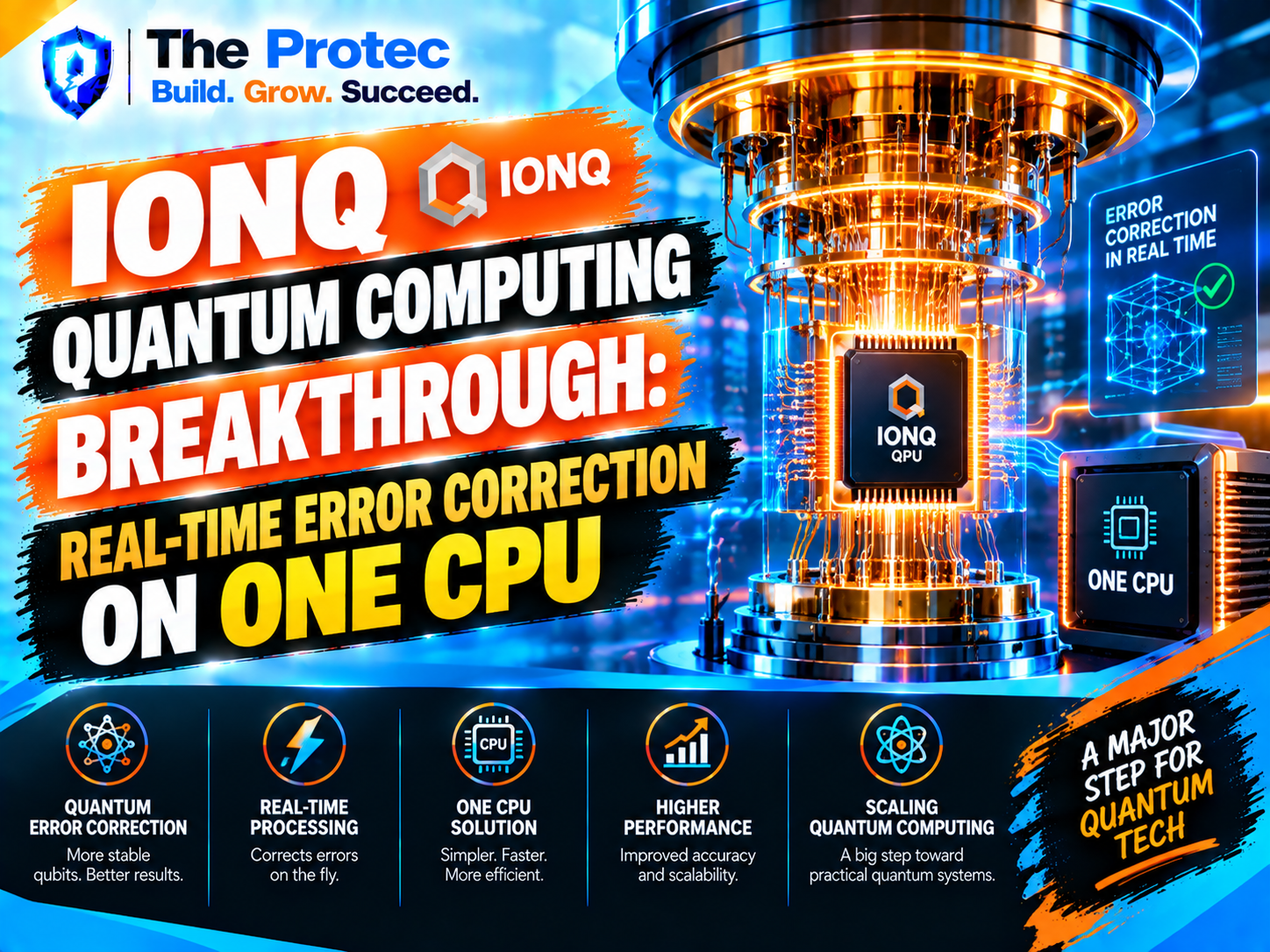
The reported IonQ quantum computing breakthrough addresses an easily overlooked part of that challenge: the speed of the classical computer supporting the quantum processor. IonQ demonstrated real-time quantum error correction decoding on a single conventional CPU, showing that error information generated by its quantum system could be analyzed quickly enough to guide an ongoing computation.
This is not the arrival of a fully fault-tolerant IonQ quantum computer. It is evidence that one critical feedback loop—the path from quantum measurement to classical interpretation—can operate with practical hardware and sufficiently low latency for the demonstrated workload. That distinction matters, because decoding could become a major quantum computing bottleneck as machines grow.
What IonQ Quantum Computing Breakthrough Demonstrates
Quantum error correction works by encoding useful information across multiple physical qubits. The system repeatedly performs carefully designed checks that reveal evidence of errors without directly reading and destroying the protected quantum state. Those checks produce classical measurement data, often called syndrome data.
Raw syndrome data does not simply announce, “This qubit has an error.” It provides a pattern of clues. A decoder must compare that pattern with the behavior of the error-correcting code and infer the most probable error or combination of errors. The computer can then compensate for the problem, either through physical operations or by updating a classical record known as a Pauli frame.
IonQ’s reported result connected this decoding process to a live quantum workload and ran it in real time on one CPU. In practical terms, the quantum processor generated noisy measurements, the CPU interpreted them, and the resulting information became available while the computation was still progressing. Readers can follow the company’s broader technical announcements through the official IonQ newsroom.
How Real-Time Quantum Error Correction Works
The relationship between quantum and classical hardware can be understood as a rapid feedback loop:
- Encode the state: A logical qubit is distributed across a group of physical qubits using a quantum error-correcting code.
- Measure error checks: The quantum processor performs operations that expose changes associated with noise while preserving the encoded information.
- Send results to classical hardware: Measurement outcomes are converted into ordinary bits and delivered to the decoder.
- Infer likely errors: A classical algorithm analyzes current and, when required, previous syndrome patterns to identify the most likely explanation.
- Continue the computation: The control system applies a correction or tracks it in software so later quantum operations and final measurements are interpreted correctly.
The word “real-time” is crucial. Decoding an experiment after it has ended may help researchers study performance, but it cannot support operations that depend on an earlier measurement. A fault-tolerant machine must make some decisions while the calculation remains active. If the decoder falls behind, syndrome data accumulates, feedback arrives too late, and the quantum processor may have to pause or proceed without essential information.
Why Decoding Speed Can Become a Quantum Computing Bottleneck
Error correction creates a demanding data-processing problem. A larger machine has more qubits, more stabilizer checks, and more measurement results. Faster correction cycles increase the rate at which those results arrive. More sophisticated codes can also make inference harder, especially when the decoder must consider correlated errors or a long measurement history.
The difficulty therefore grows along multiple dimensions at once: data volume, arrival rate, decoding complexity, and latency requirements. High accuracy is not enough if the answer arrives after the quantum control system needs it. Likewise, an extremely fast decoder is of limited value if it frequently recommends the wrong correction.
Quantum computer scaling consequently depends on a balance among accuracy, throughput, predictable latency, and power consumption. A decoder must keep pace continuously rather than produce an impressive average while occasionally stalling. This is why real-time quantum error correction is increasingly treated as a systems-engineering challenge, not just a theoretical coding problem.
Why Running IonQ Error Correction on One CPU Matters
Using a single CPU demonstrates that the reported workload did not require a data center, specialized supercomputer, or large accelerator cluster to close the decoding loop. That can simplify system design, reduce communication overhead, and make the classical control stack easier to test. It also suggests that software optimization and hardware-aware code design can deliver meaningful gains before exotic decoding hardware is necessary.
The result is particularly relevant to latency. Distributing work across many processors can increase throughput, but it also introduces synchronization and networking delays. For a modest error-correction workload, one nearby CPU may respond more predictably than a larger remote system.
However, “single CPU” should not be interpreted as proof that one processor can decode every future IonQ quantum computer. A machine containing many logical qubits could generate vastly more syndrome data. Future architectures may use multicore CPUs, graphics processors, FPGAs, ASICs, or hierarchical combinations of local and global decoders. IonQ’s breakthrough is best viewed as a useful baseline: an important real-time task can be handled efficiently with familiar classical technology at the demonstrated scale.
Logical Qubits Versus Physical Qubits
A physical qubit is an individual quantum system used by the hardware. It may be an ion, superconducting circuit, neutral atom, photon, or another controllable quantum object. Physical qubits are imperfect: control pulses have errors, states lose coherence, and measurements can be wrong.
A logical qubit is an encoded unit built from multiple physical qubits. The encoding adds redundancy in a quantum-compatible form, allowing errors to be detected and corrected without copying an unknown quantum state. The number of physical qubits required for one logical qubit depends on the code, hardware quality, target reliability, and amount of fault-tolerant protection.
Simply increasing the physical-qubit count does not guarantee a more useful computer. The key question is whether an encoded logical qubit becomes more reliable as additional error-correction resources are added. That requires physical error rates below the relevant threshold, repeated syndrome extraction, accurate measurements, capable decoding, and fault-tolerant logical operations.
IonQ quantum error correction research matters because decoding is part of that complete logical-qubit pipeline. Better hardware without timely decoding leaves valuable error information unused; a perfect decoder cannot rescue syndrome data produced by operations that are too noisy.
Classical Computing Is Essential to Quantum Architecture
The phrase “quantum versus classical computing” can create a misleading picture of two competing technologies. A practical quantum system is hybrid. Classical processors compile circuits, schedule control pulses, calibrate qubits, process measurements, decode errors, manage conditional operations, and integrate quantum results into larger applications.
As fault-tolerant quantum computing develops, this classical layer will become more important. The quantum processing unit may perform the operations that provide a potential computational advantage, but conventional electronics will orchestrate those operations and interpret their outcomes. In that sense, IonQ’s quantum computing CPU result highlights architecture rather than merely processor performance.
Placement also matters. Some decoding may run close to the quantum hardware to minimize latency, while less urgent analysis can occur elsewhere. Trapped-ion systems have different timing characteristics from superconducting or photonic platforms, so each architecture can make different trade-offs among processor speed, connectivity, code choice, and decoder design.
What the IonQ Breakthrough Does Not Yet Prove
The demonstration should not be confused with a commercially useful, fully fault-tolerant computer. Real-time decoding is necessary, but it is only one element of the larger problem. A scalable system must also create high-quality physical qubits, perform repeated checks without introducing excessive new errors, preserve logical states for long computations, and execute a universal set of fault-tolerant logical gates.
Researchers must further show that logical error rates improve as code distance or protection increases. They must manage leakage, correlated noise, measurement faults, state preparation, resource overhead, and the production of specialized states needed by many fault-tolerant schemes. The entire stack must work reliably for long periods, not merely during a controlled demonstration.
Nor does the result establish that classical decoding will remain easy at every scale. The computational load could rise rapidly as the number of logical qubits and correction cycles increases. What IonQ has demonstrated is narrower but still meaningful: for its reported experiment, a single CPU was capable of participating in the correction loop quickly enough for real-time operation.
What to Watch Next in IonQ Quantum Technology
As of September 2026, the most informative milestones are moving beyond raw physical-qubit totals. Investors, developers, and researchers should watch logical error rates, the duration of protected operations, decoder latency, correction-cycle throughput, and the number of logical operations completed before failure.
It will also be important to see whether IonQ error correction scales from a small demonstration to multiple interacting logical qubits. Transparent comparisons should report the physical resources used, the quality of unencoded and encoded operations, the decoder’s worst-case latency, and whether feedback remains real time throughout longer workloads.
If those metrics improve together, the single-CPU result may be remembered as an early systems milestone: proof that quantum measurements and conventional processors can cooperate at the speed required by an active error-correction cycle.
Frequently Asked Questions
What is the IonQ quantum computing breakthrough?
IonQ reported that real-time quantum error correction decoding for its demonstrated workload could run on a single classical CPU. The processor analyzed syndrome measurements from the quantum system and supplied information needed to keep the computation moving.
Why does quantum error correction need a classical CPU?
Error-check measurements become classical bits. A conventional processor runs a decoder that interprets their patterns, estimates which errors occurred, and tells the control system how to compensate. Quantum hardware generates the evidence, while classical hardware performs the rapid inference.
Does IonQ now have a fault-tolerant quantum computer?
No. Real-time decoding is an important component of fault tolerance, but a complete machine must sustain low logical error rates, execute fault-tolerant gates, scale to many logical qubits, and run useful algorithms reliably.
Why is a single CPU significant?
It shows that the demonstrated decoding workload can meet its timing requirements without a large classical computing cluster. That may reduce latency and complexity. Larger quantum systems, however, may still require parallel processors or specialized decoding accelerators.
Will classical computers become obsolete when quantum computers scale?
No. Practical quantum computers will remain hybrid systems. Classical processors will continue to handle control, calibration, compilation, error decoding, networking, and application-level tasks, while quantum processors address selected computations suited to quantum methods.