





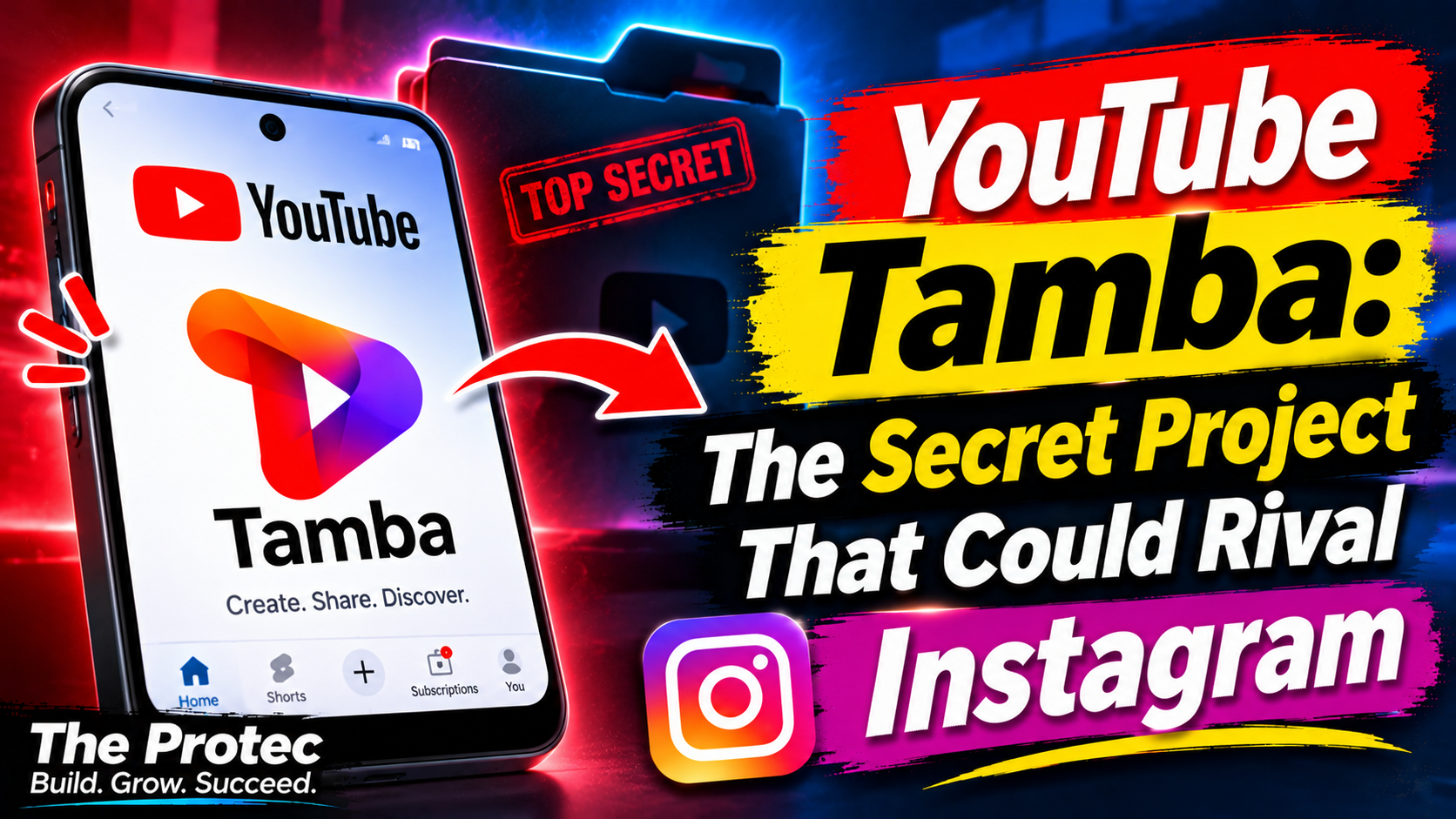
YouTube may be quietly exploring a future in which watching videos is only one part of the experience. References to YouTube Tamba discovered inside a recent Android app build point toward private profiles, direct messages, group conversations and personal media sharing—the building blocks of a social network that looks closer to Instagram than the YouTube people use today.
The discovery is intriguing, but it requires an important qualification: Google has not announced Tamba, demonstrated it publicly or confirmed plans to release it. The available evidence comes from an APK and code teardown of YouTube for Android version 21.44.534. It reveals names, assets and references that may describe an internal prototype rather than a finished product.
What researchers found inside the YouTube app
The clearest account of the project comes from an Android Authority APK teardown. Researchers examining version 21.44.534 found Tamba branding alongside code references related to accounts, communication and sharing. Additional reporting from TechRepublic highlighted how those elements could support a more complete social experience around YouTube.
The references reportedly cover a surprisingly broad set of possible functions:
- Followers and follow requests
- Public and private profiles
- One-to-one direct messages
- Group chats and conversation management
- Photo and video sharing
- Posts, comments and reactions
- Voice replies inside conversations
- Playing or sharing YouTube Shorts in chats
Taken together, those clues describe more than a minor upgrade to comments or Community posts. They suggest an account-based social layer where users could establish relationships, approve followers, publish personal content and communicate privately.
However, strings and graphical resources do not prove that every referenced option works. Developers frequently leave unfinished features, test labels and abandoned experiments inside app packages. The teardown establishes that Google has worked on Tamba-related concepts; it does not establish a launch plan or guarantee the final shape of any product.
Why the separate sandbox identity matters
One of the strongest clues that Tamba could be a distinct experiment is the package name com.google.android.youtube.sandbox. Researchers also found dedicated Android and iOS sandbox identifiers, onboarding references and dozens of custom icons associated with actions such as messaging, sharing and reactions.
A sandbox normally gives developers a controlled environment for testing interfaces and account behavior without exposing unfinished systems to the main service. The separate identifiers could allow Google to test a standalone application, a self-contained experience opened from YouTube or an internal prototype that shares YouTube infrastructure.
The word “sandbox” also argues for caution. It may be a technical label rather than a consumer-facing brand. Even if Tamba appears in internal artwork, Google could rename it, absorb selected Tamba app features into YouTube or discontinue the project before the public sees it.
YouTube already has social elements, including subscriptions, comments, creator posts, live chat and collaborative interactions around videos. What it generally lacks is the private, relationship-driven layer that defines services such as Instagram. YouTube previously offered native private messaging but discontinued that system in 2019.
Followers instead of subscriptions alone
A subscription is primarily a decision to receive content from a channel. A follower relationship can be more personal, especially when paired with follow requests and YouTube private profiles. Those references raise the possibility that Tamba accounts could be designed around people and approved connections rather than only public creator channels.
That distinction would matter for ordinary users who do not consider themselves creators. They might share a photograph, short clip or reaction with friends without publishing it to a conventional YouTube audience.
Direct messages built around video
References to YouTube direct messages, group chats and voice replies suggest that conversation could be central to the experiment. The ability to play or share Shorts inside a conversation would give those chats a native source of content. Instead of copying a YouTube link into WhatsApp, Instagram or another messaging service, users could watch and discuss it without leaving Google’s ecosystem.
This is strategically important because recommendations often travel through private conversations. Public likes and comments reveal only part of how people discover media; friends routinely send clips to one another in private. A native messaging layer could give YouTube a role in that activity after a video has been recommended.
Personal posting beyond creator channels
Photo and video sharing, reactions and comments would make Tamba feel less like an inbox attached to YouTube and more like a Google Tamba social app. If those elements are connected through profiles and follower graphs, the service could support casual posting alongside YouTube’s professionally produced videos, livestreams and Shorts.
That remains an interpretation of the discovered references, not proof of a functioning feed. The teardown has not established how posts would be ranked, whether Tamba would have a home feed or which accounts would be eligible.
How it compares with Instagram, TikTok and today’s YouTube
The apparent feature mix places Tamba near several established platforms, but its potential advantage would be YouTube’s existing content ecosystem.
- Instagram: Private profiles, follow requests, direct messages, group chats, reactions and photo or video posts are all familiar Instagram concepts. Tamba could mirror that social foundation while making YouTube videos and Shorts native to conversations.
- TikTok: TikTok combines short-video discovery with profiles, social sharing and messaging. A Tamba experience could connect similar interactions to both short-form and long-form YouTube content.
- YouTube: The current service is strongest at public video discovery, channel subscriptions and creator-audience interaction. Tamba’s references imply more emphasis on mutual connections, personal posts and private communication.
Calling it a YouTube Instagram competitor is therefore understandable, but still speculative. Google has not said it is targeting Instagram. The comparison comes from the overlap between the features found in code and the tools that underpin Instagram’s social model.
The timing also makes the idea strategically plausible. YouTube has expanded into short-form video through Shorts, while Instagram has moved beyond square photos and brief clips by supporting longer videos, creator programming and video-first discovery. Each platform increasingly operates in the other’s traditional territory.
Tamba could represent an attempt to address YouTube’s weaker side of that contest: private relationships. Instagram is not merely a place to consume media; it is where many people talk to friends about what they watch. YouTube supplies enormous amounts of shareable content but often loses the resulting conversation to another app.
Why Google wants conversations to stay inside its ecosystem
Keeping sharing and discussion within YouTube could increase the time users spend in Google’s services. A person might discover a Short, send it to a group, react to a friend’s reply and continue watching recommendations without switching platforms. That creates a continuous loop between discovery, communication and viewing.
A social graph could also improve personalization. Connections between consenting users may help a service understand which recommendations travel among friends, although any use of relationship or messaging data would create significant privacy expectations. Private profiles, safety controls, blocking, reporting and protections for younger users would be essential if an experiment like Tamba reached consumers.
For creators, native conversations could make content easier to circulate. Yet Google would need to prevent private messaging from becoming a source of spam, impersonation or harassment. The code references reveal possible interface components, not the trust-and-safety systems needed to operate them at YouTube’s scale.
Google has tried to build dedicated social and messaging services before. Google+ attempted to create a broad identity and sharing network but struggled to establish a compelling reason for users to move their existing relationships. Its consumer version closed in 2019. Allo, Google’s mobile messaging app, also shut down in 2019 after failing to achieve durable adoption.
Those outcomes illustrate Tamba’s biggest challenge: features do not automatically create a community. Instagram, TikTok, WhatsApp and other services already contain mature relationship graphs. Asking users to rebuild their circles in another app creates friction, even when the new platform offers polished tools.
YouTube does give Google an advantage its previous experiments lacked. It already has a vast audience, established identities, active creators and content that people frequently share elsewhere. Building a social experience around an existing habit could be easier than launching an empty network and asking users to populate it.
Integration would still need to be handled carefully. People may not want their viewing identity, public comments and private friend network merged automatically. A distinct Tamba profile or separate app could give users more control, while integration into YouTube could reduce the difficulty of attracting an initial audience.
What could happen to the Tamba project?
As of November 2026, there is no official Tamba announcement, public release date or confirmation that Google intends to position it against Instagram. Based on the available evidence, several outcomes remain possible:
- An internal experiment: Google may use Tamba only to test social concepts and technical systems.
- A limited trial: Selected users, regions or employees could receive access before any wider decision.
- A separate application: The dedicated package and identifiers could support a standalone social product connected to YouTube.
- Features inside YouTube: Messaging, private profiles or sharing tools could be integrated individually without a Tamba-branded launch.
- No consumer release: Google could abandon the project, as technology companies routinely do with prototypes.
The most useful signals to watch would be official Google documentation, public test enrollment, support pages, store listings or server-side activation of Tamba interfaces. Until such evidence appears, screenshots, code strings and icons should be treated as clues rather than product commitments.
Frequently asked questions
What is YouTube Tamba?
YouTube Tamba is the name associated with branding assets, sandbox identifiers and social-feature references found during a teardown of YouTube for Android version 21.44.534. The evidence suggests an experimental social experience connected to YouTube, but Google has not officially explained the project.
Has Google launched the Tamba app?
No public launch has been confirmed. There is no announced release date, official store listing or general consumer rollout. Tamba may remain internal, receive a limited test or contribute individual features to the existing YouTube app.
Which Tamba app features were found in the code?
Researchers identified references to followers, follow requests, private profiles, direct and group messaging, posts, comments, reactions, voice replies, media sharing and playing or sending Shorts inside conversations. These are code references, not confirmation that every feature is complete or operational.
Is Tamba officially a rival to Instagram?
No. Google has not confirmed that description. Tamba resembles Instagram because of its apparent mix of private profiles, follower relationships, messaging and personal media sharing. Its connection to YouTube could make it competitive, but that conclusion remains analysis rather than an announced strategy.
Would Tamba replace YouTube?
Nothing in the discovered material indicates that Tamba would replace YouTube. If it progresses, it could become a companion app, a separate social layer or a collection of new features within YouTube. The project’s final form—and whether it reaches users at all—remains unknown.