






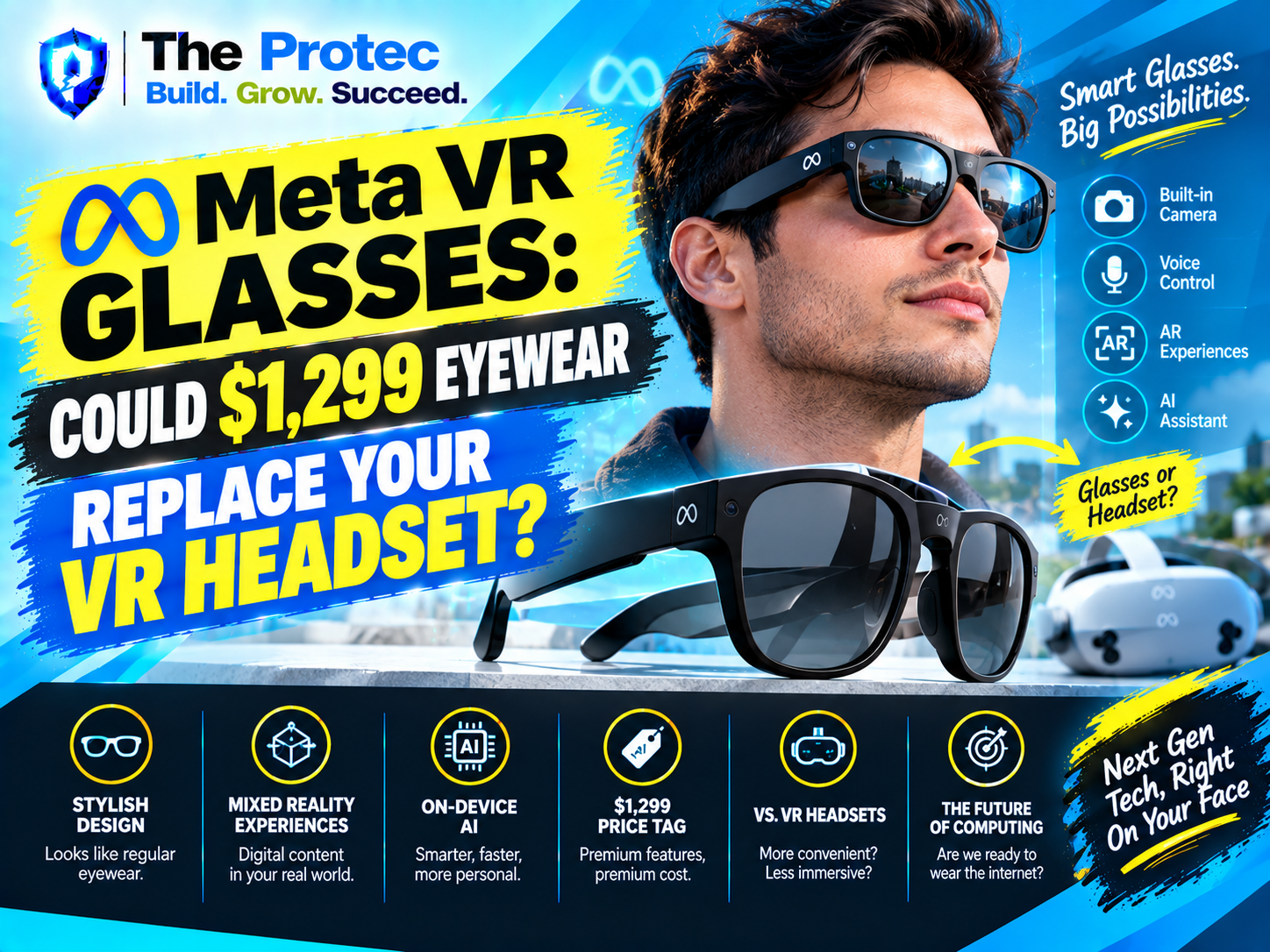
Virtual reality has spent years asking people to accept a familiar compromise: immersive digital worlds require a bulky device strapped to the face. Meta now wants to rewrite that equation. Announced at Meta Connect 2026, the new Meta VR Glasses shrink the core VR experience into eyewear weighing roughly 100 grams, while moving much of the computing and battery hardware into a separate pocket-size puck.
The concept is more ambitious than another pair of camera-equipped smart glasses. These are Meta immersive glasses designed for virtual reality, full-color passthrough, spatial computing, gaming, movies, sports and multi-screen work. They feature what Meta calls a 5K Infinite Display, micro-OLED panels, spatial audio, eye and hand controls, Meta AI and Qualcomm’s Snapdragon Reality Elite processor.
The headline specifications are matched by a premium price. The Meta VR Glasses price is $1,299.99, with availability planned for Spring 2027. That timing matters: the glasses have been announced, but they are not available to buy today. Performance, comfort and software claims will therefore need to be judged on shipping hardware next year.
If Meta delivers on its presentation, however, this could be one of the clearest attempts yet to move VR from an occasional activity into an everyday personal-computing experience.
What Meta Announced at Meta Connect 2026
The Meta Connect announcement presented the glasses as a new category positioned between lightweight Meta AI glasses and conventional VR headsets. Existing smart glasses are comfortable enough for daily wear, but their visual interfaces are limited or absent. Headsets such as Meta Quest 3 provide immersive graphics, but their size and weight make them less convenient for long sessions or spontaneous use.
Meta VR Glasses attempt to combine the strengths of both. Their defining features include:
- A roughly 100-gram glasses form factor
- A 5K Infinite Display using micro-OLED panels
- A Snapdragon Reality Elite processor
- A two-part glasses-and-compute-puck architecture
- Up to three hours of high-resolution media playback
- Full-color passthrough for mixed-reality experiences
- Integrated spatial audio
- Eye tracking and hand-based controls
- Meta AI and the Muse experience layer
- Support for entertainment, gaming and multi-screen productivity
Meta has more information about its broader mixed-reality strategy on the official Meta Connect website. The crucial distinction is that these Meta virtual reality glasses are intended to create an immersive display rather than simply place small notifications in the wearer’s view.
A 100-Gram Design Changes the VR Equation
The Meta VR Glasses 100 grams specification may be more consequential than any processor benchmark. Meta Quest 3 weighs approximately 515 grams with its standard strap, while Apple Vision Pro hardware places roughly 600 to 650 grams on the wearer’s head before accounting for its external battery. Fit and weight distribution matter as much as raw mass, but moving toward 100 grams represents a dramatic reduction in facial load.
That reduction could address several persistent VR problems. Heavy headsets can create pressure around the forehead, cheeks and nose. They may shift during rapid movement, interfere with hair and become warm over extended sessions. Even enthusiastic owners often put them away between uses because entering VR requires deliberate setup.
Glasses are different. A device that can be picked up, worn quickly and left on for longer periods has a better chance of becoming part of a daily routine. It could make watching a courtside sports stream, opening a virtual workspace or playing a short game feel less like starting a dedicated VR session.
The 100-gram figure does not tell the whole story, though. Meta has reduced the weight on the face partly by relocating components to a compute puck. Users will still carry that puck, and a cable or wireless connection must reliably link the two parts. The design trades an all-in-one headset for lighter eyewear plus another device in a pocket.
How the Glasses-and-Compute-Puck Design Works
Instead of packing the processor, cooling system and full battery assembly into the glasses, Meta separates the system into two components. The glasses handle the displays, sensors, audio and user-facing optics. The compute puck houses the Snapdragon Reality Elite platform and other hardware that would otherwise add heat and weight near the wearer’s head.
This architecture has several potential advantages. The puck has more room for thermal management, which may allow sustained performance without making the glasses uncomfortably warm. A larger external battery is also easier to accommodate. Most importantly, Meta can make the eyewear significantly lighter while retaining the processing power needed for high-resolution immersive graphics.
There are trade-offs. A separate device must be charged and carried, and the connection between the components introduces another possible point of failure. Pocket heat, cable placement and real-world durability will be important factors when the product ships. Meta will also need to show whether the puck can be replaced or upgraded independently.
The company says the system can deliver up to three hours of high-resolution media playback. That figure is useful for films, live events and shorter work sessions, but it is not necessarily a promise of three hours under every workload. Gaming, full-color passthrough, wireless connectivity and intensive AI features may produce different battery results.
Meta VR Glasses Specs: 5K Micro-OLED and Spatial Audio
The display system is central to Meta’s pitch. The Meta VR Glasses 5K display is marketed as the Infinite Display and uses micro-OLED panels. Micro-OLED technology can provide high pixel density, deep blacks and strong contrast in a compact package, making it well suited to lightweight immersive devices.
Higher resolution matters because VR screens cover a large portion of the user’s field of view. Text, fine interface elements and distant objects can look soft when pixel density is insufficient. A sharp 5K-class presentation could make virtual monitors easier to read, improve cinematic content and reduce the visible pixel structure associated with older headsets.
Meta has not yet had a mass-market release tested under everyday conditions, so the Infinite Display branding should not be treated as an independent measurement of visual quality. Resolution is only one factor. Field of view, lens clarity, brightness, refresh rate, distortion, color accuracy and the size of the optical sweet spot will all affect the final experience.
Spatial audio complements the visual system by placing sound around the wearer without requiring separate headphones. For films and games, this can reinforce direction and distance. In passthrough mode, it could also blend digital audio with awareness of the physical environment.
Eye Tracking, Hand Controls, Muse and Meta AI
Meta is building the interface around eye and hand controls rather than treating traditional controllers as the only input method. Eye tracking can identify what a user is looking at, while hand tracking can translate pinches, gestures and movements into selections. Together, they offer a more immediate way to navigate windows and immersive environments.
The Muse layer is intended to coordinate these spatial interactions, helping users move between apps, media and virtual workspaces. Meta AI adds a conversational component. A wearer could potentially ask for information, organize content, adjust an environment or receive context-sensitive assistance without leaving the immersive interface.
That combination may be particularly important for mainstream adoption. Keyboards, gamepads and tracked controllers remain valuable for specialized tasks, but everyday computing needs an interface that works when accessories are not nearby. Looking at an object and using a subtle hand gesture is closer to the frictionless interaction Meta needs for daily use.
Privacy will remain a major consideration. Eye tracking, environmental cameras, hand tracking and AI can generate sensitive data about attention, surroundings and behavior. Meta will need clear controls for data processing, recording indicators, permissions and cloud-based AI features before these glasses feel appropriate in homes and workplaces.
Meta VR Glasses for Movies, Sports and Gaming
Immersive movies and personal theaters
Meta VR glasses movies could be one of the product’s strongest use cases. The glasses can create a large virtual cinema without requiring a television or projector, while micro-OLED contrast should suit dark scenes and letterboxed content. The lower facial weight may also make a two-hour film more comfortable than it would be on a conventional headset.
Up to three hours of high-resolution playback is enough for most films, although long features and back-to-back viewing could approach the limit. Streaming quality, app support and digital-rights restrictions will determine whether the hardware can become a practical personal theater.
Live and recorded sports
Meta VR glasses sports experiences could range from giant virtual screens to immersive camera angles that place viewers near the field or court. Spatial audio may recreate crowd atmosphere, while multiple panels could show statistics, alternate feeds and commentary around the main event.
The challenge is content availability. Compelling immersive sports require specialized production, high-bandwidth distribution and licensing agreements. The hardware can enable the experience, but leagues and broadcasters must supply suitable feeds.
Gaming without a full-size headset
Meta VR glasses gaming is where comparisons with Quest become unavoidable. Lightweight eyewear could make seated games, social worlds and mixed-reality titles more comfortable. The Reality Elite processor and eye tracking may also support sophisticated rendering techniques.
Still, Meta has not established that every Quest title will transfer seamlessly. Existing games may depend on tracked controllers, specific performance targets or Quest hardware features. Serious players will want details about controller support, latency, tracking volume and backward compatibility before viewing the glasses as a complete Quest replacement.
Can Meta VR Glasses Become a Real Workspace?
The Meta VR glasses workspace experience aims to replace physical monitors with resizable virtual displays. A user could arrange several screens around a desk, keep communication tools to one side and place a large document or creative canvas in the center.
The lightweight design could be transformative here. Productivity requires longer wear than a short game demo, and reducing pressure on the face may make virtual monitors more realistic for regular use. Full-color passthrough can preserve awareness of a keyboard, colleagues and the surrounding room.
Display clarity will be critical. A 5K micro-OLED system sounds promising, but workers need crisp text across the usable field of view, stable window placement and low-latency cursor movement. Reliable connections to PCs and cloud services will matter as much as visual spectacle. Eye and hand controls may handle window management, while a physical keyboard and mouse remain preferable for intensive typing and precision work.
Meta VR Glasses vs Meta Quest 3
The Meta VR Glasses vs Meta Quest 3 comparison is less about a straightforward upgrade and more about two different architectures.
- Weight: The glasses place roughly 100 grams on the face, compared with approximately 515 grams for Quest 3.
- Computing: Quest 3 is self-contained. The glasses offload major processing and battery functions to a separate puck.
- Display: The glasses use a 5K Infinite Display with micro-OLED technology, while Quest 3 uses LCD panels and pancake optics.
- Gaming: Quest 3 has an established standalone library and tracked controllers. The glasses’ final compatibility and accessory story remain to be proven.
- Comfort: Meta’s glasses should have a major advantage in facial weight, although fit and puck management require real-world testing.
- Price: At $1,299.99, the glasses occupy a substantially more premium tier than Quest 3.
Quest 3 is likely to remain the more accessible gaming choice, particularly for buyers who value an all-in-one system. The glasses are aimed at users who prioritize comfort, display quality and broader personal-computing functions.
Meta VR Glasses vs Apple Vision Pro
The Meta VR Glasses vs Apple Vision Pro comparison is closer because both products emphasize premium displays, eye-and-hand input, passthrough and spatial productivity. Their physical approaches are notably different.
Apple Vision Pro places most of its computing hardware in the headset and connects to an external battery. Meta moves more of the system into a compute puck, enabling a much lighter glasses frame. Vision Pro offers a mature spatial interface and strong integration with Apple devices, while Meta brings years of VR gaming, social-world development and a broader consumer headset ecosystem.
Meta’s $1,299.99 launch price is also far below the original Vision Pro price, although it remains expensive compared with mainstream headsets. Apple provides official details about its approach on the Apple Vision Pro product page.
Ultimately, Meta’s advantage may be comfort and gaming heritage. Apple’s strengths remain ecosystem integration, polished productivity software and premium media experiences. Shipping software, app support and actual display performance will decide which approach is more useful.
Why Lightweight Glasses Could Shape the Future of VR Headsets
Meta believes the future of VR headsets depends on making immersive computing less intrusive. A device used every day cannot feel like protective equipment. It must be quick to wear, socially manageable and comfortable enough for films, work, communication and play.
The Meta VR Glasses are a serious attempt to reach that goal. Their two-part design acknowledges that processors and batteries still require space, but refuses to place all that weight on the user’s face. If the Infinite Display is sharp, passthrough is convincing and Muse with Meta AI feels natural, the glasses could bridge the gap between occasional VR and everyday spatial computing.
There are still important unknowns, including controller compatibility, prescription options, field of view, repairability, privacy controls and performance under demanding workloads. The price will also limit early adoption. Most importantly, consumers must wait: the Meta VR Glasses release date is Spring 2027, not today.
Frequently Asked Questions
How much will Meta VR Glasses cost?
The announced Meta VR Glasses price is $1,299.99. Accessories, prescription lens options and regional pricing may affect the total cost.
When is the Meta VR Glasses release date?
Meta plans to release the glasses in Spring 2027. They were announced at Meta Connect 2026 but are not currently available for purchase.
What are the main Meta VR Glasses specs?
Headline specifications include a roughly 100-gram frame, 5K Infinite Display with micro-OLED panels, Snapdragon Reality Elite processing, full-color passthrough, spatial audio, hand and eye controls, Meta AI and up to three hours of high-resolution media playback.
Will Meta VR Glasses replace Meta Quest 3?
Not immediately for every user. Quest 3 remains a lower-cost, self-contained gaming headset with an established software library. Meta’s glasses prioritize reduced facial weight, premium displays, entertainment and workspace versatility.
Are Meta VR Glasses the same as Meta AI glasses?
No. Meta AI glasses are primarily wearable assistants with cameras, audio and AI functions. Meta VR Glasses add immersive micro-OLED displays, spatial controls and virtual-reality capabilities intended for gaming, media and productivity.