






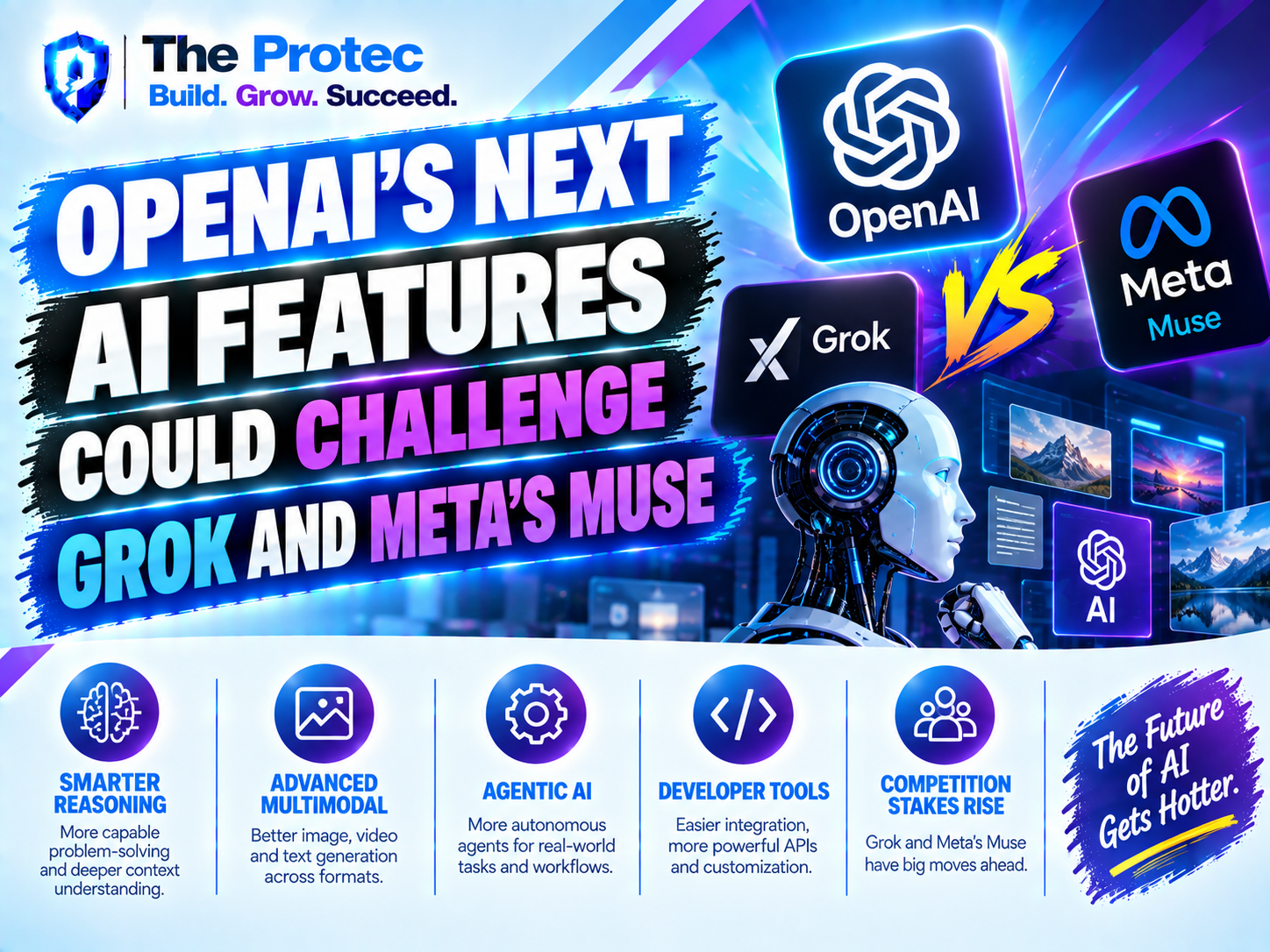
OpenAI’s next competitive battle may be about much more than building a smarter chatbot. As xAI expands Grok around real-time information and social content, while Meta develops generative systems such as Muse for visual creation, OpenAI is reportedly considering features that would turn ChatGPT into a broader assistant, creative platform, and personalized discovery environment.
That direction would be a significant evolution. ChatGPT began as a conversational interface, but the modern AI market increasingly rewards products that can research, create, recommend, publish, and act on a user’s behalf. The most important OpenAI new AI features are therefore likely to connect capabilities that previously lived in separate tools: multimodal generation, autonomous agents, persistent memory, real-time discovery, and collaborative content feeds.
Not every feature discussed around OpenAI has been officially announced. Some capabilities are already confirmed and available in parts of the company’s product ecosystem, while others come from industry reports, prototype descriptions, or informed speculation. Understanding that distinction is essential when assessing whether OpenAI is building a true Grok competitor, a Meta Muse competitor, or something more ambitious than either one.
Why OpenAI Is Expanding Beyond the Traditional Chatbot
AI chatbot competition is no longer determined only by which model gives the best answer to a typed question. Users increasingly expect an assistant to understand images, speak naturally, search current information, generate media, remember preferences, and complete multi-step work across other applications.
Grok has differentiated itself through its close relationship with X, where public conversations, breaking news, and trending topics provide a continuously changing information layer. Meta, meanwhile, can distribute AI experiences through enormous social and messaging networks while applying its generative AI research to images, video, recommendations, and advertising.
OpenAI has strong models and a widely recognized consumer product, but it does not operate a mature social network. That creates both a weakness and an opportunity. Instead of reproducing X or Meta’s platforms feature by feature, OpenAI could make ChatGPT the interface through which users discover information, produce content, coordinate tasks, and interact with specialized AI agents.
What OpenAI Has Officially Confirmed
Confirmed OpenAI AI updates already reveal the foundation of this strategy. Through product announcements published on the official OpenAI news page, the company has established several major areas of development:
- Multimodal ChatGPT AI features that can work with text, images, files, audio, and natural voice interactions.
- Web search and research tools designed to retrieve current information rather than relying exclusively on model training data.
- Image and video generation systems that extend OpenAI generative AI beyond written content.
- Memory and personalization capabilities that allow ChatGPT to adapt to a user’s preferences and previous interactions.
- Agentic tools that can reason through multi-step objectives and, with appropriate permissions, interact with websites or connected services.
- Work-oriented features such as projects, document analysis, data tools, and integrations with external information sources.
These are not merely isolated additions. Together, they provide the components needed for an AI product that can observe, plan, create, and act. OpenAI has not confirmed that every component will become part of a Grok-style social feed or Muse-like creative network, but the underlying technology is already visible.
Reported OpenAI New AI Features Under Development
Reports surrounding OpenAI’s product roadmap have repeatedly pointed toward more social, proactive, and agent-driven experiences. The precise design, release schedule, and branding remain uncertain, so these ideas should not be treated as guaranteed ChatGPT updates.
A Personalized Feed for AI-Generated Content
One of the most consequential reported ideas is a social or discovery feed built around AI-generated material. Such a feature could let users share images, prompts, research outputs, custom assistants, short videos, or interactive creations. Recommendations could be generated from a person’s interests and ChatGPT activity rather than relying only on whom that person follows.
This would place OpenAI closer to both xAI and Meta. A feed could provide the continuous engagement that conversational products often lack, while giving OpenAI access to signals about which creations people find useful, entertaining, or worth remixing.
However, a prototype is not the same as a finished product. OpenAI has not established that it will launch a conventional social network, and any public feed would introduce difficult questions involving moderation, copyright, synthetic media labels, privacy, and model training consent.
More Capable OpenAI AI Agents
OpenAI AI agents represent the clearest path beyond question-and-answer chat. Rather than telling users how to perform a task, an agent can potentially break the task into steps, gather information, use software, and return a completed result.
Future agent features could combine browsing, coding, document analysis, scheduling, purchasing workflows, and communication tools. A user might ask ChatGPT to compare products, verify availability, prepare a decision brief, and organize the next step without manually moving between several websites.
This overlaps with Grok’s push toward a more capable real-time assistant, but OpenAI’s advantage may come from workflow depth. The central challenge is reliability. Agents need transparent approval controls, secure access to accounts, clear activity logs, and the ability to stop before taking an irreversible action.
AI-Native Creation and Remixing
Another likely focus is a unified creative workspace for generating and editing text, images, audio, and video. Instead of opening separate tools for brainstorming, production, and revision, users could create an asset conversationally and transform it through follow-up instructions.
For example, ChatGPT could draft a campaign concept, produce visual directions, generate variations, adapt the result for different formats, and explain why each version suits its intended audience. Shared creations could then become templates that other users remix.
This is where comparisons with Meta’s Muse become most relevant. Muse refers to Meta’s research into efficient text-to-image generation and related visual modeling rather than a single universally available chatbot equivalent to ChatGPT. Meta’s published Muse research emphasized image generation through masked generative transformers. The broader competitive overlap lies in fast visual creation, editing, personalization, and distribution.
Real-Time Trends and Personalized Discovery
Grok benefits from access to the public conversation occurring on X. OpenAI could answer that advantage by improving how ChatGPT identifies current topics across the open web and presents them in a personalized format.
A discovery layer might combine cited search results, expert sources, user-selected interests, and AI-generated summaries. Unlike a standard trending list, it could explain why a development matters, identify conflicting claims, and let the user investigate the original evidence.
This remains an area where implementation matters more than the headline. Real-time systems can amplify rumors as quickly as they surface legitimate news. OpenAI would need strong source attribution, freshness indicators, corrections, and controls that help users distinguish reporting from commentary.
Grok vs ChatGPT: Where the Competition Is Heading
The Grok vs ChatGPT comparison increasingly reflects different distribution strategies. Grok is closely integrated with a network built around live public posts. That gives it a natural position in trend analysis, commentary, and event-driven queries. ChatGPT has developed around direct assistance, professional workflows, creative tools, and a large ecosystem of individual and business users.
Reported social and discovery features could narrow Grok’s distribution advantage, but OpenAI does not necessarily need to recreate X. A smaller network centered on useful AI outputs could be valuable if it helps people find effective prompts, research methods, agents, and creative assets.
Tone is another competitive factor. Grok has often been positioned as more irreverent and connected to internet culture. ChatGPT generally emphasizes broad utility and configurable assistance. Future OpenAI AI features may offer more flexible personalities, but enterprise adoption and safety expectations will continue to influence how far that customization can go.
Meta Muse vs ChatGPT: The Creative AI Contest
The Meta Muse vs ChatGPT comparison is less about two identical consumer assistants and more about competing approaches to generative media. Meta’s strength comes from visual research, recommendation technology, advertising infrastructure, and distribution through social apps. It can place generative creation directly beside the audiences and communities that consume the result.
OpenAI’s potential strength is conversational orchestration. ChatGPT can help users move from an undeveloped idea to a finished asset while preserving the reasoning and instructions behind each revision. If OpenAI adds stronger discovery and sharing tools, the creation process could become collaborative rather than private.
Both approaches raise similar concerns. Creators need clarity about training data, ownership, attribution, impersonation safeguards, and whether generated content is labeled. Winning the creative AI market will require more than realistic output; it will require trust and practical control.
What Is Still Speculation?
Several possibilities are logical extensions of OpenAI’s technology but remain speculative unless the company announces them. These include a full public social network, an advertising-supported ChatGPT feed, direct access to a global real-time social graph, autonomous publishing without user approval, and a creator revenue-sharing program.
It is also premature to assume that all rumored capabilities will ship under the ChatGPT name. OpenAI could test them in limited experiments, release them as separate applications, reserve them for paid plans, or abandon them after evaluating safety and user demand.
Claims about launch dates should receive particular scrutiny. OpenAI new features can change during testing, and model availability often differs by region, subscription, device, and organizational policy.
What the OpenAI Latest News Means for Users
If these developments arrive, ChatGPT could become less like a blank chat window and more like an adaptive operating layer for digital work. Users may begin with a goal rather than a prompt, allowing the system to choose whether it should search, generate media, call an agent, consult a connected source, or ask for approval.
Businesses could gain faster research and content workflows, but they will need governance for sensitive data and automated actions. Creators could gain powerful production and distribution tools while facing more competition from low-cost synthetic content. Publishers may receive new referral traffic from cited discovery experiences, although AI-generated summaries could also reduce direct visits.
For the wider market, the shift suggests that standalone model quality will become less decisive. Distribution, memory, integrations, safety, and the ability to complete tasks will shape the next stage of AI chatbot competition.
FAQ: OpenAI New AI Features
Is OpenAI officially building a competitor to Grok?
OpenAI has not announced a product explicitly described as a dedicated Grok replacement. Confirmed investments in search, multimodal models, research tools, and agents do overlap with Grok, while reports of social discovery features would increase that competition.
A social or content-feed experience has been discussed in industry reporting, but a full ChatGPT social network is not confirmed. OpenAI could instead launch limited sharing, remixing, or personalized discovery features without building a conventional social platform.
How would ChatGPT compete with Meta’s Muse?
ChatGPT could compete through integrated visual generation, conversational editing, multimodal workflows, and tools for sharing or remixing creations. Meta retains major advantages in social distribution and recommendation systems.
What are the most important confirmed ChatGPT AI features?
The confirmed direction includes multimodal interaction, web-connected research, media generation, memory, file and data analysis, and increasingly agentic task completion. Availability can vary by plan, region, and product version.
When will the rumored OpenAI new features launch?
There is no reliable universal launch date for unannounced features. Some may appear as small experiments before a broad release, while others may change substantially or never reach the public.
The Bottom Line
OpenAI’s apparent goal is not simply to add more buttons to ChatGPT. The larger opportunity is to connect intelligence, creation, discovery, and action in one personalized interface. That would let OpenAI challenge Grok’s real-time relevance and Meta Muse’s creative ambitions without copying either product exactly.
The competitive picture remains fluid. Confirmed OpenAI AI features already support a more capable multimodal and agentic assistant, while reports of feeds, sharing, and deeper personalization point toward a broader platform. Until OpenAI provides formal details, those reported elements should be viewed as possibilities rather than promises. What is clear is that the AI assistant race is moving beyond conversation—and the next winner may be the system that can turn context into reliable action.