









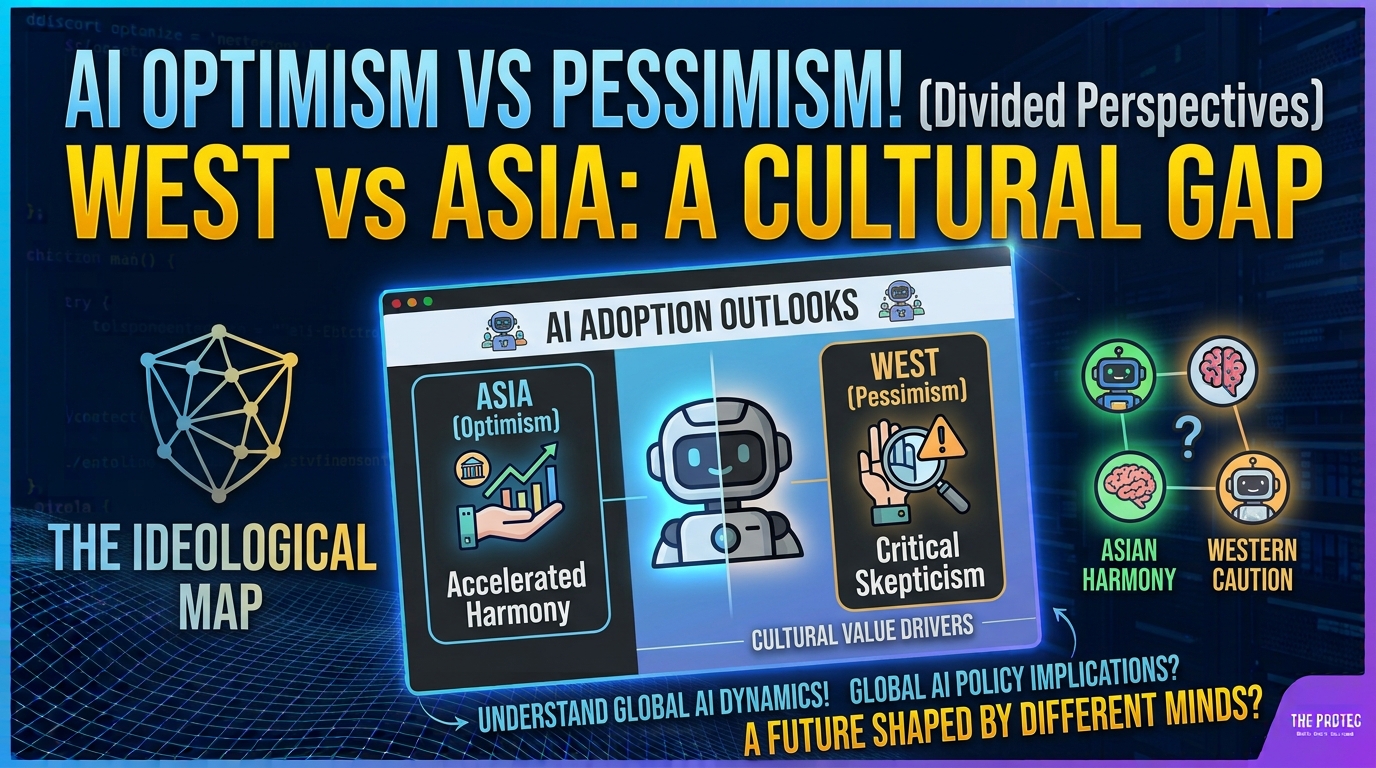
Artificial intelligence inspires markedly different expectations around the world. The debate over AI optimism vs pessimism is especially visible when wealthy Western countries are compared with fast-growing Asian economies: many Western respondents anticipate job losses and inequality, while people in several emerging markets see new routes to productivity, education and economic mobility. The divide is real, but it is neither universal nor as simple as “the West fears AI and Asia welcomes it.”
Survey results available through November 2026 suggest that economic conditions, exposure to digital tools, government policy and expectations of progress all influence public opinion on artificial intelligence. Crucially, attitudes, actual AI adoption and measurable economic results are three different things. A person can use AI regularly while distrusting it, or expect economic growth while worrying about personal job security.
What global surveys actually show
One frequently cited result comes from a 2025 Pew Research Center survey of 28,333 adults in 25 countries, conducted from January 8 to April 26. The survey covered Argentina, Australia, Brazil, Canada, France, Germany, Greece, Hungary, India, Indonesia, Israel, Italy, Japan, Kenya, Mexico, the Netherlands, Nigeria, Poland, South Africa, South Korea, Spain, Sweden, Turkey, the United Kingdom and the United States.
Asked whether AI would lead to “more jobs, fewer jobs, or not make much difference” in their country over the next 20 years, a median of 55% across surveyed high-income countries expected fewer jobs. The corresponding median was 36% among surveyed middle-income countries.
That finding measures expectations about the number of jobs—not overall support for AI, personal trust in an AI system or willingness to use one. It therefore should not be described as proof that 55% of people in wealthy countries are broadly pessimistic about artificial intelligence. Respondents may simultaneously expect fewer jobs and anticipate better health care, higher productivity or more convenient services.
The Ipsos AI Monitor 2024 provides another useful comparison. Ipsos surveyed 23,685 online adults across 32 countries between April 19 and May 3, 2024. Its country coverage included China, India, Indonesia, Japan and Singapore as well as large Western economies. Respondents indicated whether they agreed with statements such as “Products and services using artificial intelligence make me excited” and “Products and services using artificial intelligence make me nervous.” Excitement tended to be higher in several emerging markets, while nervousness remained substantial across both advanced and emerging economies.
These results also require care. Online samples in countries such as India, Indonesia and China can be more urban, connected, educated or affluent than the national population. They are valuable for cross-market comparison but may not represent every adult equally.
A third benchmark, the University of Melbourne and KPMG’s 2025 global study, surveyed 48,340 people in 47 countries from November 2024 to January 2025. It found higher reported AI use and trust in emerging economies than in advanced ones. Its questions addressed frequency of use, perceived benefits and respondents’ willingness to rely on AI. As with the other surveys, self-reported use is not the same as independently measured adoption or economic output.
Economic opportunity versus AI job displacement
The strongest explanation for the perception gap may be what people believe they stand to gain—or lose.
In many emerging economies, AI arrives alongside expanding internet access, digital payments, online education and cross-border services. Entrepreneurs can use generative AI to translate marketing materials, write software, analyze customers or serve international clients. Students can obtain low-cost tutoring, while small companies can reach markets that previously required large administrative teams.
For workers facing limited access to specialized training or formal employment, AI may look like a capability multiplier. It can help a small exporter produce product descriptions in several languages, allow a freelance developer to complete unfamiliar tasks or give a rural business access to basic analytical tools. These possibilities support more positive expectations about the AI economic impact, even before broad productivity gains appear in national statistics.
Wealthy Western economies have a different baseline. Their labor markets contain large numbers of office, media, finance, legal, administrative and technical jobs whose tasks overlap with the capabilities of generative AI. Workers who already have relatively high wages and established careers may focus less on gaining access and more on preserving income, bargaining power and professional status.
That makes AI job displacement a particularly salient concern. The risk is not limited to immediate layoffs. Employees may fear slower wage growth, reduced entry-level hiring, closer workplace surveillance or the transfer of tasks from experienced professionals to smaller AI-assisted teams. Previous waves of automation also created prosperity unevenly, reinforcing doubts that productivity gains will be shared.
Neither outlook guarantees what will happen. Experimental research has found productivity improvements for some writing, coding and customer-support tasks, especially among less experienced workers. But task-level gains do not establish economy-wide growth, and exposure to automation does not mean an entire occupation will disappear. Adoption costs, errors, organizational change, regulation and customer preferences all affect real outcomes.
Why policy and public investment shape confidence
People judge technology partly through the institutions introducing it. National AI strategies can make AI appear to be a shared development project, while weak protections or unclear rules can amplify distrust.
- China combines major investment in AI infrastructure and industrial deployment with rules for recommendation algorithms, deep synthesis and generative AI services. Adoption is extensive, but confidence in commercial applications should not be confused with unrestricted trust or the absence of privacy and employment concerns.
- India has positioned AI as a development and services opportunity through the IndiaAI Mission, public digital infrastructure and investment in computing, datasets and skills. Its large technology workforce creates optimism, although automation could also disrupt outsourcing and entry-level service roles.
- Singapore pairs high digital capacity with its National AI Strategy 2.0, workforce programs and testing initiatives such as AI Verify. Visible investment and relatively capable institutions may support acceptance, but residents still express concerns about scams, data use and employment.
- Japan illustrates why Asia cannot be treated as uniformly enthusiastic. Its aging population and labor shortages create a practical case for automation, yet consumer adoption and trust have often been more cautious than in China or India. Reliability, accountability and social acceptance remain important barriers.
- Indonesia has a young, mobile-first population and a growing digital economy. AI may be associated with entrepreneurship, education and access to services, while uneven connectivity, digital literacy and worker protection complicate adoption.
Western policy can have a different psychological effect. The European Union’s AI Act, most of whose general framework became applicable in stages by August 2026, emphasizes risk classification, transparency and accountability. Those safeguards may build long-term trust, but the political debate surrounding them also keeps potential harms highly visible. The United States has relied on a changing mix of federal guidance, sector-specific oversight, state laws and private governance, leaving workers and consumers with less certainty about protections.
Regulation is therefore not inherently optimistic or pessimistic. Clear, enforceable rules can increase confidence by defining responsibility when systems discriminate, expose data or cause harm. Poorly designed rules can also raise compliance costs, protect incumbents or slow useful experimentation.
AI adoption in Asia is not one story
“Asia” includes economies with different political systems, income levels, demographics and technology sectors. China’s large domestic platforms, India’s services economy, Singapore’s state capacity, Japan’s aging workforce and Indonesia’s mobile-first market produce different incentives.
Reported AI adoption in Asia is often highest among digitally connected workers and students in China and India. Singapore combines strong business adoption with institutional governance. Japan can be technologically advanced yet comparatively reserved in consumer attitudes. Indonesia shows considerable interest, but access and skills vary sharply between urban and rural communities.
Western attitudes toward AI are equally diverse. Younger adults and people who use AI at work may be more receptive than older or less digitally connected groups. Technology professionals can be enthusiastic about capability while supporting strict regulation. Europeans may place greater emphasis on privacy and rights, whereas Americans often divide along occupational, educational and political lines.
Cultural expectations may contribute, but broad stereotypes are poor explanations. Attitudes can reflect recent growth, confidence in education, perceived economic mobility and memories of previous technological transitions. A society in which digital platforms recently expanded opportunity may interpret AI differently from one where automation is associated with factory closures or insecure work.
Does regular use make people more optimistic?
Familiarity often correlates with greater acceptance. People who use AI for translation, research, coding or routine administration can see concrete benefits rather than treating the technology as an abstract threat. Adoption may also improve people’s ability to recognize limitations, including fabricated answers and inconsistent reasoning.
However, the direction of causation is uncertain. Optimistic people may simply be more likely to try AI. Workplace requirements may also increase usage without increasing trust. A teacher required to use an automated platform, for example, might become more familiar while growing more concerned about accuracy or student data.
Digital education matters because informed confidence is more durable than enthusiasm based on novelty. Users need to understand verification, privacy, intellectual property, bias and when human judgment remains essential. Worker retraining must likewise connect to real jobs rather than offer generic courses with no clear employment pathway.
The risks are global, even when optimism is high
Positive expectations do not remove the risks of automation, surveillance, misinformation or fraud. Generative systems can scale persuasive falsehoods, reproduce discrimination and expose confidential information. Cheap content production may weaken creative markets, while sophisticated tools can concentrate power in companies controlling compute, models and distribution.
The distribution of gains is therefore as important as total growth. If AI raises productivity but the benefits flow mainly to shareholders and highly skilled workers, public optimism may erode. Conversely, accessible tools, competitive markets, social protection and credible retraining can make adoption feel less threatening.
Governments should measure outcomes rather than relying on sentiment alone: changes in hiring, wages, business formation, learning, service quality and productivity. Public expectations can influence adoption, but they are not evidence that promised gains or feared losses have already occurred.
Will the global AI perception gap narrow?
The gap may narrow as AI becomes an ordinary part of workplaces, schools, businesses and public services. Familiarity could reduce exaggerated fears in wealthy countries. At the same time, visible job disruption, fraud or unequal gains could temper enthusiasm in emerging markets.
The eventual pattern will probably be more complex than West versus Asia. Countries that combine useful infrastructure, broad digital education, worker support and credible safeguards are likely to sustain greater confidence. Those that deploy AI without accountability or shared economic benefits may encounter resistance regardless of geography.
AI optimism vs pessimism ultimately reflects expectations about institutions and opportunity as much as beliefs about technology. The central question is not whether one region understands AI better, but whether people expect to have agency—and a fair share of the benefits—as adoption accelerates.
Frequently asked questions
Is Asia generally more optimistic about AI than the West?
Several international surveys find greater excitement, trust or expected opportunity in emerging Asian markets than in many wealthy Western countries. However, Asia is not uniform: Japan is often more cautious than India or China, and concern about jobs, privacy and misinformation exists across the region.
Does Pew’s 55% figure mean most people in rich countries oppose AI?
No. The figure is the median share across surveyed high-income countries expecting AI to produce fewer jobs over 20 years. It measures one employment expectation, not overall optimism, trust, support for regulation or personal AI use.
Why might emerging economies see AI as an opportunity?
AI can lower barriers to education, translation, software development, entrepreneurship and global markets. In countries where access to expertise or formal employment is limited, these potential gains may feel more significant than the protection of existing high-income roles.
Retraining can help workers move into new or redesigned roles, but it is not a complete solution. Programs must match actual employer demand, remain accessible to displaced workers and be supported by labor protections, income assistance and policies that encourage broad sharing of productivity gains.