








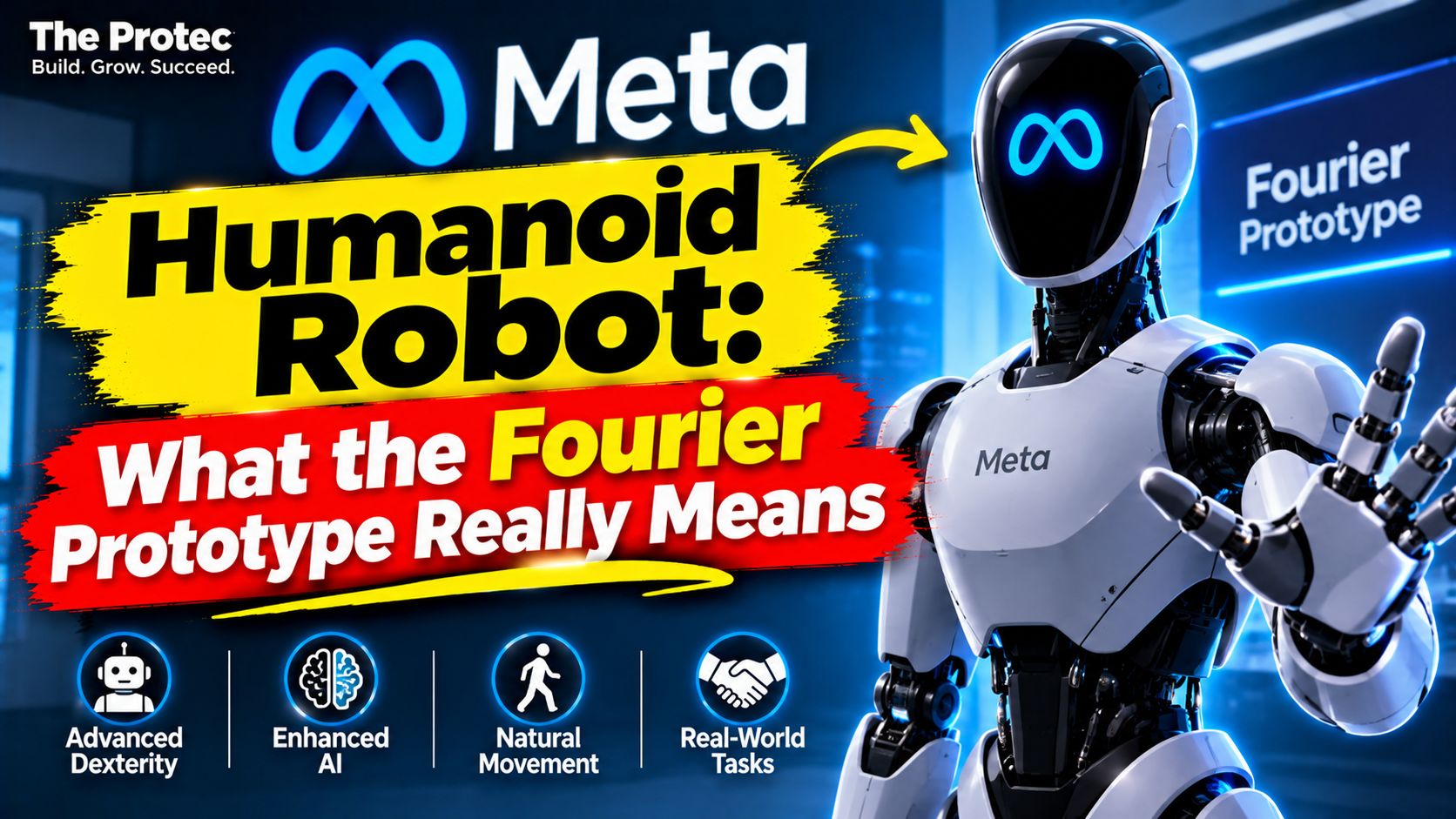
A humanoid machine reportedly assembled in roughly three months is offering a rare glimpse into how Meta may be thinking beyond screens and headsets. According to The Information, the Meta humanoid robot was built with Chinese robotics company Fourier for internal research, while work on a second prototype is underway. The account is notable, but it is not a product announcement: no verified evidence shows that Meta plans to sell the robots or enter the consumer home-robot market.
The distinction matters. A research prototype can help engineers study hardware, perception, control systems, and artificial intelligence without ever becoming a commercial device. The reported collaboration may therefore reveal more about Meta’s interest in embodied AI—systems that perceive and act in the physical world—than about any robot consumers will be able to buy.
What The Information reported about the prototype
The Information reported that Meta worked with Fourier, an established Chinese robotics manufacturer, to create a humanoid robot prototype in about three months. The publication also said a second prototype was being developed and that Meta had no plans to sell the units, describing them as intended for internal research.
Those points define the limits of what can responsibly be concluded. The report does not establish the robot’s level of autonomy, dexterity, reliability, operating time, intelligence, or ability to perform particular household tasks. It also does not confirm whether the machine uses a standard Fourier platform, a modified design, Meta-developed components, or some combination of technologies from both organizations.
Reuters has not independently verified The Information’s reporting. As of this article’s October 2026 publication date, Meta’s reported position and the detailed terms of the collaboration remain unconfirmed in the absence of a primary-source statement or additional reliable reporting. The prototype should consequently be described as reported—not as a confirmed Meta product or commercial initiative.
Why Meta may work with an established robotics manufacturer
Building a humanoid robot from scratch requires far more than designing an AI model. The hardware must integrate actuators, joints, sensors, power systems, structural components, thermal controls, electronics, and safety mechanisms. Each part must operate within tight weight, size, and energy constraints, while the complete system must withstand repeated physical movement.
Partnering with an experienced manufacturer could let an AI-focused company begin experiments without first creating an entire robotics supply chain. Fourier could potentially contribute hardware engineering, component sourcing, manufacturing knowledge, and an existing development platform. Meta could then concentrate more of its effort on areas such as perception, model integration, simulation, control software, or human-machine interaction.
That is a common strategic logic in emerging technology: use an established platform to shorten the path to experimentation. The reported three-month build time may reflect access to existing hardware and engineering processes rather than the invention of a complete humanoid system in one quarter. Without technical documentation, however, it is impossible to determine how much of the reported Meta Fourier robot was newly designed or how responsibilities were divided.
What a second humanoid robot prototype could indicate
The reported development of a second unit is potentially more informative than the existence of the first. One prototype can be a feasibility exercise. A follow-up may indicate that researchers want to test revisions, compare configurations, reproduce results, or give multiple teams access to hardware.
It can also reveal the iterative nature of robotics. Engineers routinely use one machine to identify mechanical limitations, sensor-placement problems, software bottlenecks, or maintenance issues, then adjust the next version. A second prototype could therefore signal a faster research cycle or a more organized internal robotics effort.
It does not, by itself, prove that Meta has approved a product, selected a target market, or committed to large-scale manufacturing. Two research units are still research units. The purpose, budget, team size, and long-term status of the reported program remain unknown.
Why Meta robotics research would fit a broader AI strategy
Modern AI systems are largely trained and evaluated through digital information: text, images, audio, video, and simulated environments. Robots add a more difficult dimension. They must connect perception and reasoning to physical action while dealing with incomplete information, moving objects, changing lighting, uneven surfaces, and people behaving unpredictably.
For Meta, a robotics platform could provide a test bed for combining several areas of AI research. Vision systems could interpret objects and spaces. Language models could translate instructions into plans. Software could track a machine’s position and choose actions, while control systems could turn those actions into safe movement. Data from physical interaction could also expose weaknesses that are difficult to see in purely digital tests.
This is the strategic appeal of embodied AI: an AI model must do more than generate an answer that sounds plausible. It must maintain an understanding of its surroundings, account for physical constraints, and recover when reality differs from its prediction. A misplaced virtual object is an inconvenience; an incorrect movement by a full-size robot can damage equipment or create a safety risk.
Meta’s history of investing in AI, computer vision, spatial computing, and research makes physical-world experimentation strategically understandable. Even so, that context is not proof that the reported prototype has advanced capabilities or is intended to become one of many AI-powered home robots. It only explains why internal robotics research could be useful to the company.
Why the China partnership is attracting attention
The involvement of a Chinese robotics company adds commercial and geopolitical context. China has a deep electronics manufacturing base, extensive component networks, and a growing robotics industry. Working with a manufacturer operating in that ecosystem may offer access to specialized engineering expertise and faster hardware iteration.
At the same time, cross-border technology partnerships are receiving greater scrutiny. Policymakers and companies increasingly consider export controls, intellectual-property protections, data governance, sourcing resilience, and the possibility that trade restrictions could affect access to components or technical collaboration. Humanoid robots also combine several sensitive technology areas, including AI, semiconductors, sensors, batteries, and advanced manufacturing.
Those considerations make the reported Meta-Fourier relationship newsworthy, but they are not evidence of wrongdoing. No public evidence cited in the account establishes an improper technology transfer, security incident, or regulatory violation. It would be irresponsible to imply otherwise without documentation.
The practical questions are narrower: Which company supplied which technology? Where was development conducted? What data, software, or designs were exchanged? Were any export-control or licensing requirements relevant? Until Meta, Fourier, regulators, or reliable reporting provide answers, conclusions about the partnership’s structure should remain tentative.
Research prototype, robotics program, or consumer product?
These terms describe different levels of commitment, and treating them as interchangeable can mislead readers.
- Research prototype: A limited experimental machine used to test ideas, integrate technologies, gather data, or expose technical problems. It may never leave a laboratory.
- Internal robotics program: An ongoing organizational effort involving teams, budgets, technical goals, and multiple experiments. Such a program can exist for years without producing a commercial device.
- Consumer product: A system designed for customers, with defined use cases, pricing, manufacturing plans, support, safety validation, regulatory compliance, and a route to market.
The Information’s account supports only the first category and may suggest a broader internal research effort because a second prototype is reportedly in development. It does not establish the third. There is no confirmed sale plan, launch schedule, price, household task list, or consumer availability.
The larger race to make humanoid robots useful
Humanoid designs are appealing partly because human environments are built around human bodies. Doors, stairs, shelves, tools, switches, and work surfaces assume a certain reach, height, and range of motion. In theory, a robot with a similar form could operate in those spaces without requiring every building or object to be redesigned.
In practice, useful humanoid robots face difficult engineering problems:
- Dexterity: Human hands combine strength, sensitivity, and precise control. Manipulating unfamiliar, fragile, slippery, or deformable objects remains challenging.
- Balance and mobility: Walking safely across cluttered or uneven spaces requires rapid sensing and control. A fall can damage the robot or nearby property.
- Safety: Machines operating near people need predictable behavior, force limits, emergency controls, and robust responses to unexpected events.
- Reliability: A compelling demonstration is different from completing useful work repeatedly over thousands of cycles with minimal intervention.
- Cost: Actuators, sensors, batteries, processors, maintenance, and manufacturing can make sophisticated robots expensive.
- Real-world generalization: Homes and workplaces vary enormously. Robots must handle objects and situations that were not represented exactly in their training data.
These constraints are why a prototype’s appearance says little about its practical value. The decisive evidence would involve repeatable performance, transparent testing conditions, safety measures, operating costs, and the amount of human supervision required. None of those details has been confirmed for the reported Meta machine.
What to watch next
The most important development would be an official statement from Meta or Fourier confirming the collaboration and defining its purpose. Technical information about the prototype’s hardware, software, data collection, control methods, and test environment would make it easier to assess the project’s significance.
Other signals include additional prototypes, dedicated robotics hiring, published research, demonstrations under realistic conditions, or evidence of a sustained internal team. Observers should also watch whether Meta continues describing the work as research-only. A commercial program would require much more than a prototype: a clear use case, safety validation, manufacturing scale, customer support, and an explicit route to market.
Until that evidence appears, the careful conclusion is also the most informative one. The reported project suggests that Meta may be exploring how its AI work could extend into physical machines. It does not show that a Meta robot is heading to consumers.
Frequently asked questions
Did Meta confirm that it built a humanoid robot with Fourier?
The account comes from The Information, which reported that Meta and Fourier produced a prototype in roughly three months. Reuters has not independently verified that reporting, and the partnership details remain unconfirmed without a primary-source statement or further reliable evidence.
Is the Meta humanoid robot going on sale?
No sale has been announced. The Information reported that Meta has no plans to sell the units and intends them for internal research. The prototype should not be treated as a commercial launch or evidence of a future retail product.
What can the reported prototype do?
Its specific abilities have not been reliably disclosed. There is insufficient verified information about autonomy, manipulation, mobility, safety, performance, or intended tasks. Claims that it can perform household work would therefore be unsupported.
Does the project mean Meta is entering the home-robot market?
No. Internal experimentation can help a company study embodied AI without creating a consumer business. Evidence of market entry would require a confirmed product plan, defined customer use cases, manufacturing preparation, pricing, support, and regulatory work.
Why is a second prototype significant?
A second machine may indicate continued iteration, comparative testing, or broader access for researchers. It can suggest that the work is more than a one-off assembly exercise, but it does not confirm a commercial roadmap or reveal the scale of Meta’s reported robotics effort.