







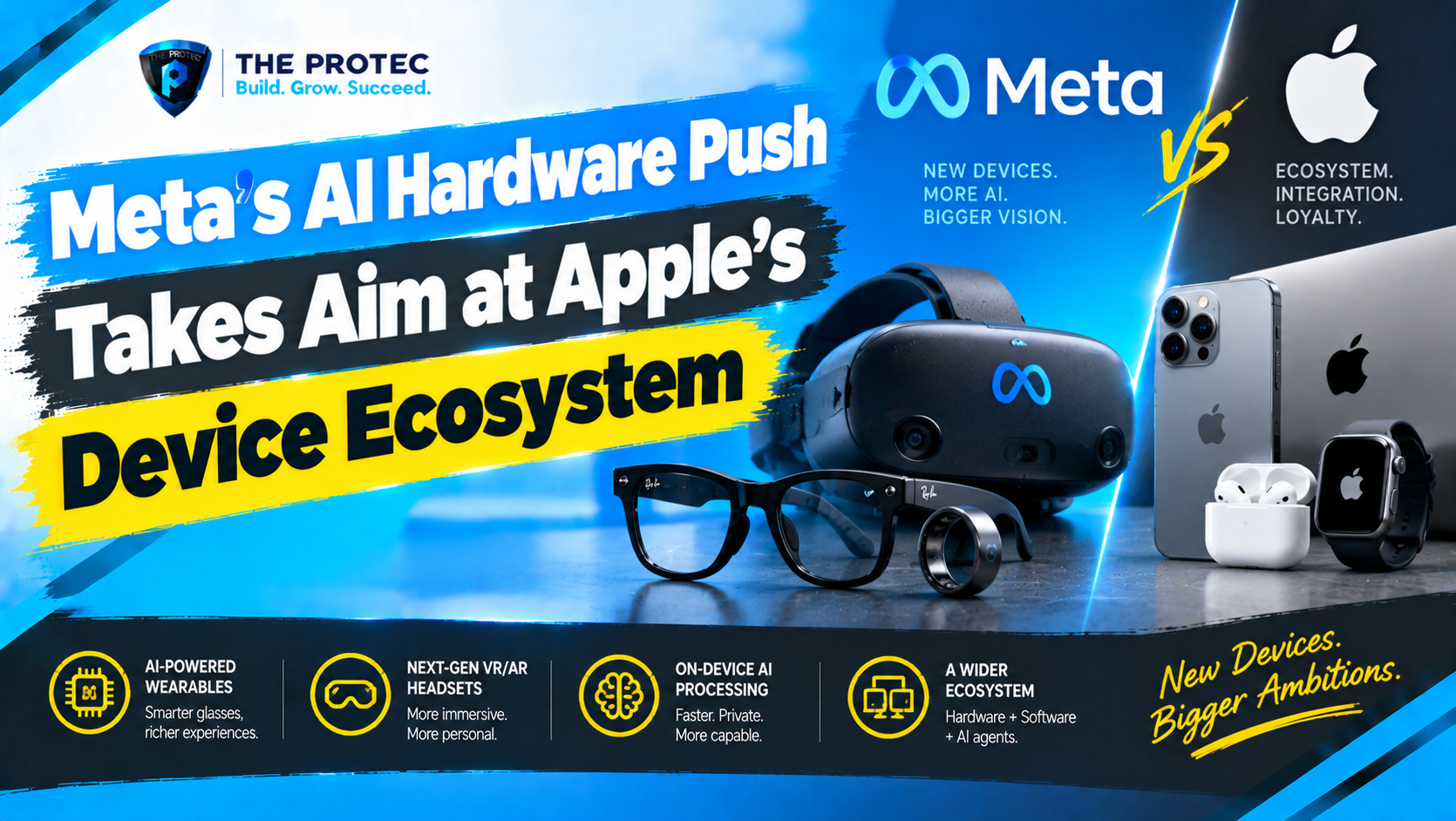
Meta’s ambitions now extend well beyond social networks, virtual reality and software-based assistants. The company is assembling a portfolio of Meta AI hardware intended to place artificial intelligence directly into objects people can wear, see through or carry throughout the day. At the center of this expansion are the compact Muse Charm, Meta’s growing AI glasses lineup and a broader vision for personal AI devices that reduce users’ dependence on smartphone screens.
The strategy does not mean the smartphone is about to disappear. Apple’s device ecosystem remains deeply entrenched, supported by the iPhone, Apple Watch, AirPods, Mac, services and a vast developer community. Meta is instead betting that the next important computing layer will be more ambient: cameras that understand what users see, microphones that hear spoken requests, displays that provide timely information and AI assistants that can act without requiring people to unlock a phone.
As of October 2026, the result is a more consequential Meta vs Apple contest. It is not yet a battle over who has replaced the smartphone. It is a race to determine which company will control the devices and AI interfaces surrounding it—and potentially what comes after it.
Meta’s post-smartphone strategy is taking shape
Meta’s AI hardware strategy is based on a simple observation: an assistant becomes more useful when it has immediate context. A chatbot inside an app knows only what a user types, uploads or explicitly shares. A wearable device can potentially understand spoken questions, visual surroundings, location, movement and recent interactions, subject to permissions and privacy controls.
That context helps explain why Meta is developing a family of devices rather than relying on one form factor. Smart glasses can offer a first-person camera, open-ear audio and, in some models, visual information. A compact device such as the Meta Muse Charm can provide another route to the Muse assistant. Watches, earbuds and future wearables could contribute additional sensors or interfaces.
Meta’s stated direction is personal AI that remains available throughout the day. The goal is not merely to shrink a phone application. It is to make the assistant easier to reach through voice, vision and hands-free interaction. Meta AI devices could therefore operate as companion products before evolving into more independent computing platforms.
What the Meta Muse Charm contributes
The Meta Muse Charm is significant because it expands the company’s hardware strategy beyond headsets and eyewear. Meta has positioned the compact device as a convenient access point for its Muse assistant, emphasizing personal AI that can be reached without repeatedly taking out a smartphone.
That positioning matters more than the device’s size. Today’s smartphones are powerful but demand deliberate attention: find the device, unlock it, open an application and navigate an interface. The Muse Charm is designed around a lower-friction model in which the assistant is closer at hand and interaction can begin more naturally.
Meta has not made every long-term capability or use case equally clear, so it is important not to assign the Charm features beyond those the company has announced. Its larger strategic role, however, is visible. Meta Muse AI hardware gives the company a way to test whether consumers want an AI-first device that complements glasses and phones rather than behaving like another miniature smartphone.
The Charm could also help Meta learn which interactions work best without a conventional screen. Short questions, reminders, translation, message assistance and contextual prompts are suited to voice-led devices. Lengthy reading, detailed editing and complex visual work still favor phones, tablets or computers. The challenge is to make a compact AI companion useful enough to justify carrying or wearing another product.
Meta AI glasses remain the strongest foundation
Meta smart glasses provide the clearest evidence that wearable AI can reach consumers in a familiar form. Ray-Ban Meta demonstrated that cameras, microphones, speakers and an assistant can be incorporated into eyewear that looks closer to conventional glasses than an experimental computer. That design approach is essential: wearables must succeed as objects people are comfortable using in public, not just as technical demonstrations.
The company’s expanding eyewear portfolio builds on that foundation. Different Meta AI glasses can emphasize audio, photography, assistant access or visual displays, but they contribute to the same platform strategy. The glasses sit in a useful position because they can capture a wearer’s perspective while leaving both hands free.
This enables interactions that are awkward on a phone. A user might ask an assistant about an object in view, request directions while walking, hear a translation during a conversation or capture a moment without holding a camera. Display-equipped models can add discreet visual guidance, notifications or responses. Meta provides additional product announcements and updates through its official newsroom.
These capabilities make Meta wearable AI more than a voice assistant attached to headphones. Cameras provide visual context, microphones collect commands and environmental audio, speakers deliver private responses, and displays can return information within the wearer’s field of view. AI connects those components by interpreting intent and deciding what information is relevant.
Why Meta’s expansion increases competition with Apple
Meta Apple competition has historically centered on advertising, application distribution, platform rules and privacy. Hardware turns that tension into a broader contest over the primary interface between consumers and digital services.
Apple’s advantage is integration. The iPhone remains one of the world’s most important computing platforms and is especially dominant in the premium smartphone market. Apple can connect its phones with watches, earbuds, computers, tablets, services and mixed-reality products through one account and a consistent software framework. Details of that portfolio are available on Apple’s official website.
Meta lacks an equivalent smartphone operating system, which has often left it dependent on Apple and Google for distribution. Meta AI hardware offers a possible way to create direct customer relationships beyond third-party app stores. If people regularly access an assistant through Meta smart glasses or the Muse Charm, Meta gains control over the hardware design, interface and service layer.
That does not mean Meta has displaced Apple’s device ecosystem. Most Meta AI devices still benefit from a phone for connectivity, setup, account management or demanding applications. Apple retains enormous advantages in processors, retail, supply chains, developer tools, customer support and consumer trust. The immediate competition concerns the next interaction layer around the smartphone, not the sudden elimination of the iPhone.
Over time, however, successful AI-powered wearables could weaken the phone’s role as the starting point for every digital task. That possibility places Meta’s AI hardware strategy in direct competition with Apple’s interest in keeping the iPhone and its connected products at the center of personal computing.
How ambient AI could change everyday computing
The case for post-smartphone computing rests on reducing friction. Instead of adapting a request to an application, a user tells an assistant what needs to happen. The AI then selects a service, interprets available context and returns the result through audio or a display.
For this model to work, Meta must coordinate several technical layers:
Multimodal understanding: The assistant must combine speech, images, text and environmental context accurately.
Efficient hardware: Cameras, microphones and displays must operate without making devices heavy, hot or short-lived.
Fast connectivity: Cloud processing needs low latency, while more on-device AI is required for speed, reliability and privacy.
Natural interfaces: Voice, gestures, touch and visual prompts must work without overwhelming the user.
Cross-device continuity: A task started on glasses or the Muse Charm should move smoothly to a phone or computer when necessary.
This is why the AI hardware market is becoming strategically important. The winning personal AI devices may not be those with the longest feature lists. They may be the products that disappear most effectively into established routines.
The barriers facing Meta AI devices
Wearable cameras and always-available microphones create concerns that conventional phones do not raise to the same degree. Meta must clearly communicate when sensors are active, what information is stored, whether data is processed locally or in the cloud, and how bystanders can recognize recording. Physical indicators, understandable controls and conservative defaults will be critical.
Meta’s history in advertising and personal data also means trust cannot be assumed. Even technically strong AI wearable devices may struggle if consumers believe their surroundings or conversations could be used in unexpected ways.
Battery life, heat and connectivity
Continuous sensing is expensive. Computer vision, wireless communication, displays and AI processing consume power while wearables have little room for batteries or cooling. Offloading work to the cloud saves local computing resources but introduces latency, connectivity requirements and additional privacy questions.
Meta must balance intelligence with comfort. Glasses cannot become too heavy, and compact products such as the Meta Muse Charm must deliver enough operating time to remain useful throughout the day.
Accuracy and dependable behavior
An assistant that misunderstands an occasional entertainment request may cause irritation. One that misreads a sign, invents details about an object or sends information to the wrong contact can create serious consequences. Meta needs strong safeguards, transparent uncertainty and graceful ways for users to confirm consequential actions.
Ecosystem depth
Hardware becomes a platform only when developers and services can create meaningful experiences around it. Apple’s device ecosystem benefits from mature applications, payments, health integrations and accessories. Meta needs compelling third-party support without allowing notifications and low-value experiences to turn ambient computing into a constant distraction.
A clear reason to buy
Novelty is not enough. Consumers already own phones, earbuds and smartwatches that handle many AI tasks. Meta must show that its products save meaningful time or enable experiences those devices cannot match. Style, prescription-lens support, durability, pricing and customer service will influence adoption as much as model performance.
Announced strategy versus post-smartphone speculation
Meta’s real products and public direction support several firm conclusions: it is expanding its AI hardware lineup, treating smart glasses as a major interface and building a family of devices around personal AI. The Muse Charm adds a compact access point for the Muse assistant, while Ray-Ban Meta and other eyewear demonstrate the value of cameras, microphones and hands-free assistance.
Claims that Meta has already created a smartphone replacement go beyond the evidence. Current wearables cannot match phones for application breadth, large-screen work, battery capacity or dependable connectivity. A fully post-smartphone future remains a longer-term possibility, not an accomplished transition.
Meta’s hardware bet is becoming harder to ignore
Meta AI devices in 2026 represent a coordinated attempt to own the next layer of personal computing. Muse Charm broadens access to the company’s assistant, while Meta AI glasses provide visual context and a practical hands-free interface. Together, they point toward computing that is more continuous, contextual and less centered on pulling a phone from a pocket.
Apple still holds the stronger conventional device ecosystem, and Meta faces substantial technical, privacy and adoption obstacles. Yet the strategic direction is clear: Meta wants AI wearables to become an everyday gateway to digital services. If that happens, the most important Meta vs Apple battle may concern not which phone people buy, but which assistant—and which device family—mediates the world around them.
Frequently asked questions
What is the Meta Muse Charm?
The Meta Muse Charm is a compact AI device designed to provide convenient access to Meta’s Muse assistant. It is part of the company’s broader effort to make personal AI available without requiring users to interact constantly with a smartphone screen.
Are Meta AI glasses replacing smartphones?
No. Meta AI glasses can handle hands-free photography, audio, assistant queries and contextual tasks, with some models adding visual information. Smartphones remain better suited to complex applications, large-screen content, connectivity and extended work. Glasses currently function primarily as companions and alternative interfaces.
How does Meta’s hardware strategy compete with Apple?
Meta is trying to build direct consumer access through AI glasses, compact assistants and other wearables. This challenges Apple’s control of the smartphone-centered experience, although Apple continues to hold major advantages through the iPhone and its integrated hardware, software and services ecosystem.
What could prevent AI-powered wearables from becoming mainstream?
The largest obstacles include privacy concerns, battery limitations, inaccurate AI responses, uncomfortable designs, weak developer support and a lack of compelling everyday uses. Meta must address all of them while proving that wearable AI offers clear benefits beyond existing phones, watches and earbuds.