






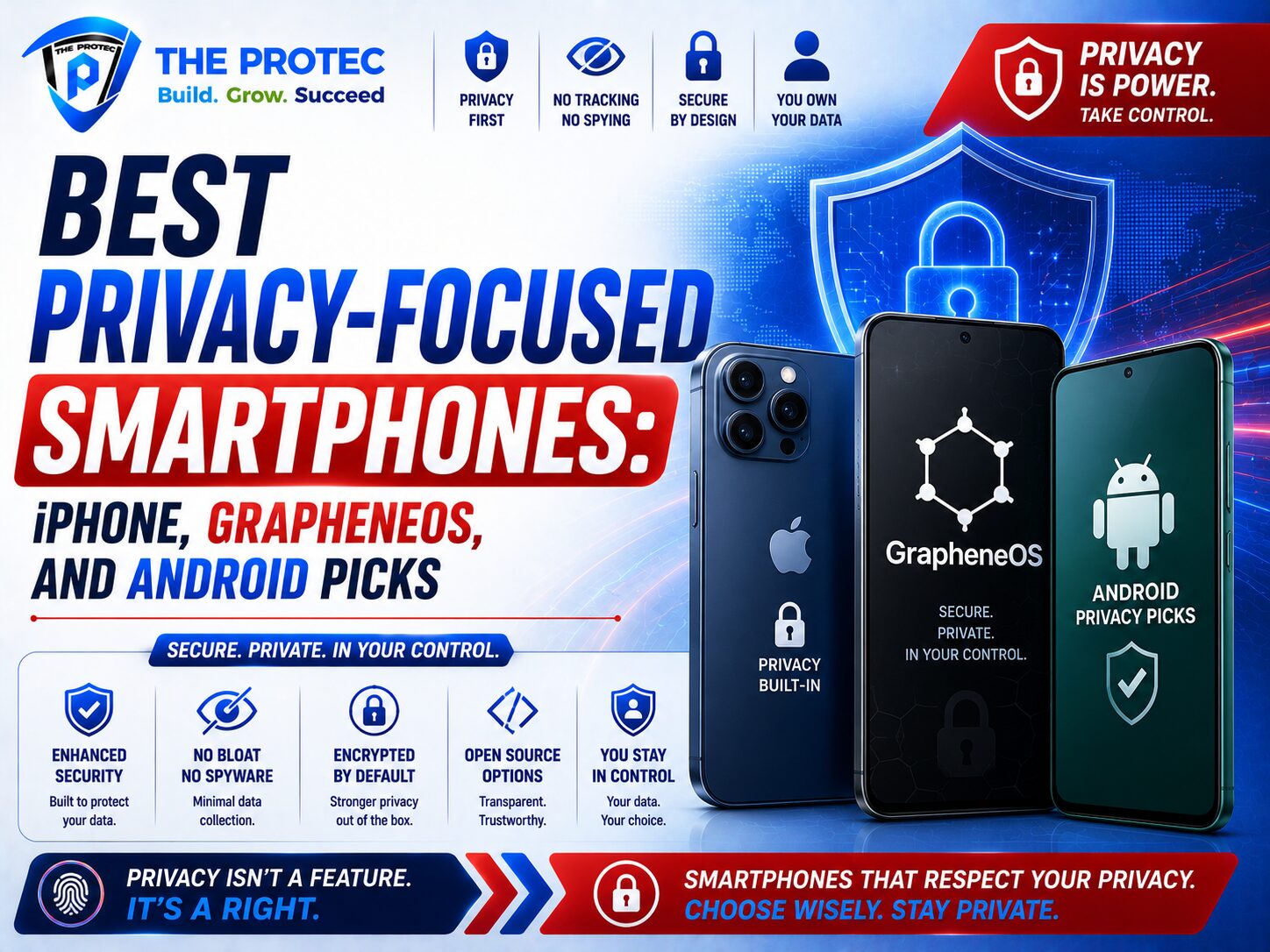
Best Privacy-Focused Smartphones: iPhone, GrapheneOS, and Android Picks
Choosing one of the best privacy-focused smartphones is no longer about picking the most obscure device on the market. In 2026, the real question is how much control you want over your data, what trade-offs you can accept, and which ecosystem fits your daily life. The modern privacy phone market now spans Apple’s tightly managed iPhone lineup, hardened Android builds like GrapheneOS, and a small but growing set of Android alternatives designed with stronger security and less data collection in mind.
This updated guide compares the most relevant privacy phones 2026 buyers should consider, with a focus on practical use rather than hype. If you need a secure smartphone for work, travel, activism, journalism, or simply reducing your digital footprint, the best choice will depend on how you balance convenience, security, app compatibility, and long-term support.
We will look at the latest privacy trends, where iPhone still leads, where GrapheneOS stands out, and which Android alternatives deserve attention. If you are searching for a GrapheneOS phone or comparing secure smartphones for everyday use, this breakdown will help you make a clearer decision.
What matters most in a privacy phone
A privacy-focused smartphone is not just a phone that blocks ads or hides your browsing activity. The best secure smartphones combine strong hardware security, fast software updates, transparent permissions, minimal telemetry, and protection against app-level tracking. In practice, that means looking at a few core factors.
- Update speed and longevity: Frequent, long-term security patches matter more than flashy features.
- Boot and hardware security: Secure enclaves, verified boot, and locked-down firmware help reduce tampering risks.
- Data minimization: The best privacy phones collect less data by default and give you control over what is shared.
- App isolation and permissions: A strong operating system should prevent one app from reading too much about another.
- Network and sensor controls: Modern privacy tools should let you limit background access, location leakage, and unnecessary connectivity.
For most people, no phone is perfectly private. The goal is to choose the device that gives you the best mix of security, usability, and trust. That is where the iPhone, GrapheneOS, and privacy-first Android alternatives diverge sharply.
iPhone: the strongest mainstream privacy choice
Apple continues to be the easiest recommendation for people who want a secure smartphone without giving up mainstream convenience. The iPhone’s biggest advantage is not that it is secretive; it is that Apple controls the entire stack. Hardware, operating system, app distribution, and security updates are tightly integrated, which gives Apple a major advantage in consistency and patch management.
In recent years, Apple has added stronger privacy tools across iOS, including more detailed permission prompts, app tracking transparency, Lockdown Mode, safety features for messaging, and improved account protections. For everyday users, these controls make the iPhone one of the most practical privacy phones 2026 shoppers can buy. It is especially compelling for people who want strong default protection and do not want to spend time hardening a device manually.
The iPhone also benefits from excellent update support. Even older models tend to receive security updates for years, and Apple’s rapid patch cadence remains a major advantage over much of the Android market. That consistency is a key reason many security teams still recommend iPhone for mainstream users.
Still, the iPhone is not a perfect privacy device. Apple’s business model is not based on selling ads in the same way as some competing platforms, but it still operates a highly connected ecosystem. iCloud synchronization, device analytics, and the company’s closed environment mean users must trust Apple to a significant degree. If your goal is maximum data minimization and open transparency, iPhone will feel restrictive.
Best for: people who want strong security with minimal complexity, professionals, families, and users who value convenience over customization.
Why the iPhone remains a top secure smartphone
The iPhone remains competitive because it combines robust hardware security with mainstream usability. It is also the easiest option for people who use communication apps, banking tools, travel apps, and enterprise services that still expect a mainstream mobile platform. If you need something that works well out of the box and still gives you excellent privacy controls, iPhone is still one of the safest choices.
GrapheneOS: the most hardened privacy smartphone option
For users who want the highest level of control, a GrapheneOS phone is often the gold standard. GrapheneOS is a privacy- and security-focused Android-based operating system designed to harden the platform without sacrificing the modern app ecosystem. It is not about looking flashy or making bold marketing claims. It is about reducing attack surface, improving app containment, and minimizing data exposure.
GrapheneOS stands out because it retains Android app compatibility while stripping away many of the privacy and security weaknesses that come with standard consumer builds. It offers stronger sandboxing, tighter permission controls, improved exploit mitigations, and a general philosophy of limiting trust in apps and services. For technically minded users, researchers, journalists, and anyone who wants maximum control, GrapheneOS is often the most compelling secure smartphone platform available.
The catch is that GrapheneOS is not a casual purchase. It works best on supported Google Pixel hardware, which is why the typical GrapheneOS phone is a Pixel device running GrapheneOS rather than a random Android handset. That means your hardware choice is constrained, and setup is more intentional than buying an iPhone. However, the payoff is substantial if privacy is your top priority.
One of the major advantages of GrapheneOS is that it gives you a much cleaner relationship with Google services. You can choose whether to use them, isolate them, or avoid them entirely. That flexibility is exactly what many privacy-focused users want in 2026, especially as more people grow uneasy about always-on cloud sync, advertising identifiers, and broad app permissions.
Best for: advanced users, security-conscious professionals, activists, journalists, and anyone who wants a hardened privacy phone with strong app compatibility.
What makes a GrapheneOS phone different
A GrapheneOS phone is not just “Android with fewer apps.” It is a platform built around reducing trust in software by default. That means better isolation, stricter controls, and a security model that gives users more leverage over what runs on the device. If you are comfortable with a steeper learning curve, GrapheneOS can offer one of the best privacy and security combinations available on a consumer phone.
Android alternatives: privacy-first without going fully hardened
There is a middle ground between iPhone convenience and GrapheneOS hardening. Several Android alternatives now cater to users who want better privacy than stock Android but do not want the stricter constraints of GrapheneOS. These devices and operating systems vary widely, so it is important to separate genuine privacy improvements from marketing language.
Some privacy-focused Android options emphasize de-Googled software, open-source app stores, and reduced telemetry. Others focus on enterprise-grade security, long update support, or regional privacy compliance. The best of these devices can be a good fit for users who want more flexibility than iPhone and less technical overhead than GrapheneOS.
That said, many Android alternatives still lag behind in one or more important areas. Update reliability can vary, bootloader policies may be less strict, and the privacy claims may not be as transparent as they appear. For buyers who want a secure smartphone, this means checking the update policy, the vendor’s data practices, and whether the device has a proven security track record.
In 2026, the strongest Android alternatives are usually not the most heavily marketed ones. They are the devices with clear patch support, verifiable security features, and a realistic approach to privacy. If you want a balance of usability and control, a well-supported Android alternative may be the right compromise.
Who should consider Android alternatives
Choose an Android alternative if you want more customization than iPhone, but do not need the advanced hardening of GrapheneOS. These phones are also attractive if you rely on specific Android workflows, split personal and work profiles, or want a device that can be managed more flexibly than Apple’s ecosystem allows.
Head-to-head comparison: iPhone vs GrapheneOS vs Android alternatives
When people compare privacy phones 2026, the decision usually comes down to trust, convenience, and flexibility. Here is how the three main options stack up in practical terms.
- Privacy by default: GrapheneOS leads, iPhone is strong, Android alternatives vary widely.
- Ease of use: iPhone leads, Android alternatives are moderate, GrapheneOS is the most demanding.
- App compatibility: iPhone and Android alternatives generally do better than GrapheneOS, though GrapheneOS remains highly compatible with most mainstream apps.
- Security posture: GrapheneOS is the most hardened, iPhone is excellent, Android alternatives depend on vendor quality.
- Customization: GrapheneOS and Android alternatives offer more control than iPhone.
- Trust model: iPhone asks you to trust Apple, GrapheneOS reduces trust in the platform, Android alternatives sit somewhere in between.
If you want the simplest answer, here it is: iPhone is the best mainstream privacy phone, GrapheneOS is the best privacy-focused smartphone for power users, and Android alternatives are the compromise option for buyers who need flexibility.
Best use cases by type of user
Not every user has the same threat model. A journalist working in a sensitive region needs a different secure smartphone than a parent who wants to reduce tracking without becoming a systems administrator. Matching the phone to the user matters more than chasing the “most private” label.
- For everyday users: iPhone is the most practical choice, with strong security and very low friction.
- For privacy enthusiasts: GrapheneOS provides the deepest control and the most refined hardening.
- For Android loyalists: A privacy-first Android alternative can preserve familiar workflows while improving data protection.
- For professionals handling sensitive data: GrapheneOS or iPhone, depending on whether you prioritize control or convenience.
- For users who dislike ecosystem lock-in: GrapheneOS or a strong Android alternative is usually the better fit.
The most important thing is to be honest about how you actually use your phone. A privacy phone that is too difficult to maintain becomes a security risk of its own if you stop updating it, misconfigure settings, or abandon safe habits. The best device is the one you can realistically keep secure.
Privacy trends shaping smartphones now
The privacy smartphone market is evolving quickly. In 2026, several trends are shaping what buyers should expect from secure smartphones. First, operating system vendors are improving permission granularity and reducing background data access, which helps all users. Second, hardware-level security features are becoming more central, especially in premium devices. Third, more users are becoming aware of cloud synchronization risks, which is pushing interest in local-first workflows and privacy-preserving services.
At the same time, app ecosystems remain a major pressure point. Messaging, banking, authentication, and workplace apps often assume broad access to device functions and cloud services. That reality keeps iPhone and Android compatibility highly relevant, even for users who care deeply about privacy. The best privacy phones 2026 are the ones that can survive in this environment without forcing the user into constant compromise.
Another major trend is the growing interest in device compartmentalization. Instead of trying to make a single phone handle every role, many users now separate devices or use profiles and sandboxing to reduce risk. GrapheneOS is especially strong in this area, but the broader market is moving in the same direction with improved work profiles, passkeys, and stronger local authentication.
Buying advice: how to choose the right secure smartphone
If you are shopping for a privacy-focused phone, start with your threat model. Ask yourself what you are trying to defend against: ad tracking, data brokers, malware, phone theft, targeted surveillance, or broad platform-level data collection. Different problems call for different solutions.
- Choose iPhone if: you want the smoothest experience with excellent security and strong privacy settings.
- Choose GrapheneOS if: you want the most hardened privacy setup and are comfortable with a more technical approach.
- Choose an Android alternative if: you want a balance of openness, customization, and reduced tracking without a steep learning curve.
Also pay attention to support windows. A privacy phone is only as secure as its update policy. Favor devices with years of guaranteed patching, a transparent software roadmap, and a strong reputation for reliability. If a device looks private but receives inconsistent updates, it is not a serious secure smartphone choice.
For readers who want an official reference point on mobile security best practices, Apple’s security documentation is a useful starting point: Apple Platform Security. For a deeper look at hardened Android privacy, the GrapheneOS project explains its design philosophy and supported devices.
Final verdict: which privacy-focused smartphone is best?
There is no single winner for everyone, but there is a clear winner for each kind of user. If you want the best balance of security, support, and convenience, the iPhone remains the most accessible privacy-focused smartphone. If you want the most serious privacy hardening and are willing to learn the platform, a GrapheneOS phone is the standout choice. If you want something between those two extremes, a well-supported Android alternative can still be a smart option.
The biggest mistake buyers make is assuming privacy is a single feature. It is actually a combination of software design, hardware trust, update quality, and daily habits. The best privacy phones 2026 are the ones that let you control those layers without making the device unusable. For most people, that means choosing the platform you can maintain consistently, not the one that sounds the most extreme.
As privacy expectations continue to rise, the gap between mainstream secure smartphones and true hardening platforms will remain important. The right phone should protect your data without getting in the way of your life. That is the standard worth aiming for.
FAQ
Is iPhone or GrapheneOS better for privacy?
GrapheneOS is generally better for privacy and security hardening, especially for users who want more control and less platform trust. iPhone is easier to use and still offers strong privacy protections, so it is often the better choice for mainstream users.
What is the best GrapheneOS phone?
GrapheneOS is typically installed on supported Google Pixel hardware, so the best GrapheneOS phone is usually a recent Pixel model with strong battery life, good camera performance, and long support. The exact model depends on current compatibility and your budget.
Are Android alternatives safe enough to be considered secure smartphones?
Some are, but quality varies a lot. The most secure Android alternatives usually have strong update policies, transparent privacy practices, and a proven security track record. Always verify support length and software maintenance before buying.
Do privacy phones stop apps from tracking me completely?
No phone can stop all tracking. A privacy-focused smartphone can reduce app permissions, limit background data, and cut down on platform-level collection, but your behavior and the apps you install still matter a lot.
Should I choose a privacy phone if I only want basic protection?
Yes. If your goal is simply to reduce tracking, improve account security, and protect against common threats, an iPhone or a well-chosen Android alternative can be a very good fit without requiring advanced technical knowledge.