






The biggest technology trends shaping what comes next
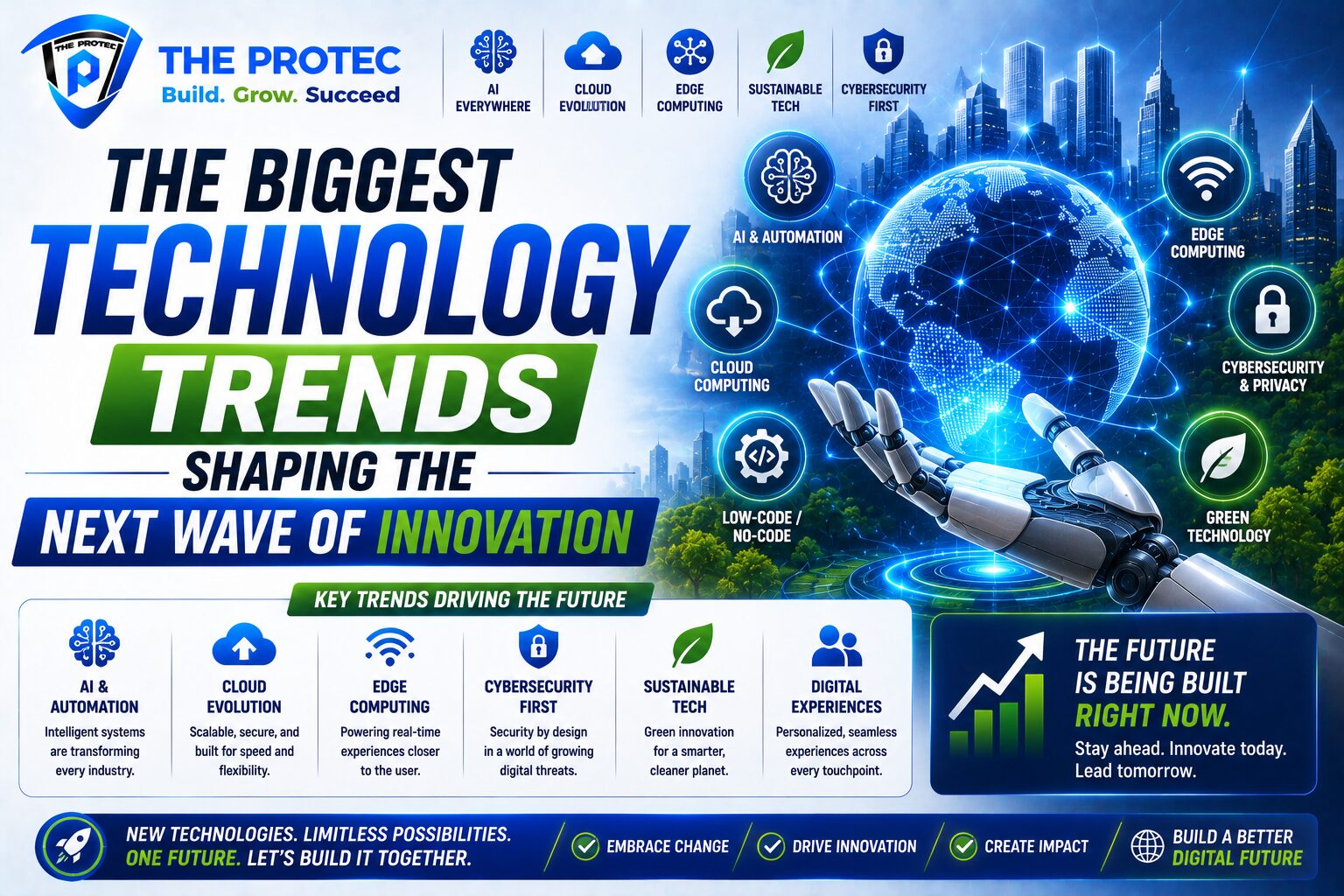
If you want to understand where business, infrastructure, and product strategy are heading, look at the convergence of AI, semiconductors, cybersecurity, and computing architecture. These forces are no longer separate conversations. They are becoming one system, and that system will define the most important technology trends 2027 will be built around.
What makes this moment different is speed. AI is moving from experimentation to operational backbone. Chips are becoming strategic assets rather than commodity components. Security is shifting from perimeter defense to continuous verification. And computing itself is being redesigned to support huge models, real-time workloads, and edge intelligence. The result is a new era of future technology that will reward organizations able to adapt quickly.
For leaders tracking IT trends, the message is clear: the next wave will not be about one breakthrough. It will be about how multiple breakthroughs compound. The companies that win will be the ones that align architecture, talent, governance, and investment around this new reality.
1. AI moves from copilots to autonomous systems
Artificial intelligence has already reshaped software development, customer support, analytics, and content operations. The next phase is more ambitious. Instead of AI acting only as an assistant, organizations will increasingly deploy AI agents that can complete multi-step tasks with limited supervision. This includes procurement workflows, IT service management, sales operations, and security triage.
This shift matters because it changes how value is created. A copilot helps a human do work faster. An agent can initiate, sequence, and complete work across systems. That means AI will become embedded deeper into enterprise processes, not just layered on top of them.
What to expect
- Agentic workflows that connect CRM, ERP, ticketing, and collaboration tools
- Industry-specific models trained on enterprise data and domain rules
- Multimodal systems that combine text, images, voice, and video
- Greater demand for model governance, auditability, and human approval checkpoints
OpenAI, Anthropic, Google, Microsoft, and major cloud providers continue to push the ecosystem toward more capable and more accessible AI systems. But the real story is not which model is largest. The real story is which organizations can operationalize AI safely and profitably.
As AI becomes more autonomous, businesses will need clearer rules for data access, model output validation, and exception handling. Those guardrails will separate useful deployments from expensive experiments.
2. Chips become the new strategic battleground
If AI is the engine, chips are the fuel system. Semiconductors are now central to national policy, cloud strategy, and product roadmaps. Every major AI advance depends on access to faster, more efficient hardware, and that has made chip design one of the most important future technology arenas.
The market is moving in several directions at once. GPU demand remains high, but specialized accelerators, advanced packaging, and custom silicon are gaining ground. Companies want more performance per watt, lower latency, and better cost efficiency. That pressure is reshaping the entire stack from data center architecture to device design.
What to expect
- More custom silicon from hyperscalers and large enterprises
- Growth in chiplets and advanced packaging to improve performance density
- Continued investment in high-bandwidth memory and interconnect technologies
- Greater emphasis on energy efficiency as AI workloads scale
This trend is not limited to the data center. AI PCs, smart edge devices, industrial sensors, and automotive systems all need specialized chips to handle local inference and real-time decision-making. That means the next wave of computing will be distributed, with intelligence running closer to the user and the machine.
For a useful overview of the semiconductor ecosystem, the Semiconductor Industry Association offers helpful market and policy context.
3. Security shifts from perimeter defense to continuous trust
Security is one of the most urgent IT trends because AI is changing both sides of the threat equation. Defenders now have better detection and automation tools, but attackers also have more powerful capabilities for phishing, malware generation, social engineering, and identity abuse. That makes traditional security assumptions harder to trust.
The most important shift is the move toward continuous verification. In modern environments, users, devices, applications, and workloads cannot be assumed safe simply because they are inside a network. Every request, every session, and every transaction must be evaluated in context.
What to expect
- Zero trust architectures becoming more practical and more common
- Identity-first security replacing network-first thinking
- AI-driven threat detection and response at machine speed
- Stronger emphasis on software supply chain security and code integrity
- Passkeys and phishing-resistant authentication expanding across consumer and enterprise systems
Security teams will also need to prepare for a new category of risk: AI system abuse. That includes prompt injection, data leakage through model inputs, model poisoning, and unauthorized tool use by autonomous agents. In other words, securing AI will become just as important as using AI.
Organizations that invest in identity, observability, and policy automation will be better positioned to respond. Security will no longer be a separate layer at the end of development. It will be designed into systems from the start.
For practical guidance on modern security frameworks, NIST Cybersecurity remains a strong reference point.
4. Computing becomes more distributed and more specialized
The future of computing is not one giant cloud or one powerful device. It is a layered model that blends cloud, edge, local, and specialized infrastructure. This evolution is being driven by AI inference, low-latency applications, data sovereignty requirements, and the need to reduce cost.
As workloads become more diverse, general-purpose computing will give way to more specialized systems. Some applications will still thrive in massive centralized data centers. Others will move closer to the user, the machine, or the factory floor. This distributed model will create more resilient and efficient technology stacks.
What to expect
- Edge computing expansion in retail, manufacturing, logistics, and healthcare
- AI PCs and local inference features that reduce cloud dependency
- Serverless and container platforms optimized for bursty intelligent workloads
- Greater use of memory-centric architectures for real-time processing
This change will also reshape software design. Developers will need to think in terms of latency, placement, and workload economics, not just functionality. A workload that is cheap in the cloud may be too slow for real-time interaction, while a local workload may be too expensive to run at scale without optimization.
In practical terms, future technology will be defined by the ability to place the right compute in the right place at the right time.
5. Data architecture gets rebuilt for AI and automation
AI is only as useful as the data feeding it. That simple truth is forcing organizations to rethink their data architecture. In the past, many companies focused on collecting data into warehouses or lakes and then analyzing it later. The next phase is more dynamic. Data must be usable in real time, governed consistently, and accessible across AI systems, automation engines, and analytics tools.
This means more organizations will invest in semantic layers, metadata management, vector databases, and data pipelines that support both structured and unstructured information. It also means data quality will become a competitive advantage rather than an afterthought.
What to expect
- Unified data platforms that serve analytics, AI, and operations together
- More investment in data lineage, cataloging, and governance
- Vector search and retrieval systems becoming standard parts of enterprise stacks
- Rising demand for real-time data pipelines and event-driven architecture
Teams that can connect clean data to practical AI use cases will move faster. Teams that cannot will spend more time cleaning up fragmented systems and less time creating value.
6. Software development becomes AI-assisted by default
One of the fastest-moving technology trends 2027 will be the transformation of software engineering itself. AI tools already help developers write code, generate tests, summarize bugs, and navigate large codebases. Over the next few years, these capabilities will become standard rather than optional.
That does not mean developers disappear. It means the role changes. Engineers will spend less time on repetitive scaffolding and more time on architecture, review, integration, and reliability. The highest-performing teams will use AI to accelerate delivery while keeping human judgment in control of design and quality.
What to expect
- AI coding assistants embedded directly into IDEs and CI/CD workflows
- Automated test generation and bug triage
- Natural language interfaces for internal tools and developer platforms
- More focus on code review, security scanning, and governance
There is also a broader implication for organizations: software creation will become more accessible. Smaller teams will be able to build and ship more ambitious products. That could intensify competition across nearly every digital category.
7. Regulation and governance become part of the tech stack
As AI, chips, and security become strategic issues, governance will become a design requirement. Companies can no longer treat compliance as a final review step. They need systems that can explain decisions, protect data, document model behavior, and prove control.
This is especially important for regulated sectors such as finance, healthcare, education, and critical infrastructure. But even consumer-facing businesses will face pressure from customers, partners, and regulators to demonstrate responsible use of AI and strong privacy practices.
What to expect
- More formal AI policies for procurement, deployment, and monitoring
- Documentation standards for model training data and output behavior
- Privacy-by-design and security-by-design becoming baseline expectations
- Governance tools built into cloud and SaaS platforms
Responsible adoption will become a market differentiator. Companies that can show how they manage risk will be easier to trust, easier to buy from, and easier to scale with.
What these technology trends mean for business leaders
These shifts are interconnected. AI creates demand for new chips. New chips unlock more capable AI. More capable AI increases the attack surface, which raises the importance of security. Security and compliance then shape how computing platforms are designed and where workloads run. That loop is why the next few years will feel less like a series of isolated innovations and more like a complete restructuring of digital infrastructure.
For leaders, the strategic takeaway is straightforward:
- Invest in AI where it solves real workflow bottlenecks
- Plan for a more distributed and specialized computing model
- Redesign security around identity, verification, and AI risk
- Modernize data architecture so it can support automation and intelligent systems
- Build governance into product and platform decisions from the beginning
Organizations that treat these as separate initiatives will move slowly. Organizations that treat them as one transformation will move faster and with more confidence.
Looking ahead
The biggest future technology story is not about a single device or app. It is about a new operating model for digital business. AI will handle more work. Chips will determine who can scale. Security will define trust. Computing will become more adaptive, local, and specialized. Together, these forces will shape the technology trends 2027 will be known for.
The companies that thrive will not necessarily be the ones that adopt every tool first. They will be the ones that understand the system beneath the tools. That means seeing how AI, hardware, data, and trust fit together. In the years ahead, that systems-level thinking will be one of the most valuable competitive advantages in business.
FAQ
What are the most important technology trends shaping the future?
The most important trends include AI agents, advanced chips, zero trust security, distributed computing, and modern data architecture. These areas are increasingly interconnected and will influence how systems are built and operated.
Why are chips such a big part of future technology?
Chips power AI training, AI inference, cloud infrastructure, edge devices, and local computing. As workloads become more demanding, specialized and efficient silicon is becoming essential for performance and cost control.
How will AI change IT trends in the next few years?
AI will automate more workflows, support developers, improve decision-making, and reshape security operations. It will also create new governance and risk-management needs across the enterprise.
What should businesses do now to prepare for technology trends 2027?
Businesses should modernize data systems, invest in security and identity controls, test AI in high-value workflows, and evaluate whether their infrastructure can support distributed computing and custom workloads.