








Apple A20 Pro Architecture Explained: What Makes Apple’s Next Chip So Fast?
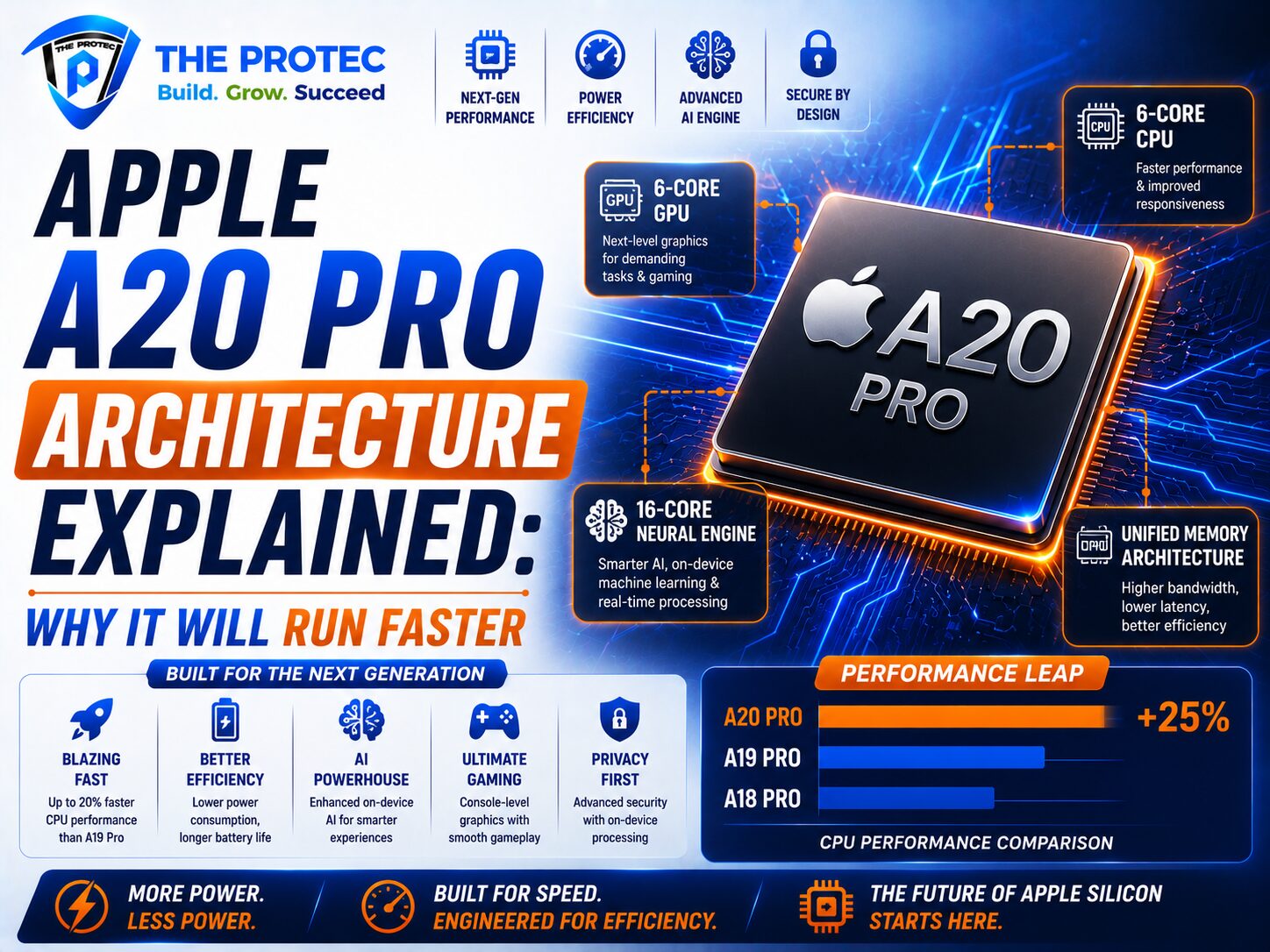
Apple’s next major silicon leap is expected to push the boundaries of performance, efficiency, and on-device intelligence once again. The Apple A20 Pro architecture is drawing attention because it represents more than a routine refresh. It sits at the intersection of advanced manufacturing, tighter integration, and a software stack that has been tuned for years to extract maximum value from custom silicon. In practical terms, the A20 Pro chip is likely to be fast not because of one breakthrough, but because of a carefully balanced system of improvements across the CPU, GPU, Neural Engine, memory subsystem, and power management.
If you want Apple silicon explained in a way that actually helps you understand real-world performance, the key is to think like a systems engineer. Apple does not win by chasing raw clock speed alone. It wins by reducing latency, increasing bandwidth, improving cache efficiency, and making each block of silicon communicate more intelligently with the others. That is why every new generation can feel dramatically faster even when the headline specs look modest on paper.
This article breaks down the most important architectural ideas behind the A20 Pro, how they may translate into everyday speed, and why Apple’s approach to chip design continues to define the premium mobile computing category.
What the Apple A20 Pro Architecture Is Built to Improve
The A20 Pro chip is expected to continue Apple’s long-term strategy: increase performance per watt while expanding the amount of work the device can do locally. That means better sustained speed under load, less thermal throttling, and stronger support for AI tasks that run directly on the device instead of in the cloud.
Apple’s chip road map has consistently focused on four pillars:
- Higher compute density through smaller process technology and smarter core layout
- Better memory efficiency to feed CPU and GPU blocks without bottlenecks
- More capable neural processing for generative AI, image analysis, and language tasks
- Improved power management so peak speed lasts longer in real use
That is the lens through which the Apple A20 Pro architecture should be viewed. The speed advantage is not a single component story; it is an architecture story.
Why Apple’s Process Advantage Matters So Much
One of the biggest reasons Apple silicon remains so fast is its access to advanced fabrication. Smaller process nodes allow more transistors in the same area, lower leakage, and improved energy efficiency. While raw node names are often marketed aggressively across the industry, the practical impact is simple: a newer process can help Apple pack more cache, more compute, and more accelerators into a chip without increasing heat dramatically.
For the A20 Pro chip, that means Apple can push more capability into a compact design while preserving the battery life users expect. In mobile devices, performance is constrained by thermals before it is constrained by theory. A chip that can maintain boost behavior for longer will feel faster than a chip that briefly spikes and then slows down.
Apple also tends to pair process improvements with aggressive custom layout optimizations. That matters because even on the same manufacturing node, a company can achieve very different results depending on how efficiently it uses the silicon footprint.
CPU Design: Big Cores, Efficient Cores, and Smarter Scheduling
At the center of the Apple A20 Pro architecture is the CPU complex. Apple’s CPU strategy has long relied on a hybrid design with performance cores and efficiency cores. This lets the chip reserve the most powerful resources for demanding work while keeping background tasks on low-power cores.
What makes Apple’s implementation special is not simply that it uses two types of cores. It is how deeply the operating system, firmware, and silicon are coordinated. The chip can move work between cores with remarkable responsiveness, which reduces wasted energy and improves the perceived speed of the entire device.
For the A20 Pro chip, expect three likely CPU-related advances:
- Higher IPC — more instructions completed per cycle, which improves real performance even without huge clock increases
- Better sustained boost — the chip should maintain top speeds longer under heavy workloads
- Refined task migration — less overhead when the OS moves work between performance and efficiency cores
In everyday use, this could show up as faster app launches, snappier multitasking, more fluid photo editing, and less slowdown during long sessions of gaming or video export.
GPU Upgrades: Why Graphics Performance Keeps Getting Better
Apple’s graphics architecture has become increasingly important as mobile devices take on workloads that once belonged to laptops. Games, 3D visualization, real-time effects, and high-resolution media editing all lean heavily on the GPU. The A20 Pro chip will likely continue Apple’s push toward more efficient parallel compute and better integration with modern graphics pipelines.
The most important GPU trends to watch in the Apple A20 Pro architecture include:
- More shader throughput for demanding visuals and games
- Improved ray-tracing efficiency for realistic lighting and reflections
- Better memory access patterns to keep the GPU fed with data
- Enhanced thermal behavior to sustain frame rates over time
Apple’s graphics stack is also tightly optimized with Metal, which means app developers can tap into hardware features more directly than on platforms with broader but less specialized abstraction layers. That software-hardware alignment is a major reason Apple silicon often feels exceptionally smooth, even when benchmark numbers do not fully capture the experience.
Neural Engine and On-Device AI: The Quiet Performance Multiplier
In the current era of personal computing, AI acceleration is one of the most important parts of chip design. Apple has steadily expanded its Neural Engine capabilities to support local machine learning, image recognition, speech processing, and increasingly complex generative workloads. The A20 Pro chip is expected to deepen that trend.
This matters because many AI features do not need to live in the cloud. Running them on-device reduces latency, improves privacy, and lowers dependence on network connectivity. It also allows the system to deliver a more immediate, responsive experience.
Apple silicon explained through the lens of AI is straightforward: the Neural Engine handles machine learning workloads efficiently, leaving the CPU and GPU free for other tasks. When the architecture is well-balanced, the entire phone feels faster because multiple subsystems are working in parallel instead of competing for resources.
Potential AI-related gains from the Apple A20 Pro architecture include:
- Faster photo and video enhancement
- Improved live transcription and language processing
- Smarter contextual suggestions
- Lower power consumption for always-on intelligent features
For users, the result is not just better benchmark scores. It is a device that responds faster in the moments that matter most.
Memory Architecture: Bandwidth Is the Hidden Speed Factor
Many people think chip speed comes mainly from CPU frequency or GPU size, but memory architecture is often the real bottleneck. A powerful core is useless if it keeps waiting for data. That is why memory bandwidth and latency are central to understanding the A20 Pro chip.
Apple has historically benefited from unified memory architecture, which lets different compute blocks access shared memory more efficiently. This approach reduces copying, improves coordination, and can accelerate workflows that move data between CPU, GPU, and neural accelerators.
What to expect from the A20 Pro chip:
- Higher memory bandwidth to support graphics, AI, and multitasking
- Lower latency for faster response times
- Smarter cache hierarchy to reduce unnecessary memory trips
- Better data sharing across compute engines
These improvements matter most in heavy workloads, but they also improve day-to-day interactions. Opening large apps, switching between camera modes, and editing high-resolution media all benefit from a memory system that keeps pace with the chip’s compute engines.
Cache, Interconnects, and Internal Efficiency
Another reason the Apple A20 Pro architecture may feel unusually fast is the invisible work happening inside the chip. Cache and interconnect design are not glamorous topics, but they have enormous impact on performance. A larger or more efficient cache can reduce the need to fetch data from slower memory, while a faster internal fabric allows different blocks of the chip to communicate with less delay.
Apple has long invested in custom interconnect logic because it gives the company tighter control over latency and power usage. In a well-designed mobile SoC, the CPU, GPU, Neural Engine, image signal processor, media engine, and memory controller all need to operate like parts of one system. If they are synchronized well, the device feels instant. If not, users experience stutter, lag, or unnecessary battery drain.
In that sense, the A20 Pro chip may not need a dramatic leap in raw frequencies to outperform its predecessors. Better internal plumbing can produce a similar or even larger gain in real-world responsiveness.
Power Management: The Difference Between Peak Speed and Real Speed
Peak benchmark performance is not the same as real-world speed. A device can post a strong score and still feel inconsistent if it cannot sustain that performance. Apple’s strength has always been its ability to manage power intelligently, and the A20 Pro chip is likely to extend that advantage.
Modern smartphones are thermally limited. Even with a highly advanced chip, the system must balance heat, battery life, and user comfort. Apple’s approach combines silicon-level power gating, OS-level scheduling, and thermal-aware performance scaling. That means the chip can boost aggressively when needed, then dial back intelligently when the workload changes.
For users, this translates into:
- More stable gaming performance
- Less overheating during video recording
- Longer battery life under mixed use
- More predictable performance in creative apps
This is a major reason the Apple silicon explained story is so compelling: Apple does not just build fast chips. It builds chips that stay fast in the conditions users actually care about.
How the A20 Pro Chip Could Change Everyday Use
Architecture matters most when it changes the experience of using a device. The A20 Pro chip should improve several everyday tasks in visible ways. App launches may become more immediate, camera processing may feel nearly instantaneous, and large AI-powered features may execute locally without a noticeable pause.
For creators, the benefits could be even more pronounced. Faster exports, smoother timeline scrubbing, better real-time effects, and improved render stability all depend on the kind of balanced silicon Apple has been refining for years.
Gamers may also see better sustained frame rates and richer visual effects. Because Apple’s GPU stack and Metal optimization continue to mature, developers can build experiences that take advantage of the hardware more effectively than before.
The biggest takeaway is that speed is increasingly multidimensional. It is not just about opening one app quickly. It is about how fast the entire system responds when multiple demanding tasks happen at once.
Apple Silicon Explained: Why Apple’s Strategy Keeps Working
To understand why the A20 Pro chip matters, it helps to zoom out. Apple silicon works because Apple controls the full stack: hardware, operating system, frameworks, and many of the core apps. That tight integration lets Apple optimize for the kinds of workloads people actually use every day.
Instead of designing a general-purpose chip for everyone, Apple designs a highly tuned system for its own ecosystem. That creates advantages in scheduling, power management, media processing, and AI acceleration. It also means the company can build features that depend on specific hardware behaviors, knowing the software will be ready to use them.
This is the core of Apple silicon explained in plain language: the chip is fast because it is part of a larger machine that is designed to work together, not as isolated pieces.
What to Watch as More Details Emerge
As more information becomes available, the most important indicators of the A20 Pro architecture will likely be found in the details rather than the headline specs. Watch for improvements in sustained performance, memory bandwidth, neural processing throughput, and thermal efficiency.
Independent testing will be especially important. Synthetic benchmarks can reveal raw capability, but real-world tests will show whether the A20 Pro chip can deliver consistent results across gaming, AI tasks, video workflows, and multitasking. The best Apple chips tend to shine not because they dominate one metric, but because they perform well across many different scenarios.
For readers following the broader Apple silicon roadmap, the A20 Pro will be most interesting if it continues Apple’s pattern of making each layer of the system smarter, faster, and more efficient at the same time.
FAQ: Apple A20 Pro Architecture
What is the Apple A20 Pro architecture?
The Apple A20 Pro architecture refers to the expected internal design of Apple’s next high-end chip, including its CPU, GPU, Neural Engine, memory system, and power management strategy. It is built to improve speed, efficiency, and AI performance.
Why is the A20 Pro chip expected to be faster?
The A20 Pro chip is expected to be faster because of a combination of advanced manufacturing, improved core efficiency, higher memory bandwidth, better internal interconnects, and stronger on-device AI acceleration. The gains come from the full system design, not a single feature.
How does Apple silicon explained differ from traditional chip design?
Apple silicon explained simply means Apple designs the chip and the software together. Unlike many competitors, Apple can optimize the operating system, frameworks, and hardware as one platform, which often leads to better performance per watt and smoother real-world responsiveness.
Will the Apple A20 Pro architecture improve battery life too?
Yes, it likely will. Apple typically pairs performance gains with better efficiency, so the A20 Pro chip should aim to deliver longer battery life or at least maintain current endurance while providing more power.
Final Thoughts
The Apple A20 Pro architecture is likely to be fast because Apple continues to design silicon as a complete system rather than a collection of unrelated parts. The A20 Pro chip should benefit from better CPU efficiency, stronger graphics performance, more capable AI acceleration, improved memory bandwidth, and refined power management. That combination is what makes Apple silicon so effective in the real world.
For users, the payoff is simple: faster reactions, smoother multitasking, better sustained performance, and smarter on-device experiences. That is why the next generation of Apple silicon is so closely watched. Apple is not merely chasing specs. It is redefining what speed feels like on a mobile device.
As the broader AI and mobile computing landscape continues to evolve, the A20 Pro chip will be judged not just by benchmarks, but by how seamlessly it handles the demands of modern work, creativity, and intelligence at the edge.
For a broader look at Apple’s silicon strategy and design philosophy, see Apple Newsroom and AnandTech.